
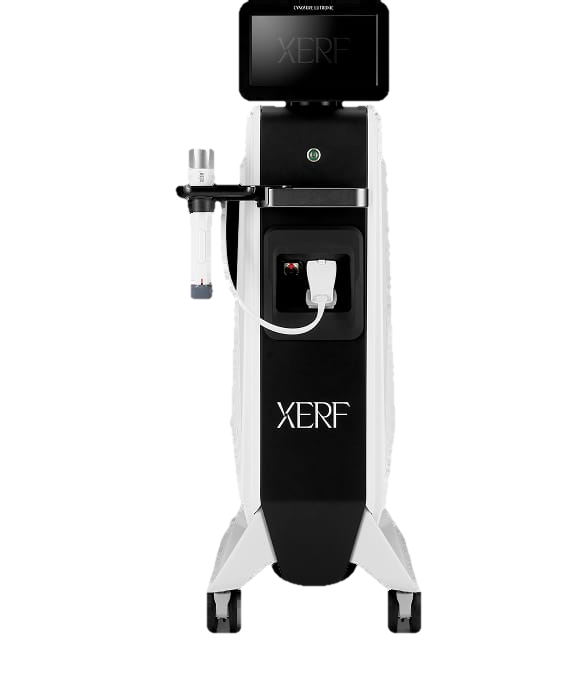
What Is XERF?
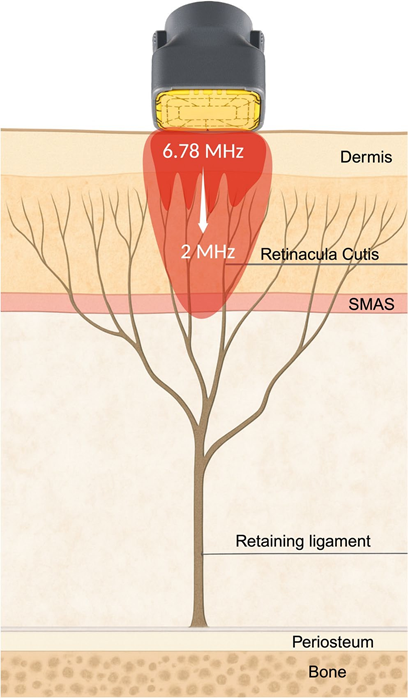
XERF is a non-invasive monopolar radiofrequency platform that can deliver dual-frequency energy using 6.78 MHz together with 2 MHz in deep treatment mode. This combination is designed to distribute thermal effects across different levels of the facial support system rather than concentrating treatment in only one superficial layer.
The frequency design is relevant to tissue depth: higher radiofrequency tends to concentrate energy more superficially in the dermis and collagen-rich fibrous structures, while lower frequency can penetrate more deeply. Using both frequencies allows treatment planning across several levels of facial support.
The Vertical Anchoring System : Why Tightening Is Not Just About the Dermis
Facial support can be understood as a collagen-rich vertical anchoring system that includes the dermis, retinacula cutis, superficial musculoaponeurotic system (SMAS) and retaining ligaments. With age, this interconnected network loses elasticity and support, contributing to sagging, altered fat-compartment organization and contour irregularities.
The immediate tightening effect of monopolar RF is attributed to collagen contraction, while longer-term improvement is linked to wound-healing responses, extracellular-matrix remodeling and tissue regeneration.
Who May Be a Good Candidate for XERF ?
XERF is most relevant to adults seeking non-surgical improvement in facial laxity, contour, brow or upper-eyelid support, and selected skin-quality concerns. Treatment planning should be individualized according to tissue thickness, facial volume, skin quality, previous procedures and the degree of laxity.
| Treatment planning factor | Practical consideration |
|---|---|
| Primary concern | Laxity, contour, brow/upper-eyelid support, wrinkles or skin quality |
| Facial volume | Thin faces need volume-preserving treatment; fuller faces may tolerate deeper contour-focused treatment |
| Skin condition | Active infection or inflammatory dermatosis should be assessed before treatment |
| Implanted devices | Pacemakers, defibrillators and other electronic implants require careful screening |
| Pregnancy / breastfeeding | Treatment is generally deferred |
| Medical history | Uncontrolled systemic disease or other significant risk factors require medical review |
| Previous procedures | Recent filler, surgery or energy-based treatment should be considered when planning timing |
| Expectation | Best suited to non-surgical tightening rather than surgical-level repositioning |
Who Requires Extra Caution or May Not Be Suitable ?
- Patients who have recently undergone facial aesthetic procedures should be assessed carefully so healing, tissue response and treatment sequencing are not compromised.
- Implanted electronic devices such as pacemakers or defibrillators.
- Active skin infection or inflammatory dermatosis in the treatment area.
- Pregnancy or breastfeeding.
- Uncontrolled systemic disease.
- Active malignancy in the treatment area.
- Any medical condition, medication or implanted device that could make radiofrequency treatment unsafe should be reviewed before treatment.
How XERF Treatment Can Be Planned by Facial Region
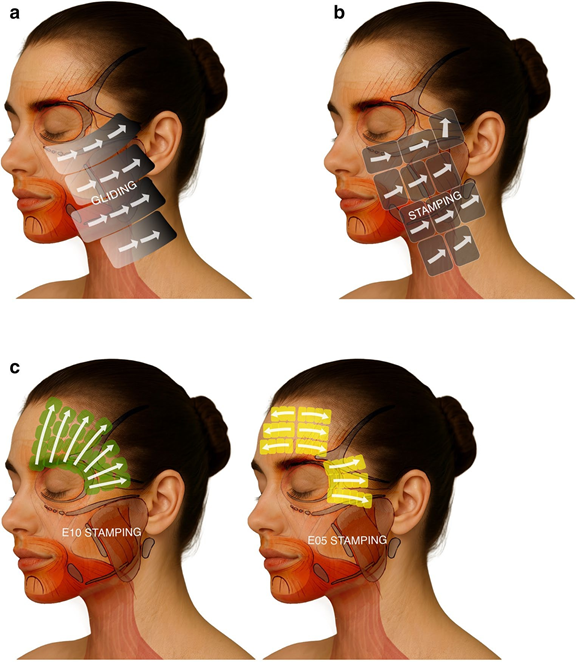
XERF treatment can be customized by facial region. Energy, applicator choice, shot density, treatment vectors, gliding versus stamping technique and cooling can all be adjusted according to tissue thickness, patient tolerance and the treatment objective.
| Facial region | Applicator example | Mode concept | Treatment density | Energy approach | Technique concept |
|---|---|---|---|---|---|
| Lower + middle face | E60 (20 x 30 mm) | Deep dual-frequency | Broad coverage | Adjusted to anatomy and tolerance | Gliding + stamping |
| Upper face | E10 (10 x 10 mm) | Deep | Targeted coverage | Adjusted to anatomy and tolerance | Vector-based stamping |
| Upper face / fine lines | E5 (10 x 5 mm) | Deep | Focused coverage | Adjusted to delicate anatomy | Targeted stamping |
Integrated cooling is used to improve comfort and protect the skin surface while energy is delivered to deeper tissues. Lower and middle face treatment can combine broad gliding and stamping passes, while smaller applicators are useful for the forehead, temporal and periorbital regions.
Built-In Temperature Monitoring
XERF incorporates real-time skin-surface temperature monitoring and treatment controls designed to reduce excessive heat accumulation. Temperature feedback is an important part of balancing effective thermal remodeling with skin-surface protection.
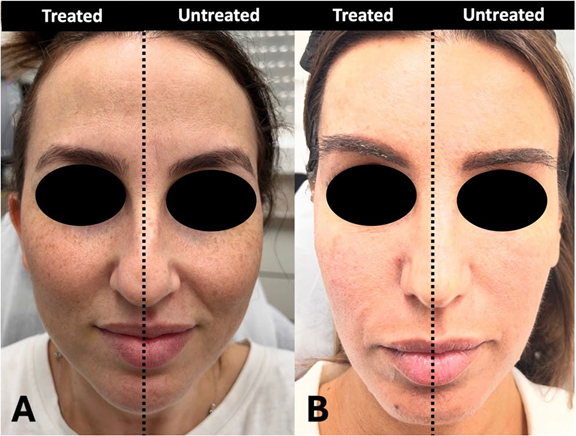
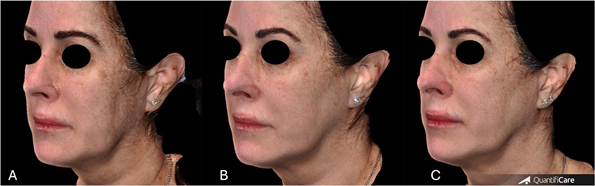
How Facial Contour Can Change After XERF
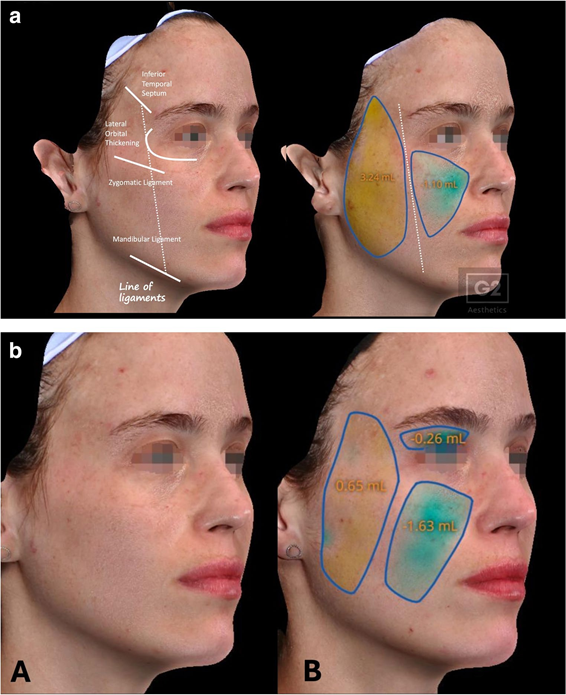
One useful way to understand facial tightening is to divide the face into medial and lateral compartments using the anatomical line of ligaments. This framework helps explain why a treatment can improve contour through tissue tightening and redistribution without simply adding volume.
XERF is a tightening treatment rather than a volumizing injectable. Changes in facial contour are therefore better understood as a combination of collagen contraction, soft-tissue remodeling and redistribution of the facial envelope rather than filler-like volume creation.
Immediate Tightening vs Progressive Remodeling
| Phase | Lateral face | Medial face | How to interpret it |
|---|---|---|---|
| Immediately after | Can appear firmer or slightly fuller from contraction / edema | Can look tighter centrally | Early appearance is not the final result |
| Following months | Edema settles and contour becomes more stable | Remodeling can improve support and transition | Judge stable contour, firmness and balance rather than same-day change |
The immediate post-treatment appearance can differ from the later result. Early tightening may reflect collagen contraction together with temporary tissue swelling, while the more meaningful contour change develops gradually as connective tissue remodels.
Does XERF melt facial fat ?
XERF is designed for controlled tightening and remodeling, not indiscriminate facial fat reduction. In thin or volume-deficient faces, treatment should be planned conservatively to preserve desirable facial volume.
Concerns about unwanted facial fat loss are especially important in naturally thin faces. XERF should be planned to tighten and support the face without unnecessarily reducing desirable facial volume. Depth, energy and treatment zones should therefore be selected according to anatomy rather than using one fixed full-face pattern.
Can XERF Create a Visible Lifting Effect ?
A visible lifting effect can come from thermal contraction and later remodeling of connective support structures. The goal is not to physically drag one fat pad to a new location, but to improve how the facial soft tissues are supported and how the contour is distributed across medial and lateral facial zones.
Contour improvement should therefore be described as tightening, support and repositioning of the facial envelope rather than as a guaranteed movement of a specific anatomical structure by a fixed distance.
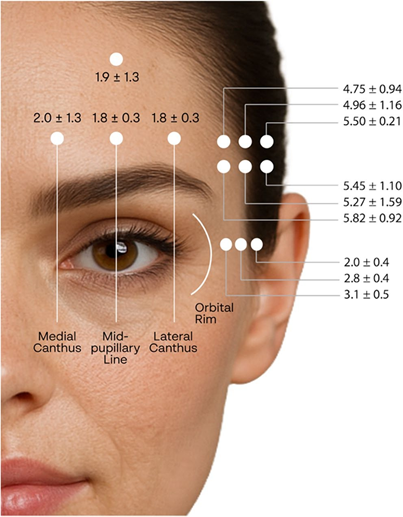
Eyebrow and Upper-Eyelid Treatment Goals
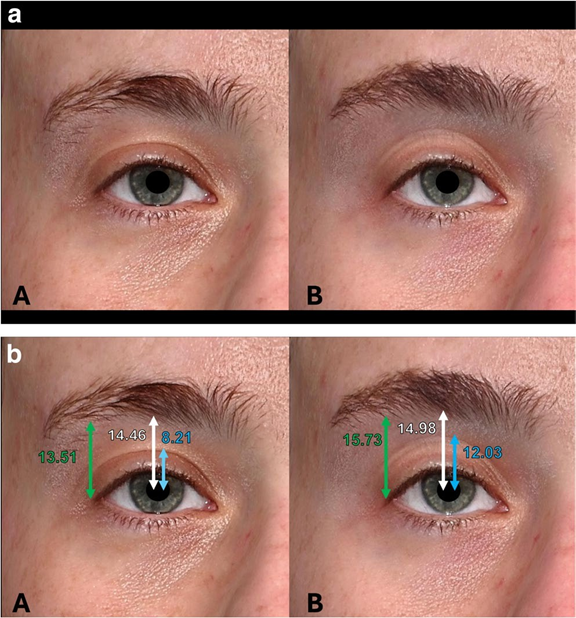
Periorbital treatment focuses on brow support, upper-eyelid skin quality and the transition between the forehead, lateral brow and orbital rim. Small applicators allow more precise treatment of curved and delicate facial anatomy.
| Periorbital concern | Primary treatment target | Applicator concept | Realistic goal | Important limitation |
|---|---|---|---|---|
| Brow support | Forehead / lateral brow support tissues | Small applicator | Subtle improvement in brow position | Not a surgical brow lift |
| Upper-eyelid laxity | Infra-brow and orbital-rim support | Small applicator | Firmer upper-eyelid contour | Does not remove significant excess skin |
| Fine lines | Superficial periorbital rhytids | Focused small-tip treatment | Smoother texture and fine lines | Dynamic lines may also need neuromodulator treatment |
What Kind of Brow / Eyelid Change Is Realistic ?
XERF is best positioned as a treatment for subtle support and tightening. The result varies with anatomy, skin thickness, muscle activity and baseline laxity; a fixed number of millimeters should not be promised.
Can XERF Improve Brow Position ?
XERF can be used to support the brow and upper-eyelid region when mild laxity is part of the problem. The expected change is typically subtle and should be judged with standardized photographs rather than dramatic claims of a surgical brow lift.
Not every patient will respond in the same way. Brow position, forehead anatomy, skin thickness, baseline laxity, muscle activity and treatment settings all influence the final result.
Skin Quality : Wrinkles, Evenness, Pores, Oiliness and Pigmentation
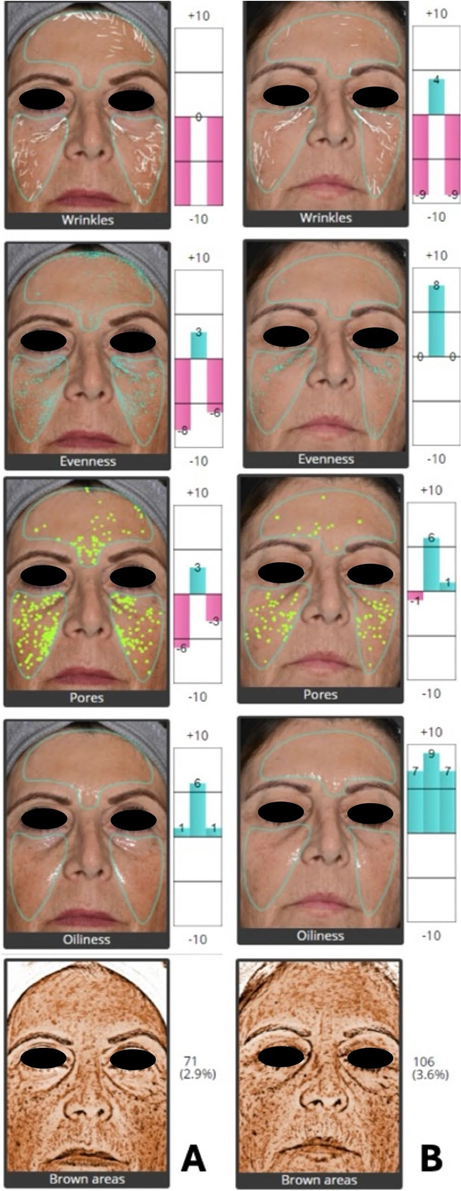
XERF treatment can also target skin-quality concerns such as wrinkles, evenness, pore appearance and oiliness. These changes are related to thermal remodeling of the dermis and may evolve progressively rather than appearing immediately.
| Skin-quality target | How XERF may help | When change is usually judged | What it does not replace |
|---|---|---|---|
| Wrinkles | Thermal remodeling can soften selected fine lines | Progressively over the following months | Neuromodulator for strongly dynamic lines |
| Evenness | Improved dermal quality can create a smoother surface | After early swelling has settled | Pigment-specific treatment |
| Pore appearance | Firmer surrounding skin can make pores look smaller | Progressively | A promise of pore elimination |
| Oiliness | Some patients notice improved overall skin balance | Over time | Medical treatment for acne / sebaceous disease |
| Pigmentation | Not the primary target of XERF | Assess separately | Melasma or brown-spot treatment |
Wrinkle and skin-quality improvement can develop gradually. Pore appearance, evenness and oiliness may also improve in selected patients, while pigmentation should be treated as a separate concern because RF is not primarily a pigment-targeted technology.
How Patients Commonly Judge a Good XERF Result
Objective imaging is useful, but aesthetic outcomes also depend on whether the patient sees a meaningful improvement in facial freshness, skin texture, contour and tightening. A good treatment plan therefore combines standardized photography with the patient’s own priorities and expectations.
| Outcome domain | What patients may notice | What to document | Important expectation |
|---|---|---|---|
| Tightening / lifting | Cleaner facial contour and better support | Standardized frontal + oblique photos | Subtle-to-moderate rather than surgical change |
| Skin quality | Smoother texture, finer lines, improved pore appearance | Consistent lighting and skin-analysis images when available | Results evolve gradually |
| Overall freshness | Face may look better supported and less tired | Patient-defined goals at baseline and follow-up | Avoid fixed promises about looking a certain number of years younger |
A Fresher, Better-Supported Appearance
Patients may describe the face as firmer, smoother or better supported after treatment. This is a subjective aesthetic endpoint and should not be converted into a promise about a specific number of years of age reduction.
Patient Satisfaction Depends on the Right Indication
Patient satisfaction is highest when the treatment is matched to mild-to-moderate laxity and realistic goals. XERF should be positioned as a non-surgical tightening treatment, not as a guaranteed substitute for filler or surgery.
Patients may notice improvements in skin texture, fine lines, pore appearance, tightening and lifting. The degree of change varies, so results should be described as individualized rather than graded by a fixed universal score.
Pain and Tolerability
Treatment sensation varies from warmth to moderate discomfort depending on the facial area, applicator, energy level, tissue thickness and individual sensitivity. Energy should be titrated to patient tolerance rather than treating severe pain as a required endpoint.
| Treatment sensation | Practical guidance |
|---|---|
| Mild warmth / pressure | Common and generally well tolerated |
| Moderate heat or discomfort | Energy can be adjusted according to anatomy and tolerance |
| Severe or disproportionate pain | Not a desired endpoint; treatment should be reassessed immediately |
Safety and Adverse Events
Temporary redness, warmth and mild swelling can occur after treatment. These reactions are usually short-lived, but any persistent pain, blistering, contour change or prolonged swelling should prompt clinical review.
Safety Priorities
Cooling, temperature monitoring, full tissue contact, correct applicator choice and individualized energy settings are central to safe treatment. Persistent pain, blistering, contour change or prolonged swelling should prompt medical review.
Does XERF Cause Facial Fat Loss ?
XERF is intended for controlled tightening and remodeling rather than indiscriminate facial fat reduction. In volume-sensitive areas, especially in thin faces, treatment should be planned conservatively to preserve desirable soft-tissue support.
This is why facial anatomy matters: the same device can be used differently in a full lower face and in a naturally thin face. Depth, energy and treatment zones should be individualized.
Why the Immediate Result Is Not the Final Result
Immediately after treatment, contour can look different because of collagen contraction and temporary edema. The early appearance should not be treated as the final result.
As swelling settles, longer-term remodeling becomes more important. Final assessment should focus on stable changes in contour, firmness, skin quality and facial balance rather than same-day appearance.
How Long Can XERF Results Continue to Evolve ?
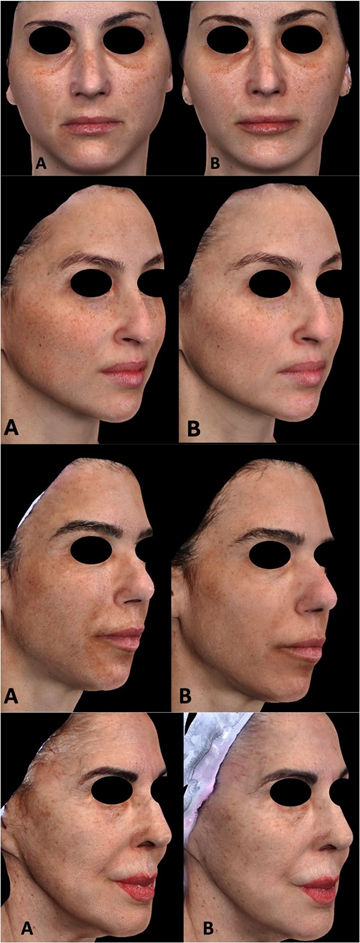
Collagen remodeling does not stop immediately after treatment. The appearance can continue to evolve over the following months as the treated tissues remodel and the early swelling component disappears.
Durability varies between patients and depends on age, baseline laxity, treatment intensity, lifestyle, ongoing aging and whether maintenance treatment is used. Long-term expectations should therefore be individualized.
Why XERF May Affect Multiple Tissue Layers
Sequential high- and lower-frequency delivery may provide complementary penetration characteristics. Integrated cooling and real-time temperature monitoring are designed to improve comfort and reduce excessive superficial heat accumulation during deeper treatment.
The visible result is likely produced by several overlapping effects, including collagen contraction, wound-healing responses and connective-tissue remodeling. No single tissue layer should be assumed to explain every visible change.
XERF vs Conventional Monopolar RF
Different monopolar RF platforms use different frequencies, applicators and energy profiles. XERF should be selected for its treatment capabilities and fit for the patient rather than marketed as automatically superior to every other RF system.
XERF uses a dual-frequency approach and multiple applicator sizes, while other monopolar RF platforms use different frequencies, energy profiles and treatment geometries. Device choice should be based on treatment goals, tissue depth, comfort and the clinician’s familiarity with the platform rather than assuming one system is universally superior.
XERF VS HIFU, RF Microneedling, Laser and Filler
XERF, HIFU, RF microneedling, laser resurfacing, injectable filler and surgery solve different problems. They should be compared by anatomical target and treatment goal rather than ranked as interchangeable versions of the same treatment.
| Concern | How XERF may help | What it does not replace |
|---|---|---|
| Facial laxity | Thermal tightening and connective-tissue remodeling | Surgical repositioning for advanced laxity |
| Brow / upper eyelid | Subtle support and skin tightening | Blepharoplasty or brow surgery when excess tissue is significant |
| Wrinkles / texture | Dermal remodeling and skin-quality improvement | Ablative / non-ablative resurfacing when resurfacing is the main goal |
| Volume loss | Can tighten the envelope around existing volume | Filler or fat restoration for true structural deficiency |
| Pigmentation | Not a primary treatment target | Melasma or pigment-specific therapy |
Who May Be a Reasonable Candidate ?
XERF is most relevant to patients seeking non-surgical improvement in facial laxity, contour, brow or upper-eyelid support and selected skin-quality concerns. Candidate selection should be based on anatomy rather than age alone.
A patient whose main concern is major excess skin, severe structural ptosis, true volume deficiency or pigmentation may require a different or combined treatment strategy.
XERF Skin Tightening in Abu Dhabi : What a Good Consultation Should Clarify
- Is my main concern laxity, volume loss, wrinkles, pigmentation, brow position or a combination ?
- Would a tightening treatment realistically achieve the degree of change I want ?
- Which XERF applicators and mode are being planned for my face ?
- Is the goal full-face tightening, lower-face contour improvement, periorbital treatment, or all of these ?
- How will baseline photographs or 3D imaging be standardized so that subtle change can be judged fairly ?
- How will the clinician avoid excessive heat and monitor skin response ?
- Do I have any implanted electronic device, active inflammatory skin condition or other contraindication ?
- What level of pain and downtime should I realistically expect ?
- If my main problem is true volume deficiency, will a tightening device alone be enough ?
- When should the result be judged: immediately, one month or three months ?
