
Jalupro SuperHydro is presented in the uploaded professional deck as a biorevitalizing injectable that combines an amino-acid cluster, three biomimetic peptides and 3.2% hyaluronic acid made from both low- and high-molecular-weight HA. The deck states a total HA concentration of 32 mg/mL in a 2.5 mL syringe, or 80 mg, and positions the product around hydration, extracellular-matrix support, collagen-related fibroblast activity and structural skin rejuvenation. The presentation also proposes advanced placement concepts around retaining ligaments and facial support structures. Those mechanism and protocol statements come from a brand training presentation rather than a controlled clinical trial, so they should be described as source claims and clinical concepts, not as independently proven outcome guarantees.
What Is Jalupro SuperHydro ?
Jalupro SuperHydro is positioned in the source as an evolution of the Jalupro biorevitalization concept. The presentation describes the formula as amino acids plus peptides plus a 3.2% blend of low- and high-molecular-weight hyaluronic acid.
The brand deck frames its role more broadly than simple hydration. It repeatedly links the product to extracellular-matrix revitalization, collagen-related fibroblast activity, retaining-ligament support and the connective-tissue framework associated with facial fat pads.
This positioning is important for patients because SuperHydro should not be described simply as a conventional volumizing dermal filler. The source presents it as a skin-structure and biorevitalization product whose intended effect is based on a combination of hydration and biologic support rather than focal projection alone.
The Formula : Amino Acids + Peptides + 3.2% LMW-HMW Hyaluronic Acid
The uploaded deck identifies three pillars of the formula: an enhanced amino-acid functional cluster, biomimetic peptides and a blend of low- and high-molecular-weight hyaluronic acid.
The amino-acid component is presented as substrate support for collagen and elastin-related biology. The peptide component is framed as a signaling layer intended to activate fibroblast and cellular processes. The HA component is positioned as the hydration and scaffold element.
Together, the deck markets this combination as a way to support a healthier extracellular environment rather than simply adding transient water or bulk.
The Amino-Acid Cluster
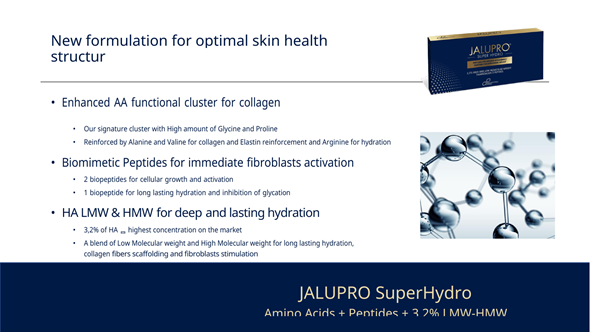
The presentation lists glycine, proline, lysine, leucine, alanine, valine and arginine in the enhanced amino-acid cluster.
Glycine is described in the deck as having antioxidant and anti-inflammatory activity and as reducing collagenase and hyaluronidase activity. Proline is linked to gene-expression regulation, cell proliferation, mTOR signaling and protein synthesis. Alanine is described as the third most abundant amino acid in collagen, valine as an essential amino acid, and arginine as supporting hydration and anti-ageing activity.
These statements are mechanistic or promotional claims from the source presentation. A patient-facing page should avoid turning them into precise clinical outcome promises unless they are supported by independent clinical data for the finished injectable product.
Why Glycine and Proline Receive Special Attention
Collagen is a protein, and the deck gives particular emphasis to glycine and proline because of their relationship to collagen structure and protein synthesis. The presentation describes the formulation as having a high amount of these amino acids.
From a communication perspective, this provides a plausible biologic rationale for an amino-acid replacement concept. It does not by itself establish how much new collagen will be produced in human facial skin after injection.
The strongest website wording is therefore that SuperHydro is formulated with amino acids relevant to collagen biology, rather than stating that a specific amount of collagen increase has been proven.
Biomimetic Peptides in the Source
The deck names three peptides: Acetyl Decapeptide-3, Oligopeptide-24 and Acetyl Tetrapeptide-5. The first two are positioned as growth-related peptides, while Acetyl Tetrapeptide-5 is positioned around hydration and anti-glycation.
Acetyl Decapeptide-3 is described by the source as supporting skin-cell generation, wound repair and collagen/elastin synthesis. Oligopeptide-24 is described as supporting cell growth, migration, survival, extracellular-matrix expression and scar-related remodeling. Acetyl Tetrapeptide-5 is described as a hygroscopic moisturizer and as inhibiting collagen glycation.
These are the deck’s mechanistic claims. Because the uploaded file is a product presentation rather than a peer-reviewed comparative clinical trial, they should be attributed to the manufacturer presentation when used publicly.
Hyaluronic Acid Architecture : 32 mg/mL, 2.5 mL, 80 mg Total
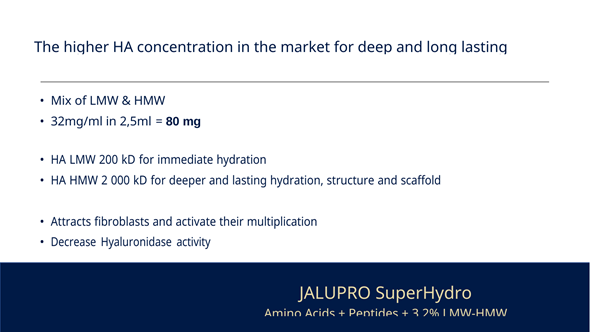
The source states that SuperHydro contains 32 mg/mL of hyaluronic acid in a 2.5 mL syringe, for a total of 80 mg of HA. It describes the formula as a mix of low-molecular-weight and high-molecular-weight HA.
The deck assigns approximately 200 kDa to the LMW fraction and approximately 2,000 kDa to the HMW fraction. LMW HA is positioned around immediate hydration, while HMW HA is described as providing deeper, longer-lasting hydration, structure and scaffold support.
The source additionally claims that this HA blend attracts fibroblasts, promotes their multiplication and decreases hyaluronidase activity. These mechanism claims should be treated as presentation-derived claims unless independently verified.
What Does “Extracellular Matrix Support” Mean in This Presentation ?
The extracellular matrix, or ECM, is the structural environment surrounding cells. The Jalupro deck repeatedly uses ECM revitalization as a central concept for SuperHydro.
The presentation links amino acids, peptides and hyaluronic acid to fibroblast activity, collagen fibers, hydration and tissue organization. It describes the intended effect as an “extra boost” for tired or devitalized skin that needs stronger cellular process activation.
For an evidence-led website, the distinction between biologic rationale and clinical proof matters. The deck supports the product concept and mechanism story, but it does not provide a randomized clinical efficacy table, histology series or validated patient-reported outcome dataset within the uploaded material.
Connective Tissue Is More Than the Dermis
A distinctive part of this presentation is its attempt to extend the biorevitalization concept beyond the superficial skin. The deck discusses retaining ligaments, retinacula cutis and connective tissue within fat-pad architecture.
The source states that facial retaining ligaments contain collagen and become looser with ageing as collagen degrades. It also illustrates a tree-like concept in which superficial dermis, retinacula cutis, SMAS, retaining ligaments and periosteum form a connected structural system.
This is a useful anatomy framework for understanding facial ageing. However, the claim that injecting SuperHydro regenerates retaining ligaments should be treated as a product-positioning hypothesis unless supported by direct clinical or histologic evidence.
The Fat-Pad Structure Claim
The presentation states that facial fat pads are composed of adipose cells and connective tissue and proposes that maintaining collagen health supports fat-pad structure.
This is biologically plausible as an anatomy concept, but the uploaded deck does not show imaging or histologic evidence demonstrating that SuperHydro restores fat-pad architecture in treated patients.
The Source Injection Map : 13 Points and 2.5 mL
The presentation proposes an “evolved protocol” designed around retaining-ligament and support structures. The mapped protocol shows six injection points per side plus one chin point.
The deck specifies 0.2 mL at six points per side and 0.1 mL at the chin, giving 13 injection points and a total of 2.5 mL. Named target concepts include orbital thickening, platysma-auricular fascia, masseteric cutaneous ligament, zygomatic ligament, upper masseteric cutaneous ligament/fat-pad region and the chin.
The same slide differentiates superficial deep-dermal placement from subcutaneous placement in the mid-cheek and says advanced users can work at bone level for the zygomatic ligament, mandibular ligament and chin. It also says to avoid the malar fat pad for the mid-cheek point and to aim at the nasolabial compartment.
Danger Zones and Why Training Matters
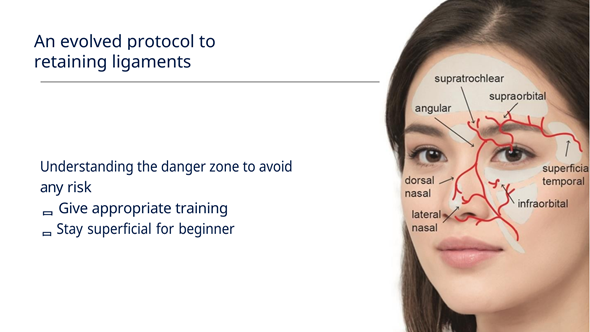
The presentation includes a dedicated facial danger-zone slide showing the supratrochlear, supraorbital, angular, dorsal nasal, lateral nasal, infraorbital and superficial temporal vascular territories.
The slide explicitly states that understanding danger zones is necessary to avoid risk, that appropriate training is required and that beginners should stay superficial.
That is a critical safety message. Even when a product is described as a skin biorevitalizer rather than a traditional filler, needle and cannula injections still occur in vascular anatomy and should be approached with the same respect for facial vessels.
Cannula Protocol for Classic Face Rejuvenation
The presentation also provides a cannula-based option for classic facial rejuvenation in tired skin. It specifies a 23G cannula and states that the intent is to stay at dermal level; forehead points are described as optional.
This reflects the brand deck’s attempt to provide flexibility between fixed-point and cannula-based delivery. It should not be generalized to all facial areas or all clinicians without specific training.
Treatment Scheduling in the Presentation
The source offers several schematic treatment pathways rather than one universal schedule. A stand-alone ligament-focused treatment is illustrated with a one-month interval followed by a later maintenance interval shown as five months.
The deck also presents a combination pathway with HIFU and another interval schematic showing one month followed by three-month spacing. Because the visual labels are abbreviated, the exact sequencing should be interpreted from official product training rather than reconstructed from the slide alone.
Another pathway combines Jalupro HMW with SuperHydro. The deck states “3 X + 3 injections HMW 2 weeks interval” and then finishing with SuperHydro for longer-lasting benefit and additional structure. The syntax is ambiguous in the source, so a public page should not turn it into a definitive regimen without clarification.
Source Ambiguity NoteSeveral interval diagrams are visually abbreviated. Where the presentation does not clearly define the exact sequence, this guide preserves the concept but does not invent a dosing schedule.
Where SuperHydro Fits Within the Jalupro Family
The final section of the deck positions the Jalupro range by treatment goal and anatomic area rather than as interchangeable syringes.
Jalupro Classic is presented as an amino-acid cluster with low-molecular-weight HA, with uses across body, eye area, neck and décolleté and combination protocols. Jalupro HMW is presented as an amino-acid cluster with high-molecular-weight HA for stand-alone facial biorevitalization, lip rejuvenation, neck, décolleté and hands.
SuperHydro is described as the enhanced amino-acid cluster plus peptides plus both LMW and HMW HA, with the deck assigning it to “ligament biorestoration” and severe dehydration / tired skin. Another slide simplifies the algorithm as: ligaments → SuperHydro, eye area → Classic or Young Eye, midface → HMW.
Jalupro SuperHydro vs a Conventional Skin Booster
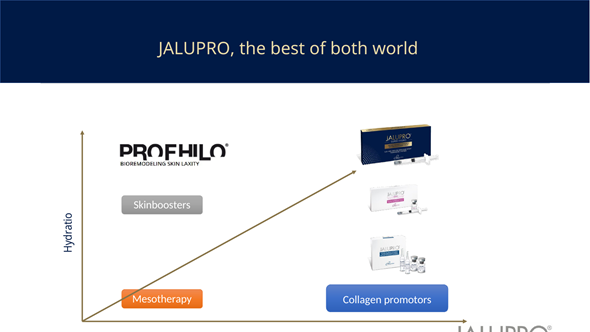
The deck deliberately places Jalupro between hydration-focused skinboosters and collagen-promoting treatments. On its final positioning chart, the vertical axis represents hydration and the horizontal axis represents collagen stimulation / skin structure.
This is a brand-positioning model rather than head-to-head clinical evidence. It is still useful for patient education: the product is intended to offer more than water-binding alone, but it is not presented as a classic high-projection volumizing filler.
The safest explanation is that SuperHydro combines a relatively high HA load with amino acids and peptides and is marketed for both hydration and tissue-support biology.
Is Jalupro SuperHydro a Dermal Filler ?
The presentation does not position SuperHydro as a conventional volumizing dermal filler. Its language centers on biorevitalization, extracellular-matrix support, collagen stimulation, hydration and structural tissue quality.
That does not mean the HA component has no immediate tissue effect, but the source’s treatment philosophy is different from using a cross-linked filler to create a defined projection in the cheek, chin or jawline.
Patients who primarily need skeletal projection or major volume replacement may therefore require a different injectable category or a combined plan.
Who May Be a Reasonable Candidate ?
Based on the source positioning, a consultation may be relevant for adults concerned with tired, dehydrated or devitalized skin, early structural skin-quality changes or a desire for biorevitalization without the primary goal of large-volume augmentation.
The deck also frames SuperHydro as a more structural option within the Jalupro family, particularly when connective-tissue support and ligament-oriented treatment are being considered.
Actual candidacy cannot be determined from the deck alone. Medical history, facial anatomy, skin thickness, vascular risk, prior procedures and the dominant aesthetic concern must be assessed clinically.
Jalupro SuperHydro in Abu Dhabi with Dr. Erfan Rahmani
For patients researching Jalupro SuperHydro in Abu Dhabi, the most important step is deciding whether the main goal is hydration, skin-quality improvement, early structural support, focal volume replacement or treatment of another ageing component.
Dr. Erfan Rahmani can assess facial anatomy, tissue laxity, hydration, volume distribution, previous injectables and the relationship between skin quality and deeper structural ageing before deciding whether Jalupro SuperHydro, another Jalupro formulation, a polynucleotide, a collagen stimulator, filler or an energy-based treatment is more appropriate.
More information : www.drerfanrahmani.com