
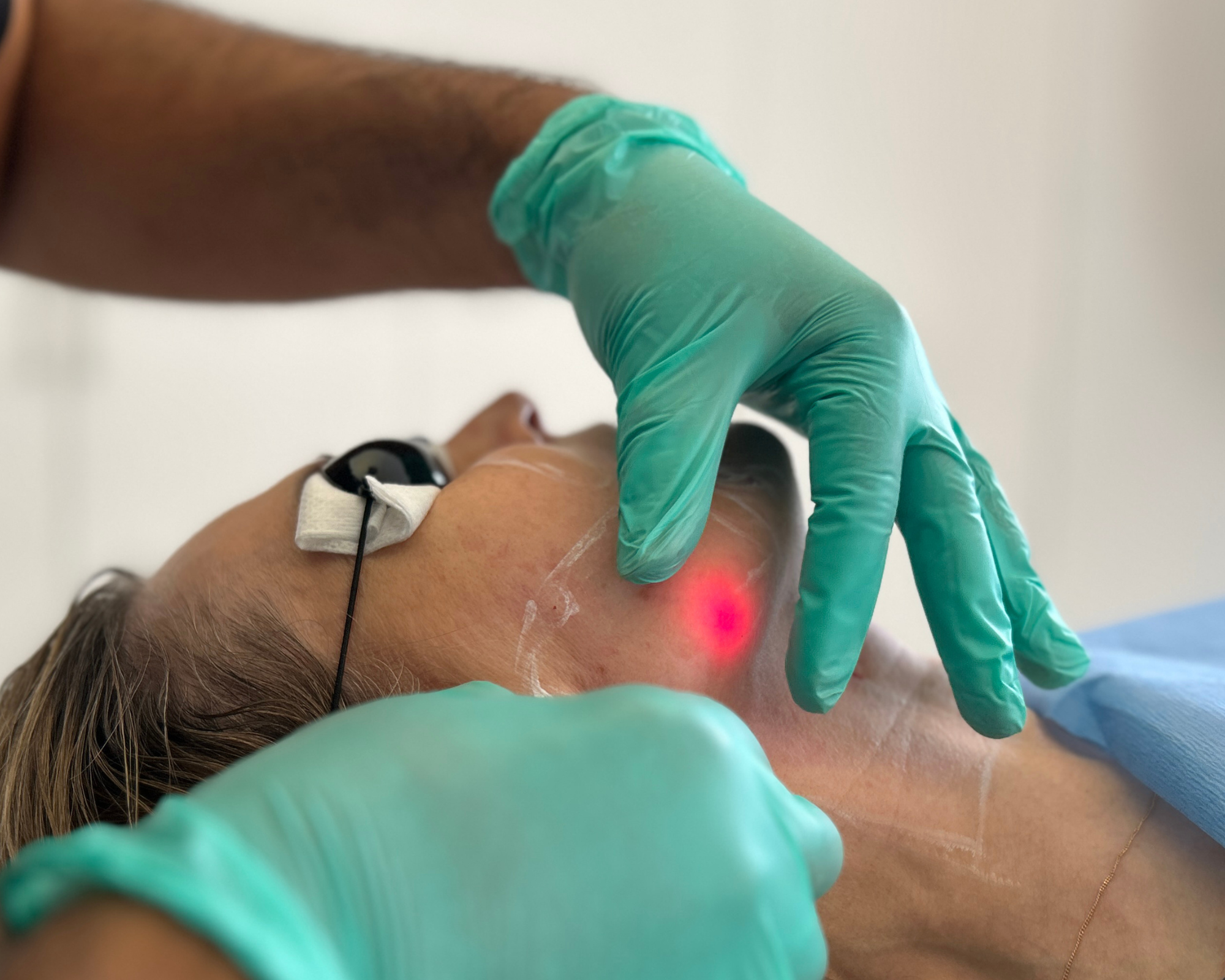
Why Double Chin Treatment Is More Than Fat Removal
Submental fullness – commonly called a double chin – can alter facial proportions, reduce mandibular definition and make the lower face appear heavier. The source frames this concern as one that can affect facial harmony, self-image and self-esteem, which helps explain why patients often seek less invasive alternatives to traditional liposuction.
Importantly, a poorly defined jawline is not always caused by fat alone. Skin laxity, chin projection, lower-face descent, platysmal anatomy and the distribution of facial fat can all influence the contour. The 2023 case report focused on localized submental fat and jowl-related contour, so its findings should not be generalized to every cause of lower-face heaviness.
What Is Endolifting® With a 1470 nm Diode Laser ?
The paper describes Endolifting® – also referred to in the literature as endolaser or Endolift – as a subdermal laser technique in which 1470 nm energy is delivered through a thin optical fiber inserted beneath the skin. The stated goals are reduction of subcutaneous fat together with tissue tightening through collagen-related remodeling.
Unlike a surface laser that acts primarily from the epidermis downward, the technique places the energy source directly within the treatment plane. This is why fiber diameter, treatment plane, power, movement, tissue resistance and anatomy become central parts of the procedure rather than minor technical details.
Why 1470 nm?
The authors discuss 1470 nm as a wavelength used for laser-assisted lipolysis and soft-tissue remodeling. Their discussion describes conversion of laser light into thermal energy within tissue, with heat delivered through a flexible optical fiber to adipocytes and surrounding connective tissue.
The paper links the wavelength to lipolysis, vessel coagulation, connective-tissue remodeling and neocollagenesis. It also notes that treatment effects depend not only on wavelength and power but also on the optical and mechanical properties of the tissue. That point is clinically important: the same numerical setting should not be assumed to behave identically in every patient or every anatomic zone.
Mechanism vs MarketingThe source describes a biologically plausible combination of lipolysis and tissue tightening, but a single case cannot prove how much of the visible result came from fat reduction, tissue contraction, edema resolution, collagen remodeling, or a combination of these mechanisms.
The Case Patient
The report involved a 45-year-old female patient with prominent jowls and aesthetic dissatisfaction. She underwent medical history review, physical examination and standardized photography. Informed consent was documented before treatment.
The authors present this case as an example of a patient seeking improvement in lower-face and submental contour without a traditional surgical approach. The study does not provide a formal grading scale for the amount of fat, the degree of skin laxity, BMI, or detailed skeletal assessment, which limits how precisely another patient can be compared with the reported case.
Source-Specific Treatment Protocol
The case report gives useful technical detail. These numbers are preserved here because the user requested a complete evidence-based article, but they belong to this specific case and device and should not be copied as a universal protocol.
| Protocol element | What the source reports |
|---|---|
| Laser platform | DELIGHT 1470, VYDENCE Medical |
| Wavelength | 1470 nm diode laser |
| Session count | One treatment session |
| Treatment area | Mandibular and submental regions |
| Optical fiber | 400 µm |
| Power | 4-8 W |
| Emission mode | Continuous |
| Setting | Outpatient procedure at Hospital Blanc, São Paulo, Brazil |
| Anaesthesia | Local anesthesia |
| Pre-procedure medication | The source reports one sublingual Toragesic tablet |
| Post-procedure compression | Bandage for 4 days |
| Adjunct aftercare | Four weekly manual lymphatic-drainage sessions |
What Was the Treatment Intended to Do ?
The 1470 nm laser was directed toward the localized submental fat. According to the source, the Endolifting® technique was used not only to promote lipolysis but also to provide additional structural support to skin and underlying tissues, with the goal of reducing sagging.
This combined objective is one reason Endolift is often discussed differently from treatments that target only fat. In selected patients, the desired aesthetic change may require both a reduction in fullness and a tighter soft-tissue envelope. In other patients, however, aggressive fat reduction could be undesirable if facial volume is already limited.
Before-and-After Photography : 60 and 180 Days
One of the strongest features of this case report is that the paper includes serial clinical photographs rather than only an immediate result. The figure captions show frontal, right-profile and left-profile views before treatment and at 60 and 180 days.

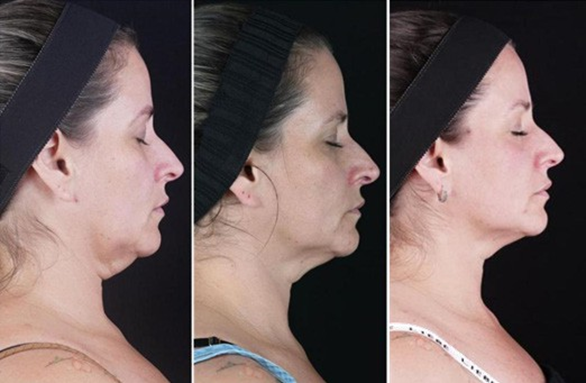

The images visually document a change in lower-face and submental contour over time. However, a single patient image series cannot determine an average response, and photographic interpretation can also be influenced by head position, neck extension, lighting, expression and weight stability. The source does not provide a blinded photographic grading score.
A Timeline Inconsistency Inside the Source
The text states that the patient returned at 30 days for follow-up, clinical evaluation and photographic monitoring. The figure captions, however, label follow-up photographs at 60 and 180 days. The source therefore contains an internal timeline inconsistency. A faithful evidence summary should not silently choose one version.
What Results Did the Authors Report ?
The authors report a visible reduction in submental fat and improvement in the facial profile. They describe the contour as more balanced and rejuvenated after treatment. The patient also reported significant satisfaction and improvement in self-esteem and self-image.
These findings are clinically meaningful for a case report because they address both visible contour and patient-reported outcome. But there was no ultrasound, caliper measurement, circumference measurement, blinded rating, fat-volume measurement or control side in this specific case report. The result assessment was based primarily on clinical evaluation and photographs.
What the Case Report Says About Recovery
The procedure was performed under local anesthesia in an outpatient setting. After treatment, the patient wore a bandage for four days and then underwent four weekly manual lymphatic-drainage sessions in the treated region.
The wider discussion in the paper positions laser-assisted treatment as potentially less traumatic than conventional liposuction, with reduced bleeding, less mechanical trauma to surrounding tissues and a faster recovery profile. Those broader statements are derived from the literature cited by the authors, not measured in a comparative arm of this one-patient report.
When Should the Result Be Judged ?
The case photographs extend to 180 days, and the discussion notes that tissue retraction includes both immediate and later collagen-related effects. The authors cite literature suggesting that collagen stimulation is better assessed after the third postoperative month.
This supports a realistic patient message: the contour seen in the first days should not be treated as the final result. Swelling resolution, tissue contraction and longer-term remodeling can change the appearance over weeks and months.
How the Paper Explains Laser Lipolysis
The discussion describes selective photohyperthermia: laser energy is converted into heat after tissue absorption. Energy travels through the optical fiber to adipose tissue, where adipocytes are exposed to thermal effects. The paper describes adipocyte enlargement and rupture within the lipolysis mechanism.
The authors also discuss collagen contraction and skin-texture improvement in relation to controlled heating. They note that the effect of the laser depends on wavelength, power and the tissue optical properties, reinforcing the need for individualized parameter selection rather than a fixed one-size-fits-all protocol.
How Endolift May Affect Skin Tightness
The paper describes connective-tissue remodeling, photobiomodulation and neocollagenesis as mechanisms contributing to a skin-tightening effect. According to the discussion, surface wrinkles may become smoother and tissue firmness may continue to improve after treatment.
This is important because a patient with submental fullness often has two overlapping concerns: the volume itself and the way the skin redrapes after volume reduction. The case report presents Endolifting® as a technique intended to address both elements in the same treatment session.
What Other Evidence Does This Case Report Cite ?
The discussion does not stand alone. It cites previous work on jowl-fat reduction, lower-face skin laxity, laser-assisted lipolysis, body contouring and upper-eyelid/eyebrow treatment. The paper specifically refers to a nine-patient Endolift jowl-fat study and to a randomized controlled trial in 96 subjects treating lower-third facial skin laxity.
Those cited studies broaden the context, but their data are not newly generated by this case report. On a high-quality website, they should be described as supporting literature rather than blended into the single patient outcome as if they were one study.
Endolift vs Traditional Liposuction : What Can This Source Actually Say ?
The article presents Endolifting® as a less invasive alternative to conventional liposuction and discusses potential advantages such as smaller tissue trauma, vascular coagulation, less bleeding, improved comfort and shorter recovery. These points come from the broader laser-lipolysis literature reviewed by the authors.
The case itself did not randomize the patient to Endolift versus liposuction. Therefore, it cannot prove superiority, equal fat removal, or lower complication rates compared with surgery. The correct interpretation is that Endolift may be considered as a different treatment category for selected patients seeking less invasive contour improvement.
Endolift vs HIFU, RF and Lipolytic Injections
The source mentions radiofrequency, high-intensity focused ultrasound and lipolytic agents as other minimally invasive or non-surgical approaches used for double-chin treatment. It does not perform a direct comparative trial among these modalities.
This means the paper cannot answer which modality is best. Treatment choice should depend on the dominant tissue problem: fat thickness, skin laxity, anatomy, desired degree of correction, tolerance for invasiveness, recovery expectations and the clinician’s assessment.
Can Endolift Replace a Neck Lift or Facelift ?
No conclusion of equivalence can be drawn from this source. The case report describes visible improvement in a patient treated non-surgically, but it does not include patients with severe skin excess or major cervical structural descent, and it does not compare outcomes with surgery.
A minimally invasive laser procedure and a surgical lift address different degrees of anatomical change. Patients seeking major correction should be counselled that a device-based treatment may not reproduce a surgical result.
Who Might Be Considered for This Type of Treatment ?
The case report does not provide a formal inclusion algorithm. Based on the actual case and the treatment objective, the most relevant candidates for discussion are patients with localized submental fullness and associated lower-face or jawline contour concerns who prefer a minimally invasive approach.
Suitability still depends on medical history, skin quality, fat volume, chin and mandibular structure, degree of laxity, prior procedures and expectations. A patient with very little facial fat may have a different risk-benefit balance from a patient with clear localized submental adiposity.
Why the 180-Day Images Matter
The inclusion of 180-day photographs is especially useful because laser-assisted soft-tissue treatments can evolve beyond the immediate postoperative period. The authors discuss immediate and delayed tissue retraction and cite collagen stimulation as a process that becomes more meaningful after the early healing phase. A six-month image therefore provides a different type of information from a day-7 or day-30 photograph.
At the same time, the paper does not provide serial quantitative measurements at every time point. There is no measured fat volume at baseline, 60 days and 180 days, and no blinded scoring system. The 180-day series is therefore best interpreted as visual evidence of persistence of the contour change in this individual patient, not as a numerical durability estimate for all patients.
Why Photographic Standardization Matters in Double-Chin Studies
Submental and jawline photographs are highly sensitive to posture. Small changes in neck extension, chin projection, camera height or head rotation can change the apparent depth of the cervicomental angle and the amount of visible submental fullness. For that reason, photographic studies are strongest when distance, lens, lighting, posture and facial expression are standardized.
The source states that clinical evaluation and photographic comparison were used, but it does not describe a formal photographic-standardization protocol in detail. This does not invalidate the visible result; it simply means the photographs should be interpreted as supportive clinical documentation rather than a precise volumetric measurement.
Why the Case Did Not Measure Fat Volume Directly
The authors concluded that submental fat visibly decreased, but the case report did not use MRI, CT, 3D volumetry, calipers, standardized ultrasound fat-thickness measurements or excised-fat weight. This is an important evidence distinction. A visible contour change can be clinically meaningful without telling us exactly how many milliliters of fat were reduced.
The same visible improvement can reflect several overlapping processes: reduction of localized adipose tissue, tighter connective tissue, skin redraping, resolution of edema and changes in the relationship between the jawline and neck. The paper presents lipolysis and tissue tightening as simultaneous mechanisms, which makes an isolated “fat-loss percentage” impossible to derive from this case.
Compression and Lymphatic Drainage in the Published Protocol
The patient wore a bandage for four days and subsequently received four sessions of manual lymphatic drainage, once weekly. These details matter because recovery and contour development were not observed in isolation from postoperative care. The published outcome reflects the complete protocol used in the case, not laser energy alone.
A website should therefore avoid implying that every Endolift protocol must include exactly the same compression or drainage schedule. The source documents what was done for this patient. A treating clinic may use a different evidence-based postoperative plan according to anatomy, treatment extent, swelling and its own medical protocol.
Patient-Reported Outcome : More Than a Cosmetic Photograph
The case report gives unusual emphasis to the patient’s emotional response. In addition to being satisfied with the contour change, she reported improved self-esteem and self-image. The authors discuss this as part of the broader value of aesthetic treatment, arguing that physical change and psychological impact can both matter to patients.
This should be reported carefully. One person’s improvement in confidence cannot be converted into a promise of psychological benefit for others. It does, however, support including patient-reported goals in the consultation rather than evaluating success only by a technical measurement or photograph.
What the Nine-Patient Jowl-Fat Study Adds to the Context
In the discussion, the authors cite a study by Nilforoushzadeh and colleagues involving nine patients treated for jowl fat. They summarize that work as showing significant effectiveness, good tolerance and biometric improvements in skin thickness, density and elasticity.
Those findings are useful background because they extend beyond a single patient, but they remain a separate study with its own design and limitations. This article therefore keeps the nine-patient evidence in the literature context rather than treating it as if those patients were part of the current case report.
What the 96-Subject Lower-Face Trial Adds to the Context
The case report also cites a randomized controlled trial by Longo and colleagues in 96 subjects with lower-third facial skin laxity. The presence of that reference matters because it indicates that the Endolift literature includes designs stronger than case reports.
However, the uploaded paper does not reproduce the complete methodology, numerical outcomes or adverse-event data from that trial. A source-faithful article should therefore identify it as supporting literature without importing unquoted statistics or conclusions that are not contained in the uploaded case report itself.
Safety : What Can and Cannot Be Inferred From One Successful Case
The patient in this report underwent the procedure without a complication described in the case narrative, and the authors characterize the approach as safe. That is reassuring at the individual-case level. It is not enough to calculate a complication rate.
Rare complications are, by definition, unlikely to appear in a one-patient report. Safety assessment requires larger cohorts, standardized adverse-event reporting and longer follow-up. For patient-facing content, the correct wording is that this published patient had a successful course, while broader safety counseling must come from the full evidence base and the clinician’s experience and device guidance.
Why “Minimally Invasive” Is More Accurate Than “Non-Invasive”
The article sometimes contrasts Endolifting® with surgery and presents it as a non-surgical alternative. Mechanically, however, an optical fiber is inserted into the subdermal tissue. The procedure therefore involves tissue entry and is more accurately described as minimally invasive rather than completely non-invasive.
This distinction helps patients set realistic expectations about local anesthesia, compression, swelling, postoperative care and the need for sterile technique. It also differentiates Endolift from external energy devices that do not place a fiber beneath the skin.
Which Double-Chin Patients May Need a Different Strategy ?
The case demonstrates a successful outcome in one patient with prominent submental fullness, but the source does not claim that every double chin is the same. A patient whose main issue is severe loose skin, marked platysmal banding, a retrusive chin, large submandibular glands or a deep structural neck problem may have a different treatment need from the published patient.
Likewise, a very lean patient with little subcutaneous fat may not benefit from a treatment plan centered on lipolysis. This is an inference from the anatomic problem the study treated, not a formal exclusion algorithm from the paper. It reinforces why clinical assessment should precede device selection.
How to Talk About “One Session” Without Overpromising
The published patient received one session, which makes the case highly relevant to patients searching for “one-session Endolift.” But the correct conclusion is only that one session was sufficient to produce a visible result in this particular case. The study did not compare one session with two sessions, did not establish a retreatment threshold and did not define a universal maintenance schedule.
A Practical Consultation Framework for Endolift Double-Chin Treatment in Abu Dhabi
- Confirm whether the concern is true submental fat, skin laxity, jowling, chin retrusion, neck anatomy or a combination.
- Assess how much volume should be reduced versus preserved.
- Review previous fillers, threads, energy devices, surgery and weight change.
- Document standardized front, oblique and profile photographs.
- Discuss that one published case cannot predict the individual result or number of sessions.
- Explain the difference between minimally invasive laser contouring and surgical liposuction or neck lifting.
- Discuss expected compression, swelling, recovery and follow-up based on the clinic’s actual protocol.
- Plan outcome assessment over weeks to months rather than immediately after treatment.
Endolift Double Chin in Abu Dhabi With Dr. Erfan Rahmani
For patients searching for Endolift double-chin treatment in Abu Dhabi, the most important step is determining whether submental fat is actually the dominant problem. Dr. Erfan Rahmani can assess the jawline, lower-face fat distribution, skin laxity, chin support and expected degree of improvement before deciding whether Endolift is appropriate.
More Information : www.drerfanrahmani.com
