

Endolift and injectable platelet-rich fibrin (i-PRF) target facial rejuvenation through different but potentially complementary pathways. Endolift delivers controlled subdermal laser energy to promote tissue contraction and collagen remodeling, while i-PRF supplies an autologous fibrin matrix rich in platelets, leukocytes and growth factors. A 2026 case report used i-PRF one day before, one week after and one month after a single Endolift session and reported visible short-term improvement in skin tightness, texture and overall appearance. The evidence is promising but limited to one patient and four weeks of follow-up.
Endolift Facial Rejuvenation in Abu Dhabi | PRF Treatment
Facial aging is rarely a single-layer problem. Skin laxity, loss of elasticity, fine lines and changes in tissue quality can occur together. A combined strategy is therefore designed around two goals: structural tightening and biological regeneration. Endolift targets the deeper tissue through a micro-optical fiber, while injectable platelet-rich fibrin (i-PRF) provides an autologous regenerative matrix rich in platelets, leukocytes and growth factors.
A 2026 case report described a 56-year-old woman treated with a deliberately timed i-PRF schedule around one Endolift session. The protocol used i-PRF on Day −1, Endolift on Day 0, then additional i-PRF at Day +7 and Day +30. At the four-week follow-up, clinical examination and standardized photographs showed improvement in skin tightness, texture and overall facial appearance, with high patient satisfaction and only mild, transient adverse effects.
EVIDENCE FIRST :
This is early evidence, not a standardized universal protocol. The publication is a single-patient case report with only four weeks of final follow-up, so the combined approach should be presented as promising rather than proven superior to Endolift alone.
What Is Endolift?
Endolift is a minimally invasive laser procedure that delivers energy into the subdermal tissue through a fine optical fiber. In the source paper, the authors describe immediate tissue contraction together with longer-term collagen remodeling. The treatment is used to address skin laxity, facial contour and tissue quality without a surgical incision.
- Subdermal energy delivery through a micro-optical fiber.
- Immediate tissue contraction from a controlled thermal effect.
- A biological remodeling response that continues after treatment.
- Potential improvement in laxity, texture and facial contour in appropriately selected patients.
What Is i-PRF — and Is It the Same as PRP?
The study did not use conventional PRP. It used injectable platelet-rich fibrin (i-PRF). In the reported protocol, venous blood was collected in tubes without anticoagulants and centrifuged to isolate a liquid fibrin matrix rich in platelets, leukocytes and growth factors. Because many patients search for “PRP facial rejuvenation,” that phrase can be included naturally for search visibility, but the scientific evidence on this page should be labeled correctly as i-PRF.
Why Combine Endolift With i-PRF?
The rationale in the case report is a combination of thermal and biological stimulation. Endolift creates a controlled local thermal stimulus in the superficial dermal/subdermal tissue, initiating tissue contraction and collagen remodeling. i-PRF is then used as a biological support intended to enhance the regenerative environment through autologous platelets, leukocytes and growth factors.
- Prime the tissue: i-PRF was injected one day before Endolift in the reported schedule.
- Create the structural stimulus: Endolift was performed on Day 0 to initiate tightening and collagen remodeling.
- Support early recovery: a second i-PRF treatment was administered one week after the laser.
- Sustain the regenerative phase: a third i-PRF treatment was administered one month after Endolift.
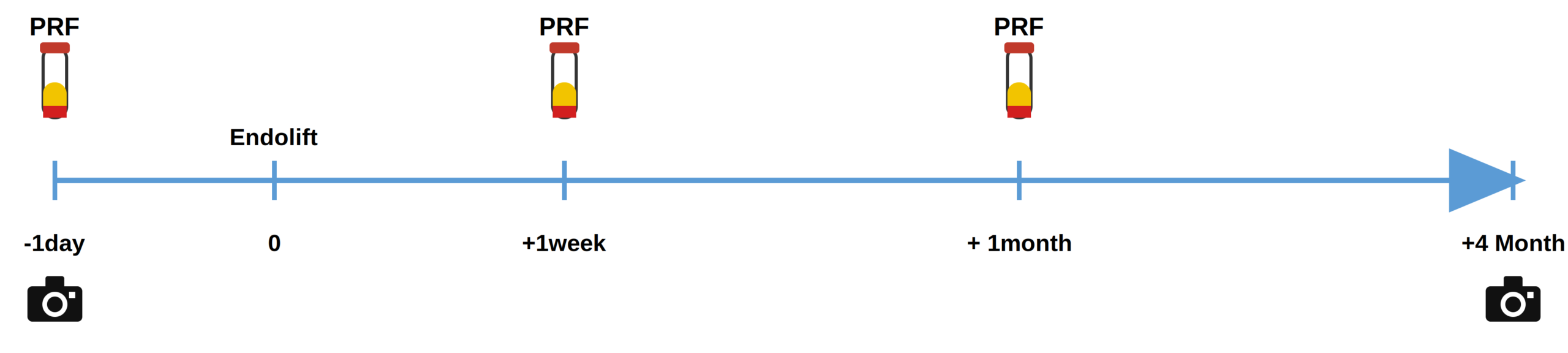
The Treatment Timeline at a Glance
| Timing | Treatment | Purpose in the Report | Evidence Status |
|---|---|---|---|
| Day −1 | i-PRF injection | Biological “priming” before laser treatment | Proposed mechanism; not yet validated in comparative trials |
| Day 0 | Single Endolift session | Controlled thermal stimulus, tissue contraction and collagen remodeling | Established Endolift mechanism; combination evidence is early |
| Day +7 | i-PRF injection | Support early healing and regenerative signaling | Case-report protocol |
| Day +30 | i-PRF injection | Support ongoing collagen synthesis | Case-report protocol |
What Did the Published Case Actually Show?
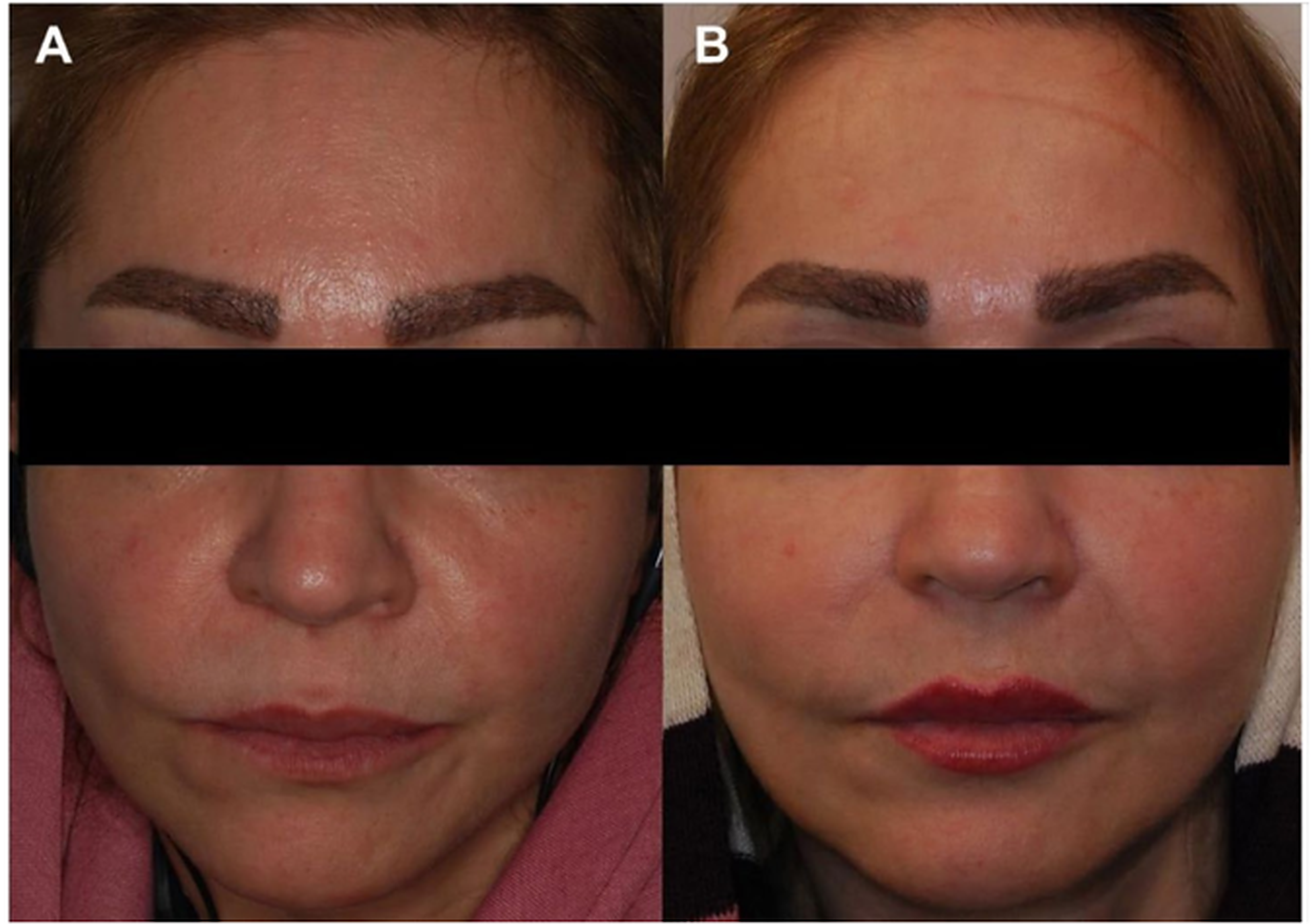
The patient was 56 years old and presented with facial laxity, reduced elasticity and fine lines. At four weeks after completing the scheduled treatment, the authors reported visible improvement in skin texture, elasticity and tightness, particularly in the lower face and neck. The patient rated the result as “very satisfied” on a four-point satisfaction scale. An independent dermatologist also reported marked improvement in skin quality and tightness.
| Reported Outcome | What the Case Report Found |
|---|---|
| Skin tightness | Marked short-term improvement on clinical assessment and photography |
| Texture / elasticity | Visible and clinically reported improvement within four weeks |
| Overall facial appearance | More youthful appearance reported by the authors |
| Patient satisfaction | “Very satisfied” — score 4/4 |
| Adverse effects | Mild pain, redness and swelling; resolved within a few days |
| Delayed / severe events | None reported during the four-week follow-up |
How the Two Treatments May Complement Each Other
| Component | Primary Role | Tissue-Level Goal | Patient-Facing Interpretation |
|---|---|---|---|
| Endolift | Controlled laser energy | Tissue contraction + collagen remodeling | Address laxity and contour from a deeper level |
| i-PRF | Autologous regenerative concentrate | Biological support with platelets, leukocytes and growth factors | Support the healing / regenerative environment |
| Combination | Thermal + biological stimulation | Potentially complementary remodeling | Aim to improve firmness, texture and overall skin quality together |
The authors describe i-PRF as a “biological catalyst” within the combined protocol. This is a mechanistic interpretation from a case report, not proof that i-PRF increases the effect size of Endolift. A randomized or controlled comparison would be required to demonstrate true synergy.
What Areas Can Be Considered?
The published case focused on facial rejuvenation with visible changes particularly in the neck and lower face. In clinical practice, the treatment plan should be based on the patient’s actual concern and anatomy rather than automatically treating the whole face.
- Lower-face laxity and early contour softening.
- Neck skin quality and laxity when appropriate for Endolift.
- Fine lines and textural aging as part of a broader rejuvenation plan.
- Patients seeking a regenerative, minimally invasive strategy rather than surgical lifting.
PATIENT SELECTION
This combined approach is not a replacement for surgery in patients with advanced skin excess, nor does the source study establish that it can correct every cause of facial aging. Bone structure, fat loss, muscle activity, pigmentation and severe laxity may require different or additional treatments.
Who May Be a Good Candidate?
- Adults with mild-to-moderate facial or neck laxity seeking a minimally invasive option.
- Patients interested in collagen-focused rejuvenation rather than only volume replacement.
- Patients who accept that collagen remodeling is gradual and that the published combination evidence is still early.
- Patients able to follow post-treatment care and return for planned regenerative sessions if clinically appropriate.
- Patients without contraindications identified during medical assessment.
Who May Need a Different Plan?
- Patients with advanced tissue descent or major excess skin who are better suited to surgical assessment.
- Patients whose main concern is volume loss rather than laxity or texture.
- Patients with active skin infection or other medical factors that make elective treatment inappropriate.
- Patients expecting guaranteed or immediate “facelift-equivalent” results from a minimally invasive procedure.
Recovery, Side Effects and Safety
In the reported case, adverse effects were mild and short-lived. The patient experienced pain, redness and swelling immediately after treatment, and these resolved within a few days without medical intervention. No delayed or severe adverse events were reported during the four-week follow-up.
| What Was Reported | Course | How to Communicate It |
|---|---|---|
| Mild pain | Transient | Possible short-term discomfort |
| Redness | Resolved within days | Expected inflammatory response may occur |
| Swelling | Resolved within days | Short-term swelling is possible |
| Severe / delayed complications | Not observed in this single case | Cannot be interpreted as zero risk in larger populations |
When Should Results Be Judged?
The case report documented visible changes by four weeks, but the authors explicitly state that four weeks is too short to evaluate the full process of collagen remodeling and neocollagenesis. They note that these biological processes typically unfold over approximately 3–6 months. Therefore, early tightening and texture changes should not be confused with the final long-term result.
- Early phase: swelling settles and initial tissue changes become visible.
- Weeks to months: collagen remodeling may continue to evolve.
- Long-term durability: not established by this case report; longer follow-up is needed.
Endolift + i-PRF vs Endolift Alone
| Question | Endolift Alone | Endolift + i-PRF |
|---|---|---|
| Main concept | Laser-based tissue tightening / remodeling | Laser remodeling + autologous regenerative support |
| Evidence base | Supported across multiple Endolift studies for several indications | Combination evidence in this paper is a single case report |
| Number of visits | Often centered around one Endolift session, depending on indication | Published schedule used one Endolift + three i-PRF visits |
| Proven superiority? | — | No. The study did not compare the combination against Endolift alone |
| Best use of evidence | Established procedure-specific literature | Promising individualized multimodal strategy |
