

What Is Radiesse Body Rejuvenation?
Radiesse is an injectable calcium hydroxylapatite (CaHA) product suspended in a carboxymethylcellulose gel carrier. In body rejuvenation, pure product may be used for structural volume restoration, while diluted or hyperdiluted forms have been studied for broader skin-quality and tightening effects. The strongest body evidence is for hand rejuvenation. Published studies also report promising outcomes for the neck, décolletage, upper arms, abdomen, thighs and above-knee skin, but the 2024 systematic review emphasizes that randomized controlled evidence is still limited for many of these off-label body applications.
Why Body Rejuvenation Has Moved Beyond the Face
Aesthetic rejuvenation has historically focused heavily on the face, yet visible aging does not stop at the jawline. Thereview describes a broader shift toward an overall youthful appearance involving several body areas. As patients pay more attention to the neck, upper chest, hands, arms, abdomen and thighs, treatment strategies have expanded beyond facial fillers and facial energy-based procedures.
Energy-based devices have long been central to non-surgical body treatment, but the review notes that injectables have increasingly become part of the therapeutic armamentarium. This matters because body aging is not only a question of localized fat or gross skin excess. In many patients, the concern is skin quality itself: reduced firmness, increased crepiness, visible laxity, loss of volume over bony structures, or a less smooth transition between skin and the underlying tissues.
Radiesse is relevant to this broader approach because it can behave differently depending on how it is used. In its pure form, its rheologic characteristics can provide structural support and volume. In diluted or hyperdiluted form, the goal described in the literature shifts toward biostimulation and skin-quality improvement rather than simple volumization. The systematic review therefore evaluates Radiesse not as one single body treatment, but as a platform used differently across different anatomical regions.
For a patient searching for body rejuvenation in Abu Dhabi, this distinction is important. A treatment that makes sense for dorsal hand volume loss is not automatically the same protocol that would be considered for neck laxity, crepey upper-arm skin or abdominal skin quality. The evidence, dilution, injection plane and expected outcome vary by anatomical site.
What Is Radiesse ? Calcium Hydroxylapatite + CMC
Radiesse is described in the review as a filler composed of 30% calcium hydroxylapatite (CaHA) and 70% carboxymethylcellulose (CMC) gel carrier. It has been used in aesthetic medicine for many years and has published data for both facial and body indications. The review highlights that the material has higher elasticity and viscosity than traditional hyaluronic-acid volumizing fillers, supporting its ability to provide tissue support when used in its pure form.
The scientific interest in CaHA has expanded because its clinical role is not limited to immediate volume replacement. Over the past decade, evidence has increasingly focused on its biostimulatory behavior. This is the basis for diluted and hyperdiluted protocols, in which the product is spread across a larger surface area to target skin quality rather than create focal projection.
Pure, Diluted and Hyperdiluted Radiesse
Pure Radiesse is undiluted product. In the body literature, the clearest evidence for pure product is hand volume restoration, where the aim may include masking visible tendons and veins and improving the appearance of age-related volume loss.
Diluted or hyperdiluted CaHA is mixed with diluent before injection. The review describes ratios ranging from approximately 1:1 through 1:6 depending on the area and published protocol. In these settings, the intent is generally less about replacing a discrete volume deficit and more about distributing CaHA over a larger tissue field to promote skin tightening and quality improvement.
Is hyperdiluted Radiesse still a filler?It is the same CaHA/CMC product, but the treatment objective changes. When used in diluted or hyperdiluted form, the literature reviewed by Galadari and Guida emphasizes biostimulation, dermal remodeling and skin-quality improvement rather than focal volumization.
Radiesse for Hand Rejuvenation : The Strongest Body Evidence
The dorsal hands are the body area with the most established evidence in the review. Age-related hand changes can make tendons and veins more visible and produce a bony or skeletal appearance. Radiesse has been studied both as a structural filler for volume restoration and, in diluted form, as a biostimulatory treatment.
The review identified 10 studies focused on the hands, including seven prospective studies, three of which were randomized controlled trials, as well as retrospective data. This is why the authors assigned the highest level of recommendation to pure Radiesse for the hands.
Pure vs Diluted Radiesse for Hands
Pure CaHA is the strongest evidence-based option when the clinical goal is dorsal hand volume restoration. Diluted 1:1 techniques have also been studied for patients with lower grades of hand aging and for biostimulatory skin improvement. Published data include increases in collagen type III density, dermal thickness and skin viscoelasticity after diluted treatment.
Is Radiesse FDA-approved for the hands?Yes. In the 2024 systematic review, hand volume restoration is identified as the FDA-approved body indication for Radiesse. The authors distinguish this from many other body applications, which are commonly off-label.
Radiesse for the Feet
The review also discusses the dorsum of the feet, where age-related changes can similarly make tendons and veins more visible. Compared with the hands, however, the evidence base is much smaller.
A published procedure used hyperdiluted CaHA/CMC at a 1:3 ratio with a proximal-to-distal fanning technique using a cannula. Because there was no validated scale for this indication, patients graded their own aesthetic outcomes at three months. The median reported result corresponded to good improvement.
The study primarily reported local, self-limiting adverse events. Three subjects, representing 5.7% of the sample, reported significant bilateral pain within one day of treatment, which resolved completely. Despite this, all participants stated that they would repeat the procedure.
For patient education, the practical message is that feet are included in the published body literature, but the evidence is substantially weaker than the hand evidence and should not be presented as equivalent.
Hyperdiluted Radiesse for Neck Rejuvenation
The neck is one of the most frequently discussed non-facial areas for CaHA biostimulation. The source review identified prospective and retrospective studies specifically examining neck rejuvenation, with protocols using diluted or hyperdiluted product rather than pure Radiesse.
The review explicitly states that pure Radiesse is not recommended for neck and décolletage rejuvenation in the included protocols. Published studies used hyperdilution at 1 : 2 or greater, and consensus guidance cited by the authors describes ratios from 1 : 2 to 1 : 4 for these areas.
What Did the Neck Studies Show?
Yutskovskaya and Kogan evaluated diluted CaHA in the neck and décolletage. Histopathologic analysis demonstrated significant increases in collagen I, neoangiogenesis and neoelastogenesis at four and seven months. Collagen III increased significantly at month four and then remained at a steady state at month seven. Ultrasound imaging also demonstrated increased dermal thickness.
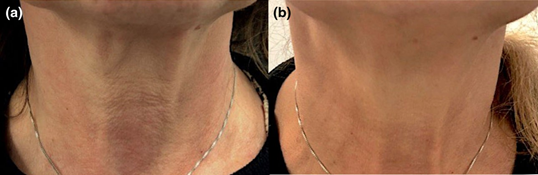
Guida and colleagues evaluated hyperdiluted CaHA for neck skin laxity and reported significant improvement on a dedicated Neck Skin Laxity scale at three months. The review describes this study as supporting the effectiveness of hyperdiluted CaHA in the neck, while still classifying the overall evidence as weaker than the evidence for hand rejuvenation.
A later prospective study by Trindade de Almeida and colleagues included 22 women with mild to moderate cervical aging and reported consistent improvement in clinical and ultrasonographic parameters. One participant reported a nodule at day 120; the review states that it resolved with massage.
What Does Hyperdilution Mean for the Neck?
The review cites consensus recommendations using approximately 1.5 mL of CaHA/CMC with hyperdilution ratios from 1 : 2 to 1 : 4 for the neck and décolletage. Based on published research and the authors’ practical experience, the review states a preference for 1 : 2 hyperdilution in these areas.
The rationale described is linked to fibroblast contact and collagen production: maintaining sufficient CaHA concentration while distributing it broadly may support the biostimulatory objective. This is a technical clinical consideration, not a universal dosing rule, and the review does not suggest that one protocol should be copied without anatomical assessment.
Radiesse for Décolletage / Upper Chest Rejuvenation
The décolletage is another body area in which the reviewed literature reports measurable improvement. In a prospective clinical trial, subjects treated for décolletage wrinkles showed significant overall improvement over time and significant improvement on the Merz Décolletage Wrinkle Scale at both rest and dynamic assessment.
The improvement was reported by week six and remained significant through day 360. This is relevant to patient expectations because it demonstrates that some CaHA body studies followed outcomes for close to one year rather than only examining short-term post-treatment appearance.
The review also notes that European Union Medical Device Regulation approval has been released for CaHA/CMC use on the décolletage. Regulatory status is jurisdiction-specific, so a treatment’s approval status in Europe does not automatically determine its status in the UAE or the United States.
Can Radiesse improve chest wrinkles?Published prospective data summarized in the 2024 review reported significant improvement in décolletage appearance and wrinkle scores after CaHA/CMC treatment, with improvement remaining significant through day 360 in one study.
Radiesse for Upper Arms
Upper-arm skin laxity and crepiness are among the body concerns evaluated in the systematic review. The evidence is smaller than the hand literature but includes prospective clinical data.
Lapatina and Pavlenko used diluted CaHA/CMC at a 1:2 ratio in the upper arms and reported a significant increase in skin elasticity. Another study by Amselem evaluated upper-arm rejuvenation using pure CaHA/CMC and reported that subjects and evaluators were satisfied or very satisfied with treatment. Assessments of flaccidity and volume improved significantly compared with baseline and across follow-up visits.
The review’s evidence table assigns moderate evidence to one pure/1:2 upper-arm category and weaker evidence to some diluted protocols. This again illustrates why a strong website page should avoid a blanket claim that all body areas have the same level of scientific certainty.
Radiesse has published evidence for upper-arm rejuvenation, including improvements in elasticity and flaccidity, but the body of evidence is more limited than for hand rejuvenation.
Radiesse for Abdomen Skin Quality
The abdomen has been studied with both pure and diluted/hyperdiluted CaHA approaches. The source review includes prospective studies evaluating dermal thickness, density and skin quality rather than simply measuring circumference or fat reduction.
Lapatina and Pavlenko used a 1:4 hyperdilution for abdominal skin and reported an increase in dermal thickness. Cogorno Wasylkowski evaluated a body-vectoring approach across the abdomen, thighs and brachial zones and reported improvements in skin density and thickness in the majority of treated zones.
In the review’s narrative summary, an increase in skin density was observed in most treated patients across all zones, specifically in 88% of patients treated for abdominal rejuvenation. This is one of the clearest numerical findings reported for the abdomen.
The review assigns weaker evidence to abdominal protocols than to pure hand rejuvenation. That limitation should be stated clearly: abdominal CaHA biostimulation is promising and published, but it is not supported by the same quantity or level of randomized evidence as the hand indication.
Radiesse for Thighs and the Area Above the Knees
The thighs and above-knee region can show textural changes, laxity and a cellulite-like surface appearance. The review includes both broader thigh/body studies and a focused pilot study of the skin above the knees.
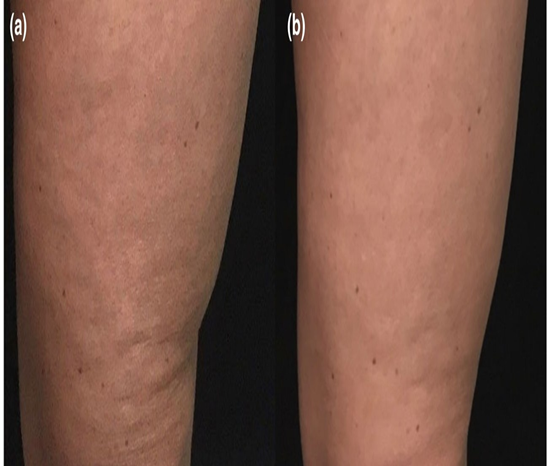
Cogorno Wasylkowski reported improvement in skin density and thickness across treated zones, with increased skin thickness seen most frequently in the thighs, affecting 88% of cases in the review’s summary. These findings support the concept that CaHA may influence dermal quality rather than acting only as a volumizing implant.
Guida and colleagues used a 1 : 4 hyperdilution in the anterior thigh above the knee and reported a significant improvement in the total mean Knee Cellulite Severity Scale at three months compared with baseline. Because this was a pilot study, it should be interpreted as promising rather than definitive evidence.
Radiesse for the Ischiatic / Gluteal Region
The review also includes a small prospective study of the ischiatic region, an area affected by chronic sitting pressure and localized depression. Sixteen women were treated using diluted CaHA/CMC.
The study reported improvements in skin quality, skin fold and roughness, and all treated ischiatic areas showed improvement in depression deformity. The review states that discoloration improved in roughly half of treated areas.
This is a useful example of how body CaHA research extends beyond the most common consumer search terms. It also illustrates the need to keep evidence strength in perspective: an encouraging small study is not equivalent to a large randomized trial.
| Area | Dilution | Evidence Level | Notes |
|---|---|---|---|
| Upper arms | Pure / 1:2 | 2b / Moderate evidence | Meaningful clinical data, less mature than hands. |
| Upper arms | 1:2 / 1:4 | 3b / Weak evidence | Promising but limited. |
| Abdomen | Pure / 1:4 | 3b / Weak evidence | Published improvement; more trials needed. |
| Thighs | 1:4 | 3c / Weak evidence | Pilot-level evidence. |
Safety and Downtime: What the Review Actually Reports
Across the studies included in the review, the overall safety profile was described as favorable. The dominant adverse events were local and self-limiting. This wording is important: “good safety profile” does not mean “no risk,” but it does describe the pattern observed in the published studies selected for the review.
For hand rejuvenation, the included studies generally reported local, self-limiting events, and one retrospective analysis found fewer adverse events with cannula than needle. For neck and décolletage treatment, the studies also generally reported local and self-limiting reactions. In the 2023 neck study, one patient developed a nodule at day 120 that resolved with massage.
In the foot study, three participants (5.7%) reported significant bilateral pain within one day after treatment, with complete resolution. In upper-arm, abdomen and thigh studies, the review again describes local and self-limiting adverse events.
Important evidence limitationThe 2024 review is not a comprehensive complication-management guideline and does not provide a full contraindication checklist. It summarizes safety findings from the included clinical studies. A patient-specific safety assessment must therefore be performed separately in clinical practice.
When Do Results Develop, and How Long Were They Followed?
The source literature evaluates CaHA body outcomes over different time frames. Because some effects are biostimulatory, the relevant endpoint is often not the immediate post-treatment appearance.
- Hand trials followed improvement through time points up to 12 months.
- A diluted hand study reported significant improvement up to six months.
- Neck histology and imaging studies evaluated changes at four and seven months.
- A neck-laxity study reported significant improvement at three months.
- Décolletage improvement was significant from week six and remained significant through day 360 in one prospective trial.
- Upper-arm studies assessed improvement through follow-up visits including approximately four months.
- Above-knee cellulite-like changes were assessed at three months.
- Foot outcomes were assessed at three months.
Body Radiesse results are not described in the literature as a single fixed timeline. Depending on the indication, investigators have evaluated changes from several weeks to several months and, in some areas, through one year.
Regulatory Status : Approved vs Off-Label Body Use
The review makes a clear regulatory distinction. The FDA-approved body indication discussed by the authors is hand volume restoration. The review also notes a recent European Union Medical Device Regulation approval for use on the décolletage.
Other body applications — including many hyperdiluted protocols for the neck, arms, abdomen, thighs, feet or ischiatic region — may be off-label depending on the jurisdiction. “Off-label” does not mean that a use has no published evidence; it means that the specific use may not be included in the product’s approved labeling in that regulatory system.
For a patient-facing page in Abu Dhabi, this distinction should be transparent. The live page should not imply that a regulatory approval in one region automatically applies in the UAE. Local clinical and regulatory requirements should govern treatment.
Radiesse Body Rejuvenation in Abu Dhabi
For patients searching in Abu Dhabi, the most useful question is not simply “Does Radiesse work for the body?” The more accurate question is “Which body concern and anatomical area are being treated, and how strong is the evidence for that specific use?”
A patient with dorsal hand volume loss is entering a very different evidence category from a patient seeking improvement in crepey abdominal skin or above-knee texture. The hands have the strongest evidence and an FDA-approved body indication in the source review. Neck, chest, arms, abdomen and thighs have encouraging clinical data, but the evidence level is lower and protocols are more heterogeneous.
A patient with dorsal hand volume loss is entering a very different evidence category from a patient seeking improvement in crepey abdominal skin or above-knee texture. The hands have the strongest evidence and an FDA-approved body indication in the source review. Neck, chest, arms, abdomen and thighs have encouraging clinical data, but the evidence level is lower and protocols are more heterogeneous.
