
Hand Rejuvenation with Dermal Fillers in Abu Dhabi
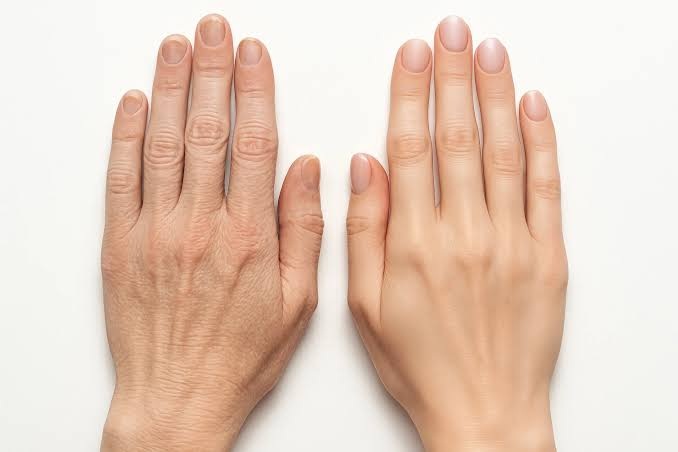
The hands can reveal age even when the face looks refreshed. Over time, loss of collagen, elastin, subcutaneous fat and structural support can make veins, tendons and bony contours more visible. Dermal fillers can restore lost volume, soften contour irregularities and, depending on the product, improve hydration or stimulate collagen formation.
The three main injectable categories used for dorsal hand rejuvenation are hyaluronic acid (HA), calcium hydroxylapatite (CaHA, commonly associated with Radiesse) and poly-L-lactic acid (PLLA, commonly associated with Sculptra). They are not interchangeable: each has a different onset, duration, reversibility profile, tissue effect and ideal patient profile.
Why Do Hands Age?
Hand aging is a combination of extrinsic and intrinsic change. Sun exposure and environmental factors contribute to pigmentation, roughness and photoaging. Intrinsic aging gradually reduces dermal collagen and elastin, subcutaneous fat and deeper structural support. The result can be thinner skin, reduced elasticity and increasing visibility of veins and tendons.
This distinction matters because surface-focused treatments such as lasers, intense pulsed light or chemical resurfacing primarily target pigmentation and texture, while fillers are designed to restore volume and structural softness. In many patients, the most complete strategy is therefore multimodal rather than filler alone.
What Does Hand Filler Actually Improve?
- Loss of soft-tissue volume on the back of the hands
- Prominent veins and tendons caused by thinning tissue
- A bony, hollow or skeletal appearance
- Contour irregularities between the wrist, dorsum and fingers
- Skin hydration and suppleness with selected HA products
- Skin quality through collagen stimulation with diluted CaHA or PLLA
The goal is not to make the hand look “filled.” A youthful result should look smooth, proportionate and natural, with enough soft-tissue coverage to reduce excessive visibility of underlying structures without creating puffiness.
How Hand Aging Is Assessed Before Treatment
A structured assessment helps determine whether a patient primarily needs volume restoration, skin-quality improvement, resurfacing, or a combination. The review article highlights two validated five-point scales used to grade dorsal hand aging and volume deficit: the Merz Hand Grading Scale and the Allergan Hand Volume Deficit Scale.
| Grade | Merz Hand Grading Scale | Typical visual impression |
|---|---|---|
| 0 | No loss of fatty tissue | Full soft-tissue coverage; veins/tendons minimally visible |
| 1 | Mild fat loss; slight vein visibility | Early change |
| 2 | Moderate fat loss; mild vein/tendon visibility | Visible aging with developing hollowness |
| 3 | Severe fat loss; moderate vein/tendon visibility | Marked structural visibility |
| 4 | Very severe fat loss; marked vein/tendon visibility | Advanced volume deficit |
The Anatomy That Makes Hand Filler Different
The dorsum of the hand contains three distinct fatty laminae — superficial, intermediate and deep — separated by thin fascial layers. The superficial lamina contains relatively few vascular and neural structures and is described in the review as the safest plane for filler placement. The intermediate layer contains dorsal veins and sensory nerves, while the deep layer is associated with the extensor tendons.
This anatomy explains why precise plane selection matters. A smooth aesthetic correction depends on placing product where it can restore soft-tissue cover without compromising vascular, neural or tendon structures. The review emphasizes careful identification of the dorsal layers and notes that intermediate-layer injections carry greater risk.
SAFETY-FOCUSED ANSWER
Most routine volumization is directed to the dorsal superficial lamina. Blunt cannulas are commonly preferred because they can reduce the number of skin punctures and may lower the chance of vascular injury or bruising compared with repeated needle entry.
Injection Technique: What the Evidence Review Describes
Commonly described techniques include proximal-to-distal fanning, retrograde linear threading and selective small boluses. When a cannula is used, some injectors enter just distal to the wrist crease and fan product across the dorsum. Other techniques use entry points in the web spaces and deliver product while withdrawing the needle or cannula.
The review reports that typical volumetric correction often uses approximately 1–2 mL per hand, although the required volume varies with anatomy, degree of atrophy and the filler selected. Product should be distributed evenly and conservatively to avoid an overfilled appearance.
HA vs Radiesse vs Sculptra for Hand Rejuvenation
There is no single “best” filler for every hand. The strongest choice depends on whether the priority is immediate volume, reversibility, stronger structural support, collagen stimulation, skin quality, or longevity.
| Feature | Hyaluronic Acid (HA) | Calcium Hydroxylapatite (CaHA) | Poly-L-lactic Acid (PLLA) |
|---|---|---|---|
| Primary action | Space filling + hydration | Volume (undiluted) + collagen stimulation (diluted) | Collagen stimulation |
| Onset | Immediate | Immediate volume; progressive collagen effect | Gradual, over weeks to months |
| Typical longevity in review | 6–15 months | 9–15 months | 18–24 months |
| Best suited to | Immediate, natural-looking correction; thin or delicate hands | Moderate/severe volume loss; medium-to-thicker skin | Severe skin atrophy; longer-term collagen-based rejuvenation |
| Reversible? | Yes — with hyaluronidase | Not easily reversible | No |
| Nodule/granuloma risk | Low | Medium, especially if too superficial | Higher relative risk due to biostimulation |
| Sessions | Often 1 session ± touch-up | Often 1 session; diluted protocols vary | Usually multiple sessions |
(1) Hyaluronic Acid Hand Filler
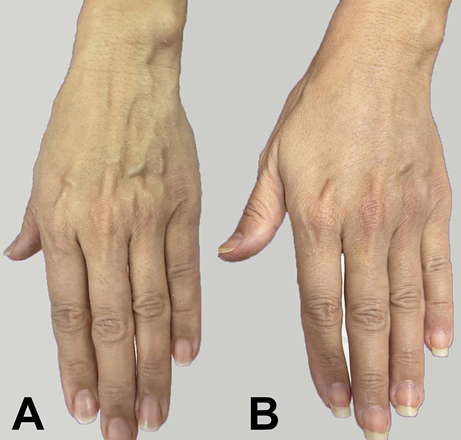
HA fillers are hydrophilic gels that provide immediate soft-tissue restoration and hydration. In the reviewed studies, HA produced visible improvement with relatively little downtime and a favorable safety profile. Because HA can be dissolved with hyaluronidase, it offers an important reversibility advantage when compared with CaHA and PLLA.
The review describes durability in the range of approximately 6–15 months, with outcomes varying by product, patient metabolism and the high mobility of the hands. One prospective split-hand study reported significantly higher response rates in treated hands than untreated hands at 12 weeks, with benefit maintained through later study visits.
WHO MAY PREFER HA?
Patients prioritizing immediate improvement, a softer natural feel, hydration, minimal downtime and the ability to reverse the product if necessary may be particularly suited to HA-based hand rejuvenation.
(2) Calcium Hydroxylapatite (CaHA / Radiesse) for Hands
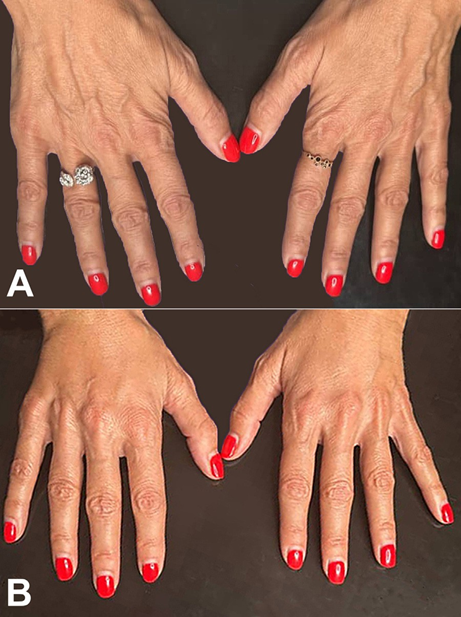
CaHA contains calcium hydroxylapatite microspheres suspended in a carrier gel. The carrier provides immediate volume, while the microspheres can stimulate fibroblast activity and collagen formation after the gel is absorbed. This dual behavior makes CaHA useful when the goal includes both structural correction and skin-quality improvement.
The review reports typical correction lasting around 9–15 months for undiluted CaHA. Diluted CaHA protocols are used as biostimulatory treatments for skin quality; limited data in the review describe outcomes that may persist longer in selected protocols. CaHA is not easily reversible, so patient selection, product depth and injector expertise are especially important.
HA EVIDENCE SNAPSHOT
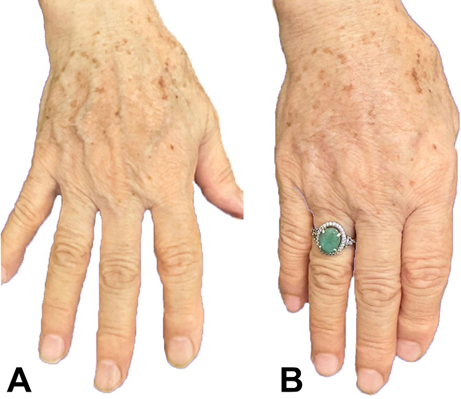
Across the reviewed HA studies, improvement was measurable within the first months and could remain visible at 6–12 months, although the magnitude gradually declined over time. The review also describes improvement in hydration and skin-quality parameters in HA-treated hands. This supports HA as both a volumizing and hydrating option, while reinforcing the need to set realistic maintenance expectations.
WHO MAY PREFER CaHA?
Patients with more noticeable volume loss, thicker skin, visible tendons/veins and a desire for structural support plus collagen stimulation may be considered for CaHA, provided anatomy and risk factors are appropriate.
3) Poly-L-lactic Acid (PLLA / Sculptra) for Hands
PLLA is a collagen stimulator rather than a traditional space-filling gel. After reconstitution and injection, the initial water-related fullness fades, and the longer-term effect develops gradually as neocollagenesis occurs. The review notes that collagen-related change begins over several weeks and that most patients require multiple treatment sessions.
Typical protocols in the review involve two to three sessions approximately six weeks apart, although published studies have used broader session ranges. The estimated effect may last around 18–24 months or longer in some patients, but the trade-off is a delayed result and the inability to dissolve the product.

WHO MAY PREFER PLLA?
Patients with significant skin atrophy who accept gradual improvement and a multi-session treatment plan may value PLLA for progressive, collagen-based rejuvenation rather than instant correction.
How Long Do Hand Fillers Last?
The hands are highly mobile, so longevity should not simply be copied from filler performance in the face. According to the review, movement may increase product metabolism. Reported ranges are approximately 6–15 months for HA, 9–15 months for CaHA and 18–24 months for PLLA. Individual results vary with product choice, injected volume, tissue quality, metabolism and hand activity.
HA: about 6–15 months. CaHA: about 9–15 months. PLLA: about 18–24 months. These are literature ranges, not guarantees for an individual patient.
Who Is a Good Candidate for Hand Rejuvenation?
The review notes that visible hand aging commonly becomes more apparent after the age of 30, but candidacy is based on anatomy and goals rather than a strict age cut-off. Hand fillers may be suitable for patients who want visible improvement with limited downtime and who have volume loss, skin atrophy, wrinkles or increased visibility of veins and tendons.
Potentially suitable features
- Loss of fullness over the dorsum of the hands
- Visible tendons or veins related to tissue thinning
- Thin or crepey skin in combination with volume loss
- Desire for non-surgical correction with relatively quick return to routine activities
- • Realistic expectations and willingness to choose filler type based on anatomy rather than brand alone
When treatment may need to be delayed or avoided
- Active skin infection; infection should be treated before injection
- Known allergy to a filler ingredient
- Pregnancy, which is treated as a relative contraindication because of insufficient safety data for elective filler treatment
- Medication or medical factors that materially increase bleeding/bruising risk — these should be reviewed with the treating clinician rather than stopped without medical advice
- History suggesting elevated granuloma/inflammatory risk when considering non-reversible biostimulatory fillers
What Is the Recovery Like?
Most reported adverse effects are mild or moderate and temporary. Swelling, bruising, tenderness and mild discomfort can occur. Cannula use and fewer skin punctures may reduce bruising. Gentle massage is sometimes used to distribute product evenly, although technique and aftercare should be individualized to the filler used.
The source review describes icing the hands for the remainder of the day, hand elevation and avoidance of very salty food for two to three days, as well as avoiding intense hand work for approximately one week. Your treating clinician’s product-specific instructions take priority.
Are Hand Fillers Safe?
The literature review characterizes HA, CaHA and PLLA as having generally good safety profiles when appropriately selected and injected. Common issues are swelling, bruising and temporary tenderness. Nodules or papules have been reported, particularly with biostimulatory fillers and with superficial placement. The relative safety advantage of HA is that it can be dissolved with hyaluronidase if the aesthetic outcome is unsatisfactory or a filler-related problem requires reversal.
No injectable procedure is risk-free. The hand contains important veins, sensory nerves and tendons, so treatment should be performed by an appropriately trained clinician with detailed knowledge of dorsal hand anatomy and the behavior of the chosen product.
Hand Filler vs Laser, IPL or Skin Resurfacing
Fillers and energy-based treatments solve different problems. Fillers restore lost volume and structural softness. Laser, IPL, photodynamic therapy and chemical resurfacing primarily target surface concerns such as pigmentation, sun damage and texture. When both structural aging and photoaging are present, a staged combination plan can address both dimensions of hand aging.
| Concern | Best-matched treatment category | Why |
|---|---|---|
| Hollow/bony hands | Dermal filler | Restores soft-tissue cover and contour |
| Visible tendons/veins from volume loss | Dermal filler | Adds tissue coverage over underlying structures |
| Pigmentation / sun spots | Laser / IPL / pigment-focused treatment | Targets chromophore and surface photoaging |
| Texture + volume loss | Combination plan | Treats surface quality and deeper volume deficit |
How to Choose Between HA, CaHA and PLLA
A useful decision framework is to start with the patient’s main priority and then filter that through anatomy and risk tolerance:
- Need immediate correction + reversibility → consider HA.
- Need immediate structure + collagen stimulation → consider CaHA, especially when skin thickness is suitable.
- Need gradual collagen-based improvement + longer duration → consider PLLA, accepting multiple sessions and delayed onset.
- Very thin or fragile skin → favor products and techniques with lower visibility/nodule risk; HA may be advantageous.
- Complex anatomy or need to treat deeper/intermediate compartments → use highly conservative selection and visualization where appropriate.
The most important principle is individualized filler selection. Product choice should align with tissue quality, severity of volume loss, desired speed of improvement, reversibility preference and the patient’s expectations.
