
Morpheus8 for Lower Face and Neck Tightening in Abu Dhabi
Lower-face aging is rarely caused by a single change. Jowling, reduced jawline definition, submental fullness and neck laxity can reflect a combination of skin looseness, soft-tissue descent and localized adipose tissue. For patients who want more than a superficial treatment but are not ready for an excisional facelift or neck lift, multimodal radiofrequency may occupy an important middle ground.
Why is lower-face and neck laxity difficult to treat?
Traditional non-surgical treatments can improve selected concerns such as texture, pigmentation, volume loss or localized fat. However, the source study emphasizes that skin and soft-tissue laxity may remain even when these individual concerns are addressed. This creates a “treatment gap” between noninvasive options and excisional surgery.
Who is in the “treatment gap”?
- Younger patients whose skin redundancy is not severe enough to justify a facelift or neck lift, but is more than very mild laxity.
- Patients who previously underwent facelift or neck lift and later developed recurrent laxity.
- Patients who could benefit from surgery but prefer to avoid it and understand that a minimally invasive treatment generally aims for a more modest degree of correction.
How do FaceTite and fractional RF microneedling complement each other?
The study combines two radiofrequency delivery methods with different tissue targets. Bipolar RF is used to heat deeper soft tissue and the fibroseptal network, while fractional bipolar RF delivers energy through microneedles at programmed depths to create controlled dermal and subdermal treatment zones.
| Component | Primary role in the source study | Why it matters |
|---|---|---|
| Bipolar RF (FaceTite) | Deeper controlled heating of subcutaneous tissue and the fibroseptal network. | Designed to support soft-tissue contraction and remodeling from below. |
| Fractional bipolar RF (Fractora modified to Morpheus8) | Fractional dermal/subdermal RF delivered through microneedles. | Adds controlled dermal coagulation, collagen stimulation and subdermal adipose remodeling. |
| Combined approach | Deep + superficial/depth-programmed energy in the same treatment strategy. | Targets more than one structural contributor to lower-face and neck laxity. |
Treatment Areas & Patient Selection
Jowls and mandibular contour
The lower face and jowl region is a central focus of the study. The treatment concept addresses both soft-tissue laxity and localized adipose tissue around the mandibular border, with the goal of improving contour rather than simply adding volume.
Submental area and neck
Neck laxity may coexist with localized submental adiposity. The multimodal RF approach in the study was used to address the lower face and neck as a structural unit rather than treating only the skin surface.
Prior facelift or neck lift
Patients with recurrent laxity after prior excisional surgery were specifically included in the study’s treatment-gap concept. A prior procedure does not automatically determine candidacy; examination of anatomy, scarring and treatment goals remains essential.
Who may not be suitable?
The source study excluded patients with :
- Active infection
- Collagen disorders
- Immunocompromised state
- Medication use that substantially limits the inflammatory response
- A propensity for keloid or hypertrophic scarring
Consultation Point
Treatment selection should be based on direct examination. A patient who is a strong surgical candidate should not be promised facelift-level correction from RF technology.
Results Timeline : What Patients Should Understand
Radiofrequency can produce an immediate tissue-heating response, but the biologic remodeling process continues after the procedure. The authors describe neocollagenesis, elastin remodeling and angiogenesis developing over the following 3–4 months.
- Early phase: swelling and tissue response can temporarily influence appearance.
- Remodeling phase: collagen and elastin changes evolve over several months.
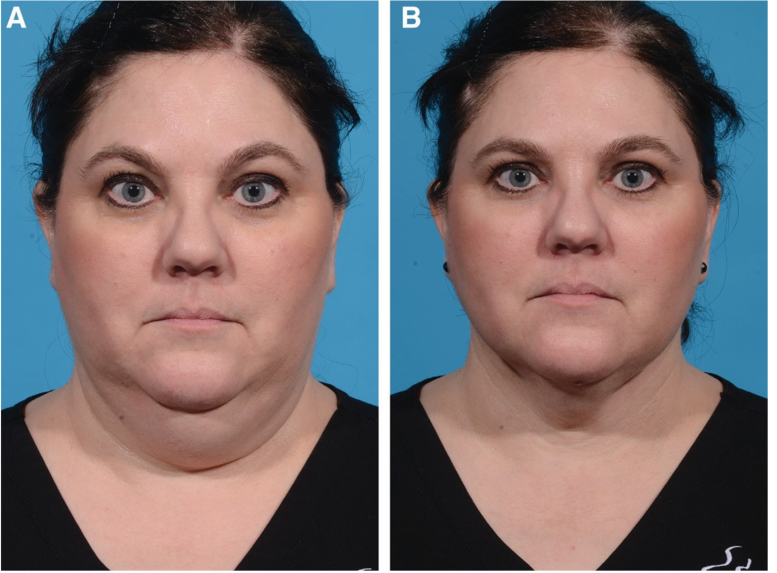
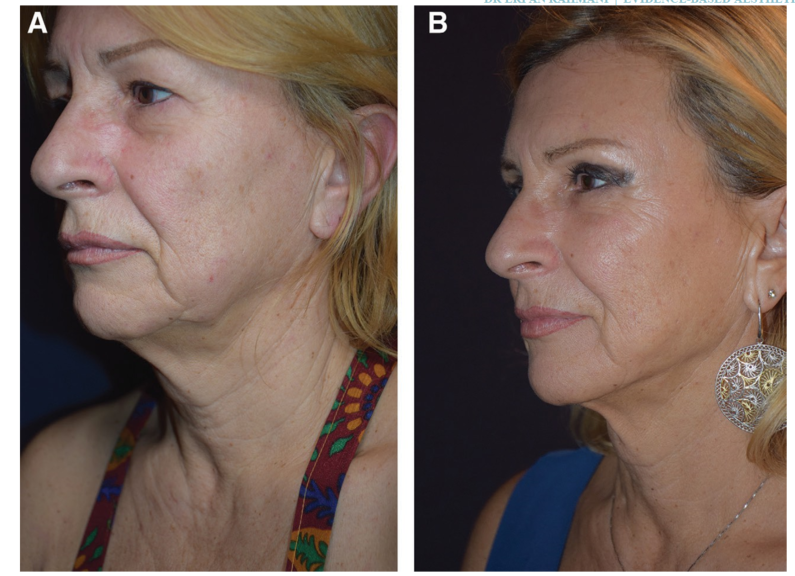
- Longer-term evaluation: the source study included an average follow-up of 2.1 years, with published clinical images shown at 12 and 24 months.
Safety & Recovery
In the 247-patient combination-treatment cohort, the recorded complications were prolonged swelling lasting more than six weeks in 4.8%, a hardened area lasting more than 12 weeks in 3.2%, and marginal mandibular neuropraxia in 1.2%. All of these events resolved without further intervention in the study.
| Reported event | Study finding |
|---|---|
| Prolonged swelling >6 weeks | 4.8% (12/247) |
| Hardened area >12 weeks | 3.2% (8/247) |
| Marginal mandibular neuropraxia | 1.2% (3/247) |
| Repeat treatment / operative intervention after RF | None reported in the cohort |
Do not overstate safety
The study supports a favorable safety profile in experienced hands, but it does not justify describing the treatment as risk-free. Nerve-related events, prolonged swelling and tissue firmness were documented.
Anatomical safety matters
Cadaveric dissections were used to study the relationship between treatment zones and the marginal mandibular nerve. The authors avoided treatment medial to the marionette lines because the nerve divides toward the lip depressor muscles in this region. This is a useful reminder that lower-face RF is anatomy-dependent and technique-sensitive.
Morpheus8 Alone vs Combination RF vs Facelift
| Option | Best framed as | Evidence / limitation |
|---|---|---|
| Morpheus8-style fractional RF | Fractional RF microneedling for dermal/subdermal remodeling and skin tightening. | Do not apply the 93% satisfaction figure from this source to Morpheus8 alone. |
| FaceTite + fractional RF | Multimodal, minimally invasive RF approach for lower-face and neck laxity. | This is the actual combination evaluated in the 247-patient study. |
| Facelift / neck lift | Excisional surgical correction for patients with more significant laxity. | The study explicitly states combination RF is not intended to replace surgery in appropriate surgical candidates. |
What is the difference between Morpheus8 and FaceTite ?
Morpheus8-style fractional RF delivers radiofrequency through microneedles at programmed depths. FaceTite delivers bipolar RF through a minimally invasive internal/external electrode system for deeper soft-tissue heating. They target different tissue levels and can be combined.
Can radiofrequency replace a facelift ?
Not in every patient. The study specifically states that combination RF does not aim to replace facelift or neck lift in appropriate surgical candidates. It is intended to expand options for patients in the treatment gap.
How effective was the combination treatment ?
Among 24/7 patients, the study reported an average 1.4-point improvement in Baker Face/Neck Classification and 93% patient satisfaction with willingness to undergo the procedure again.
How long do results take to develop ?
The source describes collagen and elastin remodeling over approximately 3–4 months. Published images in the study demonstrate outcomes at 12 and 24 months, although individual duration and magnitude of effect vary.
