
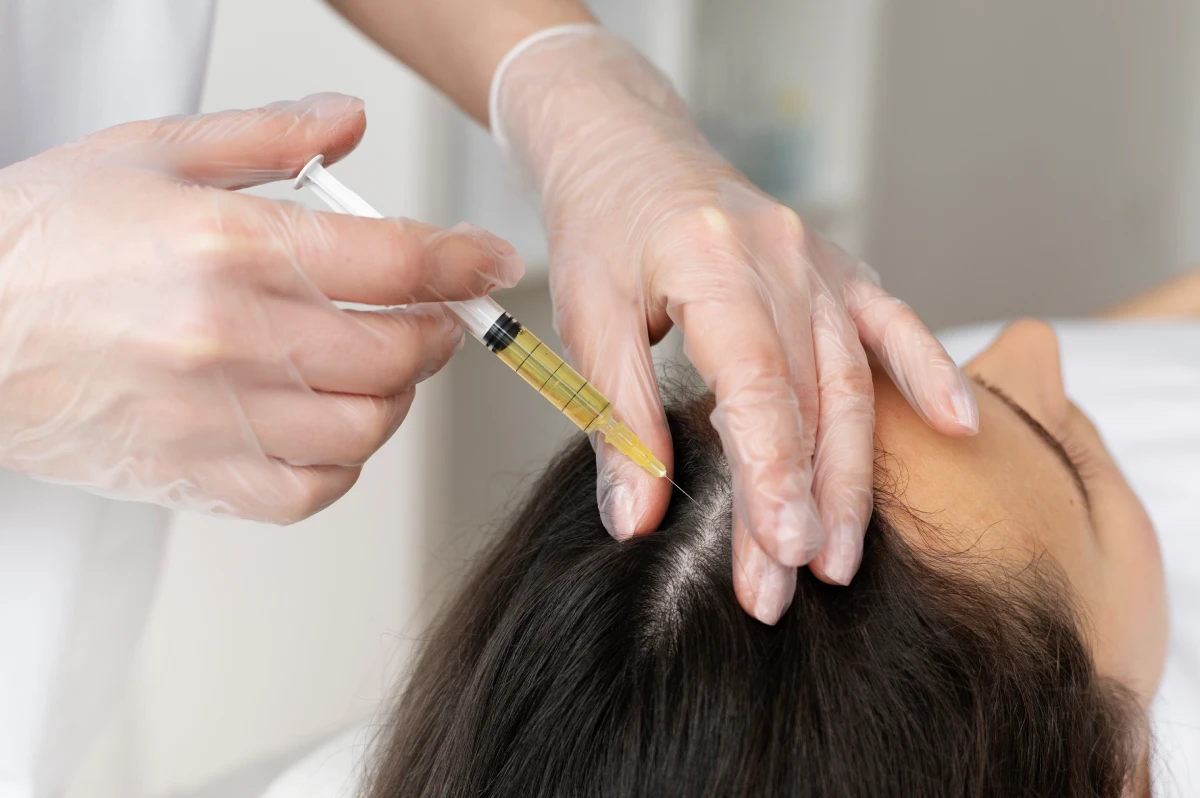
PRP is not a “one-session cure” for hair loss. It is a regenerative treatment made from your own blood and appears most useful for selected patients with androgenetic (pattern) hair loss, often as part of a broader treatment plan rather than as a replacement for all other therapies.
1. What Is PRP For Hair Loss?
PRP Uses A Concentrated Part Of Your Own Blood
PRP (platelet-rich plasma) is prepared from a small sample of the patient’s own venous blood. After centrifugation, the platelet-rich portion is separated and injected into areas of scalp thinning.
Platelets are best known for their role in clotting, but they also contain growth factors and signaling proteins. In the scalp, these signals may support the environment around miniaturized hair follicles, stimulate cellular activity and blood-vessel formation, and encourage follicles to spend more time in the active growth (anagen) phase.
Why This MattersPattern hair loss gradually miniaturizes follicles: thick terminal hairs become finer, shorter and less visible. The goal of PRP is not to create brand-new follicles where none remain, but to support follicles that are still present and potentially improve hair density, caliber and scalp coverage.
What Type Of Hair Loss Is PRP Mainly Studied For ?
The strongest discussion in the source chapter concerns androgenetic alopecia (AGA), also called male pattern hair loss and female pattern hair loss. PRP should not automatically be used for every type of shedding or every bald area; the diagnosis should be established first.
- Men commonly notice recession at the temples, frontal scalp and vertex (crown).
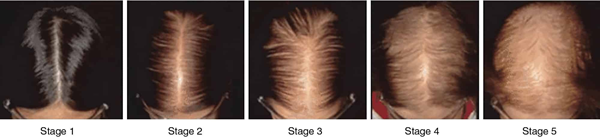
- Women more commonly develop widening of the central part with relative preservation of the frontal hairline.
- Advanced smooth bald areas with very few functioning follicles are generally less biologically favorable than earlier or moderate thinning.

2. How Does PRP Work ?
A Simple Explanation Of The Biology
The dermal papilla at the base of the follicle is a key control center for hair growth. In androgenetic alopecia, dihydrotestosterone (DHT) can shorten the growth phase and contribute to progressive follicle miniaturization. PRP does not directly block DHT. Instead, it supplies platelet-derived signals that may support growth pathways and the local microenvironment of the follicle.
| What PRP provides | What may happen in the follicle | What a patient may notice |
|---|---|---|
| Platelet growth factors | Support Wnt/β-catenin, ERK and Akt signaling described in the chapter | Potential support for active hair growth |
| VEGF and angiogenic signals | May increase vascular support around follicles | Potential improvement in the follicular environment |
| Cell-proliferation signals | May support dermal papilla and follicular cell activity | Potential improvement in density and shaft caliber |
| Autologous plasma | Treatment is prepared from the patient’s own blood | Low allergy risk compared with foreign biologic material |
Important Distinction
PRP is regenerative support, not a hormonal blocker. This is why the source chapter presents PRP primarily as an adjunct treatment and describes combination approaches with treatments such as topical minoxidil and, when medically appropriate, antiandrogen therapy.
What Did Tissue Studies Show ?
The chapter reports histologic studies in which scalp biopsies after three monthly PRP sessions showed increased epidermal thickness, more hair follicles, increased cell-proliferation markers and increased vascularity around follicles compared with baseline. These findings help explain why PRP is biologically plausible, but they do not mean every patient will experience the same visible result.
PRP Is A Process, Not An Instant Result
- Hair biology works in months, not days.
- Clinical studies commonly assess change at approximately 3 to 6 months.
- Maintenance may be required because androgenetic alopecia is a chronic, progressive condition.
- Response varies according to diagnosis, stage of hair loss, treatment protocol and individual biology.
3. Who May Be A Good Candidate ?
Patient Selection Matters More Than The Treatment Name
PRP is most rational when the patient still has miniaturized follicles that can potentially respond. A proper hair-loss consultation should assess the pattern, duration and severity of thinning, medical history, medications, previous treatments and realistic goals before recommending injections.
| Potentially favorable situation | Diagnosed androgenetic alopecia with visible thinning but preserved follicles; a patient seeking a minimally invasive adjunct treatment. |
| Often used as part of combination care | Patients already using or considering evidence-based medical therapy when appropriate, because PRP does not address the hormonal component of AGA. |
| May respond less predictably | Very advanced long-standing baldness, small number of treatment sessions, or conditions where follicles have been permanently destroyed. |
| Diagnosis must come first | Sudden shedding, inflammatory scalp disease, scarring alopecia or other causes of hair loss require a different diagnostic and therapeutic approach. |
What The Chapter Says About Predictors Of Response
In one randomized study summarized in the chapter, benefit was more pronounced in men, patients younger than 40, those who noticed hair loss after age 25, patients with a positive family history, and those with hair loss for more than 10 years. These are study observations, not a guarantee that patients outside these groups will not respond.
Realistic ExpectationPRP can improve hair density or thickness in some patients, but it does not work for everyone. A transparent consultation should discuss the chance of improvement, the need for repeated treatment and the possibility that the result may be modest.
Before Treatment, The Consultation May Include
- Confirming the pattern and likely diagnosis of hair loss.
- Assessing the scalp and the degree of follicle miniaturization.
- Reviewing medications, medical conditions and previous hair-loss treatments.
- Discussing whether PRP should be used alone or as part of combination therapy.
- Standardized baseline photography so progress can be compared over time.
3. What Happens During A PRP Hair Session?
A typical appointment, step by step
- Assessment and treatment mapping : the areas of thinning—often the frontal scalp, hair part and/or vertex—are identified.
- Blood collection : a small sample of venous blood is drawn from the patient.
- Centrifugation : the blood is processed to separate a platelet-rich fraction from other components.
- Scalp preparation : the treatment area is cleaned and prepared according to the clinic protocol.
- PRP injection : Small, spaced injections are placed across the thinning areas of the scalp.
- Post-treatment advice : the patient is given simple aftercare instructions and a plan for follow-up photography and future sessions.
Protocol using a single-spin preparation and small subdermal depot injections. PRP preparation systems and injection protocols vary between clinics, and there is currently no universally accepted single “best” protocol.
How Many Sessions Are usually discussed?
A commonly successful pattern in the chapter is an initial series of three monthly treatments. One authors’ schedule then continued with sessions every three months during the first year (months 1, 2, 3, 6, 9 and 12). Other studies used different schedules, so treatment should be individualized rather than copied mechanically.
| Month 1 | Month 2 | Month 3 | Month 6 | Month 9 | Month 12 |
|---|---|---|---|---|---|
| PRP | PRP | PRP | PRP | PRP | PRP |
When Might Results Become Noticeable ?
Several successful studies reported measurable changes by around 3 months, with continued assessment at 6 months. Improvement should be judged with standardized photographs and, when available, objective measures such as hair density or shaft caliber—not just memory or day-to-day mirror impressions.
5. What Results Can PRP Achieve ?
The Evidence Is Promising—But Not Perfectly Standardized
Randomized controlled trials summarized in the source chapter frequently reported increases in hair count, density, terminal hair density or hair shaft caliber after PRP. However, study protocols differed substantially, sample sizes were often small, and some trials did not show a significant benefit. For this reason, PRP should be presented as a promising option rather than a guaranteed regrowth treatment.

What Successful Trials Generally Had In Common
- Repeated sessions rather than a single isolated treatment.
- Objective follow-up using global photography, trichoscopy or hair-count measurements.
- Assessment over several months rather than immediately after treatment.
- Moderate rather than extremely advanced disease in many study populations.
- In some studies, continued use of conventional hair-loss therapy alongside PRP.
3. Female Pattern Hair Loss & PRP
PRP Has Also Been Studied In Women
Female pattern hair loss commonly appears as progressive widening of the central part and diffuse reduction in crown density. Several trials in women included in the chapter reported improvements in hair density or caliber after repeated PRP sessions, although not every study was positive.
 Clinical example : A 42-year-old woman before and after three PRP treatments, with photographs taken five months apart.
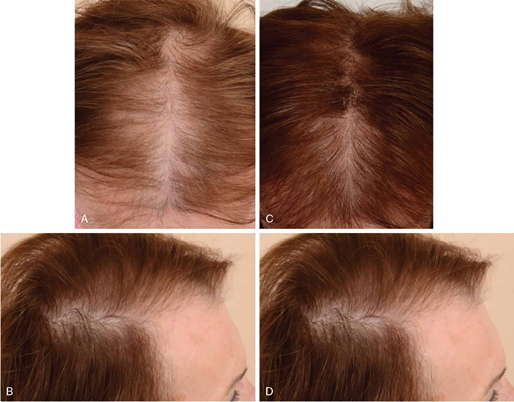 Clinical example : A 66-year-old woman before and after four PRP treatments; the patient was also using 5% minoxidil foam before PRP.
Why the last image is especially useful for patient education
Clinical example : A 66-year-old woman before and after four PRP treatments; the patient was also using 5% minoxidil foam before PRP.
Why the last image is especially useful for patient education
It demonstrates an important point: when a patient is using PRP together with another treatment, the visible improvement cannot automatically be attributed to PRP alone. Combination therapy may be the reason the overall result is better.
PRP Alone Or Combination Treatment ?
For Pattern Hair Loss, Combination Therapy Of Ten Makes More Sense
The chapter repeatedly frames PRP as an adjuvant treatment. In other words, it may add benefit to an existing treatment plan, especially when the goal is to support miniaturized follicles while medical therapy addresses other drivers of androgenetic alopecia.
| PRP | Regenerative signals and growth factors; may support follicle activity and vascularity. |
| Topical minoxidil | A first-line medical treatment for many patients with pattern hair loss; works through a different pathway. |
| Antiandrogen therapy | May target the androgen/DHT pathway in selected patients when medically appropriate. |
| Microneedling | Can create channels for transdermal delivery, but also increases potential entry points for infection or reactions; protocols are not standardized. |
PRP + Microneedling
Small randomized studies described in the chapter reported improvements with PRP combined with microneedling, including protocols also using topical minoxidil. The proposed advantage is increased access of treatment to deeper tissue around the follicle. The trade-off is that creating multiple channels in the scalp may increase the opportunity for infection, hypersensitivity or foreign-body reactions if products are placed into open channels. More high-powered studies are needed.
Avoid claims such as “PRP permanently regrows all lost hair” or “one session restores your hairline.” A more accurate statement is: “PRP may improve hair density and thickness in selected patients with pattern hair loss, particularly when used as part of an individualized treatment plan.”
Why Maintenance May Be Discussed
The longest follow-up mentioned in the chapter observed relapse around one year after the last treatment and recommended ongoing maintenance. This is consistent with the chronic nature of androgenetic alopecia: even after improvement, the biological tendency toward miniaturization remains.
8. Safety, Downtime & Side Effects
PRP Usually Has A Low & Self-Limited Side-Effect Profile
Because PRP is prepared from the patient’s own blood, it is an autologous treatment. The source chapter describes adverse events as typically temporary and mild. Patients should still receive proper medical assessment and sterile technique is essential.
| Common temporary effects | Pain or tenderness at injection sites, mild swelling and bruising. |
| Occasional effect | Mild headache. |
| Aftercare in the source | Ice and acetaminophen were described for symptom management in the authors’ protocol. |
| Microneedling-specific caution | More skin entry points may increase risk of infection, hypersensitivity or granulomatous reactions to products placed into open channels. |
| When to contact the clinic | Unexpected severe pain, spreading redness, significant swelling, discharge, fever or any symptom that feels out of proportion to routine post-injection discomfort. |
Does PRP Hurt ?
Scalp injections can be uncomfortable because the scalp contains many sensory nerve endings. The exact pain-control method varies by clinic. Most expected discomfort is brief and related to the injection process itself.
Is There Downtime?
Most patients can return to routine daily activity quickly, although the scalp may feel tender and small areas of swelling or bruising can occur. Specific aftercare should follow the treating clinic’s protocol.
Safety Message For Patients“Natural” or “from your own blood” does not mean “zero risk.” PRP should still be performed with appropriate patient selection, sterile technique, medical supervision and a clear follow-up plan.
