

What Is Hair Transplantation ?
Moving permanent donor hair to areas that have thinned.Hair transplantation is an outpatient surgical procedure that relocates a patient’s own follicular units from a donor area—usually the back of the scalp—to areas where density has been lost.
The principle is often described as donor dominance: transplanted follicles tend to retain the growth characteristics of the area from which they were harvested. This is why carefully selected hair from the mid-occipital scalp can continue to grow after it is moved to the frontal scalp or another recipient area.
Why Modern Results Look Different From Old “Hair Plugs”Older techniques often moved large plugs containing many follicles and could look unnatural. Modern transplantation uses individual follicular units, allowing the surgeon to create softer, more natural-looking density and hairline transitions.
Common Reasons Patients Consider A Transplant
- Male pattern hair loss with a suitable donor area.
- Female pattern hair loss with adequate donor density and realistic density goals.
- Reconstruction of hairlines lost after trauma or surgery.
- Selected inactive inflammatory scalp conditions after a sufficiently stable period.
- A desire for greater visible density when medical therapy alone has not achieved the cosmetic goal.
The source chapter advises against transplantation in alopecia areata, active inflammatory scalp disease or active infection. A consultation should first establish the diagnosis and confirm that the pattern of hair loss and donor area are suitable.
Who Is A Good Candidate?
Candidate Selection is One Of The Most Important Parts Of Success
A technically well-performed transplant can still disappoint if the donor area is weak, hair loss is continuing rapidly, expectations are unrealistic, or the long-term pattern of thinning has not been considered. The source chapter emphasizes that donor density, hair caliber and stability of hair loss are central to patient selection.
| Factor | More favorable candidate | Less favorable candidate |
|---|---|---|
| Hair-loss pattern | Stable or medically controlled pattern hair loss. | Ongoing, rapidly progressing hair loss. |
| Donor density | Good donor density; the source uses >80 follicular units/cm² as an example of a strong donor area. | Low donor density; the source uses <50 follicular units/cm² as a relatively poor donor characteristic. |
| Hair caliber | Thicker-caliber hair, which creates greater perceived coverage. | Fine-caliber hair, which can produce a lighter visual density even with the same graft number. |
| Expectations | Understands the limits of donor supply and the need for long-term planning. | Expects unlimited density, a very low juvenile hairline, or a permanent stop to future hair loss. |
Realistic Expectations = Better Satisfaction
The transplant adds follicles, but the patient’s non-transplanted hair can continue to thin. The source summarizes this simply: perceived density after surgery reflects transplanted hair minus ongoing hair loss.
What Should Be Assessed During Consultation ?
- Diagnosis and pattern of hair loss.
- Donor density, donor stability and follicle caliber.
- Age, family history and likely future progression.
- Current or previous medical therapy for hair loss.
- Hairline design that will remain natural if future loss occurs.
- Whether one procedure is likely to be enough or future sessions may be needed.
What Can A Hair Transplant Realistically Achieve ?
The Goal Is A Natural Frame— Not An Unlimited Number Of New Follicles
Hair frames the face, and restoring the frontal frame can make a substantial cosmetic difference. Modern follicular-unit transplantation is designed to create natural-looking transplanted hair. The procedure cannot manufacture an unlimited donor supply, and it does not treat the biological process that is causing ongoing pattern hair loss.
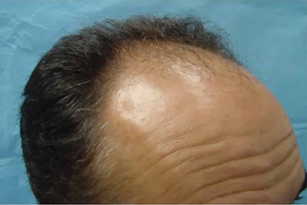
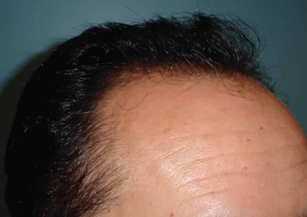
A strong photographic result does not mean every patient will achieve the same density. Donor density, hair caliber, scalp-to-hair color contrast, curl, recipient area size, graft survival and ongoing hair loss all influence the final visual effect.
How Many Procedures Are Needed?
The source chapter notes that many patients are satisfied after one or two procedures. A patient with a stable pattern and successful medical management may need only one procedure for the intended cosmetic goal, while ongoing loss can create a need for additional surgery over time.
| One procedure may be enough when… | Hair loss is stable, the donor area is strong and the cosmetic goal is limited and realistic. |
| Additional procedures may be considered when… | Hair loss continues, the treatment area expands, or the patient wants greater density within the limits of donor supply. |
| Long-term planning matters because… | A transplant moves hair; it does not stop future male or female pattern hair loss in non-transplanted follicles. |
FUE VS FUT : What Is The Difference ?
Both Are Modern Donor – Harvesting Techniques
The two main approaches described in the chapter are follicular unit extraction (FUE) and elliptical donor harvesting, commonly called follicular unit transplantation (FUT). Neither is automatically “best” for every patient.
| Feature | FUT / strip harvesting | FUE |
|---|---|---|
| How donor hair is obtained | A narrow ellipse of donor scalp is removed and divided under magnification into individual follicular units. | Follicular units are removed individually from the donor scalp using small punches or assisted devices. |
| Scar pattern | Produces a linear donor scar that is usually hidden by longer hair. | Produces many small pinpoint scars rather than one linear scar. |
| Hair length preference | Often suitable for patients who plan to keep the donor hair long enough to cover the linear scar. | Often attractive to patients who wear or may want to wear the donor hair closely cropped. |
| Procedure character | Surgical strip harvest with closure of the donor site. | No linear donor incision or sutured donor scar; individual graft extraction. |
| Best choice | Depends on donor characteristics, hairstyle, graft needs and patient priorities. | Depends on donor characteristics, hairstyle, graft needs and patient priorities. |
FUE Is Popular, But FUT Remains A Valid Option
The source chapter describes both methods as state-of-the-art. The decision should be individualized rather than based on marketing language or a single technique being presented as superior for everyone.
How FUT / Strip Haevesting Works
A Narrow Donor Strip is Removed & Divided Into Individual Follicular Units
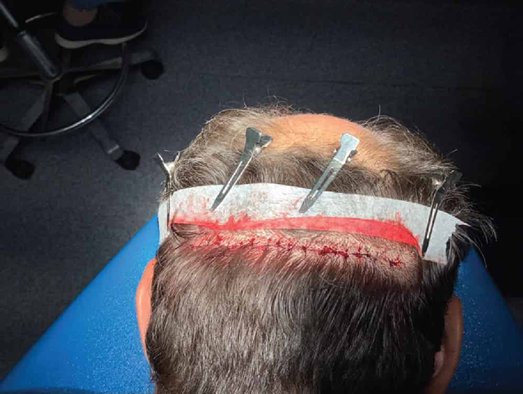
In FUT, the donor area is prepared and a narrow ellipse of scalp is removed from the occipital donor region. The donor wound is then closed, while the harvested strip is carefully dissected under magnification into individual follicular-unit grafts for placement into the recipient area.

Preparing Follicular Units From The Donor Strip
The harvested tissue is separated into smaller sections and then into individual follicular units under magnification. Careful graft handling is essential because physical trauma, drying or crushing can reduce graft survival.

Main Trade – Off With FUT
FUT can provide a large number of grafts while preserving the ability to keep much of the surrounding donor hair long. The trade-off is a linear scar in the donor area, which can become visible if the hair is cut very short.
How FUE Works
Follicular Units Are Removed One By One
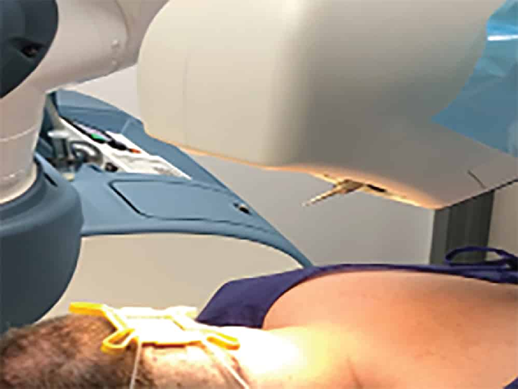
FUE avoids a single linear donor scar by extracting individual follicular units directly from the donor scalp. The chapter describes manual, mechanical and robotic-assisted approaches using small punches. The extracted grafts are then stored appropriately before they are placed into the recipient area.
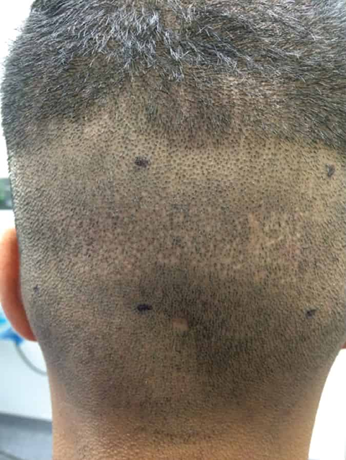
FUE Does Not Mean “Scar-Free”
FUE replaces a linear scar with many tiny circular scars. The appearance of the donor area depends on punch size, extraction density, healing, hair length and the patient’s individual scarring response.
Creating The Recipient Area
Natural Results Depend On Design As Much As Graft Harvesting
Once donor follicles are harvested, the recipient area is anesthetized and the grafts are placed into carefully planned sites. The angle, direction, spacing and distribution of follicular units determine whether the result looks natural—not just the total number of grafts.
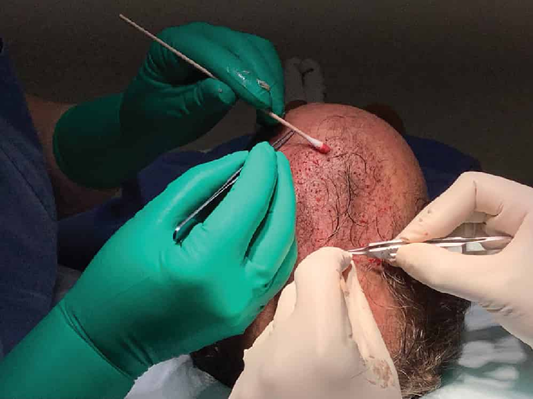 Hairline Design Must Anticipate The Future
A very low or perfectly straight hairline may look unnatural as surrounding native hair continues to recede. The source chapter emphasizes designing a mature, natural hairline that can still look appropriate years later.
Why The Frontal Scalp Often Receives Priority
For many men, concentrating donor hair in the frontal half of the scalp produces the greatest cosmetic effect while reducing the risk of an isolated transplanted “island” if vertex hair loss expands in the future. In women, the frontal hairline is often preserved but can become see-through, so carefully adding density to the frontal scalp may improve coverage while maintaining the existing hairline shape.
Recovery & Hair-Growth Timeline
Transplanted Follicles Need Time
Hair transplantation is not an instant-density procedure. The scalp heals first, transplanted follicles often enter a resting phase, and visible growth develops gradually over many months.
| First 24–48 hours | Mild swelling, tightness or tenderness can occur. A protective dressing may be used depending on technique and clinic protocol. |
| First 6–10 days | Small crusts around grafts gradually loosen with gentle washing. Patients should avoid picking or scratching the recipient area. |
| About 1 week | Many normal activities can be resumed, although strenuous or sweaty exercise is commonly restricted during early healing. |
| First few months | Transplanted hairs may shed and follicles can enter a resting phase. This does not necessarily mean the graft has failed. |
| Around 3–6 months | New growth begins to become more apparent, but density is still immature. |
| Around 9–14 months | The source chapter notes that a clear cosmetic difference may take this long to become evident as transplanted hair matures gradually. |
Photographs Are Important
Because growth develops gradually, standardized baseline and follow-up photographs help patients see changes that may be difficult to notice from day to day.
Aftercare Principles
- Follow the surgical team’s washing and wound-care instructions exactly.
- Avoid picking scabs or rubbing newly placed grafts during early healing.
- Avoid heavy exercise until the surgeon confirms that donor and recipient areas are ready.
- Contact the clinic for unexpected or increasing pain, drainage, fever or other concerning symptoms.
- Use only medications and topical products specifically recommended for the individual case.
Side Effects, Risks & Complications
Most Complications Are Uncommon, But Good Planning Is Essential
The scalp has a strong blood supply, and the source chapter describes medical and surgical complications as relatively rare. Normal healing changes can include temporary swelling, itching and crusting. The more important long-term risks often relate to poor donor harvesting, poor hairline design, overharvesting or failure to plan for future hair loss.
| Category | Examples | What patients should know |
|---|---|---|
| Common / expected | Temporary edema, itching, crusting, folliculitis or short-term shedding. | Usually manageable and self-limited when postoperative care is followed. |
| Less common | Infection, persistent numbness or pain, a broad donor scar, poor wound healing. | Should be assessed promptly by the treating surgical team. |
| Planning-related | Unnatural low hairline, straight hairline, overharvested donor area, isolated transplanted “islands” as future hair loss progresses. | Often preventable with conservative design, realistic density goals and long-term planning. |
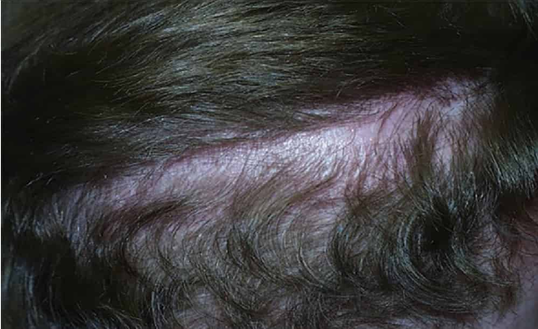
Why Medical Therapy Still Matters After Transplant
A Transplant Relocates Hair—It Does Not Switch Off Pattern Hair Loss
The transplanted follicles may continue to grow for years, but native follicles around them can keep miniaturizing. For appropriate patients, effective medical therapy can help preserve existing hair and protect the visual density created by surgery. The source chapter specifically states that combination treatment with medical therapy allows the greatest long-term density.
Think In Decades, Not Only In Graft NumbersA successful plan asks: “Will this hairline and distribution still look natural if the patient loses more native hair in five or ten years?” The answer influences hairline height, donor allocation and whether the crown should be treated aggressively.
Why Graft Number Alone Is A Poor Way To Judge Quality
- The same graft number can look very different in thick versus fine hair.
- Curly hair often creates more visual coverage than straight hair with the same number of follicles.
- A large recipient area spreads grafts more thinly than a smaller focused area.
- Donor supply is finite; using too much donor hair early can limit future options.
- Natural angles, direction and hairline design are as important as raw density.
Hair Transplantation In Men Vs Women
The Goals Are Often Different
| Men | Women | |
|---|---|---|
| Typical concern | Receding frontal hairline, frontotemporal recession and/or vertex loss. | Diffuse central thinning and a widening or see-through part / frontal density loss. |
| Long-term design challenge | Hairline and temporal recession can continue, so a conservative mature hairline is important. | The frontal hairline is often maintained, so treatment may focus more on improving density behind an intact hairline. |
| Donor assessment | Must confirm a stable donor zone and plan for possible future progression. | Diffuse thinning can sometimes involve donor regions, so careful donor evaluation is especially important. |
| Technique choice | FUE may appeal to patients who keep the donor hair very short; FUT can still be appropriate in selected patients. | The source notes that many women prefer FUT because longer hair can camouflage the linear donor scar and donor trimming. |
Not Every Pattern Of Thinning Is Transplantable
Diffuse hair loss, inflammatory disease, alopecia areata, active infection or an unstable donor area may change the diagnosis, candidacy or timing. A transplant consultation should begin with diagnosis—not with choosing FUE or FUT.
