
Endolift for Under-Eye Bags in Abu Dhabi
Under-eye bags are not all the same. They can be influenced by lower-eyelid skin laxity, reduced collagen and elasticity, orbital fat prominence, tear-trough anatomy, fluid retention, or a combination of these factors. Because the causes differ, the best treatment should be selected after assessing the anatomy rather than choosing a device based on the appearance alone.
Endolift is a minimally invasive laser-assisted technique that can be considered for selected patients when skin laxity, fine wrinkling and mild-to-moderate lower-eyelid bagging are important components of the concern. A published case series specifically evaluated Endolift for lower eye bags and reported measurable changes in wrinkles, skin thickness, density and elasticity at six months.
Evidence :
In a 2022 study of nine patients aged 35–75 years, Endolift treatment for lower eye bags was followed for six months. About 90% of patients were rated as having good or very good improvement, and the study reported significant improvements in wrinkle measurements and skin elasticity. Because this was a small case series without a control group, the results should be interpreted as promising early evidence rather than a guarantee of outcome.
Why do under-eye bags form?
The lower eyelid is anatomically delicate, and several changes can contribute to a “baggy” or tired appearance. The published study highlights reduced skin elasticity, orbital fat prolapse and under-eye hollowness as common anatomical contributors. Aging can also reduce collagen support, making the thin lower-eyelid skin more prone to laxity and visible wrinkling.
- Skin laxity and reduced collagen support
- Prominent or prolapsing orbital fat pads
- Tear-trough or lid-cheek junction hollowing
- Fine wrinkles and crepey lower-eyelid skin
- Fluid retention or puffiness that may fluctuate
- Genetic and age-related structural changes
How does Endolift work under the eyes?
Endolift uses a very fine optical fiber passed beneath the skin. The technique combines controlled movement of the fiber with diode-laser energy delivered in the subdermal plane. The aim is to stimulate tissue remodeling, collagen and elastin production, and improve the quality and support of the lower-eyelid skin. In the published study, Endolift was used as a single treatment without another procedure being added, allowing the investigators to assess the treatment more directly.
What did the 2022 study actually show?
| Study detail | Published information |
|---|---|
| Design | Case-series / pilot study |
| Participants | 9 patients: 4 men and 5 women |
| Age range | 35–75 years |
| Treatment | One Endolift session for the lower eye bag area |
| Follow-up | 6 months |
| Assessment | Visioface wrinkle analysis, Cutometer elasticity testing, ultrasonography, 3 blinded dermatologists and patient satisfaction |
| Clinical improvement | Good or very good improvement in about 90% of patients |
| Patient satisfaction | Good or very good improvement reported by about 90% of patients |
| Safety in this cohort | No severe bruising or swelling was observed; no side effect or recurrence was reported during the 6-month follow-up |
| Important limitation | Very small sample size; larger studies are needed |
Objective changes measured at 6 months
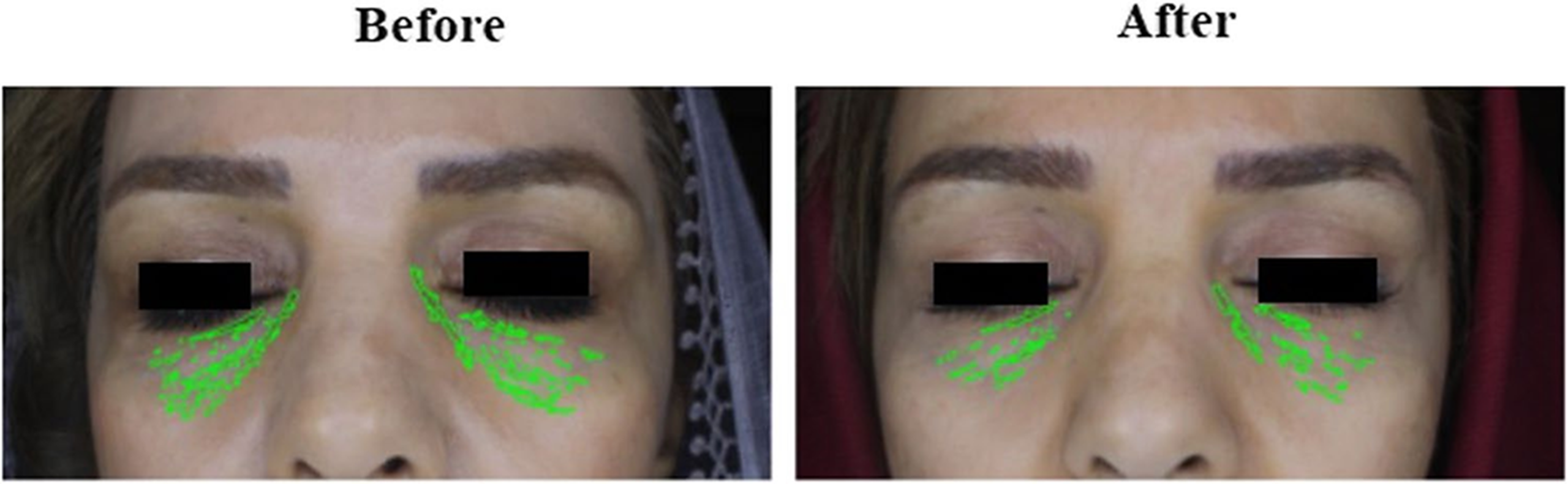
One strength of the study is that the investigators did not rely only on before-and-after photographs. They also used biometric tools to quantify changes in wrinkles, skin structure and elasticity. Several measurements showed statistically significant improvement at six months.
Published Visioface analysis

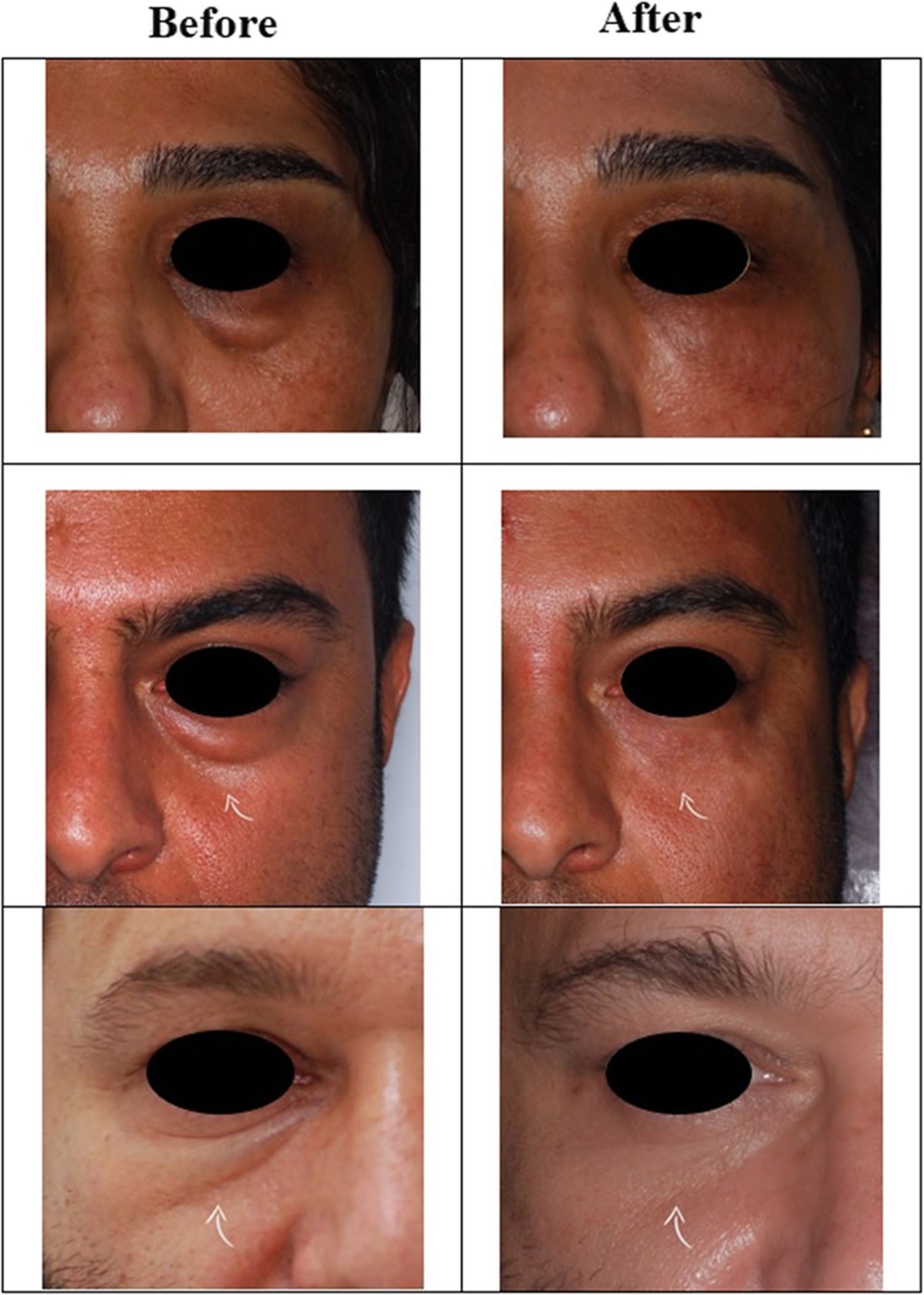
Clinical before-and-after examples from the publication
Who may be a suitable candidate for Endolift under the eyes?
The key question is not simply whether a patient “has eye bags,” but what is producing the appearance. Endolift may be considered when lower-eyelid skin laxity, fine wrinkling and mild-to-moderate bagging are meaningful components. Marked fat herniation, significant skin excess, strong tear-trough hollowing or medical causes of swelling may require a different approach.
- Mild-to-moderate lower-eyelid laxity or crepey skin
- Fine wrinkles in the lower-eyelid or lid-cheek transition area
- Early or moderate bagging where skin quality is part of the problem
- Preference for a minimally invasive option with limited downtime
- Realistic expectations and willingness to wait for progressive remodeling
When Endolift may not be the best first option
- Severe lower-eyelid skin excess or prominent fat prolapse that may be better addressed surgically
- Predominant tear-trough hollowing without meaningful laxity, where another treatment may be more appropriate
- Active infection, significant inflammation or unsuitable skin condition in the treatment area
- Eye-bag swelling driven by an underlying medical or fluid-retention problem
- Expectations of complete removal of all lower-eyelid bags or wrinkles from one treatment
Endolift vs filler vs lower blepharoplasty
These treatments target different anatomical problems, so they should not be viewed as interchangeable.
| Option | Best suited to | Main advantage | Key limitation |
|---|---|---|---|
| Endolift | Skin laxity, fine wrinkles, selected mild/moderate bags | Targets skin quality and remodeling without excisional surgery | Not a replacement for surgery in advanced structural cases |
| Hyaluronic acid filler | Selected hollowness / tear-trough contour deficit | Can improve shadowing and contour in appropriate anatomy | Does not remove true excess skin or significant fat bags; vascular safety is critical |
| Lower blepharoplasty | Marked skin excess and/or prominent fat prolapse | Most direct structural correction for advanced bags | Surgery, recovery and surgical risks |
What to expect from treatment
- Assessment — The lower eyelid and lid-cheek junction are examined to identify laxity, fat prominence, hollowness and skin quality.
- Treatment planning — The treatment area and depth are individualized; the lower eyelid requires conservative technique because of its delicate anatomy.
- Fiber-based treatment — A fine optical fiber is used in the subdermal plane to deliver laser energy and stimulate remodeling.
- Early recovery — Temporary swelling, tenderness or redness can occur even though the small published series did not report severe bruising or swelling.
- Progressive result — Collagen remodeling is gradual. The source study evaluated the final outcome at six months, so immediate post-treatment appearance should not be treated as the final result.
Recovery and downtime
The study described the treatment as having minimal downtime, and no severe bruising or swelling was observed in its nine patients. In real-world practice, however, any procedure around the lower eyelid can produce temporary swelling, redness, tenderness or bruising. Recovery varies with anatomy, technique and individual healing response. Patients should follow the treating physician’s aftercare instructions and seek review if symptoms are unusual, severe or progressive.
How long do results take?
Endolift is not only a “day-one” treatment. The goal is tissue remodeling, and collagen-related changes develop over time. The published study assessed biometric and photographic outcomes at six months. For website messaging, it is more accurate to describe results as progressive rather than promise a fixed result after a specific number of days.
How many sessions are needed?
The published lower-eye-bag study used a single treatment session and assessed patients six months later. That does not mean every patient requires exactly one session. The number of treatments should be individualized based on anatomy, degree of laxity, response and overall treatment plan.
Safety: what the evidence does and does not tell us
In the nine-patient case series, the authors reported no severe bruising or swelling and no side effect or recurrence during six months of follow-up. This is reassuring, but the study is too small to establish the full frequency of uncommon complications. The lower eyelid is a high-precision anatomical area, and treatment should be performed by a clinician experienced in facial anatomy and laser-based procedures.
