
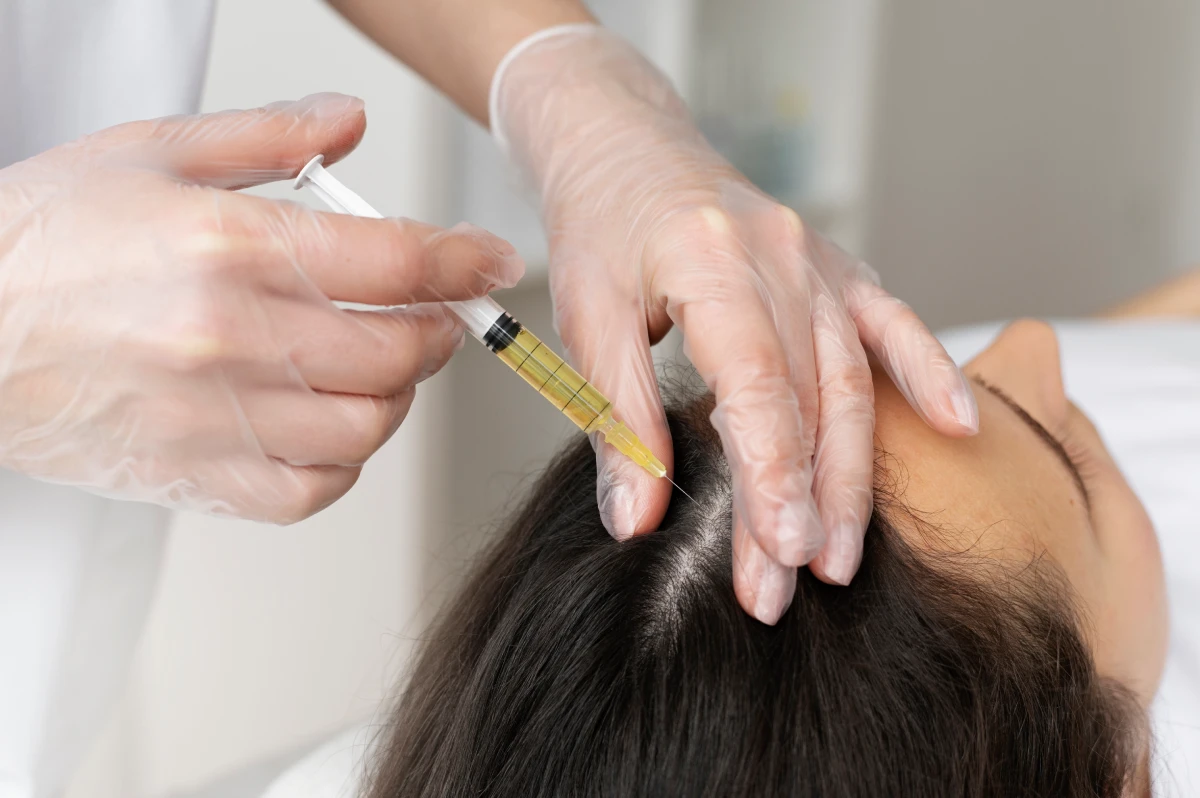
What Is PRP?
Platelet-rich plasma (PRP) is prepared from autologous blood — meaning the patient’s own blood. The supplied dermatology source defines PRP as plasma containing a platelet concentration approximately three to five times above baseline. The blood is centrifuged to separate platelet-poor plasma from the platelet-enriched fraction used for treatment.
Because PRP is autologous, the source describes it as generally safe from an immune-reaction perspective. Its attraction in dermatology is biological: activated platelets release a complex mixture of growth factors, cytokines and chemokines involved in tissue repair, cellular signaling and matrix remodeling.
How Does PRP Work in the Skin and Hair?
Platelet alpha-granules release biologically active signals after activation. These signals can influence cell proliferation, differentiation, migration, angiogenesis and extracellular-matrix remodeling. The biological effect is not produced by a single growth factor; it is the result of a complex mixture whose concentration can differ between patients and preparation systems.
| Growth factor | Source-supported role | Why it matters in dermatology |
|---|---|---|
| PDGF | Fibroblast activation; angiogenesis; fibrous-tissue formation; re-epithelialization | Dermal remodeling, wound-healing biology and hair-follicle signaling |
| TGF-β1 | Matrix remodeling; fibroblast/myofibroblast differentiation; collagen production | Collagen and extracellular-matrix remodeling; scar biology |
| VEGF | Angiogenesis; endothelial-cell growth and migration | Supports neovascularization and vascular signaling |
| FGF-2 / KGF | Epithelial, keratinocyte, endothelial and fibroblast proliferation/migration | Skin repair and dermal-papilla / hair-follicle biology |
| EGF | Epidermal-cell proliferation and migration | Epidermal repair and cellular turnover |
| HGF | Extracellular-matrix formation and tissue growth | Tissue regeneration signaling |
| IGF-1 | Cell proliferation, differentiation and migration | Cellular growth signaling; relevant to hair-cycle biology |
PRP for Skin Rejuvenation
Aging skin is associated with epidermal thinning, reduced fibroblast numbers and reduced production of collagen and other extracellular-matrix proteins. The supplied chapter reports that activated PRP can stimulate human dermal fibroblast proliferation and type I collagen production. It also describes remodeling of fragmented collagen as part of the biological rationale for rejuvenation.
Clinical studies cited in the source reported improvement in general appearance, firmness/sagging and wrinkle state after repeated facial PRP sessions, and another study reported improved skin turgor with increased epidermal and dermal thickness. These findings support PRP as a regenerative option, but they should not be presented as a guaranteed result for every patient.
DOES PRP BUILD COLLAGEN ?
The source supports a collagen-remodeling mechanism: activated PRP has been shown to stimulate dermal fibroblasts and type I collagen production, while multiple platelet-derived growth factors can influence collagen, elastin and glycosaminoglycan synthesis. The magnitude of clinical benefit varies by protocol and patient.
PRP for Atrophic Acne Scars
Atrophic acne scars contain areas of inadequate matrix deposition and appear depressed or pitted. The source reports PRP as an adjunct — rather than a stand-alone universal solution — with microneedling, fractional resurfacing, ablative fractional CO2 laser or other supplemental approaches. These combinations have been reported to improve the overall clinical response in atrophic acne scars.
The biologic rationale includes TGF-β1-mediated fibroblast and myofibroblast differentiation and extracellular-matrix deposition. Importantly, the source raises a caution that PRP may be contraindicated for hypertrophic scars because excessive fibroblast activation and collagen deposition can theoretically worsen scarring.
PRP for Hair Loss and Hair Regeneration
Most PRP data in alopecia are focused on non-scarring hair loss, particularly androgenetic alopecia. The source describes a mechanism involving dermal papilla cells, which are important regulators of hair-follicle growth and cycling. Activated PRP has been shown experimentally to increase dermal papilla cell proliferation and hair-inductive activity.
PRP-related signaling may also prolong the anagen growth phase through anti-apoptotic pathways and support the transition from telogen to anagen through angiogenesis and neovascularization involving VEGF, PDGF, EGF and FGF-2. However, the source also notes that the clinical literature remains conflicted and calls for additional data and better-standardized treatment protocols.
IS MORE PRP ALWAYS BETTER FOR HAIR ?
Not necessarily. The supplied source notes experimental data in which higher PRP concentrations did not further increase dermal papilla cell proliferation, suggesting that hair-follicle responses may be sensitive to the concentration and composition of PRP rather than following a simple “more is better” relationship.
Why PRP Protocols Can Produce Different Results
One of the most important scientific points in the source is lack of standardization. The final PRP product can vary according to the collection device, single versus double centrifugation, anticoagulant, platelet-capture efficiency, leukocyte content, activation method, injected volume, injection technique and patient-specific biology. These variables can alter platelet quality and the concentration of released growth factors.
- Preparation device and centrifugation method
- Baseline platelet biology and patient-to-patient variability
- Leukocyte-rich versus leukocyte-poor composition
- Anticoagulant selection
- Whether and how platelets are activated
- Injection volume, depth and technique
- Treatment indication and combination procedure
Safety and Medical Assessment
PRP is autologous and is generally described as safe, but it is still a medical procedure. The source lists bleeding, infection, bruising and pain among recognized risks. It also cites rare reports of skin necrosis and blindness. These serious complications reinforce the importance of appropriate anatomy, injection technique, clinical judgment and a medically appropriate treatment setting.
MEDICAL SAFETY NOTE :
This page should not imply that PRP is risk-free or that an autologous product cannot cause procedural complications. A consultation should determine the indication, treatment area, relevant medical history and whether PRP is appropriate for the individual patient.
What Happens During a PRP Appointment?
- A blood sample is collected from the patient.
- The sample is centrifuged to separate plasma fractions and concentrate platelets.
- The resulting PRP composition depends on the preparation system and protocol.
- PRP is then applied or injected according to the clinical indication and treatment plan.
- When appropriate, PRP may be used alongside procedures such as microneedling or fractional resurfacing for selected indications.
Evidence Summary for Trust
| Indication | What the supplied source supports | Evidence nuance for copy |
|---|---|---|
| Skin rejuvenation | Fibroblast proliferation, type I collagen production, dermal remodeling; small clinical studies reported improvements in appearance, firmness, wrinkles, turgor and skin thickness. | Use “may improve / has been studied for”; avoid guaranteed rejuvenation claims. |
| Atrophic acne scars | Reported as an adjunct with microneedling and fractional/ablative laser approaches; matrix remodeling is biologically plausible. | Position as combination therapy; separate hypertrophic-scar caution. |
| Androgenetic alopecia | Mechanistic and clinical literature suggests dermal papilla stimulation, anagen support and angiogenic signaling. | State that evidence is promising but protocols and literature remain inconsistent. |
| Wound healing | PDGF, VEGF, EGF, FGF-2 and TGF-β1 participate in angiogenesis, re-epithelialization, fibroblast activity and remodeling. | Useful scientific background; avoid turning an aesthetic service page into a wound-treatment claim. |
| Melasma / other uses | Small reports and combination-treatment studies are mentioned in the source. | Do not make these core commercial claims without a dedicated evidence review. |
Source-Derived Scientific Table : Key PRP Signals
The supplied chapter includes a table linking platelet-derived growth factors to skin rejuvenation, wound healing, scar management and hair regeneration.
| Dermatologic effect | Key growth factors | Condensed mechanism |
|---|---|---|
| Skin rejuvenation / dermal remodeling | PDGF-AA/BB/AB; TGF-β1; VEGF; FGF-2/KGF; EGF; HGF | Fibroblast and keratinocyte activity; collagen/ECM remodeling; angiogenesis; epithelial and endothelial proliferation/migration. |
| Wound healing | PDGF; VEGF; FGF-2; EGF; TGF-β1 | Angiogenesis, re-epithelialization, fibroblast/keratinocyte growth and matrix deposition. |
| Scar management | TGF-β1 | Fibroblast/myofibroblast differentiation and extracellular-matrix remodeling. |
| Hair regeneration | PDGF-AA; FGF-2; VEGF; PDGF; EGF | Dermal papilla cell growth, hair-follicle induction, prolongation of anagen, angiogenesis and neovascularization. |
PRP Therapy in Abu Dhabi - Frequently Asked Questions
