
Sunekos 1200 is a non-crosslinked 1200 kDa hyaluronic-acid formulation combined with six functional amino acids. In a retrospective morphometric analysis of 32 women who underwent two treatment sessions, facial hydration increased across the zygoma, malar and jaw-angle regions, while objective measurements associated with facial width and jawline angle decreased. Marionette-line scores also improved over 12 weeks. The strongest changes were generally seen at the 12-week assessment rather than immediately after treatment. The results are encouraging, but the study was small, retrospective and lacked an untreated or ingredient-isolation control group.
The value of this study is that facial rejuvenation was not judged only by subjective before-and-after impressions. The investigators used standardized photography, caliper measurements, ImageJ morphometry and computer-assisted feature-ranking methods to quantify changes in hydration, jawline geometry, facial breadth and marionette lines.
What Is Sunekos 1200 ?
Sunekos 1200 is described as a non-crosslinked hyaluronic-acid injectable with a molecular weight of approximately 1200 kDa. The formulation also contains a functional amino-acid cluster: glycine, proline, lysine and leucine are associated with collagen synthesis, while alanine and valine are associated with elastin synthesis.
The treatment concept is centered on the extracellular matrix rather than on creating a highly crosslinked structural implant. The source material describes high-molecular-weight hyaluronic acid as contributing to hydration, antioxidant activity and a mild volumizing effect while supporting fibroblasts and other structural elements of the dermis.
Why the Extracellular Matrix Matters in Skin Aging
The dermis is a connective-tissue compartment containing fibroblasts, collagen, elastin, blood vessels and other structural components. Fibroblasts are responsible for producing much of the collagen and elastin that contribute to tensile strength, elasticity and resilience.
With aging, extracellular-matrix organization changes. The skin can become drier, thinner, less elastic and more lax, while lines and contour changes become more visible. The rationale behind combining hyaluronic acid with selected amino acids is to influence both hydration and the tissue environment in which collagen and elastin are produced.
How High-Molecular-Weight Hyaluronic Acid May Help
Hyaluronic acid is an important extracellular-matrix molecule involved in hydration and tissue mechanics. The 1200 kDa non-crosslinked HA used in this formulation is presented as a hydrating component with antioxidant and free-radical-scavenging properties.
Why the Six Amino Acids Are Included
The formulation contains glycine, L-proline, L-lysine HCl, L-leucine, L-valine and L-alanine. The source frames these as functional amino acids that support collagen- and elastin-related matrix activity rather than as conventional filler particles.
Who Was Included in the Study ?
- Women in the adult age range specified by the study protocol.
- Mild to moderate cutaneous photoaging.
- Fitzpatrick skin phototypes III and IV.
- Two completed treatment sessions.
- Standardized photographs available at baseline, before session two and at the 12-week control.
Who Was Excluded ?
- Patients with facial filler treatment within the previous 12 months.
- Previous facial plastic surgery or surgery in the treatment area.
- Recent or planned facial resurfacing during the study period, including chemical peels, dermabrasion or ablative laser resurfacing.
- Recent or planned non-invasive skin tightening, botulinum toxin, mesotherapy or facial fat injections during the study period.
How Was Facial Hydration Measured ?
Hydration-related measurements were performed in three facial regions on both sides: the zygoma, malar region and gonion or jaw-angle region. A skinfold caliper was used as part of the archived clinical measurement protocol.

How Was Lifting and Tightening Measured ?
The analysis used geometry rather than relying only on visual judgment. A reduction in gonion angle was interpreted as increased jawline lifting or tightening. The distance between the two tragus points – bitragion breadth – and the distance between the two mandibular angles – bigonion breadth – were also measured.
In this morphometric framework, reductions in facial breadth measurements were interpreted as evidence of tightening.
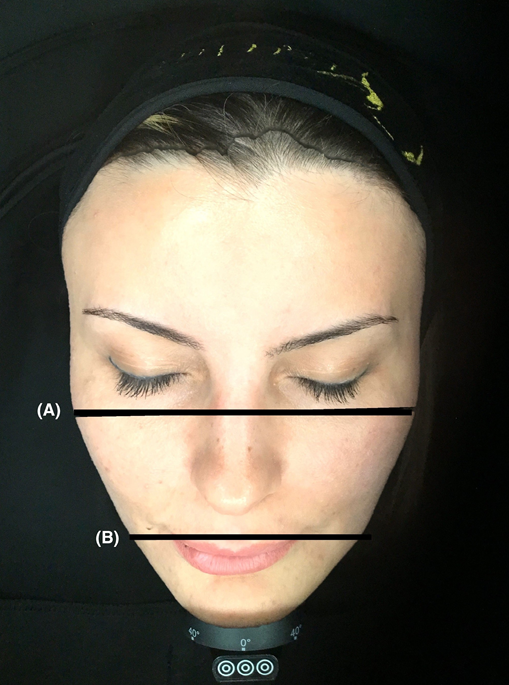
Marionette-Line Assessment
Marionette lines were graded on a five-point scale, with higher values representing more pronounced wrinkling. A decrease in the score therefore represented improvement.
Hydration Results After Sunekos 1200
Hydration increased in all three measured facial regions by the 12-week evaluation. The largest percentage change was seen in the left malar region, where the reported increase reached 47.37%.
| Region | Right side: 12-week change | Left side: 12-week change |
|---|---|---|
| Zygoma | +37.5% | +26.13% |
| Malar | +36.59% | +47.37% |
| Gonion / jaw angle | +18.60% | +25.64% |
The time course is also important. Hydration changes were already present after the first session in several regions, but the largest overall differences were observed when baseline measurements were compared with the 12-week results.
This suggests that the visible and measurable response was not limited to immediate injection-related hydration. The later measurements remained higher after the treatment period.
Jawline Lifting : Gonion Angle Changes
Gonion angle was used as an objective surrogate for jawline lifting. After the first session, the angle decreased by an average of 2.57° on the right and 2.59° on the left.
When baseline was compared with the 12-week assessment, the average decrease was 4.65° on the right and 3.97° on the left. Within the study’s measurement framework, these reductions were interpreted as increased firmness and lifting.
Facial Breadth : Bitragion and Bigonion Changes
Bitragion breadth decreased from an average of 14.28 ± 0.78 cm before treatment to 13.45 ± 0.81 cm at 12 weeks.
Bigonion breadth decreased from 10.68 ± 0.98 cm to 9.77 ± 0.91 cm over the same period.
The investigators interpreted these changes as additional morphometric support for a tightening effect. These measurements should not be confused with surgical repositioning; they are geometric surrogates captured from standardized images.
Marionette Lines: What Changed ?
The average marionette-line grade decreased from 3.75 ± 0.80 before treatment to 2.81 ± 0.78 at 12 weeks. This was statistically significant in the study analysis and was interpreted as improvement in minimal to moderate wrinkling around the lower face.
Summary of the Main 12-Week Morphometric Outcomes
| Outcome | Baseline | 12-week result | Interpretation in the study |
|---|---|---|---|
| Bitragion breadth | 14.28 ± 0.78 cm | 13.45 ± 0.81 cm | Reduced facial breadth / tightening |
| Bigonion breadth | 10.68 ± 0.98 cm | 9.77 ± 0.91 cm | Reduced lower-face breadth / tightening |
| Marionette-line grade | 3.75 ± 0.80 | 2.81 ± 0.78 | Fewer / less prominent marionette lines |
| Gonion angle change | Baseline reference | −4.65° R / −3.97° L vs baseline | Jawline lifting surrogate |
| Hydration | Baseline reference | Higher in all 6 measured sites | Improved skin hydration |
Why the 12-Week Results Matter
Many injectable treatments create an immediate change because fluid or product has just been placed into the tissue. The study design is useful because the largest statistical differences were generally seen at the 12-week assessment.
That does not prove new collagen or elastin production directly, because no biopsy or biochemical tissue assay was used in this clinical analysis. It does show that the morphometric changes persisted beyond the immediate post-injection period.
What Did the Statistics Show ?
Most morphometric parameters showed statistically significant differences when baseline was compared with 12 weeks. This included hydration measures, gonion angles, bitragion breadth, bigonion breadth and marionette-line grading.
Not every parameter changed significantly after the first session. For example, some gonion hydration and left zygoma hydration measurements did not reach significance at the earliest comparison. The stronger and more consistent signal emerged over the longer 12-week interval.
Did Lifestyle Factors Influence the Results ?
The study explored associations with smoking, BMI, exercise and daily water intake. Some correlations were statistically significant, including relationships between BMI and lower-face breadth or marionette-line measurements, and between smoking or exercise and selected hydration or angle measurements.
These exploratory correlations should be interpreted cautiously. The sample was small, multiple variables were tested, and the authors specifically noted that intrinsic and extrinsic aging factors could influence the results.
What Makes This Study Different From a Typical Before-and-After Report ?
- Standardized imaging rather than casual smartphone photography.
- Objective facial geometry measurements using Image.
- Hydration-related measurements in six facial sites.
- A numerical marionette-line scale.
- Computer-assisted feature ranking in addition to conventional statistics.
- A later 12-week assessment rather than relying only on immediate post-injection appearance.
What the Study Does Not Prove
The results are useful, but they should not be overextended. The analysis does not prove that Sunekos 1200 produces the same degree of tightening, hydration or wrinkle improvement in every patient.
- The study was retrospective.
- Only 32 women were included.
- There was no untreated control group in the reported clinical analysis.
- The study did not isolate hyaluronic acid alone versus amino acids alone.
- The main follow-up was 12 weeks, so longer-term durability was not established.
- The study population was limited to selected adult women with mild/moderate photoaging and Fitzpatrick III-IV skin types.
- The study was funded by Professional Dietetics S.p.A., the manufacturer associated with the product.
Sunekos 1200 vs. a Conventional Volumizing Filler
The formulation evaluated here used non-crosslinked 1200 kDa hyaluronic acid with amino acids. The study’s endpoints were skin hydration, morphometric tightening and wrinkle-related changes rather than correction of a single structural volume deficit.
The source does describe a volumizing property of the high-molecular-weight HA, but the clinical study should be interpreted primarily as a skin-quality and morphometric rejuvenation analysis rather than as evidence of a filler-like lifting effect.
What Results Might a Patient Notice First ?
Hydration was one of the earliest measurable changes and was also the strongest category in the computer-assisted analysis. This makes improved skin hydration a plausible early clinical feature of the response.
Jawline measurements and marionette-line grading also improved, but the strongest overall statistical differences were generally seen at 12 weeks. Patients should therefore avoid judging the final response only in the first days after injection.
How Many Sessions Were Used ?
The women included in this analysis had two Sunekos 1200 treatment sessions. The second session occurred approximately two weeks after the first, and the main later assessment was performed at 12 weeks.
The manuscript focuses on outcomes and morphometric analysis rather than providing a detailed point-by-point injection map or standardized per-point dose. A clinical injection protocol should therefore come from the product’s current professional instructions and clinician training rather than being reconstructed from this outcome study.
Potential Candidates for a Sunekos 1200 Consultation
Based on the population studied, the treatment is most directly relevant to adults with early-to-moderate facial aging where hydration loss, mild laxity, lower-face contour changes and marionette-line development are important concerns.
- Dry or poorly hydrated facial skin.
- Mild to moderate photoaging.
- Early loss of firmness or elasticity.
- Lower-face and jawline soft-tissue laxity.
- Marionette-line development.
- Patients seeking a non-crosslinked HA-and-amino-acid skin-quality approach rather than a highly structural filler correction.
Sunekos 1200 in Abu Dhabi : What to Ask Before Treatment
For patients considering Sunekos 1200 in Abu Dhabi, a useful consultation should focus on the tissue problem rather than the product name alone.
- Is my main concern dehydration, laxity, marionette lines, volume loss or a combination ?
- Would Sunekos 1200 be used alone or as part of a broader skin-rejuvenation plan ?
- How many sessions are planned and when should the result be evaluated ?
- Is the goal skin quality or structural volumization ?
- How will my previous filler, botulinum toxin or energy-based treatments affect timing ?
- Which changes should be expected early, and which may take several weeks ?
Treatment Timeline Based on the Clinical Analysis
Before session 1 : Baseline standardized photographs and morphometric measurements.
Around 2 weeks : Second treatment session and repeat photography/measurement.
Following weeks : Hydration, firmness and morphometric changes continue to evolve.
12 weeks : The strongest overall differences were generally documented at this later assessment.
