

Hand Rejuvenation with Radiesse : Why a Dual CaHA Approach Is Different
The hands often reveal age through a combination of soft-tissue volume loss, increased visibility of veins and tendons, and reduced skin elasticity. Calcium hydroxyapatite (CaHA) filler can be used in two distinct ways: in a nondiluted form to provide volumization, and in a diluted or hyperdiluted form to support biostimulation and skin-quality improvement. The clinical paper used as the evidence base for this guide specifically investigated both strategies together in the same treatment session.
What causes hands to look older?
In the study, the aesthetic concerns prompting treatment were visible veins and tendons together with loss of skin elasticity. These features reflect the two main problems a rejuvenation plan may need to address: loss of volume and deterioration in skin quality.
- Volume loss can make tendons and veins look more prominent.
- Reduced elasticity can make the dorsal hand appear thinner and more aged.
- A treatment focused only on filling may not address skin quality, while a purely biostimulatory strategy may not immediately replace lost volume.
The core concept : two formulations, two roles
| CaHA formulation | Primary role in the cited study | Target layer / objective |
|---|---|---|
| Nondiluted CaHA (Radiesse) | Volumization | Placed to restore atrophic areas and provide structural fullness |
| Diluted CaHA | Biostimulation | Used to support collagen- and elastin-related improvement in skin quality |
| Combined approach | Dual correction | Aims to address both volume loss and skin-quality changes in the same overall plan |
Clinical images preserved from the source article

What Did the Clinical Study Actually Test?
A strong patient-facing article should separate what was directly studied from what is merely plausible. This study was a focused clinical evaluation of a specific combined CaHA protocol rather than a head-to-head trial against hyaluronic acid fillers, surgery, lasers, or other biostimulators.
| Study feature | Details reported in the article |
|---|---|
| Participants | 40 White female patients |
| Age range | 45–57 years |
| Baseline concern | Visible veins and tendons plus loss of hand skin elasticity |
| Severity | Only grade 4 on the five-point hand grading scale |
| Treatment concept | Nondiluted CaHA for volumization + diluted CaHA for biostimulation in the same session |
| Treatment timing | Baseline, then the same protocol repeated at 2 months and 4 months |
| Follow-up points | 14 days, 2 months, 4 months, and 6 months |
| Main outcome measured | Patient satisfaction score from 1 (not satisfied) to 5 (very satisfied) |
| Serious complications | None reported in the study |
Results : What Happened Over Six Months?
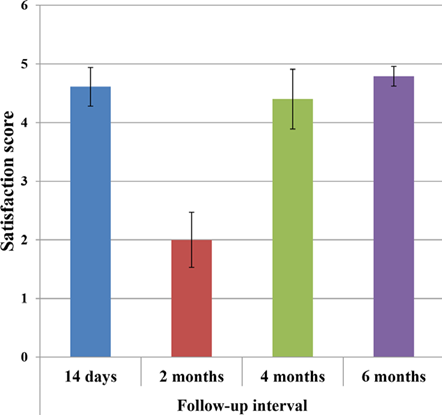
Patient satisfaction changed over time in a pattern that is particularly useful for expectation setting. Satisfaction was high at 14 days, dropped at the 2-month assessment, then increased again at 4 months and was highest at the 6-month follow-up. The same treatment protocol was repeated at the 2- and 4-month visits, which is important when interpreting the later scores.
| Follow-up | Mean satisfaction score | Change vs day 14 | Interpretation |
|---|---|---|---|
| 14 days | 4.61 ± 0.33 | Baseline comparison | High early satisfaction |
| 2 months | 2.00 ± 0.47 | −56.6% | Marked decline before the next stages of the protocol |
| 4 months | 4.40 ± 0.51 | −4.6% | Satisfaction returned close to early levels |
| 6 months | 4.79 ± 0.17 | +3.9% | Highest mean score reported in the study |
RESULT IN ONE SENTENCE
The study reported a favorable 6-month patient-satisfaction outcome with no serious complications, but it did not include a control group and did not objectively measure skin quality with imaging or biomechanical devices.
What Can the Dual CaHA Strategy Potentially Improve?
Based on the goals and conclusions of the cited paper, the combined approach is designed to address two visible dimensions of aging hands: structural volume loss and skin-quality deterioration. For a website, these should be presented as treatment goals rather than guaranteed outcomes.
- A hollow or atrophic appearance on the back of the hands.
- Prominence of veins and tendons related to loss of soft-tissue coverage.
- Reduced skin elasticity and a thin, aged appearance.
- The mismatch between a rejuvenated face and hands that still appear visibly aged.
Volumization vs biostimulation: a useful patient explanation
Volumization is about replacing lost structural support. Biostimulation is about encouraging a gradual tissue response that may improve the quality and thickness of the skin. CaHA is unusual because the same material can be adapted for either role depending on how it is prepared and used by the treating physician.
| Approach | What the patient is trying to improve | Expected character of change |
|---|---|---|
| Nondiluted CaHA | Visible volume loss / atrophy | More immediate structural support |
| Diluted CaHA | Skin quality / elasticity | More gradual biostimulatory improvement |
| Dual strategy | Both concerns together | Layered plan combining immediate structure with progressive tissue-quality goals |
Who might be a reasonable candidate?
The study population had advanced hand-aging changes (grade 4 on a five-point scale), so its evidence is most directly relevant to patients with clear volume loss, visible tendons and veins, and reduced elasticity. It does not establish the optimal protocol for younger patients, men, other ethnic groups, or milder grades of hand aging.
Results Timeline: What Should Patients Understand?
Early Phase
The study recorded high satisfaction at 14 days. Some of this early effect is consistent with the volumizing component and post-treatment appearance.
Around 2 months
Mean satisfaction fell substantially in this study. This is a useful reminder that a biostimulatory plan may evolve over time and that early appearance is not the final endpoint.
4 months
Satisfaction increased again after the protocol was repeated at the 2-month visit.
6 months
The highest mean satisfaction score was recorded after the treatment plan had been repeated at both 2 and 4 months.
How long do results last?
This particular paper followed patients for six months. It therefore supports a statement that good results were observed up to six months in the studied protocol, but it does not establish the durability beyond that period. The authors specifically recommended longer follow-up and larger studies.
Safety, Limitations, and Responsible Patient Counseling
The study reported no serious complications across the treatment stages. That finding is reassuring within the study, but it should not be translated into “risk-free.” Any injectable treatment can have adverse effects, and the paper was not designed or powered to define rare complication rates.
What the source supports
- No serious complications were reported in the 40-patient study.
- Good patient-satisfaction results were observed through six months.
- The authors believed the dual approach offered synergistic volumization and biostimulation.
What the source does NOT establish
- It does not prove superiority over HA filler, PLLA, fat transfer, lasers, or other hand-rejuvenation options.
- It does not establish long-term results beyond six months for this exact protocol.
- It does not provide objective ultrasound, elasticity, or software-based skin analysis as an outcome measure.
- It does not show whether the same protocol is optimal in men, younger patients, milder hand aging, or more diverse skin types.
- It does not eliminate the need for individualized medical assessment and informed consent.
Radiesse Hand Rejuvenation in Abu Dhabi : Consultation-Focused Local Content
For patients searching in Abu Dhabi, the most useful first step is a consultation that evaluates whether the main problem is volume loss, skin-quality deterioration, or both. A dual CaHA plan is most relevant when both concerns are present and when the anatomy supports injectable treatment.
During assessment, the physician should discuss the visible structures on the dorsal hands, the degree of atrophy, skin elasticity, previous treatments, expectations, and whether a volumizing, biostimulatory, or combined strategy is appropriate. The treatment plan should be personalized rather than copied directly from a published protocol.
Why physician assessment matters
Hand rejuvenation is anatomically different from facial filling. The objective is not simply to add volume; it is to create a smoother, more youthful appearance while maintaining natural hand contours. Patient selection, product choice, treatment depth, and the balance between structure and skin quality all require medical judgment.
