

Endolift for Acne Scars in Abu Dhabi | CO₂ Laser Skin Resurfacing
Deep acne scars often need a treatment plan that works at more than one level of the skin. Rolling scars, in particular, are tethered downward by fibrous bands that connect the deeper dermis to underlying tissue. Surface resurfacing alone may improve texture, but it does not necessarily release that deep attachment. Subcision addresses the tethering; fractional CO₂ resurfacing addresses the upper dermis and surface irregularity. The combined SLASS approach is designed to treat both problems in one strategy.
The 2025 study used a 1470 nm diode fiber laser as a form of subdermal laser-assisted scar subcision (SLASS), followed in the same session by ablative fractional CO₂ laser. Forty-two patients were evaluated after the first combined session, making this a larger clinical series than earlier reports of Endolift based subcision.
CLINICAL PRINCIPLE :
This page is most relevant to rolling or “attached” atrophic acne scars. Ice-pick and sharply edged boxcar scars may require different or additional techniques. A scar-by-scar assessment is therefore more useful than choosing a device based on the word “acne scar” alone.
Why Rolling Acne Scars Are Different
Atrophic acne scars are commonly grouped into ice-pick, boxcar and rolling patterns. Rolling scars tend to have a deeper fibrous component that pulls the skin downward, creating broad depressions and an uneven shadow pattern. This deep tethering is one reason why superficial treatments alone may not fully correct them.
- Rolling Scars : broad, wave-like depressions with fibrous tethering beneath the skin.
- Boxcar Scars : wider depressions with more defined edges and variable depth.
- Ice-pick scars : narrow, deep tracks that often require focal techniques rather than simple resurfacing alone.
What Is SLASS (Subdermal Laser-Assisted Scar Subcision)?
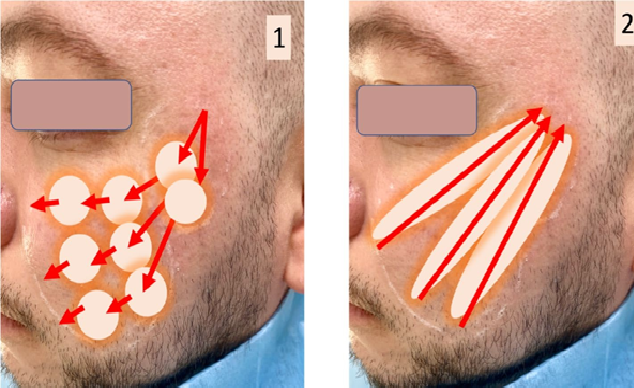
SLASS is the term proposed by the authors for using a subdermal 1470 nm laser fiber to perform scar subcision. Instead of relying only on a needle, cannula or mechanical liberator, the fiber is moved beneath the scar to release the fibrous septa while laser energy adds a controlled thermal component.
- Mechanical release : The fiber is advanced through the scarred subdermal plane to disrupt the tethering bands responsible for the depressed rolling appearance.
- Thermal effect : Energy is delivered selectively when fibrosis is encountered, adding what the authors describe as a thermomechanical subcision effect.
- Deep remodeling / tightening : A second retrograde pass is used across the treated area to support deeper collagen remodeling and tissue tightening.

Why Add Fractional CO₂ After the Subcision Step?
The two technologies work at different levels. SLASS focuses on the fibrous attachments and deeper dermal–subdermal architecture, while fractional CO₂ laser resurfaces the upper skin and creates controlled microscopic columns of injury that stimulate remodeling during healing. The study describes this as a full-depth combination: deep release underneath the scar followed by fractional treatment of the epidermal and dermal surface layers.
| Treatment Layer | Main Problem | Treatment Role | Potential Benefit |
|---|---|---|---|
| Deep dermal / subdermal | Fibrous tethering | SLASS / Endolift-assisted subcision | Release attached rolling scars and remodel deeper collagen |
| Upper dermis / epidermis | Surface texture and atrophic irregularity | Fractional CO₂ laser | Resurfacing and neocollagenesis during recovery |
| Combined strategy | Both deep attachment and surface damage | SLASS + fractional CO₂ | Treat two different scar components in the same plan |
WHY COMBINE?
The combination does not mean that every acne-scar patient needs both procedures. The rationale is strongest when rolling tethering is a major component and the patient also has surface textural damage that can benefit from fractional resurfacing.
What Did the 42-Patient Study Find?
The retrospective study included 42 patients (29 women and 13 men) with a mean age of 28 years. The analysis focused on the first combined SLASS + fractional CO₂ session. Photographs were assessed by two blinded dermatologists using validated scar scales, and patients also rated their own improvement.
| Outcome | Before → After | Study Finding |
|---|---|---|
| ECCA acne-scar score | 172.02 ± 40.8 → 79.40 ± 24.35 | Mean reduction of 92.6 ± 34.3 points; statistically significant |
| SCAR-S severity score | 4.02 ± 0.74 → 2.36 ± 0.87 | Mean improvement of 1.67 points; statistically significant |
| Patient-rated improvement | 0–10 scale | Mean subjective improvement 7.02 ± 1.3 / 10 |
| Severe adverse effects | — | None reported in the study |
The average interval to the post-treatment photographs used for analysis was approximately 16.6 weeks. The authors also reported no meaningful efficacy or safety differences by sex, age or skin phototype within this study population. This should not be interpreted as proof of equal safety in every skin type, because the study was retrospective and did not include a control group.

Who May Be a Good Candidate?
The strongest rationale is for patients whose acne scars include a clear rolling or tethered component. A clinical examination is needed to determine whether the depression is being held down by fibrous bands and how much of the visible problem comes from deep attachment versus surface texture, pigment, pore enlargement or sharply edged scars.
- Rolling or attached atrophic acne scars with visible tethering.
- Patients with a combination of deeper depressions and superficial textural irregularity.
- Stable acne scarring after active inflammatory acne is controlled.
- Patients who understand that meaningful improvement does not mean complete scar removal.
- Patients who can accept a healing period from fractional CO₂ resurfacing and follow sun-protection / aftercare instructions.
When the Plan May Need to Be Different
- Predominantly ice-pick scars may need focal treatment such as CROSS or punch-based techniques.
- Deep, sharply edged boxcar scars may require focal resurfacing, punch elevation/excision or other scar-specific strategies.
- >The published study is focused on rolling atrophic scars; it does not establish a treatment protocol for active acne or for predominantly non-rolling scar patterns.
- Because fractional CO₂ resurfacing can be associated with pigmentation changes and visible recovery, individual risk assessment and aftercare planning are important.
What Happens During the Treatment?
In the published study, topical and local anesthesia were used. The subdermal laser-assisted subcision was performed first, followed by fractional CO₂ resurfacing. For patients, the key point is not the exact device setting but the sequence: release the tethering first, then treat the surface component.
- Scar mapping and clinical assessment to identify rolling / tethered zones and determine whether additional scar types are present.
- Local preparation and anesthesia appropriate to the planned treatment area.
- Subdermal laser-assisted release of the fibrous bands using a controlled superficial subdermal plane.
- A second fiber pass for deeper remodeling / tightening of the treated region.
- Fractional CO₂ resurfacing with intensity adjusted according to scar depth and the surrounding skin.
- Post-treatment wound care, sun protection and recovery skincare.
IMPORTANT :
The exact fiber diameter, power, pulse pattern and CO₂ density used in the published study are research-protocol details and are not universal settings. Treatment parameters should be individualized by a trained clinician according to anatomy, scar depth, skin thickness and device characteristics.
Downtime, Recovery and Safety
The combined treatment has more visible downtime than Endolift-based subcision alone because fractional CO₂ intentionally creates a resurfacing injury. In the study, the expected recovery period included approximately 5–7 days of swelling, edema and crusting, mainly attributed to the CO₂ component.
- Swelling / edema and crusting : approximately 5–7 days in the study.
- Temporary sensory symptoms : some patients reported mild paresthesia for several weeks after the SLASS component.
- Motor nerve complications : none were reported in the 42-patient series.
- Severe adverse effects : none were reported in the study.
- Pigment risk : fractional laser resurfacing can carry a pigmentation risk; careful patient selection and post-treatment photoprotection remain important.
The source study used topical antibiotic after treatment, recovery cream and sun protection. Aftercare should be individualized, with particular attention to wound care and photoprotection because laser resurfacing can be associated with pigmentation changes.

How Does This Compare With Traditional Subcision?
Traditional subcision mechanically releases fibrous bands using a needle, cannula or liberator. It remains a valid and well-established acne-scar technique. The SLASS concept is different because the fiber provides both mechanical movement and a thermal effect, which the authors describe as “thermomechanical subcision.” The laser may also contribute to deep collagen remodeling and coagulation, potentially reducing bruising compared with purely mechanical approaches.
| Feature | Traditional Subcision | SLASS / Endolift-Assisted | Fractional CO₂ |
|---|---|---|---|
| Primary target | Fibrous tethering | Fibrous tethering + deeper remodeling | Upper dermis / surface texture |
| Main mechanism | Mechanical release | Thermomechanical release | Fractional ablative resurfacing |
| Surface resurfacing | No | No / limited | Yes |
| Downtime driver | Bruising / swelling varies | Swelling / sensory symptoms vary | Crusting, erythema and resurfacing recovery |
| Best role in rolling scars | Deep release | Deep release with laser-assisted remodeling | Complementary surface remodeling |
How Many Sessions Are Needed?
The study evaluated the result after the first combined session, even though some patients later received additional sessions or other treatments. That means the paper supports measurable improvement after one treatment, but it does not establish that one session is sufficient for every patient. Session number should depend on scar severity, scar type, response, downtime tolerance and whether other modalities are required.
EXPECTATIONS :
A realistic goal is improvement in scar depth, shadowing and skin texture — not “zero scars.” Acne scar treatment is usually a remodeling process, and multimodal planning is common when different scar types coexist.
