
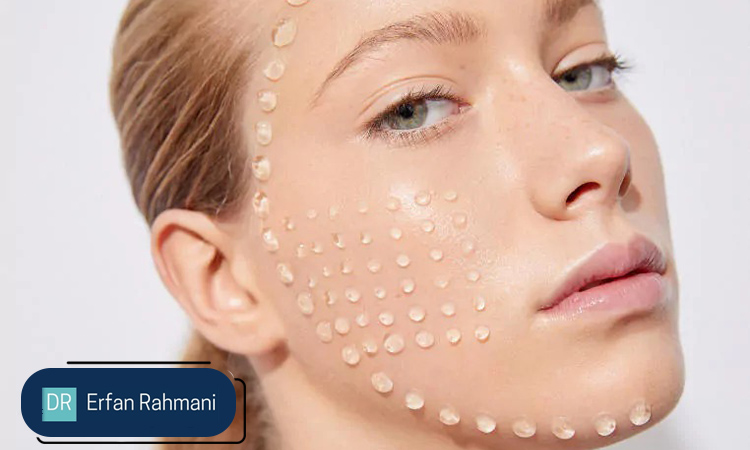
What is a hyaluronic acid skin booster?
A hyaluronic acid (HA) skin booster is an injectable treatment designed primarily to improve skin quality rather than create facial volume. Clinical studies summarized in a systematic review report improvements in hydration, texture, firmness, radiance and elasticity, with generally high patient satisfaction and mostly mild, temporary injection-site effects. Treatment plans vary by HA formulation, skin concern and patient assessment.
Hyaluronic Acid Skin Booster in Abu Dhabi
If your main goal is better skin quality – not simply more facial volume – injectable hyaluronic acid can play a different role from a conventional dermal filler. Small-particle or skin-quality-focused HA formulations are placed in or near the dermal layers to improve hydration and support the extracellular environment of the skin. The best available clinical evidence is encouraging for hydration, texture, radiance, firmness and elasticity, while also showing that results depend on product characteristics, treatment protocol and patient selection. For patients in Abu Dhabi, the practical question is not only “Does a skin booster work?” but also “Which type of injectable HA is appropriate for my skin, what can it realistically improve, how many sessions may be needed, and what are the safety considerations?” This guide answers those questions using the findings of a systematic review of injectable HA for facial skin quality.Benefits of Hyaluronic Acid Skin Boosters
- Improved skin hydration: Injectable HA can increase water content within the treated tissue and may be particularly useful when dryness or dehydration is a major concern.
- Smoother texture and reduced roughness: Several studies reported improvements in skin surface quality, smoothness and texture.
- Better elasticity and viscoelastic behavior: HA skin-quality treatments may improve how the skin stretches and rebounds rather than simply adding facial volume.
- Improved firmness and a fresher appearance: Positive studies reported improvements in firmness, radiance, brightness and overall appearance, although the degree of change varies between products and patients.
- Subtle rejuvenation without major structural change: The treatment objective is skin quality rather than reshaping the face, making it suitable for patients who want a natural-looking improvement.
- Potential collagen- and extracellular-matrix support: Some studies described fibroblast, collagen and extracellular-matrix changes after small-particle HA injections; this should not be assumed to be identical for every formulation.
- Relatively limited downtime for many patients: Common reactions are usually temporary, although bruising, swelling and tenderness can last longer in some patients.
What Does “Skin Quality” Actually Mean ?
Skin quality is broader than the presence or absence of wrinkles. In clinical aesthetic medicine, it may include hydration, smoothness, firmness, elasticity, surface roughness, radiance, brightness, texture, skin fatigue or “tired” appearance, and the overall structural behavior of the skin. The dermis contains collagen, elastin and ground substance, which together help maintain the skin’s structure and function. Fibroblasts are central to this environment because they produce important extracellular matrix components. Aging is influenced by both intrinsic factors and the “exposome” – the cumulative effect of external influences such as ultraviolet radiation, pollution, diet and lifestyle over time.What Is Hyaluronic Acid and Why Is It Used in the Skin?
Hyaluronic acid is a naturally relevant component of the skin’s extracellular environment and is well known for its capacity to bind and retain water. In dermatology and aesthetic medicine, HA has been used in multiple ways, including topical products, conventional fillers and injectable skin-quality treatments. When injectable HA is placed in the dermis, the goal can extend beyond filling a single wrinkle. HA can help increase tissue hydration and provide a supportive extracellular matrix environment. The review also discusses the possibility that dermal HA may support fibroblast activity and collagen-related remodeling, which may contribute to improvements in elasticity, texture and overall skin quality.How Is a Skin Booster Different From a Traditional Dermal Filler?
The distinction is mainly the treatment objective. Conventional HA fillers are commonly selected to restore or create volume, contour facial structures, or correct specific depressions. The systematic review intentionally excluded studies focused on contour augmentation such as lips, temples, malar volume or nasolabial fold filling because its purpose was to study skin quality. Skin-booster techniques generally use formulations and injection patterns intended to distribute HA more diffusely through the skin. Smaller HA particles and lower-density products may be placed in the dermis and can hold water with less volumizing effect than larger-particle products. Larger, denser HA products are more often placed in deeper planes when volume or structural support is required.Areas That Can Be Treated
The face is the principal area discussed in the systematic review that underpins the evidence statements on this page. In clinical aesthetic practice, selected HA skin-quality products may also be used in other areas depending on the formulation, indication and injector assessment.- Face : Commonly treated for dehydration, dullness, fine surface texture and mild loss of elasticity.
- Under-Eye Region : Only when the product and indication are appropriate; this area requires careful assessment because not every under-eye concern is a skin-booster indication.
- Neck & Décolletage : May be considered for skin-quality concerns such as dryness and crepey texture, depending on product labeling and clinical judgment.
- Hands : Selected HA formulations may be used for hand skin-quality improvement or rejuvenation when appropriate.
Skin-Quality Outcomes
| Outcome | What the evidence reported | Clinical interpretation |
|---|---|---|
| Hydration | Repeatedly improved in HA-alone studies. | Useful when dryness and reduced skin water content are major concerns. |
| Elasticity / viscoelasticity | Several studies reported improved elasticity or biomechanical recovery. | May improve how skin deforms and rebounds rather than simply changing facial volume. |
| Firmness | Improvement was reported in multiple studies, although one small study recorded reduced firmness despite improvement in other measures. | Results can vary by product, method and measurement tool. |
| Texture / roughness | Surface roughness, smoothness and texture improved in several trials. | Relevant for patients focused on skin finish and tactile quality. |
| Radiance / brightness | Improved in several studies, including some combination formulations. | Aesthetic “glow” outcomes are partly subjective but were repeatedly captured. |
| Overall appearance | Global aesthetic assessments generally improved in positive studies. | Best interpreted as an aggregate clinical outcome, not a guarantee for every patient. |
HA Alone Vs HA “Cocktails”: An Important Finding
The review separated studies of HA alone from studies that combined HA with other active ingredients such as vitamins, amino acids, minerals, coenzymes, antioxidants, mannitol or growth-factor-containing products. HA monotherapy produced more consistent positive findings. In the combination-treatment group, three studies reported meaningful improvement in skin-quality parameters, while two studies found no significant clinical or histologic changes. This does not mean that every combination product is ineffective. It means that, within this specific evidence set, HA alone had the clearer and more consistent signal. Differences in HA concentration, particle size, accompanying ingredients, study design and injection technique may all contribute to the mixed results reported with cocktails.How Injectable HA May Improve Skin Quality
- Water attraction and retention : HA has hygroscopic properties, meaning it attracts water into the tissue matrix. This can improve hydration and skin turgor.
- Viscoelastic support : The skin behaves as a viscoelastic structure rather than a purely elastic material. HA can influence the mechanical properties of the dermal environment.
- Extracellular matrix support : Dermal HA may help restore or reinforce the extracellular scaffold around fibroblasts, supporting the structural environment in which collagen and elastin function.
- Collagen-related effects : The review discusses evidence that HA microinjections may stimulate fibroblast activity and collagen production or remodeling, although the strength of this biological effect depends on product and study design.
- Diffuse skin-quality improvement : Microdroplet or micropuncture techniques distribute product through a wider treatment field, which is different from a localized bolus intended to create contour or projection.
How Many Sessions Are Usually Used?
There was no single universal protocol across the studies. However, a recurring pattern was a short treatment series, often three sessions spaced about four weeks apart. Other protocols included four sessions at 15-day intervals, treatments three weeks apart, a single treatment with optional later repeat, or other individualized schedules. The review suggests that a patient with mild loss of elasticity or firmness may sometimes be treated with a single session, whereas more pronounced skin-quality change may justify a series of approximately three treatments. This should be viewed as evidence-informed guidance rather than a rigid rule, because the studies used different HA formulations and endpoints.Who May Be a Good Candidate for an HA Skin Booster?
A skin booster may be considered when the main concern is facial skin quality rather than a need for major structural augmentation. Typical goals may include improving hydration, fine surface texture, radiance, mild loss of elasticity or a tired-looking skin quality. A consultation is important because the product, concentration, rheology, particle size, injection depth and treatment pattern should be matched to the individual rather than selected only by brand name. The review emphasizes that HA products are similar but not interchangeable. Individual assessment of facial aging and skin quality is therefore essential before treatment.What a Skin Booster Is Not Designed to Do
- It is not primarily a substitute for a structural filler when the goal is projection, contour or meaningful volume restoration.
- It is not a substitute for botulinum toxin when the main issue is dynamic expression lines caused by muscle movement.
- It is not a substitute for a resurfacing or energy-based procedure when the dominant problem is a different tissue target such as significant photodamage, scar texture or marked laxity.
- It should not be marketed as a permanent treatment; the systematic review did not establish long-term durability.
What Happens During a Skin Booster Treatment ?
A skin booster appointment typically starts with a medical consultation and skin assessment. The aim is to determine whether the main concern is dehydration and skin quality, volume loss, muscle-driven lines, laxity, scarring or another problem that may require a different treatment.- Treatment planning : The HA formulation, amount, injection pattern and treatment depth are selected according to the indication, product characteristics and anatomy.
- Preparation : The skin is cleansed carefully and a topical numbing agent may be used when appropriate.
- Injection : Depending on the product and treatment plan, HA may be placed using fine-needle microinjections, micropuncture or another suitable technique.
- Appointment Time : A typical service-page estimate is approximately 30 to 45 minutes, although treatment time varies with the area and technique.
- Aftercare : Patients receive individualized instructions about expected swelling, bruising, skin care, exercise, heat exposure and when to seek medical review.
Results and Recovery : What Is Realistic?
Skin-booster results should be described as gradual skin-quality improvement rather than an instant structural transformation. Hydration-related changes may be noticed earlier, while texture, elasticity or collagen-related changes can evolve over a longer period and may require a treatment series. There is no single universal recovery timeline. Small injection marks or redness may settle quickly in some patients, while bruising, swelling or tenderness can persist for longer. In the reviewed studies, the most common short-term effects generally resolved within less than two weeks. The systematic review did not establish one fixed duration of benefit for all HA skin boosters. Maintenance planning should therefore be individualized according to the product used, response, skin quality and treatment goals.Safety, Downtime and Possible Side Effects
Across the included studies, injectable HA for facial skin quality was generally well tolerated and no major safety signal was reported. The most common short-term adverse effects were bruising, swelling and tenderness, usually resolving within less than two weeks. The review also discusses potential skin-booster complications such as lumpiness, nodules and extrusion of material. Possible contributing factors include delayed inflammatory reactions, infection or biofilm processes, injection location and injection volume. Meticulous antisepsis, correct product selection and appropriate injection technique are important for risk reduction. Importantly, a systematic review of skin-quality studies does not capture every rare complication that can occur with injectable HA in routine aesthetic practice. Treatment should therefore be performed by an appropriately trained medical professional who understands facial anatomy, product behavior, sterile technique and complication management.HA Skin Booster vs Dermal Filler vs Botulinum Toxin
| Feature | HA skin booster | HA dermal filler | Botulinum toxin |
|---|---|---|---|
| Primary goal | Hydration and skin-quality improvement | Volume, contour and structural correction | Reduce muscle-driven dynamic lines |
| Typical placement concept | Diffuse intradermal / microinjection pattern depending on product | Targeted deeper or structural placement depending on indication | Intramuscular or targeted neuromuscular injection |
| Best suited for | Dryness, texture, radiance, mild elasticity concerns | Volume loss, contouring, defined folds / depressions | Expression lines and selected muscle-related concerns |
| Main visual change | Subtle, global improvement in skin quality | Shape / projection / volume change | Reduced movement-related wrinkling |
Hyaluronic Acid Skin Booster in Abu Dhabi : What to Ask at Your Consultation
For a patient considering an HA skin booster in Abu Dhabi, a high-quality consultation should focus on diagnosis of the skin concern rather than immediately choosing a brand or package. The discussion should include your main goals, current skin quality, previous injectables or energy-based treatments, relevant medical history, the type of HA proposed, expected injection plane, number of sessions, expected downtime and how complications would be managed if they occur.- Is my main problem hydration and skin quality, or do I actually need volume restoration or another treatment?
- Which HA formulation are you recommending, and why is it appropriate for my skin?
- Is the treatment intended to add volume or mainly improve skin quality?
- How many sessions do you recommend for my specific concern?
- What short-term reactions are expected, and what symptoms should prompt urgent review?
- How will the treatment fit with my other procedures such as Botox, filler, microneedling, lasers or energy-based treatments?
Why Choose Dr. Erfan Rahmani for Skin Booster Treatment in Abu Dhabi ?
Skin-booster treatment should begin with diagnosis of the skin concern rather than choosing a product only by brand name. Dr. Erfan Rahmani’s Abu Dhabi aesthetic practice uses an individualized approach that considers facial anatomy, skin quality, previous treatments, the intended role of HA and whether another treatment may be more appropriate.- Medical assessment before treatment, with attention to skin quality, facial anatomy and treatment goals.
- A natural-looking treatment philosophy focused on improving skin quality rather than unnecessary volume.
- Product and technique selection based on the indication rather than a one-size-fits-all package.
- Discussion of alternatives when filler, botulinum toxin, biostimulation, resurfacing or an energy-based procedure may better match the concern.
- Clear counseling on expected outcomes, treatment intervals, downtime and potential complications.
Skin Booster Price in Abu Dhabi
Skin booster treatments on the current clinic service page start from AED 999. The final cost depends on the HA product selected, the treatment area, the amount required and the number of sessions recommended after assessment. Price information should be reviewed periodically so that the website remains accurate if products, packages or clinic pricing change.Skin Booster Treatment in Abu Dhabi - Frequently Asked Questions
1. Do hyaluronic acid skin boosters really work ?
The available clinical evidence is promising. Studies summarized in the systematic review reported improvements in hydration, elasticity, texture, smoothness, radiance, firmness and overall skin quality. The evidence is not equally strong for every product or protocol, and larger randomized trials are still needed.
2. Are skin boosters the same as fillers ?
No. Both may contain hyaluronic acid, but the treatment objective is different. A skin booster is generally used for diffuse improvement in skin quality, while a conventional filler is selected mainly for volume, contour or structural correction.
3. Will an HA skin booster make my face look puffy ?
Skin-quality HA formulations are generally selected and injected differently from volumizing fillers. Product particle size, concentration, rheology, amount and injection depth all influence whether a treatment mainly hydrates the skin or produces visible volume.
4. How many sessions do I need ?
There is no universal protocol. Several studies used three treatments about four weeks apart, while others used different intervals or single-session approaches. Your plan should be individualized to the product and degree of skin-quality change.
5. How quickly will I see results ?
The review supports improvement after treatment courses but does not establish one universal onset timeline. Hydration-related changes may be noticed earlier than collagen-related or biomechanical changes, and repeated sessions were common in the evidence.
6. How long do the results last ?
The systematic review did not provide strong long-term durability data. Some individual studies included later optional retreatment, but a fixed duration cannot be stated from this evidence alone.
7. What are the most common side effects ?
Bruising, swelling and tenderness were the most commonly reported short-term effects in the reviewed studies, generally lasting less than two weeks.
8. Can skin boosters cause lumps or nodules ?
Yes, although they were not the dominant finding in the clinical studies. The review discusses lumpiness, nodules and extrusion as possible complications. Technique, injection location, volume, inflammation and infection-related processes can contribute.
9. Is hyaluronic acid better alone or mixed with vitamins ?
In this systematic review, HA used alone produced a more consistent positive effect than HA combined with multi-ingredient cocktails. Some cocktail studies were positive, while two showed no significant clinical or histologic improvement.
10. Can HA skin boosters stimulate collagen ?
Some included research reported collagen and extracellular-matrix changes after small-particle cross-linked HA injections. The review discusses fibroblast and collagen-related mechanisms, but the magnitude of this effect should not be assumed to be identical for every HA product.
11. Who should choose a skin booster instead of filler ?
A skin booster is more aligned with concerns such as hydration, texture, radiance and mild elasticity change. Filler is usually more appropriate when the goal is significant volume replacement, contouring or projection.
12. Can HA skin boosters be combined with other treatments ?
The review notes that HA has been used alongside procedures such as botulinum toxin, photodynamic therapy, fractional CO2 laser, fillers, microneedling and chemical peeling. Combination planning should be individualized, including timing and skin recovery.
13. Are all HA skin boosters the same ?
No. HA products differ in cross-linking, concentration, particle size, density, rheology and intended injection depth. The review explicitly notes that HA products are similar but not interchangeable.
14. Are skin boosters suitable for every skin type ?
The review describes HA skin boosting as potentially suitable across different skin types and concerns, but an individual medical assessment remains necessary to decide whether it is appropriate and how it should be performed.
15. What makes a good HA skin-booster consultation in Abu Dhabi ?
A good consultation should define the problem first, then match the product and technique to the indication. It should also include realistic outcomes, side effects, treatment intervals, alternatives and a clear follow-up or complication plan.
16. How much do skin boosters cost in Abu Dhabi ?
The current service-page price starts from AED 999. The exact cost varies by product, treatment area, amount used and the number of sessions required. A personalized quotation should follow assessment.