
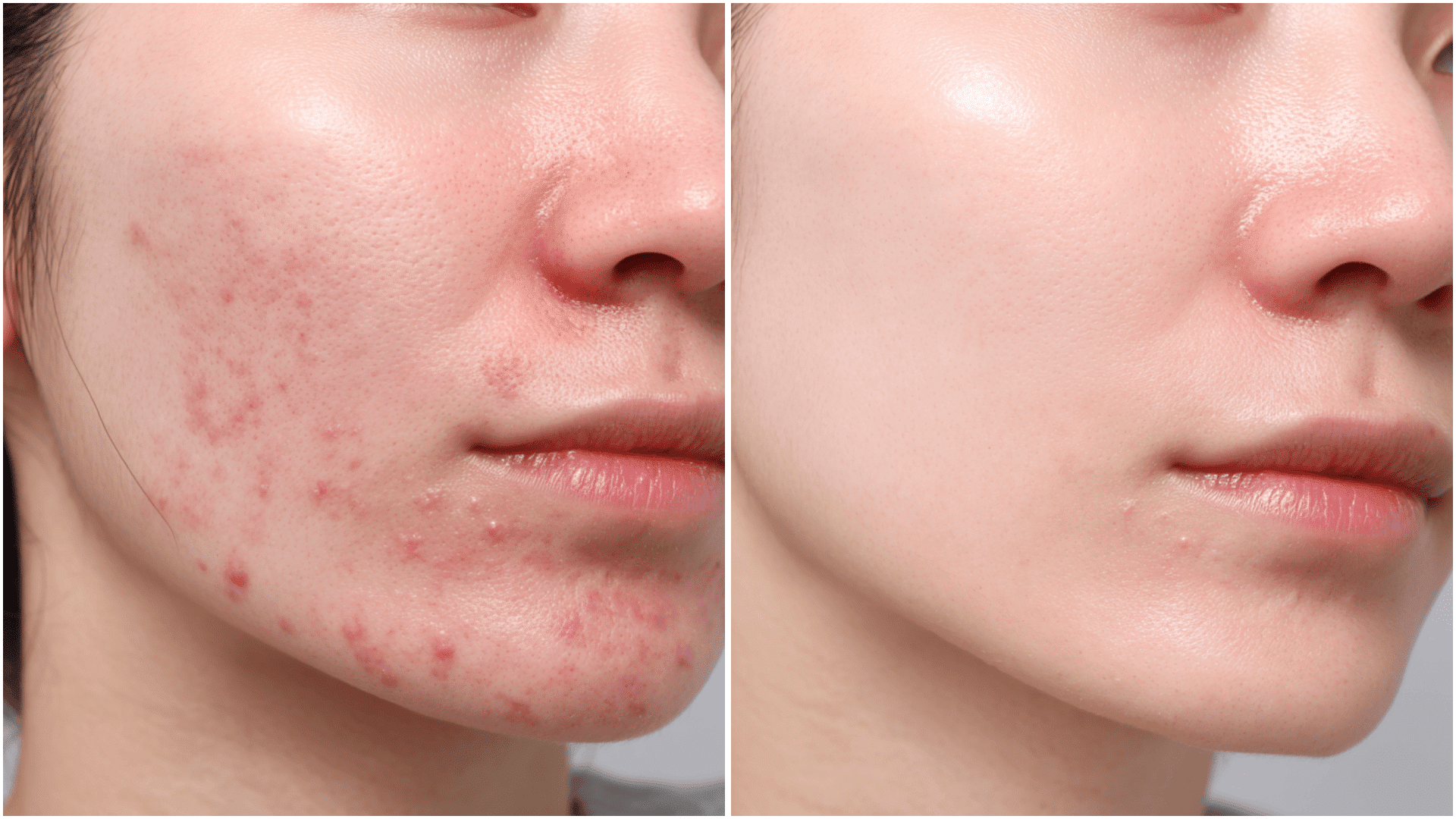
There is no single best acne-scar treatment because acne scars are not all the same. Ice pick scars are narrow and deep, boxcar scars have sharper edges, and rolling scars are broader and often tethered by fibrous bands. The best plan usually matches each scar type to the treatment that addresses its main structural problem: CROSS or focal procedures for narrow deep scars, resurfacing for boxcar edges and texture, subcision for tethered rolling scars, and combination treatment when several scar types exist on the same face.
The Most Important Step: Identify the Scar Type First
Atrophic acne scars are not a single condition. The visible shape of the scar often reveals the underlying structural problem. A narrow scar that extends deeply into the dermis behaves differently from a broad depression pulled downward by fibrous bands.
This is why the same treatment can work very well for one scar and poorly for another scar only a few centimeters away. Good scar treatment is morphology-driven: first classify, then choose the technique.
| Scar Type | Typical Shape | Main Structural Issue | Common Treatment Direction | Common Mistake |
|---|---|---|---|---|
| Ice Pick | Narrow, deep, V-shaped opening | Deep focal tract | CROSS or selected focal techniques | Using broad surface resurfacing alone |
| Boxcar | Round/oval depression with clearer edges | Loss of dermal tissue with defined borders | Resurfacing, microneedling/RF, filler or punch depending on depth | Treating every boxcar scar as identical |
| Rolling | Broad, sloping, wave-like depression | Fibrous tethering and soft-tissue distortion | Subcision ± filler/biostimulation/resurfacing | Laser-only treatment without releasing tethering |
Ice Pick Scars
Ice pick scars are narrow at the surface but extend deeply. Because the defect is focal and deep, a treatment that only smooths the upper skin may leave the deeper tract largely unchanged.
The treatment mindset is therefore focal: concentrate treatment inside the scar rather than treating the entire surrounding cheek with the same intensity.
Boxcar Scars
Boxcar scars have more defined edges than rolling scars. Some are shallow and respond to resurfacing or collagen induction, while deeper boxcar scars may need a more structural approach.
Depth matters : A shallow boxcar scar is a different problem from a deep, sharply edged defect.
Rolling Scars
Rolling scars create an undulating surface and often feel tethered when the skin is stretched. Fibrous bands beneath the scar can pull the skin downward, making the depression more obvious in side lighting.
When tethering is the dominant problem, releasing the band is usually more logical than repeatedly resurfacing the skin above it.
How do I know which acne scar I have ?Ice pick scars are narrow and deep, boxcar scars have clearer vertical edges, and rolling scars are broader with sloping edges and often appear tethered. Many patients have a mixture, so an in-person scar map is more useful than choosing treatment from one close-up photograph.
Morphology-Based Acne Scar Treatment Map
| START | Classify each scar | Ice pick / Boxcar / Rolling / Mixed |
| ICE PICK | Focal deep defect | Consider CROSS or selected punch-based approach |
| BOXCAR | Assess depth and edge sharpness | Shallow: resurfacing / collagen induction; Deep: focal structural approach |
| ROLLING | Check for tethering | Tethered: subcision, then consider filler, laser or collagen stimulation |
| MIXED | Do not force one treatment | Stage different modalities for different scar groups |
| SKIN TONE | Estimate PIH risk | Adjust resurfacing intensity and aftercare |
| ENDPOINT | Improve depth + edges + texture | Aim for natural improvement, not complete scar erasure |
Chemical Peels for Acne Scars
Chemical peels create a controlled chemical injury that stimulates epidermal renewal and dermal remodeling. Their usefulness depends heavily on peel depth, scar type, skin phototype and the clinician’s ability to control the treatment endpoint.
Superficial peeling can help tone, texture and post-acne discoloration, but deeper atrophic scars usually require a more focused or deeper strategy.
| Approach | Primary Goal | Where It Fits | Main Limitation |
|---|---|---|---|
| Superficial Peel | Surface renewal + discoloration support | Mild texture and post-acne marks | Limited effect on deep atrophic scars |
| Medium-Depth Peel | Deeper resurfacing | Selected textural scars | More downtime and pigment risk |
| CROSS | Focal chemical reconstruction | Narrow deep scars, especially ice-pick-type defects | Requires precise application; not a broad full-face peel |
What Is TCA CROSS ?
CROSS stands for chemical reconstruction of skin scars. Instead of spreading peel solution across the whole face, the clinician places a strong focal chemical agent directly inside selected scars.
The controlled focal injury stimulates remodeling from within the scar. This makes CROSS especially relevant when the defect is narrow and deep rather than broad and rolling.
Why CROSS Is Often Combined With Other Treatments
CROSS can improve the focal depth of selected scars but does not automatically smooth the entire cheek. Once the deepest pits have improved, resurfacing or microneedling can be used separately to blend texture across the surrounding skin.
Pigment Risk With Chemical Treatments
Post-inflammatory hyperpigmentation is an important consideration, particularly in patients with darker skin tones or a strong tendency to pigment after irritation. Concentration, contact, endpoint and aftercare all matter.
Fractional Laser Resurfacing
Fractional laser treatment creates microscopic zones of controlled thermal injury while leaving surrounding tissue available to support healing. The goal is to remodel scar edges, stimulate new collagen and improve the overall transition between scarred and normal skin.
Fractional CO2 Laser
Fractional CO2 is an ablative resurfacing option with a strong dermal remodeling effect. It can be useful for boxcar scars, mixed atrophic scars and global scar texture when the patient can accept a more intensive recovery.The trade-off is recovery and pigment risk. More aggressive treatment is not automatically better, particularly in skin that develops post-inflammatory hyperpigmentation easily.
Fractional Er : YAG Laser
Er : YAG is another ablative resurfacing approach. It can be used to improve scar edges and texture while allowing the treatment plan to be tailored to the desired balance between tissue ablation and recovery.
Non-Ablative Fractional Laser
Non-ablative fractional lasers heat dermal tissue while preserving more of the epidermal surface. They generally offer less downtime but may require a more gradual treatment course.
CO2 laser or non-ablative laser for acne scarsAblative fractional lasers usually provide stronger resurfacing but involve more recovery and a greater pigment-management burden. Non-ablative fractional treatments are gentler and can be attractive when downtime or pigment risk is a major concern. Scar type and skin phototype should decide the trade-off.
Picosecond Laser for Acne Scars
Picosecond platforms deliver ultrashort pulses and can be combined with fractional optical delivery to create microscopic treatment zones. They are particularly interesting when the treatment plan needs dermal remodeling with a more conservative surface-recovery profile.
For acne-scar patients with darker skin tones or a history of post-inflammatory pigmentation, a carefully selected picosecond strategy may be considered as part of a broader scar plan.
What Picosecond Treatment Does Not Replace
A picosecond laser does not mechanically release a tethered rolling scar. If the depression is being pulled down by fibrous bands, subcision may still be required before or alongside energy-based remodeling.
Radiofrequency for Acne Scar Remodeling
Radiofrequency creates controlled heat inside the dermis. The thermal effect can contract existing collagen and stimulate a remodeling response without relying on melanin as the treatment target.
This makes RF useful when the goal is collagen remodeling in patients who also need careful pigment-risk management.
Fractional RF Microneedling
RF microneedling combines mechanical microchannels with controlled radiofrequency energy delivered through needles. The treatment can be adjusted by needle depth, energy and coverage to target different levels of atrophic scarring.
It can be useful for rolling and boxcar patterns, general texture and pores, and it can be integrated into a combination plan after deeper tethering has been addressed.
RF Microneedling vs Laser
| Feature | RF Microneedling | Fractional Laser |
|---|---|---|
| Energy Pathway | Needles deliver RF into the skin | Laser energy enters from the surface |
| Primary Strengths | Dermal remodeling, texture, rolling/boxcar support | Resurfacing, scar-edge blending, texture |
| Pigment Consideration | Often attractive when pigment risk is a major concern | Depends strongly on wavelength, intensity and skin type |
| Tethered Rolling Scars | Can improve remodeling but does not replace mechanical release | Does not replace subcision when tethering is dominant |
Subcision for Tethered Rolling Acne Scars
Subcision is a mechanical scar-release procedure. A needle or cannula is passed beneath the depressed scar to release fibrous tissue that anchors the skin downward. Once the tether is released, the scar can elevate and the healing response can contribute additional collagen support.
Who Is Subcision Best For ?
- Broad rolling scars that flatten when the skin is stretched
- Scars that appear anchored or pulled downward
- Depressions where resurfacing alone has not corrected the underlying tether
- Mixed scars where rolling components need release before filler or resurfacing
Dual-Plane Subcision Concept
Some scars have tethering at more than one tissue level. A multi-plane release strategy can be considered when the scar’s anatomy suggests both superficial and deeper fibrotic attachment.
Subcision + Filler
After a tethered scar has been released, selected filler can be used to support the newly freed depression when residual volume deficiency remains. The sequence matters: filling a scar that is still tightly tethered may add volume without fully correcting the downward pull.
Subcision + RF or Laser
Subcision treats the tether; RF or laser treats texture and collagen remodeling. Combining the two can make sense when a rolling scar has both deep anchoring and surface irregularity.
Subcision Risks and Downtime
- Bruising and ecchymosis
- Temporary Swelling
- Bleeding or hematoma
- Tenderness
- Infection
- Temporary worsening of inflammatory acne in some patients
- Rare contour irregularity or injury to deeper structures if anatomy is not respected
Dermal Fillers for Atrophic Acne Scars
Fillers can elevate selected depressed scars and improve the transition between the scar base and surrounding skin. They are most useful when the scar is distensible and when true soft-tissue support is missing.
A filler should not be used as a substitute for releasing strong tethering. In rolling scars, subcision may need to come first.
| Filler Family | Main Role | Where It May Fit | Important Planning Point |
|---|---|---|---|
| Hyaluronic Acid | Immediate structural support | Selected rolling/boxcar depressions | Reversible HA can be useful for precise correction |
| CaHA | Support + collagen stimulation | Selected superficial atrophic patterns | Biostimulatory behavior differs from HA |
| PLLA / Related Collagen Stimulators | Progressive collagen support | Broader rolling-scar fields | Results are gradual rather than instant |
| Permanent Filler | Long-term volume correction | Highly selected cases | Permanent products require a higher threshold for patient selection and complication Planning |
Why ‘Filler for Every Scar’ Is a Bad Strategy
Not every depression is a volume deficit. A narrow ice pick scar needs a different approach, and a tethered rolling scar may need release before support. Filler works best when the tissue has been correctly diagnosed rather than when every visible shadow is injected.
Autologous Fat and Nanofat
Autologous fat can be used when a larger area of depressed scarring also has soft-tissue volume loss. Subcision may be performed first when fibrous tethering is present.
Nanofat and other processed fat preparations are used with a regenerative rather than purely volumizing objective, but technique and indication are highly operator dependent.
PRP and PRF in Acne Scar Treatment
Platelet-rich products are typically used as adjuncts rather than as universal stand-alone scar treatments. Their role is to support healing, fibroblast activity and collagen remodeling around procedures that already address the scar’s mechanical or textural problem.
| Approach | Potential Role | Best Use Mindset |
|---|---|---|
| PRP | Growth-factor-rich adjunct | Combine with microneedling, laser or scar procedures when appropriate |
| PRF | Fibrin scaffold with slower release profile | Adjunctive regenerative support |
| Microneedling + Platelet Product | Mechanical collagen induction + regenerative support | Useful for texture-focused combination plans |
Microneedling for Atrophic Acne Scars
Microneedling creates controlled micro-injury within the dermis. The healing response supports collagen and elastin remodeling and can improve overall scar texture.
It is especially useful as part of a broader plan, but it may not be strong enough by itself for deep ice pick scars or strongly tethered rolling scars.
Punch Excision and Punch Grafting
Punch techniques remain valuable for selected deep focal scars. Instead of trying to resurface a very deep narrow defect repeatedly, the scar can be surgically removed or replaced with a small graft depending on the anatomy. After healing, resurfacing may be used to blend the scar margin with surrounding skin.
Acne Scar Treatment in Skin of Color
In patients with darker skin tones, the scar itself is only part of the treatment problem. Post-inflammatory hyperpigmentation can become as visible as the scar texture.
This means treatment intensity, interval, pre- and post-procedure skincare, sun exposure and choice of device all matter. A treatment plan should improve the scar without creating a new pigment problem.
Which acne-scar treatments are suitable for darker skin ?
Subcision, microneedling, RF microneedling, carefully selected lasers and focal scar techniques can all be considered in darker skin. The key is not the treatment name alone – it is controlling inflammation, energy, depth and aftercare to reduce post-inflammatory hyperpigmentation risk.
Why Combination Treatment Often Makes More Sense
A patient may have ice pick scars on the temples, rolling scars on the cheeks, boxcar scars near the jawline and post-inflammatory pigmentation across the same treatment area.
Using one procedure repeatedly can leave the other structural problems untreated. Combination treatment works by assigning a different job to each modality.
| Scar Pattern | First Structural Step | Second Remodeling Step | Why the Combination Works |
|---|---|---|---|
| Ice Pick Dominant | Focal CROSS / selected punch technique | Laser or microneedling for blending | Treat depth first, then texture |
| Tethered Rolling Scars | Subcision | Filler, RF microneedling or laser | Release the anchor before resurfacing |
| Boxcar Dominant | Assess depth; structural support if needed | Fractional laser or RF microneedling | Improve edges + dermal remodeling |
| Mixed Scars | Scar-by-scar planning | Staged multimodal treatment | Different scars receive different tools |
| Scar + Discoloration | Treat structural scar safely | Pigment-specific plan when appropriate | Avoid expecting one device to fix both problems |
Example : Rolling Scar Combination Plan
- Step 1 : Map tethered scars
- Step 2 : Release selected bands with subcision.
- Step 3 : Reassess residual depression.
- Step 4 : Add filler or collagen-stimulating support only where true volume remains missing.
- Step 5 : Use resurfacing or RF microneedling later to improve texture.
Example : Ice Pick + Boxcar Combination Plan
- Step 1 : Treat the deepest narrow pits focally
- Step 2 : Allow healing
- Step 3 : Address boxcar edges and global texture with fractional resurfacing or collagen induction.
- Step 4 : Reassess for any residual deep focal defects rather than automatically repeating the same full-face treatment.
What If I Am Taking Isotretinoin ?
The old rule of automatically postponing every procedural acne-scar treatment for a long period after isotretinoin is no longer applied in the same way to every procedure. The decision should be individualized according to dose, skin condition, healing history, procedure type and the clinician’s experience.
This does not mean that every aggressive resurfacing procedure is appropriate during isotretinoin therapy. The practical approach is to assess the specific procedure rather than using one blanket rule for all lasers, peels, RF or surgery.
Active Acne Should Be Controlled Alongside Scar Treatment
Scar treatment does not make sense if new inflammatory lesions are continuously creating new scars. Active acne control and scar revision should be planned together.
In some patients, scar procedures can begin while acne is being medically managed, but the treatment zone should not contain uncontrolled infection or severe active inflammation.
Acne Scar Consultation in Abu Dhabi : What Should Be Assessed?
- Which scars are ice pick, boxcar and rolling ?
- Which rolling scars are truly tethered ?
- Are the boxcar scars shallow or deep ?
- Is the main visible problem scar depth, sharp edges, pigmentation, redness or enlarged pores ?
- What is my Fitzpatrick skin type and how easily do I develop post-inflammatory pigmentation ?
- Do I still have active acne that needs simultaneous treatment ?
- Which scars need focal treatment and which need full-field resurfacing ?
- Would subcision be useful before filler, laser or RF microneedling ?
- Do I need a staged combination plan rather than one repeated procedure ?
- What recovery time can I realistically accept ?
- Which treatments carry the greatest pigment risk for my skin ?
- How will standardized photographs be used to assess progress ?
- What improvement is realistic and which scars are likely to remain partially visible ?
Common Acne-Scar Treatment Mistakes
- Choosing a device before classifying the scars
- Using laser repeatedly on strongly tethered rolling scars without release
- Using filler inside every depression regardless of scar type
- Expecting TCA CROSS to smooth broad rolling scars
- Using aggressive resurfacing in a patient with high PIH risk without a pigment-management plan
- Treating acne scars while allowing uncontrolled active acne to continue
- Judging improvement from inconsistent phone photographs
- Changing treatments too quickly before collagen remodeling has had time to develop
- Promising complete scar removal instead of realistic improvement
Safety, Downtime and Expected Reactions
Downtime depends on the procedure. Subcision tends to create bruising and swelling; ablative resurfacing creates more visible surface recovery; RF microneedling may cause redness and pinpoint marks; CROSS can create focal crusting.
A good scar plan should consider not only efficacy but also healing, pigmentation risk, work schedule and the patient’s tolerance for visible recovery.
| Procedure | Typical Short-Term Reaction | Important Risk | Recovery Style |
|---|---|---|---|
| Subcision | Bruising, swelling, tenderness | Hematoma, infection, contour irregularity | Bruise-dominant |
| CROSS | Focal whitening/crusting then healing | PIH, over-treatment, new scar if poorly controlled | Focal crusting |
| Ablative Fractional Laser | Redness, swelling, resurfacing recovery | PIH, prolonged erythema, infection | More visible downtime |
| RF Microneedling | Redness, swelling, pinpoint marks | PIH, burns or textural change if overtreatment occurs | Usually shorter surface recovery |
| Filler | Swelling/bruising | Nodules, vascular complications depending on product/plane | Injection-type recovery |
When to Contact the Clinic Urgently
- Increasing heat, redness and pain rather than gradual improvement
- Pus or drainage
- Severe swelling or rapidly enlarging hematoma
- Blistering or unexpected skin breakdown after an energy treatment
- Marked color change of the skin after an injection
- New neurologic symptoms
- Any reaction that feels significantly more severe than the expected post-procedure recovery
Acne Scar Treatment in Abu Dhabi - Frequently Asked Questions
