

What Are Stem Cell-Based Hair Therapies?
Regenerative Hair Treatment Is An Umbrella Term
Stem cell-based hair therapies aim to influence the environment around existing hair follicles by using cells, growth factors or cell-derived signals. The source chapter focuses mainly on androgenetic alopecia (pattern hair loss) and other nonscarring forms of alopecia.
The best-known approach in the chapter is stromal vascular fraction (SVF), a cell-rich mixture obtained from adipose (fat) tissue. The chapter also discusses adipose-derived stem cell-conditioned medium (ADSC-CM), stem cell-derived exosomes and experimental small molecules designed to activate hair follicle stem cells.
What These Treatments Are NotThey should not be described as a guaranteed way to “create new hair follicles” or permanently reverse every type of baldness. The research is still evolving, protocols are not standardized, and the chapter specifically states that SVF is not a first-line treatment for androgenetic alopecia.
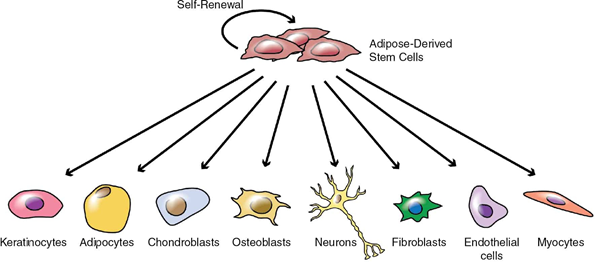
Why Adipose Tissue Became Interesting For Hair Restoration
- Adipose tissue is abundant and relatively accessible compared with many other stem-cell sources.
- Fat tissue contains adipose-derived stem cells (ADSCs), progenitor cells, mature cells and multiple signaling molecules.
- The fat layer of the skin is biologically linked with the hair cycle and communicates with the dermal papilla around hair follicles.
- Researchers therefore hypothesize that regenerative signals from adipose-derived cells may support follicles that are miniaturizing but still biologically active.
2. What Is Stromal Vascular Fraction (SVF)?
SVF Is More Than “Stem Cells” Alone
When adipose tissue is processed and much of the mature fat and connective tissue is removed, the remaining stromal vascular fraction contains a mixture of cells and signaling molecules. This includes adipose-derived stem cells, hematopoietic stem cells, pericytes, progenitor cells, endothelial cells, immune cells, fibroblasts and growth factors.
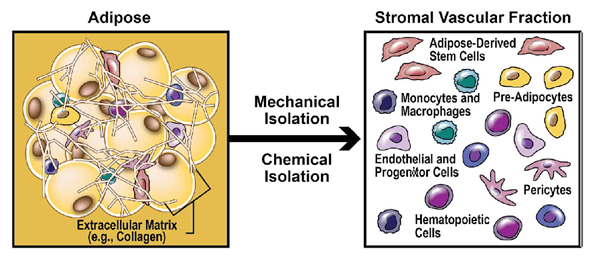 Patient-Friendly Way To Understand It
SVF is not a purified “magic stem-cell injection.” It is a biologically complex mixture derived from the patient’s own fat tissue. Its proposed effect is mainly through communication between cells and follicles rather than simply turning injected cells directly into new hair.
How Might SVF Support Hair Follicles ?
| Paracrine signaling | Cells release growth factors and other molecules that can influence nearby hair follicles without needing to permanently become part of the follicle. |
| Growth-factor support | The chapter describes molecules such as PDGF and IGF-1 as part of the signaling environment relevant to hair growth. |
| Anti-inflammatory effects | Regenerative signaling may reduce inflammatory activity around the follicular environment. |
| Antiandrogen-related effects | The source describes secretion of molecules with potential antiandrogen effects, although SVF should not be treated as a replacement for established hormonal therapy. |
| Vascular support | Neovascularization and improved local tissue support may contribute to the regenerative effect. |

3. Who May Be A Candidate?
Early or Moderate Hair Loss is Biologically More Favorable Than Advanced Loss
The source chapter notes that there are no established clinical practice guidelines defining the ideal patient for SVF or other stem cell-based hair therapies. Most published studies are small, use different techniques and focus mainly on androgenetic alopecia or alopecia areata.
| Potentially more favorable | Earlier androgenetic alopecia where miniaturized follicles are still present and the goal is to support density or hair shaft thickness. |
| Less predictable | Severe or long-standing hair loss where many follicles may no longer be capable of meaningful recovery. |
| Not first-line | The chapter specifically recommends discussing better-established options first, including topical minoxidil, finasteride when appropriate, and PRP. |
| Procedure-related suitability | SVF requires adipose harvesting, so patients who are not suitable for liposuction or who are highly risk-averse may not be appropriate candidates. |
| Pregnancy / major medical risk | The chapter lists pregnancy, severe cardiovascular disease and severe coagulation disorders among reasons a patient may not be suitable for the liposuction-based SVF approach described. |
Diagnosis First
“Hair loss” is not one diagnosis. A patient with scarring alopecia, inflammatory scalp disease, sudden shedding or another medical cause needs the correct diagnosis before any regenerative injection is considered.
What Should Be Reviewed Before An Investigational Regenerative Procedure ?
- Pattern, duration and severity of hair loss.
- Past medical and surgical history, including wound healing and abnormal scarring.
- Bleeding problems, immunosuppression or severe infection history.
- Current medications, including drugs that affect coagulation or local-anesthetic metabolism.
- Current and previous hair-loss treatments and whether evidence-based first-line options have been tried.
- Baseline standardized photography for objective follow-up.
What Results Does The Research Suggest ?
Improvement is Possible, But The Evidence is Still Limited
The chapter summarizes early studies in which patients with androgenetic alopecia treated with SVF showed improvements in hair density and hair diameter. In the reviewed literature, changes were generally assessed over months rather than days.
| Approximate timing | Changes in density and diameter may become apparent around 6 months in the studies summarized in the chapter. |
| Hair density | The chapter reports study ranges of roughly 14% to 23% improvement in hair density. |
| Hair diameter | Reported study ranges for hair diameter were approximately 11% to 24%. |
| Hair cycle | An increase in the proportion of hairs in the anagen (growth) phase may also occur. |
| Durability | A single treatment may produce improvement, but the effect may not persist in every patient. |
| Repeat treatment | Two to three treatments at approximately one-month intervals may produce more noticeable or sustained outcomes in some studies. |
These Numbers Are Not A Promise
The percentages above come from small studies summarized in the source chapter. They should not be presented as guaranteed clinical results. Age, diagnosis, severity of hair loss, preparation technique and use of combination therapy can all influence outcome.
Combination Therapy May Matter
The source suggests that SVF used alongside established hair-loss treatments such as minoxidil or finasteride may be more effective than SVF alone. This reinforces a key principle: regenerative therapy is better viewed as a possible adjunct than as a replacement for evidence-based hair-loss management.
5. How Is SVF Prepared In Clinical Studies ?
The Process Begins With A Small Fat Harvest
In the technique described in the chapter, adipose tissue is first collected with tumescent liposuction. Only a relatively small amount may be required when the purpose is SVF isolation rather than body contouring. The harvested fat is then processed to concentrate the stromal vascular fraction.
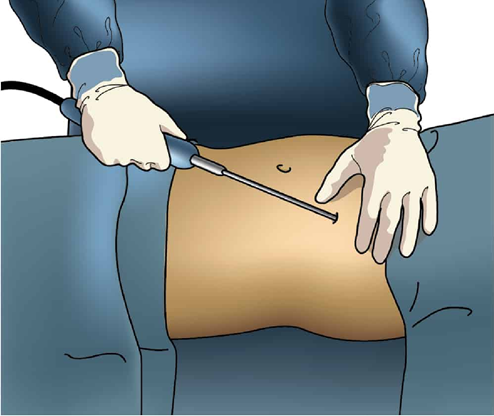 Why This Matters For Patients
SVF hair treatment is not simply a scalp injection. In the protocol discussed by the source, it also involves a donor-site procedure to harvest adipose tissue, with its own aftercare, bruising, discomfort and procedural risks.
Two Broad Ways To Isolate SVF
Enzymatic vs Mechanical Comparison Table
| Feature | Enzymatic / chemical | Mechanical / nonenzymatic |
|---|---|---|
| How it works | Uses enzymes such as collagenase, trypsin or dispase followed by centrifugation. | Uses physical processing such as washing, shaking, vibration, fractionation and centrifugation. |
| Cell yield | Generally higher concentration of nucleated SVF cells. | Generally lower cell yield and more residual tissue / blood components. |
| Time | More time-consuming; digestion can add 30–120 minutes. | Often faster; some protocols take less than 15 minutes. |
| Cost | Usually more expensive. | Usually less expensive. |
| Regulatory complexity in the US source | Considered more than minimal manipulation and therefore subject to stricter FDA regulation. | May fall under less strict categories depending on the exact processing method and jurisdiction. |
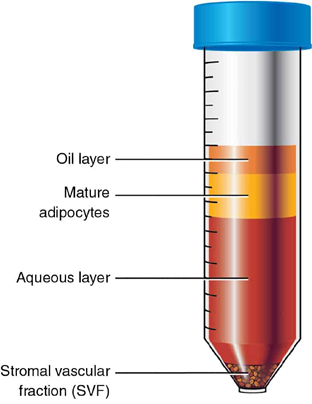
6. What Happens After SVF Isolation ?
In Study Protocols, SVF is Reconstituted & Injected Into Thinning Areas
After isolation, SVF may be mixed with the patient’s own fat, PRP or saline depending on the study protocol. The chapter describes small-volume injections into the subcutaneous fat layer of androgen-dependent scalp areas such as the hairline, central part or vertex.
- Treatment mapping: areas of androgen-dependent thinning are identified and photographed.
- Fat harvest : Adipose tissue is collected from an appropriate donor area.
- SVF Isolation : The tissue is processed using an enzymatic or mechanical protocol.
- Reconstitution : The concentrated fraction is prepared in the vehicle specified by the study protocol.
- Scalp Injections : Small injections are spaced across target areas of thinning.
- Atercare : Donor-site and scalp wound care are reviewed, and follow-up is scheduled to document response.
The source chapter explicitly states that its treatment descriptions are neither comprehensive nor prescriptive. Techniques vary by study, and stem cell-based procedures require appropriate training, clinical judgment and compliance with local regulation.
Expected Short-Term Effects
- Pain or discomfort at the donor and injection sites.
- Temporary redness, itching, bruising or swelling.
- Drainage of blood-tinged fluid from liposuction sites can occur.
- There is a small procedural risk of bleeding, infection, scarring or pigmentation change.
- Compression garments may be recommended for the liposuction donor area depending on the protocol.
7. Exosomes For Hair Loss
Exosomes Are Cell – Derived Messengers, Not Stem Cells Themselves
Exosomes are tiny membrane-bound vesicles released by cells. They carry proteins and genetic material such as mRNA and microRNA and can transfer biological signals between cells.
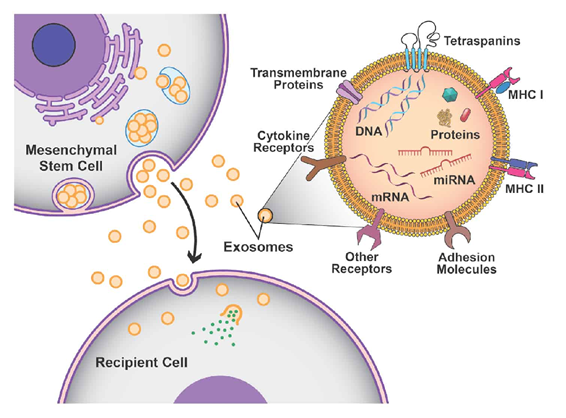
The chapter discusses exosomes as an acellular regenerative approach. In laboratory models, exosomes have stimulated dermal papilla cell proliferation and increased signaling molecules such as VEGF and IGF-1. A small pilot study in 20 people reported increased hair density and thickness after 12 weeks, but this is early evidence and requires confirmation in larger controlled trials.
Why “Acellular” MattersExosome products do not contain living stem cells. This may simplify storage and theoretically reduce some risks associated with undifferentiated cell transplantation, but it does not mean that all exosome products are equivalent, standardized or clinically proven.
What About Stem Cell-Conditioned Medium?
ADSC-conditioned medium (ADSC-CM) is another acellular approach. Stem cells are cultured in the laboratory, then the cells are removed and the remaining medium contains secreted growth factors and signaling molecules. Small studies summarized in the chapter reported improvements in hair density and thickness, but the evidence remains limited.
Future Research : Activating The Patient’s Own Follicle Stem Cells
The source also describes experimental small molecules that increase lactate production in hair follicle stem cells, with the goal of encouraging follicles to enter the growth phase. These are research concepts rather than established clinical hair-loss treatments.
Quick Comparison of The Regenerative approaches In This Chapter
| Approach | Living cells? | What it contains / does | Evidence status in the chapter |
|---|---|---|---|
| SVF | Yes | Mixed cell-rich fraction derived from processed adipose tissue. | Small clinical studies; not first-line; protocols vary. |
| ADSC-CM | No | Conditioned medium containing factors secreted by cultured adipose-derived stem cells. | Small clinical studies; evidence remains limited. |
| Exosomes | No | Cell-derived vesicles carrying proteins, mRNA and microRNA. | Preclinical data plus a small pilot human study. |
| Small molecules | No | Research compounds intended to stimulate existing follicle stem-cell metabolism. | Experimental / future-direction research. |
Key Distinction
“Stem cell-based” does not always mean living stem cells are injected. Conditioned medium and exosomes are acellular approaches that use signals produced by cells rather than the cells themselves.
8. Safety, Regukation & Marketing Claims
This is The Section Patients Should Not Skip
Regenerative medicine can sound attractive because terms such as “stem cells” and “exosomes” imply renewal. The source chapter, however, emphasizes that stem cell interventions have also been associated with serious adverse events in non-dermatologic settings and therefore require strict oversight.
Regulatory Context From The SourceThe chapter’s regulatory statements refer specifically to the United States. At the time of publication, it states that SVF and other stem cell therapies for alopecia should be restricted to FDA-supervised clinical trials. Local requirements in Abu Dhabi and the UAE are jurisdiction-specific and must be verified separately before any treatment is offered.
| What is well established? | Pattern hair loss has more established first-line treatments with stronger evidence than stem cell-based approaches. |
| What is still investigational? | SVF, ADSC-conditioned medium, exosome-based treatment and related regenerative technologies remain incompletely standardized in the source chapter. |
| What should patients ask? | What exactly is being injected? Is it cells, SVF, conditioned medium or an exosome product? How is it processed? What evidence supports that specific product and protocol? |
| What should raise concern? | Guaranteed regrowth claims, promises of permanent cure, unclear product sourcing, lack of informed consent or inability to explain regulatory status and evidence. |
| What should good consent include? | The investigational nature of the treatment, known and unknown risks, alternatives, expected timeline, possibility of nonresponse and costs. |
Key Message
regenerative hair therapies are emerging options under investigation, not that they are proven cures. This protects patients and also makes the medical content more credible.
