

Endolift-Based Subcision for Rolling Acne Scar Treatment in Abu Dhabi
Rolling acne scars can look soft-edged on the surface, but their depth is often maintained by fibrous bands tethering the skin downward. Endolift-based subcision is an emerging technique designed to release these attachments beneath the scar while using a 1470-nm diode laser to support dermal remodeling and collagen stimulation. For carefully selected patients, it may offer a minimally invasive option within a broader acne-scar treatment plan.
What are rolling acne scars?
Rolling scars are depressed acne scars with sloping edges. They are often caused or maintained by fibrous attachments beneath the skin that pull the scar downward. This is why resurfacing alone may not fully correct them: the tethering component may need to be released before the surface can improve optimally.
How subcision works
Traditional subcision mechanically separates the fibrous bands beneath a depressed scar using a needle or cannula. Releasing these attachments can allow the scar to rise and can trigger a wound-healing response that supports new connective tissue formation. The published Endolift technique applies the same core concept through a laser fiber passed in the subdermal plane.
What makes Endolift-based subcision different?
- Mechanical release: the fiber is moved beneath the scar to disrupt the fibrous attachments responsible for tethering.
- Laser-assisted remodeling: the 1470-nm diode laser delivers energy in the tissue, with the aim of supporting dermal remodeling and collagen production.
- Limited entry points: in the published pilot protocol, the technique was performed through a single perforation on each side rather than multiple punctures.
- Potentially shorter recovery: the authors reported mild, transient inflammation and no severe swelling or bruising in their small study cohort.
| Technology | Endolift / 1470-nm diode laser; the methods section describes a 300-μm fiber |
| Treatment schedule | One treatment session in the study protocol |
| Assessment | Blind photographic review by 3 board-certified dermatologists + patient satisfaction |
| Follow-up | 3 months |
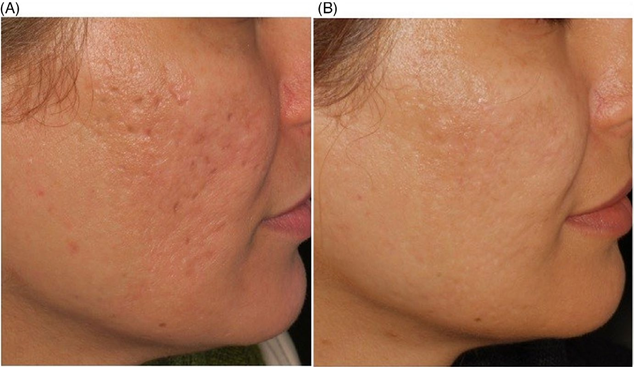
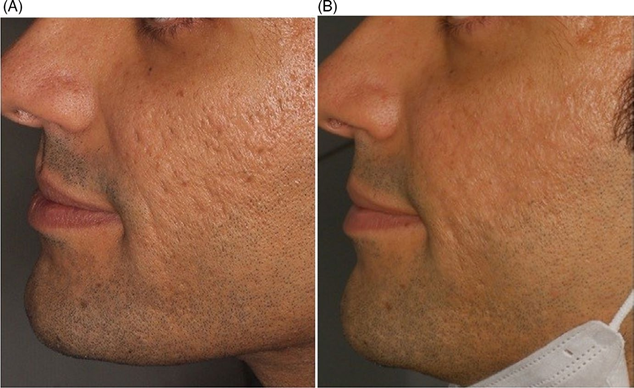
| Physician-rated result | Good or very good improvement in about 90% of patients |
| Patient satisfaction | Good or very good satisfaction reported across the cohort |
| Lesion count | Mean lesion count decreased from 25.5 ± 12.1 to 11.4 ± 2.1 (P < .05) |
| Safety reported | Mild inflammation resolved within 2 days; no severe swelling/bruising, infection, hypertrophic scarring or hyperpigmentation reported in the cohort |
Published Clinical Example
Who may be a good candidate?
A consultation should first identify the scar type. Endolift-based subcision is most logically considered when rolling or tethered atrophic scars are a meaningful part of the problem. A patient with predominantly ice-pick scars, active inflammatory acne, post-inflammatory pigmentation, or boxcar scars may require a different or combined strategy.
- Rolling or tethered atrophic acne scars
- Stable acne with no major active inflammatory outbreak in the treatment area
- Realistic expectations about improvement rather than complete scar removal
- Willingness to follow aftercare and allow time for collagen remodeling
When another treatment may be more appropriate
Acne scars are rarely one single scar type. Depending on the pattern, a treatment plan may include fractional resurfacing, microneedling or RF microneedling, punch techniques, TCA CROSS, fillers, regenerative treatments, or conventional subcision. The best plan is based on scar morphology, skin type, downtime tolerance and previous treatments — not on using one device for every scar.
What to expect during treatment
- Scar mapping — The depressed and tethered areas are assessed and marked while the skin is in a natural position.
- Subdermal fiber passage — A fine fiber is introduced beneath the skin and passed parallel to the surface in the subdermal plane.
- Release of tethering — Controlled movements are used to separate the fibrous attachments beneath the scars.
- Laser-assisted remodeling — Energy delivery is intended to support tissue remodeling and collagen stimulation in the treated plane.
- Recovery and follow-up — Temporary redness, swelling or tenderness may occur. Results should be assessed over time rather than immediately after the procedure.
Downtime and safety
In the pilot study, temporary mild inflammation resolved within two days, and the authors reported no severe swelling, bruising, infection, hypertrophic scarring or hyperpigmentation during the three-month follow-up. However, this does not mean the procedure is risk-free. Any subdermal treatment can cause bruising, swelling, tenderness, infection, contour irregularity, pigmentary change or other complications, and individual risk varies with anatomy, skin type, technique and aftercare.
How many sessions are needed?
The published protocol used one treatment session, but that should not be interpreted as a universal rule. In real-world scar management, the number of sessions depends on scar type, scar depth, treatment response, skin quality, previous procedures and whether combination treatments are required. Some patients may need staged treatment over several months.
When will results be visible?
Some improvement may become noticeable as tethering is released, but collagen remodeling is gradual. The study evaluated patients over a three-month period. For website communication, it is more accurate to describe results as progressive and individualized rather than promising an immediate or fixed percentage of improvement.
Endolift-based subcision vs traditional subcision
| Feature | Traditional needle/cannula subcision | Endolift-based subcision |
|---|---|---|
| Primary action | Mechanical release of fibrous bands | Mechanical release plus laser energy in the subdermal plane |
| Entry points | Varies by technique and scar distribution | Pilot paper describes one perforation on each side |
| Evidence base | Longer history and broader clinical literature | Early evidence; published pilot study is small |
| Best fit | Tethered/depressed scars after clinical assessment | Potential option for rolling/tethered scars in selected patients |
| Key caution | Bruising, swelling, pain and other procedural risks | Similar procedural risks remain; evidence is still limited |
Why combination treatment often matters
A scar can have more than one structural problem at the same time: tethering underneath, an irregular surface, enlarged pores, pigmentation, or loss of volume. Releasing the scar may address the tethering component, while another modality may be needed to improve texture, color or deeper volume loss. This is why a scar-by-scar plan usually produces a more rational strategy than choosing one treatment based only on its name.
Evidence limitations you should know
- Only nine patients were included.
- There was no randomized control group.
- Follow-up was limited to three months.
- The study focused on rolling acne scars, so the findings should not be generalized to every scar type.
- The authors themselves concluded that larger controlled trials are needed to compare Endolift with needles and other subcision techniques.
