
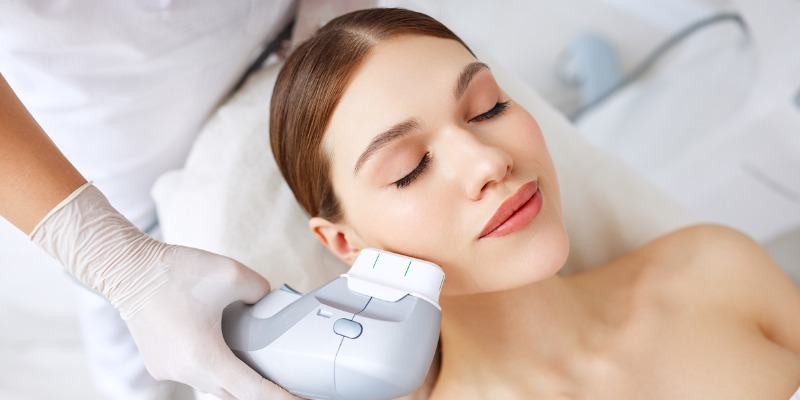
What is HIFU and what is it used for ?
High-intensity focused ultrasound (HIFU) is a non-surgical energy-based treatment that concentrates ultrasound at selected tissue depths. In aesthetic medicine, the best-established uses are tightening lax skin of the face and neck and treating selected areas of localized subcutaneous fat. The energy creates controlled thermal zones that trigger collagen remodeling; at deeper body-contouring settings it can also injure adipocytes. Results develop gradually rather than instantly, and outcome depends on anatomy, device, depth, energy, treatment pattern and operator technique.
HIFU is a non-invasive ultrasound treatment used mainly for facial and neck tightening and selected body-contouring indications. It works by focusing acoustic energy at specific depths, creating controlled thermal injury that stimulates collagen remodeling and, at deeper settings, can reduce subcutaneous fat. Common temporary effects include pain, redness, swelling, bruising, tingling or numbness. Rare but important complications have been reported, which is why anatomical knowledge, correct depth selection and careful patient selection matter.
HIFU in Abu Dhabi : A Scientific Guide to Skin Tightening, Body Contouring, Results and Complications
High-intensity focused ultrasound, usually shortened to HIFU, has moved from medical applications such as tissue ablation into aesthetic medicine, where it is used most often for facial and neck tightening and for selected body-contouring goals. Its appeal is easy to understand: the skin surface can remain intact while energy is concentrated beneath it, allowing clinicians to target deeper structural levels without surgical incisions.
However, the word “non-surgical” should not be interpreted as “risk-free.” HIFU works by intentionally creating controlled thermal injury. The same physics that can stimulate collagen remodeling and reduce localized fat can also cause unwanted tissue injury when depth, energy, anatomy, contact or treatment planning are inappropriate. A high-quality consultation therefore starts with anatomy and indication—not with a device name.
How Does HIFU Work?
HIFU devices deliver a focused beam of ultrasonic energy to a selected focal depth. Frequency and depth are linked: higher frequencies generally act more superficially, while lower frequencies can reach deeper tissue planes. At the focal point, vibration and friction generate heat. The review describes tissue temperatures in the range of approximately 60–70°C, enough to produce controlled coagulation and tissue injury at the intended target.
The energy is not supposed to heat every layer continuously. Instead, focused treatments create small thermal injury zones. Around those points, the surrounding tissue can remain relatively preserved, allowing repair and remodeling to occur. In skin tightening, the biological goal is collagen contraction followed by new collagen formation and remodeling. In body contouring, the goal may include controlled adipocyte injury followed by inflammatory clearance of damaged fat cells.
| Mechanism | What happens | Aesthetic relevance |
|---|---|---|
| Focused acoustic energy | Ultrasound converges at a selected depth rather than heating the entire skin column uniformly. | Allows targeting of deeper structural layers while the epidermis can remain intact. |
| Thermal injury zones | Friction and vibration generate focal heat and controlled coagulation. | Triggers wound-healing signaling, tissue contraction and remodeling. |
| Collagen response | Thermal injury is followed by collagen remodeling and increased collagen content in deeper dermal layers. | Supports gradual tightening and improved firmness. |
| Adipocyte injury | At body-contouring depths, heat and membrane injury can damage fat cells. | Supports reduction of selected localized fat deposits. |
| Inflammatory clearance | Macrophages migrate to the treated adipose tissue and clear damaged cells over subsequent weeks. | Explains why contour change develops progressively rather than immediately. |
What Tissue Depths Are Used ?
The source review describes example probes used in the literature at approximately 1.5 mm, 3.0 mm and 4.5 mm for facial and neck applications, with deeper probes such as 6 mm and 9 mm described for subcutaneous fat treatment. These values are not interchangeable across devices. Cartridge design, frequency, pulse characteristics, energy calibration and manufacturer recommendations differ, so a published depth should be understood as a tissue-target concept—not a universal setting.
| Example focal depth | Typical conceptual target | Clinical context |
|---|---|---|
| 1.5 mm | More superficial dermal levels | Delicate or thinner areas may require more superficial targeting. |
| 3.0 mm | Deeper dermis / superficial subcutaneous-fascial interface | Commonly discussed for tightening and collagen remodeling. |
| 4.5 mm | Deeper structural plane including the SMAS region depending on anatomy | Used in lower-face, jawline and neck lifting strategies. |
| 6–9 mm | Deeper subcutaneous tissue | Described in body-fat reduction applications rather than routine superficial facial tightening. |
Why Patient Anatomy Matters More Than a Device Name
The same cartridge depth does not correspond to the same tissue layer in every patient. Facial thickness, fat distribution, age-related volume change, muscular anatomy and degree of laxity all influence what lies beneath the handpiece. A depth that is appropriate over a thicker cheek may be inappropriate in a thin temple or upper neck. This is one reason the review emphasizes adapting probe depth and energy to the area being treated.
For patients, the practical question is not simply “Which HIFU machine do you use?” A more useful question is: “Which tissue layer are you trying to treat in my face or body, and why is that layer appropriate for my anatomy?” That conversation is more closely connected to safety and outcome than branding alone.
HIFU for Face and Neck Rejuvenation
Facial and neck rejuvenation is one of the most established aesthetic uses of HIFU in the reviewed literature. The treatment is designed to tighten lax tissue and improve contours by targeting the dermis and deeper support structures while avoiding a surgical incision. The strongest response is expected in patients with mild-to-moderate laxity rather than major tissue descent that would usually require a surgical lift for a predictable dramatic correction.
What Do Clinical Studies Report ?
| Study signal summarized in the review | Reported result | How to interpret it |
|---|---|---|
| 75-patient face/neck study | All patients showed clinical improvement at 90 days. Satisfaction was reported at 78.7% for nasolabial folds, 86.6% for jawline, 81.3% for chin/submental area and 81.3% for neck. | Suggests clinically visible improvement, but satisfaction varies by anatomical zone. |
| 20-patient neck study | 18 of 20 patients were satisfied at 6 months; physician assessment also found significant improvement. | Supports use in selected neck-laxity patients, but the sample was small. |
| 22-woman face/neck study | At 3 months, average improvement in laxity was reported at about 58% by physicians and 60% by patients. | Demonstrates measurable change in a small study; results should not be treated as a guaranteed percentage for every patient. |
| 2020 meta-analysis summarized by the review | Improvement was reported in 88% of patients in studies using PGAIS and 83% in studies using SGAIS. | Overall evidence suggests a majority improve, but methods and devices varied across studies. |
Which Areas May Be Treated ?
- Lower face and jawline : A common goal is improvement in mild jowling and definition along the mandibular border.
- Submental region and upper neck : Selected patients may benefit from tightening and, depending on device and depth, treatment of localized fat.
- Cheeks : Deeper probes may be used in appropriately selected anatomy, with attention to preserving desirable facial volume.
- Forehead, brow and temples : More superficial treatment may be considered, but these are anatomically sensitive regions.
- Periorbital Area : Treatment requires careful depth selection and appropriate eye protection when applicable.
- Nasolabial Region : Studies have included this region, but outcome depends on whether the fold is driven by laxity, volume loss or facial structure.
When Do HIFU Results Appear ?
HIFU does not behave like a filler or neuromodulator, where patients may notice a specific pharmacologic or volumizing effect relatively quickly. Its core rejuvenation mechanism relies on a wound-healing and remodeling response. Some tissue contraction may be noticed earlier, but the more meaningful change is expected to evolve over weeks to months as collagen remodeling progresses.
The reviewed face and neck studies commonly assessed outcomes around 3 months, and some followed patients to 6 months. Long-term durability varies by age, baseline laxity, treatment technique and subsequent aging. Patients should view HIFU as a gradual tightening treatment, not a permanent replacement for surgery.
HIFU vs Surgical Facelift
| Question | HIFU | Surgical facelift |
|---|---|---|
| Invasiveness | Non-surgical, no large incisions. | Operative procedure with incisions and surgical recovery. |
| Magnitude of change | Generally subtle to moderate tightening in appropriately selected laxity. | More predictable and dramatic correction of significant tissue descent. |
| Downtime | Usually limited, although tenderness, swelling or sensory symptoms can occur. | Longer recovery with surgical aftercare. |
| Durability | Variable and not permanent; maintenance may be considered. | Longer-lasting structural repositioning, though aging continues. |
| Best candidate | Patient seeking non-surgical improvement with realistic expectations. | Patient with more advanced laxity seeking a stronger correction and willing to accept surgery. |
Expectation Setting
A non-surgical device should not be marketed as producing the same magnitude of tissue repositioning as a surgical facelift. HIFU can be useful when the goal is improvement without surgery, but candidate selection is central to satisfaction.
HIFU vs Radiofrequency : Are They the Same ?
No. Both are energy-based technologies, but they deliver energy differently. The reviewed paper notes that some histologic literature found radiofrequency heating to be more diffuse, whereas focused ultrasound can concentrate energy at selected depths. That does not mean HIFU is universally “better” than RF. Device design, target depth, desired outcome, facial fat distribution, skin thickness, pain tolerance and combination planning all affect which modality may be more appropriate.
The best framing is not “HIFU vs RF: which wins?” but “Which tissue layer and biological target are we treating?” A patient with superficial textural concerns may require a different strategy from a patient with deeper laxity or localized submental fat.
HIFU for Body Contouring and Localized Fat Reduction
HIFU can also be used at deeper focal depths to target subcutaneous fat. The mechanism differs from skin-tightening-only protocols: acoustic energy is focused within adipose tissue, causing membrane injury, thermal coagulation and adipocyte death. The inflammatory response then clears damaged cells over subsequent weeks. This explains why circumference reduction is measured later rather than immediately after treatment.
What Does the Evidence Show for the Abdomen and Body ?
| Evidence summarized in the review | Reported outcome | Caution |
|---|---|---|
| 282-patient abdominal study | Average abdominal circumference reduction of 4.7 cm at 3 months after one treatment. | Treatment protocol varied among patients; this is not a guaranteed outcome. |
| Multicenter study: 137 treated + 27 controls | Average abdominal circumference reduction of 1.9 cm after a single treatment; reduction remained statistically significant at 12 weeks. | Different device and protocol from other studies. |
| Patient-reported body-contouring study | Up to 86% reported satisfactory improvement at 12 weeks; physicians observed improvement in at least 73%. | Satisfaction is subjective and depends on baseline anatomy and expectations. |
| Long-term Korean follow-up | Circumference reduction was observed in 87.5% of a followed group one year after the last treatment. | This refers to the proportion with measurable reduction, not a uniform amount of fat loss. |
| Small upper-arm studies | Reductions were observed but some small-sample results were not statistically significant. | Evidence is weaker for some body areas and sample sizes were very small. |
What HIFU Body Contouring Is Not
- It is not a weight-loss treatment.
- It is not equivalent to liposuction for large-volume fat removal.
- It is not a treatment for every type of body laxity or every body area.
- It cannot compensate for poor candidate selection, unrealistic expectations or inappropriate treatment depth.
- Published centimeter reductions should not be quoted as guaranteed personal outcomes.
Who May Be a Better Candidate for Body HIFU ?
Based on the logic of the reviewed studies, the more suitable patient is generally someone near a stable weight with a localized subcutaneous fat layer that can be safely targeted, rather than someone seeking major weight loss. Tissue thickness matters because the focal zone must sit within the intended fat layer rather than a deeper structure. A physical examination is therefore essential before treatment planning.
Can HIFU Tighten Body Skin as Well as Reduce Fat ?
Some studies summarized in the review measured improvements in skin elasticity after HIFU on areas including the abdomen, thighs and cheeks. This is biologically plausible because focused ultrasound can stimulate collagen remodeling in addition to affecting fat. However, the degree of tightening varies, and treatment should not be presented as a guaranteed alternative to excisional surgery when there is major redundant skin.
HIFU Side Effects and Complications : The Section Patients Should Read Carefully
HIFU is often marketed around “minimal downtime,” but a scientifically responsible explanation has to include both common transient effects and uncommon serious complications. Most published aesthetic side effects are self-limited. Rare adverse events matter because they illustrate what can happen when energy reaches the wrong structure or when anatomy and treatment depth are not adequately respected.
Common Short-Term Effects
| Effect | What the review reports | Typical interpretation |
|---|---|---|
| Pain / discomfort | One pooled discussion cited average pain scores of about 5.09/10 without anesthesia and 3.9/10 with anesthesia. | Pain varies substantially by area, depth, device and individual sensitivity. |
| Erythema | Temporary redness may occur. | Usually short-lived. |
| Swelling | Transient edema is reported after treatment. | Generally resolves without intervention. |
| Bruising / petechiae | Small areas of bruising or pinpoint bleeding can occur. | Usually temporary. |
| Tingling / numbness | Sensory disturbance or transient dysesthesia may occur. | Should be monitored; persistent or motor symptoms require clinical review. |
| Tenderness | Deep tenderness can occur in treated areas. | Often reflects the inflammatory response and local tissue heating. |
The review notes that these more common effects generally resolve within up to two weeks. However, duration is not identical for every patient, and persistent or worsening neurological symptoms should not be dismissed as ordinary downtime.
Rare Nerve Injury
The review describes a published case of neurapraxia after facial HIFU in a 33-year-old woman. Symptoms included numbness and difficulty with upper-lip movement, consistent with injury to a facial nerve branch supplying the orbicularis oris. The symptoms resolved spontaneously within six months. Although this is a rare case report rather than a common outcome, it demonstrates why treatment near motor nerves requires precise anatomical knowledge.
Rare Vascular Injury
A separate case report described carotid artery dissection after a “7D HIFU” neck treatment in a 41-year-old woman. The patient developed headache and symptoms of cerebral infarction, and imaging confirmed the dissection. The review emphasizes that aesthetic HIFU is not completely free of serious risk and that inappropriate parameter selection can damage adjacent tissue. This event appears rare, but its seriousness justifies conservative planning in the neck.
Safety red flags after treatmentUrgent medical assessment is appropriate for new focal weakness, facial asymmetry, severe or escalating neurological symptoms, visual symptoms, severe headache, chest or neurological symptoms, or other features that are not consistent with ordinary short-term tenderness or swelling.
Does HIFU Affect Blood Tests or Internal Organs ?
In the aesthetic/body-contouring studies summarized by the review, HIFU could transiently increase the proportion of granulocytes such as neutrophils, consistent with local repair and clearance of damaged cells. The review reports no significant changes in lipid profile, CRP or ESR, and no significant change in laboratory parameters reflecting liver, kidney, pancreatic or coagulation function in the cited aesthetic studies. These findings should be interpreted within the studied populations and protocols, not as a universal guarantee for every device or patient.
Why Operator Experience Matters
One of the most clinically useful sections of the review concerns real-time visualization. In a simulated treatment study involving 52 dermatologists, transducer contact accuracy was statistically better when ultrasound visualization was used. The upper neck and eyebrow regions were particularly challenging because their concave anatomy makes consistent contact more difficult. Operators who had performed more than 60 procedures also achieved better results in the simulation.
The practical message is broader than a single technology: energy-based treatment is a procedure, not just a machine. Device quality matters, but so do handpiece contact, tissue depth, anatomical mapping, avoidance of nerves and vessels, and knowing when not to treat.
What Should Be Checked Before HIFU ?
- What is the actual indication: laxity, localized fat, or another concern that may require a different modality?
- How severe is the laxity? Patients with advanced tissue descent may be better served by a surgical consultation.
- Where are the facial fat compartments, nerves and vessels relative to the intended treatment depth?
- Is the patient very lean in an area where unintended fat loss would be cosmetically undesirable?
- What focal depth and treatment pattern are appropriate for that anatomical region and device?
- Is the clinician using a device and cartridge system they are trained to operate?
- What is the plan if persistent sensory or motor symptoms occur after treatment?
Investigational and Emerging HIFU Applications
The review also discusses studies exploring HIFU beyond conventional aesthetic tightening and fat reduction. These are scientifically interesting, but they should not be presented to patients as equally established indications. Evidence ranges from animal models and small randomized studies to case reports and early exploratory series.
| Investigational area | What the review found | Evidence maturity |
|---|---|---|
| UV-induced hyperpigmentation | Animal and small human studies explored effects on induced pigmentation; benefit was more apparent in some Fitzpatrick IV participants, but direct acceleration of pigment clearance was not definitively established. | Early / investigational |
| Tattoo removal | An exploratory series reported complete removal in 19% and partial reduction in 43% after 1–3 sessions using high-frequency focused ultrasound. | Exploratory; not standard first-line aesthetic practice |
| Actinic keratosis / selected lesions | Small series reported high lesion-clearance rates in carefully selected cases. | Dermatologic investigational use; not a cosmetic self-treatment indication |
| Seborrheic keratosis | A small study reported 96.3% overall response with 68.5% complete removal. | Early evidence; larger studies needed |
| Common warts | Case reports were contradictory: some responded, others did not. | Insufficient / inconsistent evidence |
Do not over-market emerging indications
For a clinic website, these topics can be discussed as research developments, but they should not be turned into treatment promises unless the indication is clinically appropriate, legally permitted and supported by the specific device’s authorization and the clinician’s scope of practice.
HIFU and Pigmentation : Why This Needs Careful Wording
The pigmentation literature in the review is not strong enough to justify marketing HIFU as a routine pigmentation treatment. In a randomized study of UV-induced hyperpigmentation in Fitzpatrick III–IV skin, type IV participants showed a greater reduction in discoloration than controls, but the investigators could not establish that HIFU directly accelerated pigment clearance. For patients with melasma or post-inflammatory hyperpigmentation, a diagnosis-led pigment plan remains more appropriate than assuming a tightening device is a pigment treatment.
HIFU for Lesions Is Not the Same as Aesthetic HIFU
High-frequency focused ultrasound used for selected keratotic or neoplastic lesions is technically and clinically different from routine face-lifting HIFU. Those reports belong in dermatology research and lesion management, where diagnosis, histopathology and oncologic safety may be central. A patient should never interpret early lesion-ablation reports as permission to treat an undiagnosed skin lesion cosmetically.
Who Is a Good Candidate for HIFU ?
The ideal candidate depends on the treatment objective. For facial tightening, HIFU is most defensible when there is mild-to-moderate laxity and the patient accepts a gradual, non-surgical degree of change. For body contouring, the target should be a localized, safely accessible subcutaneous fat layer rather than generalized obesity. In both settings, anatomy and expectations are more important than age alone.
| More favorable profile | Requires caution / may need another option |
|---|---|
| Mild-to-moderate laxity | Severe skin redundancy or major tissue descent |
| Realistic expectation of gradual tightening | Expectation of a surgical facelift result from one device session |
| Localized subcutaneous fat for body contouring | Goal of substantial weight loss or visceral-fat reduction |
| Adequate tissue thickness for the intended depth | Very thin facial areas where fat loss could worsen hollowness |
| No active problem that makes treatment unsafe | Active infection, open wound, or another condition requiring medical evaluation |
| Willingness to accept temporary discomfort and swelling | Unable to tolerate the expected sensation or post-treatment tenderness |
When HIFU May Not Be the Best First Choice
HIFU is not automatically the best technology for every aging face. A patient whose main concern is dynamic wrinkles may benefit more from a neuromodulator; a patient with true volume loss may need a volume-restoration strategy; a patient with superficial pigment or textural irregularity may need a laser or other skin-focused modality; and a patient with major laxity may need a surgical opinion. Choosing treatment by diagnosis avoids “device-first” medicine.
Can HIFU Cause Facial Fat Loss ?
Focused ultrasound can be used intentionally to damage adipose tissue at appropriate depths, so unintended facial fat loss is biologically plausible if energy is delivered into a facial fat compartment that should be preserved. This is one reason that thin faces, temples, certain midface regions and patients with pre-existing volume loss require conservative planning. The goal in facial rejuvenation is not simply to use the deepest cartridge available; it is to target the correct tissue layer for that patient.
How Many Sessions Are Needed ?
The source review includes studies showing improvement after a single treatment, but it does not establish one universal schedule for every HIFU device and every patient. Treatment number should therefore be framed as individualized. Some patients may be satisfied after one session, whereas others may require maintenance or may be better candidates for a different modality rather than repeated HIFU.
How Long Do Results Last ?
Long-term durability varies by indication. A body-contouring study summarized in the review documented measurable circumference reduction in a high proportion of followed patients one year after treatment. Facial outcomes are influenced by continuing aging, tissue quality and the treatment protocol. It is more accurate to say that HIFU can produce progressive changes that may persist for months, with durability varying between patients, rather than promising a fixed number of years.
HIFU in Abu Dhabi : What to Ask at a Consultation
Patients searching “HIFU Abu Dhabi” are often comparing clinics by price or device brand. A safer and more clinically useful comparison is to evaluate how the treatment is planned. Abu Dhabi patients come from diverse ethnic and skin-type backgrounds, so individualized anatomy and skin assessment should be part of the consultation rather than assuming one standard protocol fits everyone.
Consultation Checklist
- What exactly is causing my concern: laxity, fat, volume loss, muscle activity, skin texture or a combination ?
- Which tissue layer will be targeted and which cartridge or focal depth is intended for that layer ?
- How will you avoid unwanted treatment of facial fat, nerves and vascular structures ?
- What change is realistic for my degree of laxity compared with surgery or other energy-based treatments ?
- What temporary symptoms are common with this device and treatment area ?
- Which symptoms after treatment would require me to contact the clinic urgently ?
- How long should I wait before judging the final result ?
- If the result is insufficient, what is the next step: maintenance, combination treatment, or a different modality?
HIFU in Abu Dhabi - Frequently Asked Questions
