

Endolift for Horizontal Neck Lines in Abu Dhabi
Horizontal neck lines are different from many facial wrinkles. They may appear as transverse furrows across the front of the neck and can be visible even in younger adults. Genetics, skin dryness, reduced collagen support, environmental exposure, smoking and repeated neck flexion related to phones or computer use may all contribute. Because horizontal lines, skin laxity, platysmal bands and submental fat are different problems, treatment should be selected according to the anatomy rather than using one “neck rejuvenation” solution for everyone.
Endolift is a fiber-assisted 1470-nm diode-laser technique that can be considered for selected patients with horizontal neck wrinkles when skin quality, dermal remodeling and laxity are important components. A 2024 study specifically evaluated Endolift for horizontal neck lines using objective biometric tools, blinded physician assessment and patient satisfaction.
What are horizontal neck lines?
Horizontal neck lines — sometimes called necklace lines, neck rings or “tech neck” lines — are linear depressions running across the anterior neck. They are not simply an older-person problem. The source study notes that they can occur in young adults and even children, and that frequent neck bending during computer or mobile-device use may contribute in younger people.
- Genetic tendency and natural skin structure
- Reduced hydration, collagen support and connective-tissue quality
- Repeated neck flexion from phones, laptops or desk work
- Environmental exposure and smoking-related skin aging
- Age-related loss of elasticity and dermal support
- A combination of static lines, skin laxity and dynamic neck movement
Horizontal neck lines vs platysmal bands vs neck laxity
These concerns often coexist but are not the same. Horizontal neck lines are transverse creases. Platysmal bands are usually vertical muscle bands that become more visible with contraction or aging. Neck laxity refers to loose or sagging skin, while a double chin is related to submental volume or fat. A precise assessment matters because Endolift, botulinum toxin, filler, radiofrequency, resurfacing treatments or surgery may target different components.
How can Endolift help horizontal neck wrinkles?
In the study, a sterile optical fiber was introduced beneath the skin and 1470-nm diode-laser energy was delivered while the fiber was moved through the treatment plane. The clinical goal is controlled tissue remodeling rather than simply “filling” the line. The investigators evaluated whether this approach could reduce wrinkle dimensions while improving skin thickness, density and elasticity.
- Mechanical fiber movement acts within the subdermal treatment plane
- Laser energy is intended to stimulate collagen-related remodeling
- Skin ultrasound can measure changes in dermal and epidermal structure
- Cutometer measurements can quantify changes in skin elasticity
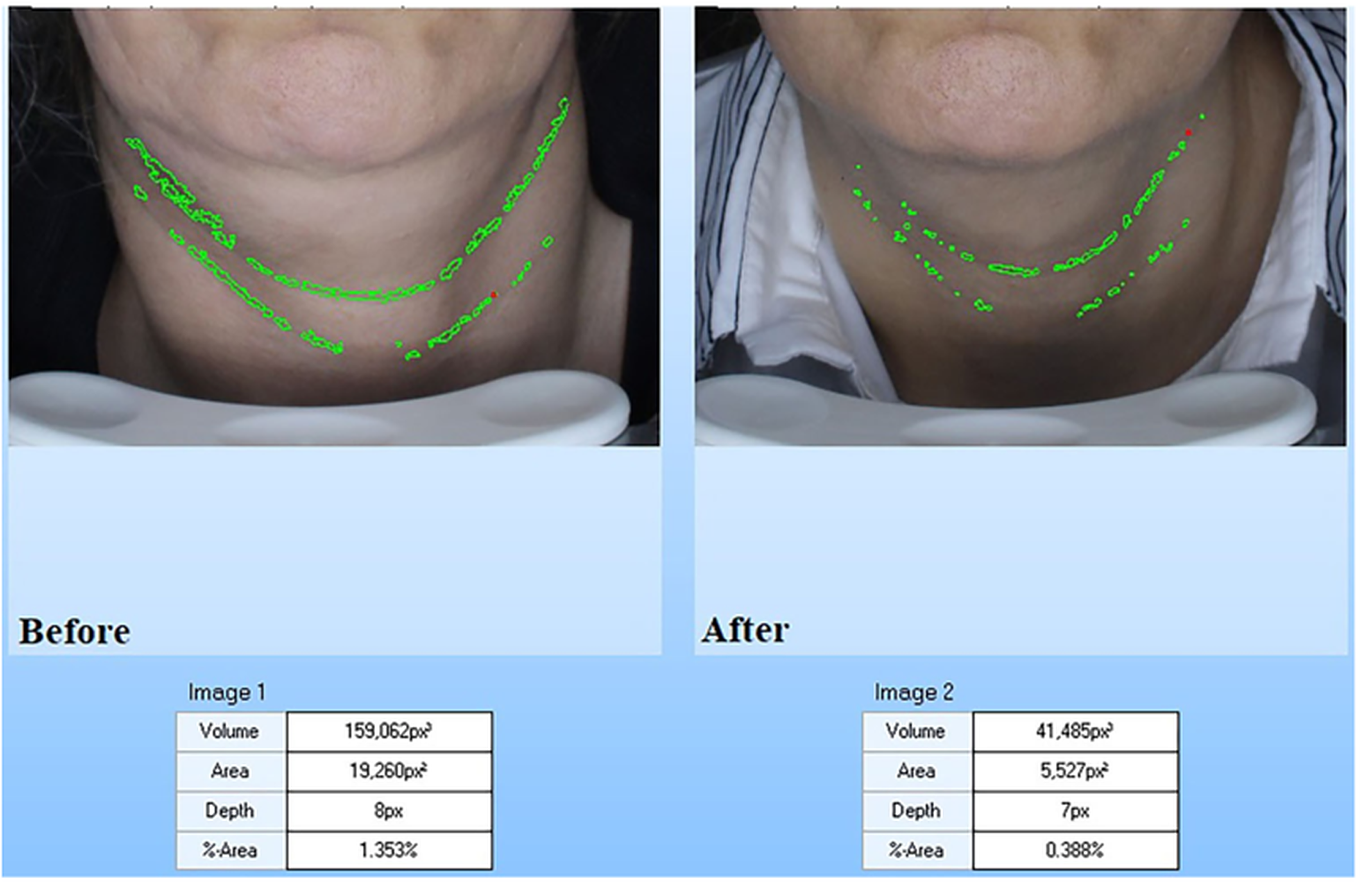
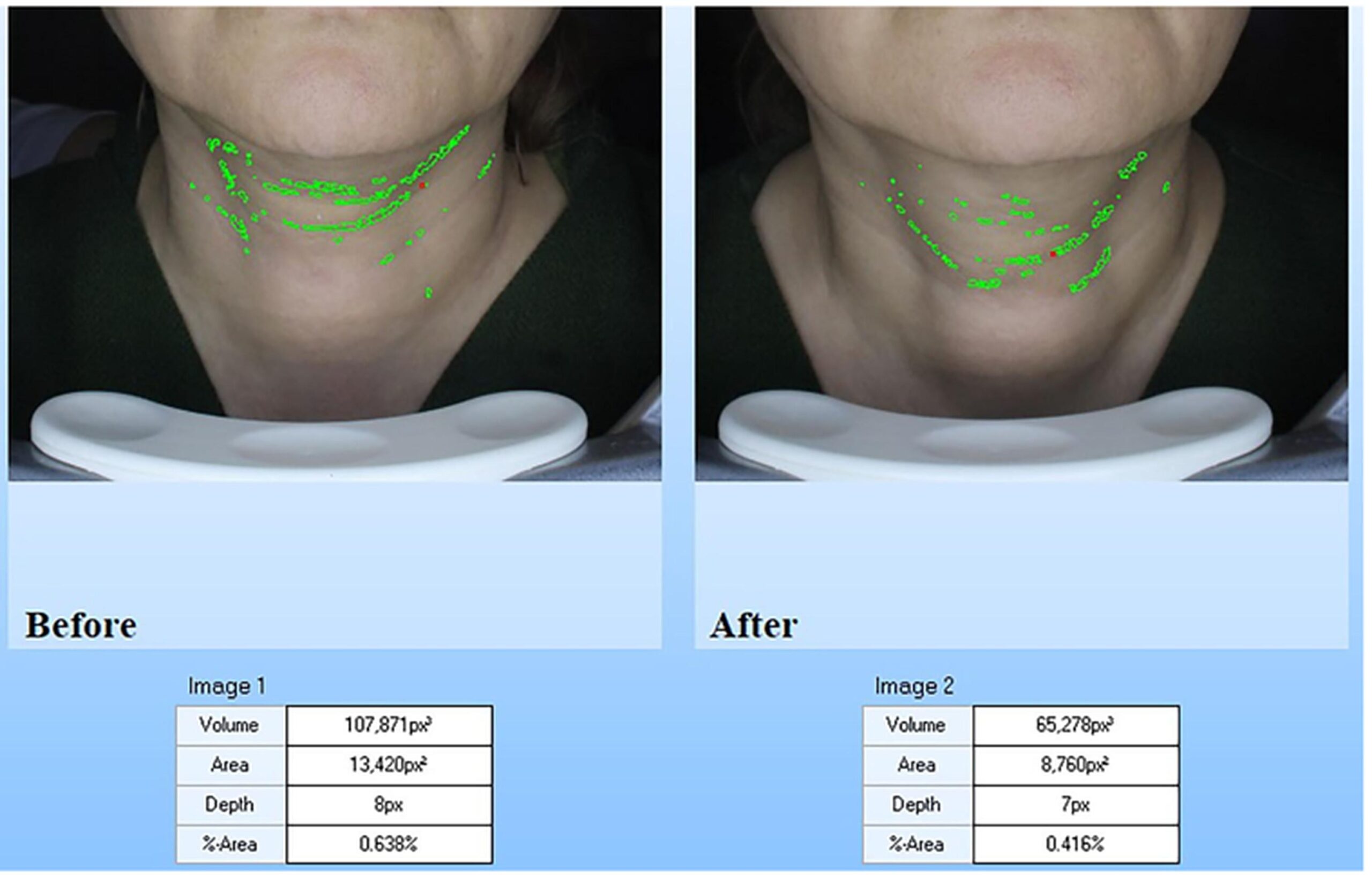
- Visioface analysis can quantify changes in wrinkle volume, depth and area
Published Visioface analysis
Ultrasound evidence of skin remodeling
Skin ultrasonography was used to evaluate structural changes in the epidermis and dermis. The publication reports significant increases in epidermal and dermal density and thickness after treatment, supporting a measurable remodeling response in the studied group.
Who may be a suitable candidate for Endolift neck-line treatment?
The most important question is what is creating the line. Endolift may be considered when horizontal wrinkles coexist with reduced skin quality or mild-to-moderate laxity and the patient prefers a minimally invasive approach. Deep fixed creases, marked laxity, strong platysmal activity or volume loss may need a different or combined strategy.
- Visible horizontal neck lines with a skin-quality or laxity component
- Early-to-moderate “necklace lines” in younger or middle-aged adults
- Patients seeking collagen-remodeling rather than simple line filling
- Mild-to-moderate neck laxity accompanying transverse wrinkles
- Realistic expectations and willingness to wait for progressive remodeling
When Endolift may not be the best first option
- Predominantly dynamic vertical platysmal bands, where neuromodulator treatment may be more relevant
- Very deep isolated horizontal grooves that may require volume correction or combination therapy
- Marked excess skin or advanced neck laxity that may need surgical assessment
- Active infection or inflammatory skin disease in the treatment area
- Pregnancy or breastfeeding — these groups were excluded from the source study
- Expectations of complete or permanent removal of every neck line after one session
Endolift vs filler vs Botox vs RF / resurfacing
These treatments act on different components of neck aging and should not be treated as interchangeable.
| Option | Best suited to | Main advantage | Key limitation |
|---|---|---|---|
| Endolift | Horizontal lines with skin-quality / laxity component | Subdermal collagen-remodeling approach; may address skin quality and laxity together | Not a substitute for surgery or volume correction in every anatomy |
| Hyaluronic acid / biostimulatory filler | Selected deeper static horizontal grooves or volume deficit | Can soften an individual crease by restoring support | Injection-related risks; does not directly treat every laxity component |
| Botulinum toxin | Dynamic platysmal activity or selected neck-line patterns | Targets muscular contribution | Does not replace skin-tightening or volume correction |
| RF / fractional laser | Texture, superficial wrinkles and broader skin-quality concerns | Can stimulate collagen and improve surface quality | Treatment course, downtime and response vary by modality |
| Neck lift surgery | Advanced laxity / structural aging | Most direct correction for significant skin and tissue laxity | Surgery, recovery and surgical risk |
What to expect from treatment
- Assessment — The neck is examined to separate horizontal lines from laxity, platysmal bands, submental fat and volume loss.
- Treatment planning — The horizontal wrinkle pattern and surrounding skin quality are mapped before deciding whether Endolift alone or a combined approach is appropriate.
- Fiber-assisted treatment — A fine optical fiber is used beneath the skin to deliver 1470-nm laser energy in the selected treatment plane.
- Early recovery — In the published study, mild edema and redness resolved within 1–2 days. Individual recovery can vary.
- Progressive remodeling — The source study assessed biometric and photographic changes after several months, so improvement should be described as progressive rather than immediate.
Recovery and downtime
The study reported mild edema and erythema after treatment, resolving completely within one or two days, with no side effect reported during the three-month monitoring period. In routine clinical practice, temporary swelling, redness, tenderness, bruising or entry-point sensitivity can still occur. Recovery depends on treatment intensity, anatomy and individual healing response.
How long do results take?
Endolift aims to trigger tissue remodeling, so the result is not limited to the first few days. The source study compared biometric measurements before treatment and at approximately three months. For patient education, it is more accurate to explain that tightening and wrinkle improvement can develop progressively over weeks to months rather than promise a fixed result on a specific day.
How many sessions are needed?
The published horizontal-neck-wrinkle study used a single Endolift treatment. That does not mean every patient requires exactly one session. Session number should be individualized according to wrinkle depth, skin quality, laxity, response and whether other treatments are being combined.
Safety: what the study tells us
In the small 10-patient study, mild edema and erythema resolved within one to two days, and no side effect was reported during the study follow-up. The source excluded patients with active infection, coagulopathy, immunocompromised status, thyroid disease, cancer, autoimmune disease, pregnancy and breastfeeding. These data are useful but are not large enough to define the frequency of uncommon complications. Patient selection and anatomical technique remain essential.
Important evidence limitation:
This study involved only 10 participants and did not provide a large controlled comparison with filler, botulinum toxin, RF, fractional laser or surgery. The published findings support evidence-led discussion of Endolift for neck lines, but not claims of guaranteed or universal results.
