
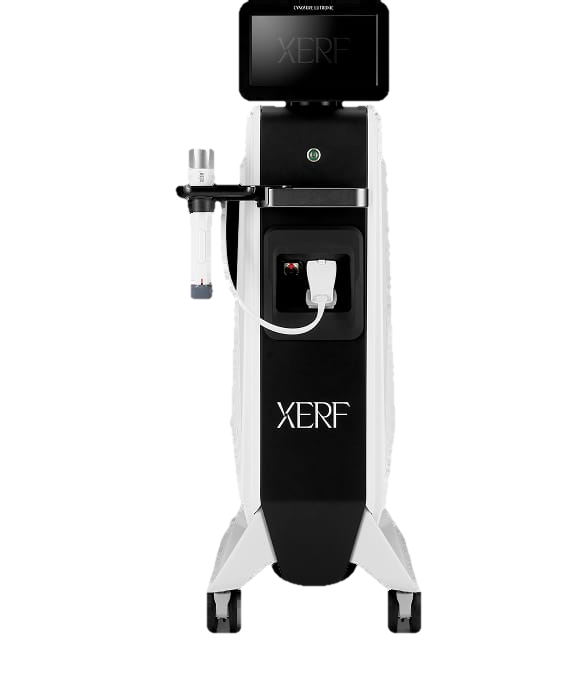
What Is XERF Dual-Frequency Monopolar RF ?
XERF is a non-invasive monopolar radiofrequency system designed to heat the dermis and deeper supporting tissue without needles or surgical incisions. The platform can operate at 6.78 MHz alone or combine 6.78 MHz with 2 MHz in a dual-frequency deep mode.
Monopolar RF works by creating resistive heating within tissue. The thermal response can immediately change collagen structure and can also trigger a longer remodeling phase involving fibroblasts, collagen synthesis, elastin changes and extracellular-matrix reorganization.
The dual-frequency concept is intended to broaden tissue engagement. The lower 2 MHz component has a longer wavelength and lower attenuation, which can favor deeper energy deposition. When paired with 6.78 MHz, the result is a treatment field that can affect both dermal collagen and deeper connective structures.
Why Use 6.78 MHz + 2 MHz Instead of 6.78 MHz Alone ?
Frequency influences how RF energy behaves in tissue. A 6.78 MHz monopolar RF signal is well established for dermal heating. The addition of 2 MHz changes the depth profile and appears to increase engagement of deeper dermal and subcutaneous structures.
| Feature | 6.78 MHz Alone | 6.78 + 2 MHz Dual Frequency |
|---|---|---|
| Primary experimental comparison | Conventional single-frequency monopolar RF | Dual-frequency deep-mode delivery |
| Immediate deep dermal effect | Collagen thickening and shortening | More pronounced deep dermal collagen change |
| Subcutaneous fibrous septa | Structural change present | Thicker, more organized and more prominent septal fibers |
| One-month remodeling | Collagen remodeling present | Greater collagen thickening and more organized fiber architecture |
| Elastin signal | Increased from baseline | Increased, with broader dual-frequency remodeling pattern |
The difference is not simply “more heat.” The objective is to distribute a therapeutic thermal dose across multiple tissue levels while avoiding epidermal injury and uncontrolled hot spots.
What Was Tested in the Preclinical Model ?
The tissue study compared single-frequency 6.78 MHz treatment with dual-frequency 6.78 + 2 MHz treatment using the XERF system. Female porcine skin was treated on the dorsal surface, and tissue was examined at two key time points: six hours after treatment and one month after treatment.
Histology was used to assess immediate collagen contraction, deep dermal and subcutaneous changes, later collagen remodeling and elastin. Thermal imaging monitored the skin surface, while tissue-safety staining was used to look for thermal injury.
The system used EFFECTOR 60 and EFFECTOR 40 applicators in the experimental protocol. The source material describes treatable footprints of 20 × 30 mm and 20 × 20 mm, respectively, with uniform energy delivery across the contact area.
Immediate Tissue Response : Collagen Shortening and Thickening
Within hours of RF exposure, collagen can undergo a physical contraction response. Heat disrupts hydrogen bonds within collagen, leading to shortening and thickening of the collagen bundle. This is one of the recognized mechanisms behind the immediate tightening effect of monopolar RF.
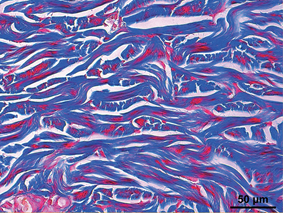
The dual-frequency condition produced more pronounced changes in the deep dermis than the 6.78 MHz-only condition. The most important histologic signature was not merely increased staining intensity; the collagen bundles appeared structurally thicker and shorter, consistent with acute thermal contraction.
Why the Subcutaneous Fibrous Septa Matter for Skin Tightening
Skin tightening is not only a dermal event. The subcutaneous layer contains collagen-rich fibrous septa that form a connective network between fat lobules. These septa contribute to tissue organization and mechanical support.
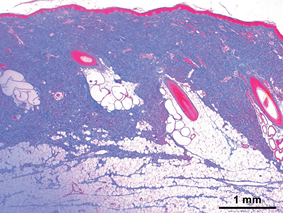
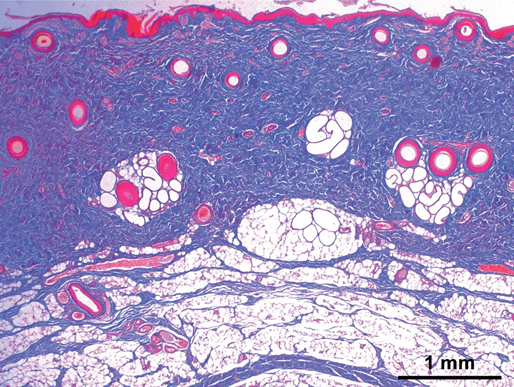
The preclinical tissue sections showed that the fibrous septa became thicker, better organized and more visually prominent after treatment, with the dual-frequency condition demonstrating the strongest effect. This supports the idea that deeper connective-tissue remodeling may contribute to tightening beyond the superficial dermis.
One-Month Collagen Remodeling : From Immediate Contraction to Tissue Reorganization
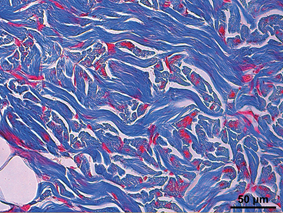
The early contraction response is only the first phase. Over the following weeks, RF-induced heating can activate fibroblasts and extracellular-matrix remodeling. At one month, collagen in the dermis appeared denser, more compact and more regularly aligned than at baseline.
This distinction matters clinically: immediate tightening and later remodeling are different biological processes. The first is dominated by heat-driven collagen contraction; the second is a reparative process involving new matrix synthesis and reorganization.

Quantitative Collagen Findings
Quantitative analysis of collagen-bundle diameter showed a significant increase after treatment, with the largest thickening in the dual-frequency 6.78 + 2 MHz group. The reported statistical comparison for collagen-bundle diameter showed a highly significant difference in the dual-frequency condition.
The biological interpretation is straightforward: the dual-frequency mode did not merely heat the surface. It produced measurable structural changes in collagen at depth, consistent with stronger tissue engagement.
Elastin and Extracellular-Matrix Remodeling
Collagen is only one part of skin mechanics. Elastin contributes to recoil and elasticity, while the broader extracellular matrix influences tissue resilience, tone and mechanical support.
At one month, elastin staining increased compared with baseline. The source also describes denser and more regularly aligned collagen bundles, together with more distinct subcutaneous septa. This combination is consistent with an active remodeling phase rather than a purely temporary thermal contraction.
How 2 MHz May Support Deeper Tissue Heating
Lower RF frequencies have longer wavelengths and reduced attenuation in tissue. The 2 MHz component is therefore relevant because it can shift energy deposition toward deeper tissue levels.
The proposed mechanism includes preferential heating of adipose tissue, which may behave as a thermal reservoir. Heat can then conduct into adjacent collagen-rich deep dermal and fascial structures. This provides a biophysical explanation for why dual-frequency delivery produced stronger deep-tissue histologic effects than 6.78 MHz alone.
The platform also uses a variable pulse architecture intended to create a gradual temperature rise rather than a sharp peak. In principle, a slower build-up can increase cumulative intradermal thermal dose while reducing hot-spot risk.
What Happens After Heating? Fibroblasts, Collagen and Elastin Synthesis
Thermal RF exposure can trigger more than a mechanical contraction. Fibroblasts respond to the tissue environment and participate in collagen and elastin synthesis. Over time, this supports extracellular-matrix remodeling and improved structural integrity.
The source discusses mechanotransductive signaling pathways including FAK, MAPK/ERK and PI3K/Akt as potential links between acute physical tissue change and longer-term synthesis of matrix proteins. For a patient, the practical implication is that the visible result of RF tightening may evolve after the session rather than being limited to the immediate post-treatment appearance.
Thermal Safety : How Was the Skin Surface Protected ?
The XERF system includes a cooling mechanism designed to protect the epidermis while deeper tissue is heated. In the preclinical testing, infrared thermal imaging was used to monitor the skin surface and confirm that temperatures remained below the intended safety ceiling.
Measured surface temperatures remained below 43°C across the tested 6.78 MHz and 6.78 + 2 MHz conditions. Tissue-safety staining performed later showed preserved tissue architecture and no thermal damage in the epidermis or dermis in this model.
What This Evidence Does – and Does Not – Prove
The mechanistic evidence is valuable because it shows what the device does inside tissue: immediate collagen contraction, deeper septal engagement, one-month collagen remodeling, elastin change and maintained epidermal safety under the tested conditions.
However, this was a preclinical porcine model, not a large human clinical trial. Histologic improvement does not automatically translate into a guaranteed millimeter measurement of lifting, a fixed wrinkle-reduction percentage or an identical result in every face or body area.
- The evidence strongly supports a biological mechanism of deeper dual-frequency tissue engagement.
- It supports a favorable thermal-safety profile under the tested experimental conditions.
- It does not establish a universal number of sessions or a guaranteed degree of visible lifting in humans.
- Human outcomes still depend on anatomy, age, tissue thickness, applicator choice, energy, cooling, technique and indication.
What Types of Concerns Fit the Mechanism of Dual-Frequency RF ?
The tissue effects seen in this model are most relevant to concerns in which collagen remodeling and connective-tissue tightening are the therapeutic target. In practical aesthetic planning, that can include mild to moderate skin laxity, early loss of firmness, textural aging and areas where deeper structural support is part of the problem.
The device should not be viewed as a substitute for surgery when major tissue descent or significant skin redundancy is present. It also does not replace volume restoration when the dominant issue is skeletal or fat-compartment volume loss.
XERF Dual-Frequency RF vs. Conventional Monopolar RF
| Question | Conventional 6.78 MHz RF | XERF Dual Frequency 6.78 + 2 MHz |
|---|---|---|
| Does it heat collagen-rich dermal tissue? | Yes | Yes |
| Does it show immediate collagen contraction? | Yes | Yes, with stronger deep-dermal changes in the model |
| Deep fascial / septal engagement | More limited in the direct comparison | More pronounced |
| One-month collagen remodeling | Present | Greater bundle thickening and organization |
| Surface-temperature control | Cooling and technique dependent | Below 43°C in the tested model with device cooling |
Why “Deeper” Does Not Mean “More Aggressive” by Default
A common misunderstanding is that deeper energy automatically means a harsher treatment. In RF, depth and safety are governed by the interaction of frequency, electrode geometry, pulse architecture, cooling, contact, impedance and total thermal dose.
The goal is not maximal temperature. The goal is a controlled thermal window that is high enough to trigger collagen contraction and remodeling while preserving the epidermis and avoiding focal overheating.
XERF in Abu Dhabi : What Patients Should Ask Before Treatment
Patients searching for XERF in Abu Dhabi should focus on treatment planning rather than device name alone. The same platform can use different applicators, depth modes, energy levels and treatment strategies, so the quality of the consultation matters.
- Is my main concern mild laxity, deeper tissue support, fine lines, or volume loss ?
- Will the treatment use conventional 6.78 MHz or the dual-frequency 6.78 + 2 MHz deep mode, and why ?
- Which applicator is appropriate for the treatment area ?
- How will cooling, contact and patient tolerance be monitored ?
- What degree of improvement is realistic for my anatomy ?
- Would another treatment – such as laser resurfacing, ultrasound, injectables or surgery – address my dominant concern more directly ?
A strong treatment plan should explain which tissue layer is being targeted, why a particular depth mode is being chosen, and what the expected balance is between immediate contraction and gradual remodeling.
