
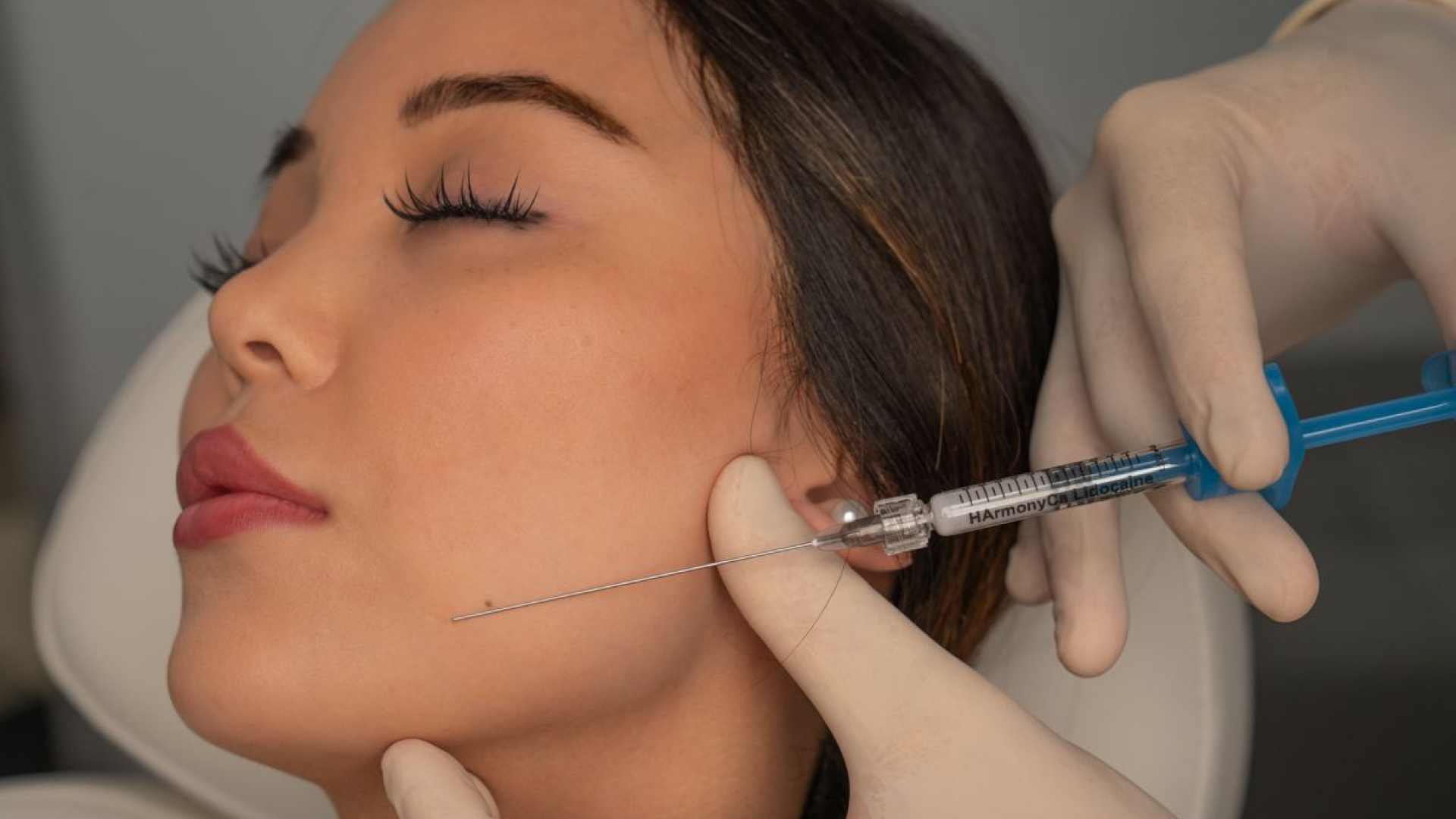
What Is HArmonyCa™ ?
HArmonyCa™ is a hybrid facial injectable that combines two established filler concepts in one formulation: hyaluronic acid for immediate support and calcium hydroxyapatite microspheres for biostimulation.
Each 1.25 mL syringe contains 20 mg/mL hyaluronic acid, CaHA microspheres and lidocaine for treatment comfort. The CaHA microspheres are suspended within the HA gel, creating a product that behaves differently from an HA-only filler.
Why Combine HA and CaHA ?
Facial aging is not only a problem of lost volume. The dermal support network also changes: collagen becomes reduced and less organized, elastic fibers deteriorate, skin becomes less firm and the natural hyaluronic-acid environment declines.
A hybrid filler addresses two different treatment needs at the same time. HA provides an immediate mechanical effect, while CaHA supports a slower biological response. This allows treatment to focus on both the visible contour today and the quality of the supporting tissue over time.
The HA Component : Immediate Support and Smoother Contour
Hyaluronic acid is well suited to restoring volume and improving facial contour. In a hybrid formulation, it also creates a smooth carrier for the CaHA microspheres and provides immediate support while the longer-term collagen response develops.
This immediate effect is important for patients who do not want to wait months before seeing any visible structural change.
The CaHA Component : Biostimulation and Connective-Tissue Support
Calcium hydroxyapatite microspheres provide the biostimulatory side of the treatment. They act as a scaffold within the tissue and stimulate fibroblast activity, supporting new collagen formation.
The purpose is not simply to add volume. The collagen response helps improve firmness, elasticity and the mechanical quality of the treated tissue.
HArmonyCa™ vs HA-Only Filler
| Feature | HA-only Filler | HArmonyCa™ Hybrid Filler |
|---|---|---|
| Immediate contour / support | Yes | Yes |
| Biostimulatory CaHA component | No | Yes |
| Main concept | Volume restoration and contour correction | Immediate support + connective-tissue stimulation |
| Skin-firmness strategy | Primarily mechanical support | Mechanical support plus collagen-related remodeling |
| Best planning mindset | Precise correction of selected volume deficits | Broader support, firmness and contour improvement |
HArmonyCa™ vs CaHA-Only Treatment
CaHA is valued for its biostimulatory effect and ability to support collagen remodeling. HArmonyCa™ adds an HA phase to that concept, giving the treatment an immediate gel-based support effect while the CaHA component contributes to longer-term tissue remodeling. This makes the hybrid formulation particularly relevant when both immediate facial support and progressive improvement in tissue quality are desired.
Why HArmonyCa™ Is Often Described as a Dynamic Filler
A natural aesthetic result should not be judged only from a still photograph. The face moves constantly during speech, smiling, laughing, looking down and changing expression.
The dynamic-filler concept focuses on whether the treated skin and soft tissue continue to move naturally while appearing firmer and better supported. HArmonyCa™ is particularly interesting in this context because its role is not limited to filling a static hollow; it also supports skin elasticity and connective-tissue quality.
What does ‘dynamic filler’ mean ?A dynamic filler is one that supports facial shape and tissue quality while preserving natural movement and expression. The goal is to improve laxity and support without making the face look rigid or overfilled.
Why Facial Movement Matters
Many signs of laxity are more obvious when the patient smiles, lowers the chin, turns the head or pinches the skin. A treatment that looks good only in a neutral frontal photograph may not look equally natural during animation.
This is why movement-based assessment can be useful when planning or reviewing HArmonyCa™ treatment.
Connective Tissue : The Real Target Behind Skin Support
The visible skin surface is only one part of facial aging. Beneath it is a network of collagen, elastic fibers, fibrous septae and soft-tissue compartments that determines how the face holds its shape.
When this support network weakens, the result can be laxity, softer jawline definition, less stable cheek contour and more visible folding during movement. A hybrid filler can be used as part of a strategy to improve this support environment.
Where Can HArmonyCa™ Be Used ?
Treatment planning can involve selected zones of the midface, lateral face and lower face. The product is not simply injected into every visible line; it is placed strategically to improve structural support and transition between facial compartments.
| Facial Zone | Potential Treatment Objective | Planning Concept |
|---|---|---|
| Zygomatic / malar region | Lateral cheek support and contour | Improve support without creating a heavy central cheek |
| Jaw ramus | Posterior lower-face structure | Strengthen the lateral facial frame |
| Jawline | Improve lower-face definition | Support the mandibular contour rather than simply adding bulk |
| Prejowl transition | Soften an irregular mandibular line | Improve transition without overfilling the jowl |
| Mental / lower-face support | Improve lower-third balance | Integrate with the jawline rather than treating one point in isolation |
| Submental / adjacent support zones | Selected contour support | Assess whether the issue is laxity, fat, structure or a combination |

The Five-Entry-Point Concept
A structured cannula plan can be used to access multiple treatment zones while limiting unnecessary skin punctures. The described approach uses entry points around the subzygomatic region, mandibular body near the anterior masseter border, prejowl sulcus, parotid region and zygomatic/malar region.
These are not universal points for every patient. The face should still be evaluated individually for anatomy, asymmetry, laxity, volume distribution and the actual treatment objective.
Injection Plane and Technique
The described technique places HArmonyCa™ in the superficial subcutaneous layer through a cannula using retrograde linear fanning. This allows controlled distribution across a broader treatment zone rather than concentrating a large bolus in one point.The purpose of fanning is to create a more homogeneous support pattern. The exact entry point, vector and amount should be adapted to the patient’s anatomy.
Why HArmonyCa™ Is Not a ‘Fill Every Hollow’ Treatment
Hybrid-filler planning should be structural. If every visible depression is filled independently, the face can become heavy or lose its natural shape.A better strategy is to identify which zones have lost support, which zones need contour refinement, and which areas should be left relatively untouched to preserve facial character.
HArmonyCa™ for Jawline Definition
The jawline is a natural area for hybrid-filler planning because lower-face aging often combines reduced structural support with skin laxity. HArmonyCa™ can be used to improve the mandibular transition and reinforce the lateral frame of the lower face.
Jawline treatment should remain proportional. Excessive lateral volume can make the lower face too broad, while overfilling around the jowl can make heaviness more obvious.
HArmonyCa™ for the Jaw Ramus
The jaw ramus is the posterior vertical component of the mandible. Supporting this region can strengthen the lateral frame of the lower face and create a cleaner transition toward the jawline. This area can be particularly useful when the goal is not a dramatic angle but a better sense of structural continuity between the cheek, lower face and mandibular border.
HArmonyCa™ for the Prejowl Area
The prejowl sulcus is the depression immediately in front of the jowl. Correcting the transition can make the jawline appear smoother and more continuous. The key is to avoid simply filling the entire jowl complex. A structural approach considers the chin, mandibular border and lateral jawline together.
HArmonyCa™ for the Lateral Cheek and Zygomatic Region
The lateral cheek and zygomatic region contribute to facial support and the transition between the midface and lower face. Strategic treatment can improve support without necessarily creating a visibly ‘filled’ cheek. This is particularly relevant for patients who want a firmer facial contour rather than obvious central-cheek volume.
Skin Firmness and Elasticity
Firmness describes how well the tissue resists deformation. Elasticity describes how well it returns toward its original shape after movement or pressure.
Because HArmonyCa™ combines immediate HA support with a CaHA-driven collagen response, it fits well into treatment plans where improving both contour and tissue mechanics is the goal.
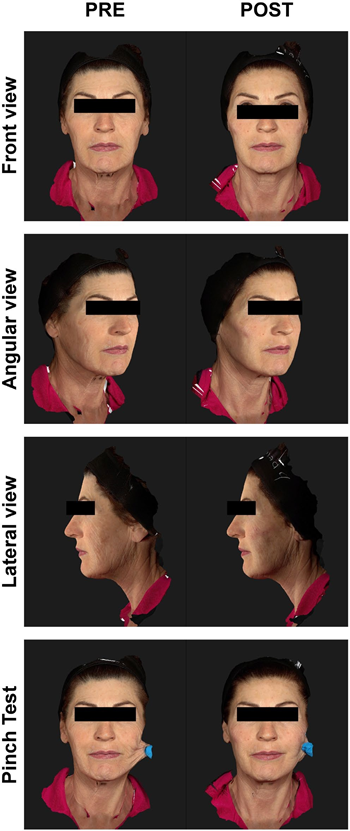
The Pinch Test : Why It Can Be Useful
The pinch test is a simple way of showing how loose or mechanically weak skin behaves when compressed between the fingers. It can help demonstrate laxity that is less obvious in a static photograph.
When reviewing a treatment designed to improve connective-tissue support, movement and pinch behavior can sometimes reveal changes that are not obvious in a single frontal image.
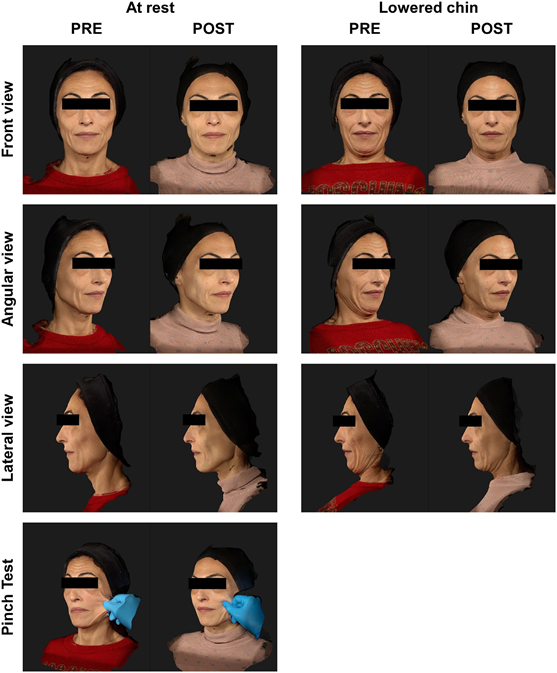
Why Looking Down Can Reveal Lower-Face Laxity
Lowering the chin temporarily exaggerates gravitational folding and soft-tissue laxity. This position can reveal how well the lower face is supported during a movement that is common in everyday life, including smartphone and video-call use. A natural treatment should continue to look balanced in this position rather than appearing stiff or excessively volumized.
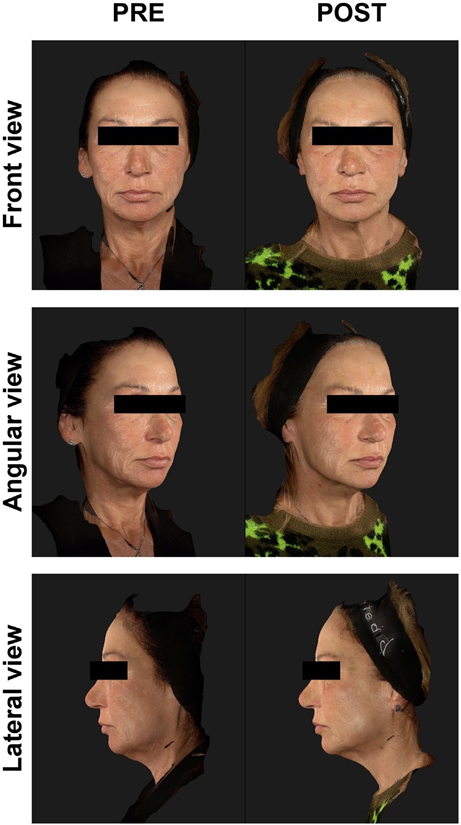
Skin Quality vs Volume : They Are Not the Same Goal
A patient can have enough facial volume and still have poor skin firmness. Another patient can have good skin quality but true structural volume loss. A third patient may have both problems.
HArmonyCa™ is most conceptually useful when the treatment plan needs both immediate support and progressive improvement in tissue quality.
Photoaging, Scarring and Other Skin Conditions
Patients seeking facial rejuvenation may also have photoaging, post-acne scarring, oily or acne-prone skin, or rosacea. These conditions can alter texture, color and overall facial appearance independently of volume and laxity.
HArmonyCa™ should not be presented as a stand-alone treatment for the underlying dermatologic disease. Its role is facial support and rejuvenation. Active skin disease, infection or uncontrolled inflammation still requires separate medical assessment.
How Long Does the Effect Last ?
A hybrid filler has two overlapping phases. The HA component provides an early mechanical effect, while the CaHA component supports a slower collagen-related response.
Because tissue remodeling and product persistence vary between patients, longevity should not be treated as a fixed promise. Age, metabolism, facial movement, treatment area, injected amount and baseline tissue quality can all influence how the result evolves.
Does HArmonyCa™ Look Natural ?
Natural appearance depends more on treatment design than on the product name. A face can look unnatural when too much product is placed in the wrong zone, when every depression is filled, or when the desired facial shape is not considered.
HArmonyCa™ is particularly suited to a natural-result strategy when it is used to improve support, elasticity and contour rather than to create excessive local volume.
Can HArmonyCa™ Be Combined With Other Treatments ?
Hybrid filler may be incorporated into a broader facial rejuvenation plan that also uses neuromodulators, lasers, other fillers or surgical procedures when appropriate.
The important question is sequencing. Combination treatment should be planned around healing time, tissue response, treatment goals and the anatomical areas involved rather than performing multiple procedures simply because they are available.
HArmonyCa™ and Botulinum Toxin
Neuromodulators and hybrid filler address different components of facial aging. Botulinum toxin modifies selected muscle activity; HArmonyCa™ provides structural support and biostimulation.
They may complement each other when both dynamic muscle activity and tissue laxity contribute to the patient’s concern.
HArmonyCa™ and Energy-Based Treatments
Energy-based procedures and hybrid filler also solve different problems. Devices may target skin remodeling, tightening or fat, while HArmonyCa™ provides injectable support and collagen stimulation.
A combined plan can make sense, but device timing and injectable timing should be individualized rather than standardized for every patient.
Immediate Reactions and Downtime
Temporary redness, swelling, tenderness or bruising can occur after injection. These reactions are usually related to the injection process itself and often settle as the tissue recovers.
Patients should receive individualized aftercare instructions and know which symptoms are expected versus which require medical review.
Delayed Reactions
Delayed swelling or nodules can occur after dermal filler treatment and should not be ignored if they persist, become painful or are associated with redness, heat or other inflammatory signs.
A hybrid filler contains more than one structural component, so delayed reactions should be assessed by a clinician familiar with the specific product rather than treated as if the injectable were HA alone.
Safety Starts With Patient Selection
- Review current skin condition and exclude active infection in the treatment field.
- Review systemic disease and medication history.
- Review previous filler, laser, surgery and neuromodulator treatments.
- Assess facial anatomy, asymmetry and baseline tissue quality before deciding entry points.
- Use an injection plane and distribution strategy appropriate to the product.
- Provide clear instructions for expected swelling, bruising and warning signs.
- Have a plan for early and delayed filler complications.
Who May Be a Good Candidate ?
- Patients with mild to moderate facial laxity.
- Patients who want improved skin firmness as well as contour support.
- Patients with early loss of jawline definition.
- Patients with a prejowl transition that contributes to an irregular mandibular contour.
- Patients who want lateral cheek or lower-face support without obvious overfilling.
- Patients looking for a treatment that combines immediate support with biostimulation.
- Patients who understand that natural improvement is usually more desirable than maximal volume
Who May Need a Different Treatment Strategy ?
- Patients whose main problem is severe skin excess requiring surgical repositioning.
- Patients seeking a very small, precise correction in a highly localized area where a different filler approach may be more appropriate.
- Patients with active infection or uncontrolled inflammatory skin disease in the treatment zone.
- Patients expecting the result of a facelift from an injectable.
- Patients whose main concern is pigment, vascular redness or acne activity rather than support and laxity.
- Patients who already appear overfilled and primarily need reassessment rather than additional volume
HArmonyCa™ in Abu Dhabi : What a Good Consultation Should Clarify
- Is my main problem volume loss, laxity, poor skin firmness, contour change or a combination ?
- Do I need a hybrid filler, an HA-only filler, a device treatment or a combination ?
- Which areas need more support and which areas should be protected from additional volume ?
- Will the treatment focus on the lateral cheek, jaw ramus, jawline, prejowl or multiple structural zones ?
- How should my face look during movement, not just at rest ?
- What degree of immediate change should I expect from the HA component ?
- What longer-term change is expected from collagen remodeling ?
- How will the treatment avoid making the lower face too wide or heavy ?
- What other procedures have I had, and how should they be sequenced with HArmonyCa™ ?
- What symptoms after treatment are normal, and what should prompt an urgent review ?
