
Hand Rejuvenation in Abu Dhabi : A Complete, Safety-First Guide
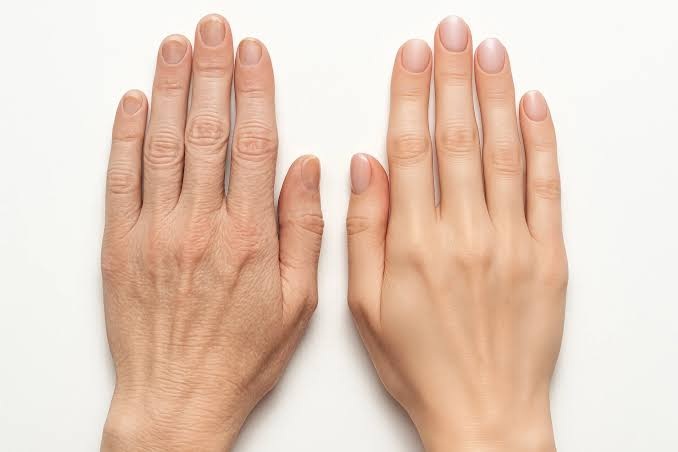
The face is not the only area that reveals time. Hands are constantly exposed to sunlight, frequent washing, environmental stress and movement. As skin becomes thinner and the soft padding over the back of the hand decreases, veins, tendons and bones can become more visible. Pigment, rough texture and crepiness may add to the contrast. The result is often a mismatch between a refreshed face and hands that appear older.
Hand rejuvenation is not one standard injection or device session. It is a treatment strategy built around the patient’s dominant concern. Volume loss may respond to an appropriate dermal filler or, in selected surgical cases, fat transfer. Brown spots and uneven tone need a surface-focused plan. Laxity and crepey texture may require collagen-stimulating or energy-based options. Treating the wrong layer can give an incomplete result, so diagnosis comes before product choice.
Hand filler can soften the appearance of prominent veins, tendons and bony contours by restoring lost padding on the back of the hand. It does not remove veins, erase every pigment spot or stop the natural aging process. A consultation should separate volume loss from pigmentation, texture and laxity before any treatment is recommended.
What Is Hand Rejuvenation ?
Hand rejuvenation describes a group of medical aesthetic treatments intended to improve the appearance of the dorsal hands – the backs of the hands rather than the palms. Depending on the patient, the plan may include volume restoration, improvement in skin quality, correction of benign pigment, treatment of selected textural change or a staged combination of these approaches.
The goal is not to make the hands look swollen or artificially smooth. Good treatment aims to restore a believable transition between the skin and deeper structures while preserving normal movement and hand function. The result should look appropriate both when the hand is resting and when it is moving.
Why Do Hands Age So Noticeably ?
Several processes occur at the same time. Repeated ultraviolet exposure contributes to lentigines, uneven tone, collagen breakdown and fine wrinkling. The skin barrier is challenged by washing, sanitiser, detergents and dry environments. Beneath the surface, age-related loss and redistribution of fat reduces camouflage over veins, extensor tendons and metacarpal bones. These structures may be normal and healthy; they simply become easier to see.
The relative contribution of each process differs. One patient may mainly dislike prominent veins, another may be concerned about brown spots, and another may notice thin, crepey skin. This explains why the “best hand treatment” is not universal.
The Three Treatment Targets
- Volume : Loss of soft padding, increased visibility of veins, tendons and bony contours.
- Skin Quality : Thin, crepey or lax skin with reduced elasticity and uneven light reflection.
- Surface Change : Sun spots, uneven pigmentation, roughness and fine lines.
A filler can restore volume but cannot reliably remove epidermal pigment. A laser or peel may improve selected surface changes but cannot replace substantial lost padding. Combining treatments may be appropriate, but only after priorities, sequence and recovery are planned.

Why Anatomy Matters for Hand Filler
The dorsal hand contains several mobile tissue layers separated by fascia. The most superficial lamina has variable fat and comparatively few major structures. Deeper lies an intermediate layer containing veins and sensory nerves; the extensor tendons sit deeper still. Skin thickness, fat volume and the location of visible structures vary between individuals and even between the two hands.
This layered anatomy is why hand augmentation should be treated as a medical procedure. Product selection, placement, volume, instrument choice and distribution must be adapted to the patient. Thin skin makes irregularities easier to see, while injury to vessels can cause bruising and, rarely, more serious vascular complications. The hand also needs to remain functional, so overcorrection is not a desirable endpoint.
How a Consultation Should Work
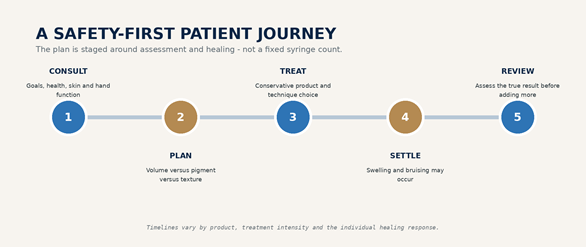
A high-quality consultation begins by identifying the main complaint, not by choosing a syringe. Dr. Erfan Rahmani assesses the hands at rest and in movement, compares both sides and considers the relationship between volume loss, skin laxity, pigment and visible vessels. Medical history, medication, previous filler, scars, inflammatory conditions and hand function all matter.
- What concerns you most: veins, tendons, boniness, wrinkles, pigment or overall skin quality ?
- Do you want a subtle improvement or a more complete multi-stage rejuvenation plan ?
- Have you previously had filler, fat transfer, laser, sclerotherapy, surgery or trauma to the hands ?
- Do you have joint, tendon, nerve or blood-vessel disease affecting the hands ?
- Are there active infections, wounds, dermatitis, rashes or recent procedures near the treatment area ?
- Do your work, sport or daily activities require heavy hand use immediately after treatment ?
Who May Be a Good Candidate ?
A potential candidate is generally a healthy adult who is bothered by age-related volume loss or skin changes, has realistic expectations and understands that non-surgical results are temporary. The skin and soft tissues must allow a conservative plan, and the person must be willing to follow aftercare and attend review.
Treatment may be postponed or declined when there is active infection, open skin, uncontrolled inflammatory disease, significant hand vascular or tendon disease, uncertain previous filler, allergy to a product component, pregnancy or breastfeeding, or a medical history that makes the risk-benefit balance unfavourable. Anticoagulants and supplements can influence bruising, but prescribed medication should never be stopped without the prescribing clinician’s advice.
Hyaluronic Acid Hand Filler
Hyaluronic acid (HA) fillers are water-binding gels used to restore soft-tissue volume. Their main attractions are immediate contour correction, a range of product characteristics and the availability of hyaluronidase to break down HA when clinically indicated. Reversibility is useful, but it does not remove every risk and should never be described as an effortless “undo button.”
For hand rejuvenation, an HA filler can create a smoother layer of padding over the dorsal hand and reduce the contrast of veins and tendons. The objective is subtle camouflage rather than a puffy or featureless hand. Product choice and regional indications differ, so the exact gel should be selected only after assessment and according to local product registration and labelling.
Potential Advantages of HA
- Immediate, adjustable volume restoration.
- A softer contour when the product and plane suit thin, mobile hand tissue.
- Hyaluronidase is available for selected corrections or complications involving HA.
- Can be staged conservatively and reviewed before additional volume is considered.
Important HA Limitations
- Results are temporary and duration varies by product, amount, tissue and metabolism.
- Swelling, bruising, tenderness, asymmetry or visible irregularity may occur.
- Very superficial clear gel may create a blue-grey Tyndall effect.
- Dissolving may not reverse tissue injury caused by an unrecognised vascular event.
Calcium Hydroxylapatite for the Hands
Calcium hydroxylapatite (CaHA) is a biostimulatory filler composed of microspheres suspended in a carrier gel. It can provide immediate correction while also stimulating collagen-related tissue remodelling. Its opacity can be useful when visible veins need camouflage, and diluted or hyperdiluted approaches may be considered when skin quality rather than substantial volume is the main objective.
CaHA is not an HA gel and cannot be dissolved with hyaluronidase. This makes patient selection, product preparation, placement and avoidance of overcorrection especially important. In the United States, specific CaHA products have an FDA indication for correction of dorsal hand volume loss; this does not automatically define availability or approved use in the UAE. The exact product label and local registration must be checked.
Potential Advantages of CaHA
- Immediate support with an additional biostimulatory effect.
- Opaque material may camouflage underlying vessels effectively.
- Can be tailored toward volume or skin-quality goals by an experienced medical practitioner.
- Clinical studies and post-market experience support its role in selected hand-rejuvenation patients.
Important CaHA Limitations
- It is not dissolved by hyaluronidase.
- Swelling, bruising, tenderness, firmness, contour irregularity or nodules can occur.
- Thin skin and high hand mobility can make poor distribution more noticeable.
- A conservative, anatomy-led plan matters more than maximising the amount injected.
HA vs CaHA vs Fat Transfer
| Question | HA Filler | CaHA Filler | Fat Transfer |
|---|---|---|---|
| Main role | Immediate soft-tissue volume | Volume plus biostimulation | Surgical volume replacement |
| Material | Hyaluronic-acid gel | CaHA microspheres in carrier gel | Patient’s own processed fat |
| Reversibility | May be dissolved with hyaluronidase | Not dissolved with hyaluronidase | Not simply reversible |
| Recovery | Usually short; swelling/bruising possible | Usually short; swelling/bruising possible | Longer; includes donor-site recovery |
| Duration | Temporary and product-dependent | Temporary with potential longer skin benefit | Potentially durable; some fat resorbs |
| Best suited to | Selected patients seeking adjustable volume | Selected patients seeking volume and skin-quality benefit | Patients accepting a surgical procedure and variable fat survival |
There is no universal winner :
The better option depends on tissue thickness, degree of volume loss, skin quality, previous treatment, reversibility preference, downtime and the practitioner’s assessment. Product popularity alone is not a treatment plan.
What About Poly-L-Lactic Acid ?
Poly-L-lactic acid (PLLA) is a collagen-stimulating injectable used in aesthetic medicine, but the supplied chapter notes that it has fallen out of favour for hand volumisation because nodules and unevenness may become visible beneath thin, mobile skin. This does not mean PLLA is unsuitable for every body area; it means the dorsal hand has specific anatomical constraints and alternative options are often preferred.
Can Hand Filler Hide Veins ?
Filler does not remove a vein. By replacing some of the soft padding above deeper structures, it can reduce the contrast and shadow that make veins and tendons look prominent. This optical camouflage is often one of the most satisfying effects of hand volumisation. The underlying vessels remain present and functional.
Direct vein treatment is a different medical pathway and is not automatically required when volume restoration achieves the desired effect. If a patient is considering sclerotherapy or another vascular procedure, the hands should be assessed by an appropriately qualified clinician, with future venous access and treatment sequencing considered carefully.
Does Hand Filler Tighten Crepey Skin ?
Volume replacement can make loose skin look smoother by supporting it from beneath. CaHA may also contribute to collagen-related improvement. However, filler alone cannot correct every degree of laxity, thinness or surface wrinkling. When skin quality is the dominant concern, the plan may include a skin-focused modality rather than simply adding more volume.
Combination Hand Rejuvenation
The hands age in more than one layer, so a combination plan can be more logical than repeatedly increasing filler volume. Published reviews support a multimodal approach, while also noting that protocols and sequencing are not fully standardised. Treatments should be selected by concern and adapted to skin type, recovery tolerance and medical history.
- Sun protection and barrier care : Essential foundations for preventing additional photoaging.
- Pigment-focused treatments : Selected chemical peels, intense pulsed light or lasers may improve benign sun spots after diagnosis.
- Texture and collagen treatments : Fractional devices, radiofrequency or microneedling may be considered for selected skin-quality concerns.
- Volume restoration : HA, CaHA or surgical fat transfer may camouflage deeper structural visibility.
- Platelet-rich plasma or other regenerative strategies : Evidence and protocols vary, so benefits should not be overstated.
Daily broad-spectrum sunscreen and physical protection are central to any hand-rejuvenation plan. Without consistent UV protection, pigment and collagen damage continue even after a technically successful procedure.
What Happens on the Day of Treatment ?
The appointment begins with confirmation of the medical history, consent, photographs and the agreed plan. The hands are cleaned carefully and assessed in a neutral, relaxed position. If an injectable treatment is selected, comfort measures and product choice are individualised. Treatment should be deliberate and unhurried, with repeated checks of contour, skin colour, comfort and hand movement.
The objective is even distribution and conservative correction. More product is not automatically better. Overfilling can make the hands look puffy, exaggerate asymmetry, create palpable areas or interfere with a natural appearance during movement. In many cases, staged treatment and review are safer than trying to achieve the maximum change in one visit.
Safety Over Speed :Hand filler should be performed by a medically trained practitioner who understands dorsal hand anatomy, uses traceable products, maintains sterile technique and has a written plan for recognising and managing complications.
When Will I See the Result ?
Volume change from a filler is usually visible immediately, but swelling can temporarily exaggerate fullness or asymmetry. Bruising and tenderness may also affect the first impression. The true contour is judged after the tissues settle, not by repeatedly pressing or reshaping the hands at home.
Recovery Timeline: What Patients Commonly Notice
| Time Point | What Patients Commonly Notice |
|---|---|
| Immediately | A smoother dorsal contour may be visible; early swelling can affect symmetry. |
| First 24–72 hours | Swelling, tenderness, firmness or bruising may be most noticeable. |
| Around 1–2 weeks | The hands generally look more settled; timing varies by product and patient. |
| Planned review | Contour, skin response and the need for any further treatment are assessed. |
| Following months | The result gradually softens as the product integrates and later metabolises. |
How Long Do Hand Fillers Last ?
Duration varies by product, amount, tissue characteristics, hand activity, metabolism and previous treatment. Studies describe meaningful improvement over months, and some patients retain benefit beyond a year, but a fixed guarantee is not appropriate. A review should be based on the actual return of volume loss rather than an automatic calendar top-up.
CaHA may offer a longer skin-quality benefit because of its biostimulatory properties. HA has the advantage of potential enzymatic dissolution. Fat transfer can be more durable, but part of the grafted volume may be resorbed and the procedure involves surgery. Each option has a different trade-off between control, reversibility, downtime and longevity.
Recovery And Aftercare
Most non-surgical hand-rejuvenation patients resume ordinary activities quickly, but the hands are difficult to rest completely. Aftercare should be tailored to the product and procedure. Swelling may feel more noticeable because the hands are used continuously and often hang below heart level.
- Keep the hands clean and follow the clinic’s instructions for the injection sites.
- Use a wrapped cool pack only if recommended; never place ice directly on the skin.
- Elevate the hands when practical during the early swelling period.
- Avoid heavy gripping, intense exercise, heat exposure and unnecessary pressure for the period advised.
- Remove tight rings before treatment and do not force them onto swollen fingers afterwards.
- Do not massage or manipulate the product unless the treating physician specifically instructs you to do so.
- Contact the clinic if pain, swelling, colour change or hand function is worsening rather than improving.
Risks, Side Effects and Red Flags
Common short-term effects include swelling, tenderness, bruising, redness, temporary firmness and mild asymmetry. Less common problems include infection, delayed inflammation, persistent swelling, palpable or visible product, nodules, contour irregularity, allergic reaction and an unsatisfactory aesthetic result.
The most serious filler complication is accidental intravascular injection or compression that compromises blood supply. Although uncommon, it can cause tissue injury and requires immediate assessment. The FDA also notes that some filler reactions can appear weeks, months or years later, so a complete treatment record and prompt medical review are important.
Contact the clinic immediately :Increasing or severe pain, persistent blanching, a cool area, dusky or mottled skin, rapidly worsening colour change, marked swelling, weakness, numbness or difficulty moving the hand require urgent medical assessment.
Emergency Care :Sudden severe symptoms, rapidly progressive swelling with breathing difficulty, signs of anaphylaxis, or any stroke-like or visual symptom after filler require emergency care without delay. Inform the treating clinic as soon as safely possible.
Questions to Ask Before Hand Filler
- What is my main treatment target: volume, pigment, texture or laxity ?
- Which exact product is proposed, and is it registered and appropriate for this area in the UAE ?
- Is the planned use on-label or off-label in this jurisdiction ?
- What result is realistic for my tissue thickness and degree of volume loss ?
- What are the specific risks, alternatives and likely recovery ?
- What emergency products and referral pathway are available ?
- How will the treatment and product batch be documented ?
How to Choose a Hand-Rejuvenation Practitioner in Abu Dhabi
Hand filler is not simply a beauty service. The dorsal hand contains important veins, nerves and tendons beneath thin mobile skin. Choose a licensed medical practitioner with training in injectables and anatomy, access to genuine traceable products, appropriate infection-control standards and a clear complication pathway.
- A consultation that distinguishes volume loss from surface change.
- A specific explanation of benefits, limitations, alternatives and serious risks.
- A conservative plan that does not rely on a promotional syringe count.
- Standardised photography, documentation and planned follow-up.
- Willingness to delay or decline treatment when the anatomy or medical history is unsuitable.
- No needle-free filler pens, self-injection or treatment in a non-medical setting.
Dr. Erfan Rahmani’s Approach in Abu Dhabi
Dr. Erfan Rahmani uses a consultation-first approach to aesthetic medicine. For the hands, the first decision is whether the patient needs volume restoration, a skin-quality plan, pigment treatment or a staged combination. The aim is to improve proportion and tissue quality without making the hands look heavy or overfilled.
If the dominant concern cannot be corrected safely with filler, if previous product is uncertain, if skin or vascular findings require another specialist, or if the expected benefit does not justify the risk, the recommendation may be to postpone treatment or choose a different pathway. Good aesthetic medicine includes knowing when not to inject.
