

Why the Chin and Jawline Matter So Much to Facial Balance
The lower face has a disproportionate influence on how the entire face is perceived. A retruded chin can make the nose appear more prominent, a weak mandibular border can reduce facial definition, and an excessively widened lower face can disturb the relationship between the midface and jaw.
The source chapter therefore treats lower-face augmentation as a full-face planning problem rather than a single injection zone. Proper chin and jawline treatment can improve global facial balance in both men and women, but only when the patient’s baseline anatomy and profile are understood first.
How the Lower Face Ages
Facial aging is not limited to skin laxity. The chapter describes a combination of bone remodeling and resorption, fat-pad change, weakening or altered behavior of facial septa and ligaments, loss of elastic tissue and gravity-driven soft-tissue descent.
At the mandible, age-related skeletal change includes reductions in ramus height, mandibular body height and body length together with an increase in mandibular angle. The mandible follows an anterior and inferior resorptive pattern, while the chin becomes relatively more anterior and shorter with age.
Why Jowls and Prejowl Hollows Develop
The chapter describes the jowl as a product of multiple layers rather than one simple pocket of fat. Inferior movement of jowl fat compartments, the mandibular septum, mandibular ligament, platysma relationship and underlying skeletal support all influence the visible contour.
This distinction matters because adding volume directly into a jowl can make it look heavier. Structural treatment may instead involve the chin, prejowl sulcus, lateral jawline or other supporting zones, depending on the patient’s anatomy.
360-Degree Facial Assessment: The Foundation of Natural Results
One of the strongest concepts in the chapter is 360-degree assessment. The face should be evaluated from the front, profile and oblique views, both at rest and during animation. Treating only what is visible from the front can create a result that looks disproportionate in profile.
The frontal view allows assessment of facial thirds, horizontal fifths and lower-face width. The profile view allows the clinician to judge the relationship between the nose, lips and chin. Aesthetic planning should also consider temporal volume, midface width and the overall facial silhouette before deciding how much lower-face width or projection is appropriate.
Male vs Female Chin and Jawline Goals
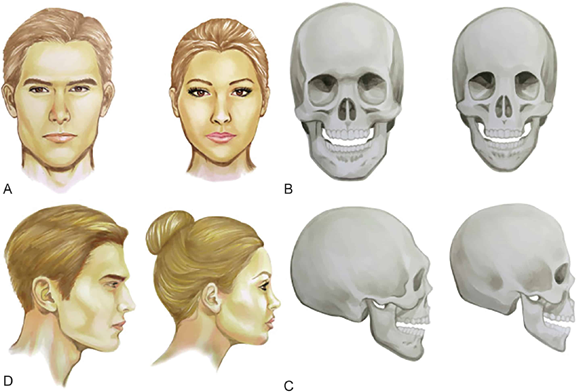
The chapter describes traditional sexual dimorphism in lower-face aesthetics while repeatedly emphasizing individual variation. A conventionally masculine lower face is often wider and more angular, with a bigonial width approaching the bizygomatic width and a chin that may be wider and more projected.
A conventionally feminine lower face is often narrower relative to the midface, with a softer jaw curve and a chin that may be more rounded. These patterns are aesthetic references, not rules. The patient’s own facial shape, ethnicity, identity and desired result should drive the plan.
Profile Analysis : Nose, Lips and Chin Must Be Read Together
The chin cannot be evaluated in isolation from the lips and nose. The source chapter discusses profile tools such as Ricketts’ E line, Steiner S line and Jacobson’s soft-tissue analysis as ways to understand projection and facial convexity.
These are not formulas that automatically dictate treatment. Their value is that they force the clinician to consider whether the face is globally balanced before adding projection or length to the chin.

What Makes a Jawline Look Masculine or Feminine?
The mandibular angle is a major contributor to lower-face character. The chapter cites a survey in which a mandibular angle of about 130 degrees was regarded as desirable for a male jaw, with a distinct transition from the horizontal mandibular body to the vertical ramus.
A smoother, less prominent transition can appear more feminine. In practice, however, jawline contouring must be harmonized with the chin, cheek width and the patient’s overall face rather than pursuing one universal angle.
Lower-Face Anatomy That Matters for Filler
Safe and natural augmentation requires an understanding of multiple anatomical layers. The chapter reviews bone, superficial and deep fat compartments, retaining ligaments, septa, vessels, nerves, muscles, the parotid gland and tissue planes.
Bone and the Mental Foramen
The mandible forms the structural base of the lower face. The mental foramen is an important landmark because the mental nerve and artery exit in this region. Treatment of the lateral chin therefore requires anatomical awareness rather than simply following a cosmetic injection map.
Superficial and Deep Fat Compartments
The jawline and chin contain multiple superficial and deep fat compartments. These compartments influence both youthful contour and the pattern of aging. Understanding where volume is absent, retained or displaced helps explain why two patients with similar-looking jowls may need completely different treatment strategies.
Retaining Ligaments and the Jawline
The mandibular septum, mandibular ligament and masseteric cutaneous ligament are particularly relevant to lower-face contouring. The source chapter explains that product placement on different sides of the facial ligament line can have different lifting and volumizing effects.
Vascular Anatomy and Why It Matters
The facial artery crosses the mandibular border near the antegonial notch and then changes course as it travels upward. The mental and submental arterial systems also matter in chin treatment. Because vascular anatomy is variable, lower-face filler should be approached as a medical procedure rather than a routine beauty service.
Muscles, Myomodulation and the Lower Face
The DAO, depressor labii inferioris, mentalis, masseter and superior platysma all influence lower-face expression and contour. The chapter also discusses myomodulation: filler can alter local muscle behavior even when botulinum toxin is not used.
Which Fillers Can Be Used for Chin and Jawline Augmentation ?
The chapter specifically identifies hyaluronic acid, calcium hydroxyapatite and poly-L-lactic acid as injectable options that may be considered in the lower face. The correct choice depends on whether the treatment goal is projection, structural definition, soft contour transition or broader biostimulatory rejuvenation.| Product family | Role in the chapter | Potential strength | Important planning point |
|---|---|---|---|
| Hyaluronic acid (HA) | Preferred by the chapter authors for many lower-face applications | Wide range of rheologic profiles and reversible with hyaluronidase | Product firmness/flexibility should match the anatomical zone and treatment goal. |
| Calcium hydroxyapatite (CaHA) | Alternative structural/biostimulatory filler | Can provide contour support and collagen stimulation | Not reversed with hyaluronidase; product behavior differs from HA. |
| Poly-L-lactic acid (PLLA) | Alternative biostimulatory injectable | Gradual collagen-related volumizing effect | Best understood as a different therapeutic category from immediately moldable HA. |
Why Filler Rheology Matters
The chapter notes that high-G’ products are often selected when structure, support and definition are desired, such as in the chin and jawline. More flexible products may be preferred in highly mobile transition areas. This is one reason why choosing a filler by brand name alone is less useful than choosing it by anatomical purpose.
Chin Augmentation : What Can Be Changed?
The chin can be modified in several different dimensions. A patient may need more forward projection, more vertical length, additional width, a softer rounded contour or correction of a deep mental crease. These are separate goals and should not automatically be treated with the same pattern.
Chin Projection
Projection changes the anteroposterior relationship of the lower face. In carefully selected patients, increasing projection can improve facial convexity and balance the nose-lip-chin relationship. The chapter also emphasizes that larger changes may need to be staged rather than forced into one session.
Chin Lengthening and Rounding
Increasing vertical chin height can make the lower face appear slimmer by changing the relationship between height and width. A squarer, more linear inferior border is often associated with masculine contouring, while a more centrally rounded contour is often associated with feminine shaping.
Chin Widening and Squaring
Widening can strengthen the lower face and is often requested in male contouring, though it is not exclusively a male goal. The source notes that width should remain proportional to the rest of the face; excessive lateral augmentation can create an unexpectedly heavy or masculine appearance.
Can Filler Make a Chin Look Shorter ?
The chapter describes an optical principle in which the perceived point of maximal light reflection can change apparent chin length. This is useful because contouring is not always about adding more projection or length; sometimes visual balance can be altered through surface shape.
Mental Crease Treatment
A deep mental crease can contribute to shadowing and make the chin look visually separated from the lower lip. Filler can be used to soften the crease and improve continuity of the chin surface, but superficial placement must be approached carefully because visible product irregularity or a Tyndall-type appearance can occur.
Jawline Filler : What Are We Actually Treating?
Jawline contouring is best understood in three broad zones: the jawline proper, the mandibular angle and the preauricular region. The prejowl sulcus is another important transition zone because filling or supporting it can create a straighter mandibular line.
Prejowl Sulcus
The prejowl sulcus can sometimes be improved directly and sometimes indirectly by treating the chin or lateral jawline. The chapter warns that completely filling this hollow without considering the entire lower face can widen the jaw or chin and create an unwanted masculine look in some women.
Mandibular Angle & Jawline Definition
For a traditionally masculine contour, the mandibular angle can be made visually more distinct and the lower face wider. For a softer feminine contour, the jawline may be shaped as a smoother convex curve from the antegonial region toward the preauricular area.
Because each person has different proportions, these patterns are reference points rather than fixed templates. The best result is the one that matches the patient’s own anatomy and desired aesthetic.
Can Jawline Filler Fix Jowls ?
Sometimes it can improve the appearance of the jawline around a jowl, but filler does not remove a jowl. The source chapter specifically warns against injecting directly into the jowl because that can accentuate its appearance. Structural support in adjacent zones may improve the contour, while significant laxity may require energy-based treatment or surgery.
Needle vs Cannula : What Does the Chapter Say?
Both needles and cannulas may be used in the lower face. The authors state a preference for cannula in many lower-face areas and cite a study in which cannula use was associated with 77.1% lower odds of vascular occlusion compared with needle use.
This does not make cannulas risk-free. Vascular anatomy, plane, product, injection strategy and clinician experience all remain important. A cannula is a tool, not a substitute for anatomical knowledge.
Masseter Botox and Jawline Filler : Why the Combination Needs Thought
Reducing masseter volume with botulinum toxin can create a slimmer lower face and increase the ratio between cheek width and jaw width. The chapter also points out a less-discussed consequence: in older patients, reducing masseter bulk can make jowls appear more prominent because lateral structural support is reduced.
When masseter treatment is being performed for clenching or grinding, lower-face volume loss may need to be considered in the overall aesthetic plan.
When Filler Is Not Enough
The source chapter explicitly warns that many patients demonstrate their desired outcome by manually pulling the lower face backward and upward. That maneuver often represents a lifting goal that filler cannot fully reproduce. In such cases, realistic expectations are essential, and energy-based devices or surgical treatment may be more appropriate.
Safety : Why Lower-Face Filler Is a Medical Procedure
The lower face contains important vessels, nerves, glands and muscular structures. The facial artery crosses the mandible, the mental neurovascular bundle exits the mental foramen, and the parotid gland and duct occupy the lateral cheek region. The chapter repeatedly frames anatomical understanding as essential for reducing risk.
Potential complications of filler treatment are not exhaustively catalogued in this chapter, because its focus is lower-face augmentation technique and anatomy. However, it highlights vascular-occlusion risk, product irregularities, superficial visibility, and the possibility of injury to structures such as the parotid duct when the incorrect plane is used.
What the Source Supports – and What It Does Not
| Supported by the chapter | Not established by the chapter |
|---|---|
| Chin and jawline filler can meaningfully improve facial harmony in selected patients. | That every patient can achieve a surgical lifting result with filler. |
| HA, CaHA and PLLA can all be considered for lower-face augmentation. | That one filler family is universally superior in every patient. |
| Full-face and profile assessment are essential before treatment. | That a fixed number of syringes is appropriate for everyone. |
| Needle and cannula are both used; cannula was associated with lower occlusion odds in cited data. | That cannula use eliminates vascular risk. |
| Male and female contour references can help guide treatment planning. | That gender alone should dictate treatment design. |
| Masseter neuromodulation can change lower-face shape and may interact with jawline aesthetics. | That masseter Botox is always beneficial for jawline appearance. |
| Structural anatomy should guide product placement. | That online diagrams can substitute for hands-on clinical training. |
Chin & Jawline Filler in Abu Dhabi : What a Good Consultation Should Cover
- What do I want to change: projection, length, width, jawline sharpness, prejowl shadow or overall facial balance?
- How does my chin relate to my nose and lips in profile?
- Would widening my jaw improve my face, or make it too square?
- Do I have true volume deficiency, skin laxity, jowling, or a combination?
- Is my desired outcome realistically achievable with filler, or does it resemble a surgical lift?
- Which filler category is being considered and why?
- How will the plan preserve natural movement and avoid an overfilled appearance?
- Will masseter Botox help or potentially worsen visible jowling in my anatomy?
- What safety plan is in place for filler complications?
- How will treatment be staged if a larger structural change is needed?
