
Endolift for Nasolabial Folds
and Marionette Lines
Endolift is a minimally invasive 1470-nm fiber-laser procedure that may help soften selected nasolabial folds and marionette lines by targeting tissue laxity and stimulating collagen remodeling. It is not a substitute for filler in every patient: folds caused mainly by volume loss may still require volume restoration, while folds driven by laxity or tissue descent may benefit from a tightening-focused strategy. Treatment planning should be individualized after facial assessment.
What Are Nasolabial Folds and Marionette Lines?
Nasolabial folds are the creases that extend from the sides of the nose toward the corners of the mouth. Marionette lines extend downward from the mouth toward the chin and jawline. They become more visible as facial tissues change with age, but they can also be noticeable in younger adults depending on anatomy, expression patterns, skin quality and tissue support.
Aging is not simply a “wrinkle problem.” Changes in collagen, elasticity, skin thickness, fat compartments, muscle dynamics and midface support can all contribute to lower-face folds. That is why the best treatment depends on what is actually creating the line in a specific patient.
Why Can These Folds Become Deeper?
- Progressive skin laxity and reduced collagen support.
- Changes in cheek and midface support that increase folding of the skin.
- Loss or redistribution of facial volume.
- Repetitive facial movement and individual anatomy.
- Extrinsic aging factors such as cumulative sun exposure and smoking.
Where Endolift Fits Into Lower-Face Rejuvenation
Endolift delivers laser energy through a very fine optical fiber in the superficial subdermal plane. The aim is not to “fill” a crease. Instead, the procedure is used to create controlled thermal stimulation within targeted tissue, supporting contraction and collagen remodeling. In appropriately selected patients, this may improve the way the skin drapes over the nasolabial and marionette regions.
Important distinction :
A fold caused predominantly by volume deficiency is biologically different from a fold caused predominantly by laxity or tissue descent. Endolift, filler, biostimulators and resurfacing procedures therefore solve different parts of the aging process. A combined plan may be more logical than using one treatment for every cause.

Patient Satisfaction
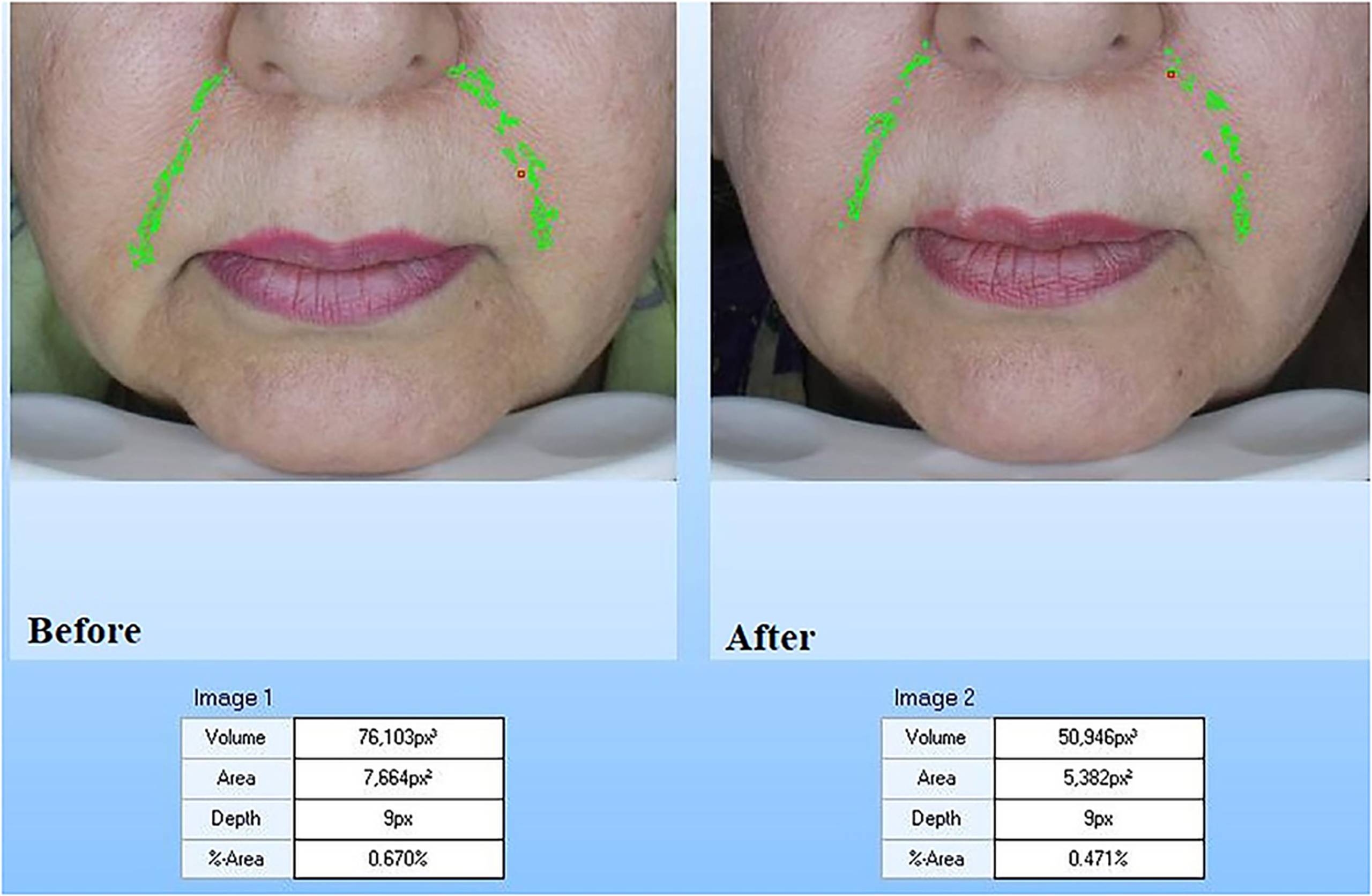
At the 3-month assessment, 6 of 10 participants were reported as well satisfied and 4 of 10 as moderately satisfied. The study reported no dissatisfied participants. Blinded physician assessments were also favorable.

What the Imaging Suggests
The study did more than rely on photography. Ultrasound measurements showed increases in epidermal and dermal thickness and density, while Cutometer measurements showed changes consistent with improved elasticity. These objective measurements support a tissue-remodeling mechanism rather than a simple camouflage effect.
Safety, Recovery and the “Danger-Zone” Issue
The nasolabial and marionette regions are anatomically sensitive. The source study itself describes this as a facial danger-zone treatment, which is a strong reason to emphasize clinician training, anatomy and conservative case selection rather than presenting the procedure as a routine “laser facial.”
- In the study, mild edema and erythema resolved within 1–2 days.
- No adverse effects were reported during the 3-month monitoring period.
- The study used reduced treatment intensity and time in this region because of the anatomy.
- Published safety data from a 10-person cohort cannot exclude uncommon complications.
- Patients should receive individualized risk counseling before treatment.
Who May Be a Good Candidate?
Endolift may be considered when the clinical problem includes mild-to-moderate lower-face laxity, visible folding associated with tissue descent, or a desire for a minimally invasive tightening approach. The final decision depends on anatomy, tissue thickness, previous procedures and the patient’s expectations.
Potentially Suitable Features
- Mild-to-moderate nasolabial or marionette folding with a laxity component.
- Lower-face heaviness or early jowl formation occurring with the folds.
- A preference for tissue tightening rather than simply adding volume.
- Realistic expectations about gradual collagen remodeling and the possibility of combination treatment.
When Another Treatment May Be More Appropriate
- Deep structural volume loss that primarily requires restoration of support.
- Severe skin redundancy where surgery may offer a larger degree of correction.
- Active infection or other contraindications to an invasive laser procedure.
- Active infection or other contraindications to an invasive laser procedure.
Endolift vs Filler for Nasolabial Folds
| Question | Endolift | Dermal filler | Why this matters |
|---|---|---|---|
| Main target | Laxity, tissue tightening, collagen remodeling | Volume/support deficit | Different mechanisms |
| Immediate volume | No | Yes | Filler can restore lost structural support |
| Collagen remodeling | Yes, intended effect | Product-dependent; some biostimulatory options | May influence treatment sequencing |
| Best use | Selected laxity-dominant folds | Selected volume-deficient folds | Assessment is more important than the brand/device |
| Combination | May be staged with injectables | May be staged after tissue tightening | Avoid one-size-fits-all plans |
Radiofrequency / RF Microneedling
RF-based treatments primarily stimulate dermal remodeling through radiofrequency energy. They can be useful when texture and skin quality are major concerns. Endolift differs because energy is delivered through an optical fiber in the subdermal plane, which can make it more targeted for selected tissue-tightening and contouring goals.
Fractional CO₂ or Er:YAG Resurfacing
Resurfacing lasers are more surface-oriented and can be valuable for fine lines, texture and photodamage. They may involve more visible recovery and are not identical to subdermal tightening. In some patients, resurfacing and structural treatments are complementary rather than competing options.
HIFU / Focused Ultrasound
Focused ultrasound is a non-incisional energy treatment that targets deeper tissue planes without introducing a fiber. Endolift is minimally invasive and uses direct optical energy in the treated plane. The preferred modality depends on anatomy, tissue thickness, treatment goals and clinician experience.
Surgical Lifting
Surgery provides a different magnitude of tissue repositioning and remains the reference option for significant laxity. Endolift should not be marketed as equivalent to a facelift; it is better positioned as a minimally invasive option for selected patients who do not require or do not want surgical correction.
What to Expect From a Consultation in Abu Dhabi
- Identify whether the line is primarily caused by laxity, tissue descent, volume loss, dynamic movement, or a combination.
- Assess the lower face, cheek support, jowls, skin quality and previous filler or energy-based treatments.
- Discuss whether Endolift alone is reasonable or whether a staged multimodal plan is more appropriate.
- Review realistic outcomes, recovery, aftercare and specific anatomical risks before proceeding.
