

PRP for Wound Healing : What Patients Should Know
Platelet-rich plasma (PRP) is prepared from a patient’s own blood and contains a concentrated platelet fraction. Platelets release growth factors and signaling proteins involved in clot formation, cell migration, angiogenesis, fibroblast activity, epithelialization and tissue remodeling. In the supplied literature review, PRP was associated with faster tissue regeneration, less scar formation, improved neovascularization, fewer recurrences, and lower pain or discomfort in several wound settings.
PRP may support wound healing by delivering platelet-derived growth factors directly to damaged tissue. These signals can encourage angiogenesis, cell proliferation, epithelialization and extracellular-matrix remodeling. Published studies have evaluated PRP in chronic non-healing ulcers, diabetic foot ulcers, venous ulcers and selected burn wounds, usually as an adjunct to appropriate wound care.
What is a wound?
A wound is a disruption of normal skin structure and function and may also involve deeper soft tissue. The source chapter divides wounds into acute wounds, which typically follow an identifiable injury or surgery, and chronic wounds, in which normal healing is delayed or arrested.
Why some wounds become chronic
The chapter describes prolonged inflammation, infection or irritation, tissue hypoxia and failed epithelialization as important mechanisms behind chronic wounds. It also lists systemic factors that can impair healing, including aging, smoking, malnutrition, immobilization, diabetes, vascular disease and immunosuppression.
The four overlapping phases of wound repair
- Hemostasis and inflammation – platelets aggregate at the injury site and release mediators from alpha and dense granules.
- Epithelialization and proliferation – epithelial cells migrate, fibroblasts proliferate and extracellular matrix begins to form.
- Matrix synthesis and contraction – fibroblasts organize collagen and ground substance while the wound contracts.
- Maturation and remodeling – collagen is cross-linked and remodeled over many months; scar tissue does not fully regain the strength of uninjured skin.
How PRP may support the healing environment
PRP is described in the source as a plasma fraction with platelets concentrated above baseline. When platelets degranulate, they release biologically active proteins that act locally. These mediators can influence chemotaxis, angiogenesis, cell proliferation and differentiation—core processes in tissue repair and regeneration.
| PRP component / signal | Biological role described in source | Potential relevance to wound repair |
|---|---|---|
| PDGF | Chemotaxis, cell growth and tissue-repair signaling | Supports fibroblast activity and granulation-tissue formation |
| VEGF / angiogenic signals | New capillary growth and endothelial responses | May improve neovascularization in a healing wound bed |
| EGF / epithelial signals | Epithelial cell growth and migration | Supports re-epithelialization |
| TGF-β | Matrix synthesis and remodeling | Influences collagen deposition and tissue remodeling |
| Fibrin / adhesive proteins | Local tissue sealant and scaffold effects | Can support clot stability and delivery of platelet mediators |
Which Wounds Have Been Studied With PRP?
The source reviews a wide range of wound types rather than presenting PRP as a single-condition treatment. The evidence base includes randomized controlled trials, prospective studies, case-control studies and case series.
| Wound category | Clinical context in the source | PRP evidence discussed | Important evaluation point |
|---|---|---|---|
| Diabetic / neuropathic ulcers | Often occur over pressure points and may be painless because of neuropathy | Multiple randomized and observational studies reviewed | Assess neuropathy, infection and arterial perfusion |
| Venous leg ulcers | Typically lower-leg ulcers associated with venous hypertension and edema | RCTs and comparative studies reviewed | Address venous disease and compression needs |
| Arterial / ischemic wounds | Painful distal ulcers associated with impaired arterial flow | Included within chronic-wound literature | Perfusion assessment is critical before adjunctive regenerative treatment |
| Pressure ulcers | Chronic wounds caused by sustained pressure and tissue compromise | Included in several clinical series | Pressure off-loading and wound-bed care remain fundamental |
| Burn wounds | Deep second-degree and deep dermal/full-thickness burns studied in trials | Three randomized controlled trials summarized | Major burns require specialized burn-care pathways |
PRP and chronic non-healing ulcers
The chapter summarizes many studies in diabetic foot ulcers, venous ulcers, pressure wounds and mixed chronic wounds. Study protocols vary substantially: some used topical PRP or platelet gel, some combined topical application with injection, and treatment schedules ranged from short courses to repeated applications over several weeks. This variability is important—there is no single protocol in the chapter that can be generalized to every wound.
Clinical Safety Note
A chronic wound should not be treated as a cosmetic problem. The underlying cause—vascular insufficiency, neuropathy, infection, immune disease, pressure injury or malignancy—must be evaluated first. PRP is best framed as an adjunctive regenerative option within a diagnosis-driven wound-care plan.
PRP in burn care
The source discusses three randomized trials involving deep second-degree or deep dermal/full-thickness burns. Proposed benefits include improved vascular ingrowth, fibroblast proliferation, re-epithelialization, hemostatic support and lower pain or pruritus. The same chapter emphasizes that significant burns require structured emergency assessment and, when indicated, referral to specialized burn centers.
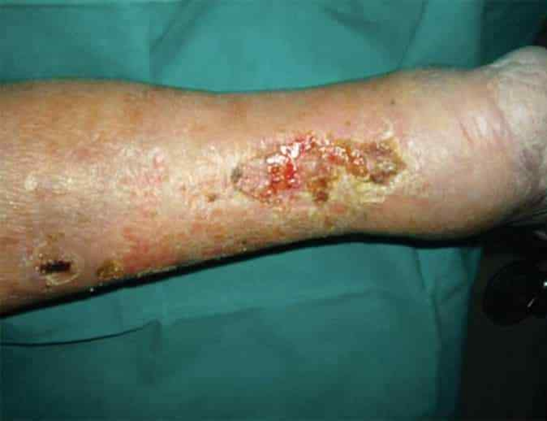
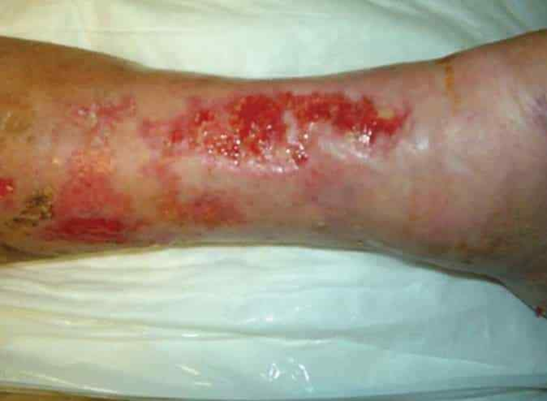
Clinical Case From the Source Chapter : Chronic Venous Ulcer
The supplied chapter includes a clinical case of a 65-year-old man with a chronic painful leg ulcer after trauma and a history of venous insufficiency. The wound was evaluated for vascular, malignant, immune and infectious causes. After debridement and appropriate wound care, PRP was added. The chapter reports progressive granulation and reduction of the wound, with complete healing by two months.
Important Context
These are source-book clinical images, included for education and evidence illustration. They are not patient images from a local clinic and should not be presented online as a clinic’s own before/after results.


Evidence Summary : What the Source Supports
The chapter’s literature review favors a regenerative role for PRP in wound care, but the studies span different wound types, PRP preparations, routes of application, treatment frequencies and comparison groups. A credible patient-facing page should therefore communicate both the positive signal and the heterogeneity of the evidence.
| Evidence-supported message | How to phrase it for patients | Avoid saying |
|---|---|---|
| PRP contains growth factors involved in tissue repair | PRP may support the biological processes involved in wound healing. | PRP guarantees wound closure. |
| Clinical studies include chronic ulcers and selected burns | PRP has been studied as an adjunct in several chronic wound types and selected burn injuries. | PRP is suitable for every wound. |
| The source reports faster regeneration, neovascularization and less scar/pain in reviewed studies | Published studies suggest potential benefits in healing speed, vascularization and comfort. | PRP always prevents scarring or pain. |
| Protocols vary across studies | Treatment planning depends on wound type, cause and the clinical protocol used. | There is one universal PRP dose or schedule. |
Who may need specialist wound assessment before considering PRP?
- Patients with suspected arterial insufficiency or poor limb perfusion.
- Diabetic foot ulcers or neuropathic wounds.
- Wounds with infection, necrotic tissue, unusual borders or uncertain diagnosis.
- Rapidly progressive or very painful ulcers where immune or vascular causes are possible.
- Large, deep, facial, hand, genital, joint, electrical, chemical or inhalation-associated burns
What happens during a medical evaluation?
A useful consultation should focus first on the wound diagnosis, duration, circulation, neuropathy, signs of infection, systemic disease, medication history and previous wound-care measures. Only after these factors are addressed should an adjunct such as PRP be considered.
