

Under-eye filler is a medical treatment that may soften a true tear trough or infraorbital hollow by replacing carefully selected volume. It does not treat every dark circle or eye bag. The safest and most natural-looking plan begins with an anatomical assessment of the eyelid, cheek, skin quality, pigmentation and fat pads.
Under-Eye Filler in Abu Dhabi: The Complete Patient Guide
A hollow under-eye can make the face look tired even after a full night’s sleep. In some people, the concern is a narrow tear trough. In others, the hollow continues across the lower eyelid or blends into a flatter mid-cheek. Dark circles, visible eye bags and fine crepey skin may sit on top of the same anatomy—but they are not the same problem and they do not respond to the same treatment.
That distinction matters. Under-eye filler can be an elegant, minimally invasive option for carefully selected patients, yet the area is anatomically delicate and highly vascular. A good consultation is therefore less about deciding how much filler to use and more about deciding whether filler is the right treatment at all. This guide explains the assessment-first approach used when discussing tear trough filler in Abu Dhabi.
At a Glance
- Best suited to: a genuine under-eye hollow with suitable skin quality and limited fluid retention.
- What it can do: soften the shadow between the lower eyelid and cheek and create a smoother transition.
- What it cannot reliably do: erase pigment, remove large fat bags, tighten significantly loose skin or replace surgery when structural ageing is advanced.
- Product category commonly considered: a carefully selected hyaluronic acid filler, depending on medical assessment and local product approval.
- Downtime: swelling, tenderness and bruising are possible; the appearance evolves as swelling settles.
- Safety priority: conservative treatment by a licensed, appropriately trained medical practitioner who understands periorbital anatomy and vascular complications.
What Is the Tear Trough?
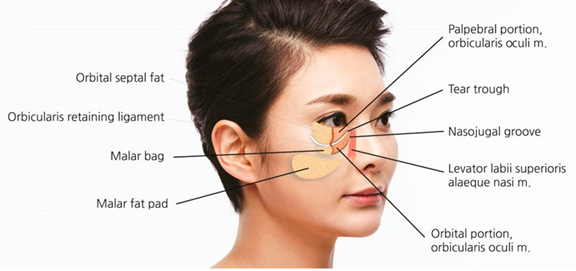
The tear trough is the groove that begins near the inner corner of the lower eyelid and follows the upper border of the cheek. Clinically, it is useful to separate a medial tear trough from broader infraorbital hollowness and from the more lateral lid–cheek groove. These shapes can overlap, but the pattern influences whether treatment should focus beneath the eye, in the mid-cheek, or not involve filler at all.
In youth, the transition from lower eyelid to cheek is usually smooth. With genetics, ageing or weight change, the balance between bone support, deep fat compartments, the orbicularis oculi muscle, retaining structures and skin changes. The resulting indentation catches light and creates a shadow. This is why a shadow caused by shape may improve when contour is restored, while true brown or blue-grey pigmentation may remain.
Why Under-Eyes Look Hollow, Dark or Tired
The visible concern is often produced by more than one factor. The 2025 anatomical review used for this guide describes volume change in deep fat compartments, differences in skin thickness, retaining structures, orbital fat prominence and mid-face support as important contributors. In practical terms, the same complaint—‘I look tired’—can come from very different anatomy.
| What you see | What may be happening | Role of filler |
|---|---|---|
| True tear trough | A defined groove or hollow creates a structural shadow. | May help when anatomy and skin quality are suitable. |
| Pigmentation | Brown, blue-grey or mixed discoloration is present even in even lighting. | Does not directly remove pigment; another plan may be needed. |
| Eye bags | Protruding fat creates a bulge above the hollow. | May camouflage a mild transition in selected cases; prominent bags may need another approach. |
| Malar oedema or festoons | Fluid-prone swelling or a mound sits over the upper cheek. | May worsen puffiness; filler may be unsuitable. |
| Skin laxity or fine lines | Thin, crepey or loose skin is the dominant feature. | Volume alone may not tighten skin and can look heavy. |
| Mid-cheek volume loss | The support below the hollow has flattened or descended. | Treating cheek support may be more balanced than filling only the trough. |
Three Common Patterns of Under-Eye Hollowing
A useful clinical classification describes the extent of the hollow around the lower orbital rim. The label is not a verdict; it is a way to understand how localized or widespread the contour change may be.
- 1. Class I : the depression is mainly medial, close to the inner lower eyelid. The central cheek may show only mild flattening.
- 2. Class II: the medial hollow is clearer and the depression begins to extend laterally, often with early mid-cheek volume loss.
- 3. Class III: the hollow extends more broadly around the orbital rim and may coexist with a visible lid–cheek groove, cheek deficiency, malar bags or soft-tissue descent.
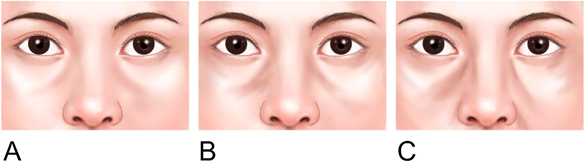
The more complex the pattern, the less likely it is that one small injection point—or filler alone—will produce a balanced result. A broader assessment of the mid-face becomes increasingly important.
Who May Be a Good Candidate?
A suitable candidate usually has a visible groove or hollow that improves when the surrounding tissue is gently supported, relatively stable skin and fluid balance, realistic expectations and no active medical reason to postpone treatment. The goal is subtle improvement, not a perfectly flat lower eyelid.
- A true tear trough or infraorbital hollow is the main concern.
- The lower-eyelid skin is not excessively thin, loose or crepey.
- There is no significant malar oedema, festooning or tendency to persistent under-eye swelling.
- Eye bags are mild enough that a contour-balancing approach may be reasonable.
- The patient accepts a conservative plan and understands that treatment may be staged.
- General health, medications, allergies and previous procedures have been reviewed.
When Under-Eye Filler May Not Be the Best Choice
One of the strongest signs of expertise is the willingness to recommend no filler. The source review specifically highlights greater difficulty when there is excessive wrinkling or skin excess, very thin skin, prominent pre-existing discoloration, large orbital fat pads, a history of severe allergy or swelling around the eye, or previous eyelid surgery and scarring.
- Prominent eye bags, festoons or chronic fluid retention.
- Severe skin laxity or advanced lower-eyelid ageing.
- Very thin, translucent skin with a high risk of visible product
- Dark circles driven mainly by pigment or visible vessels rather than shadow
- Active skin infection, inflammation, rash or an unwell state
- Pregnancy or breastfeeding, where safety data are limited
- Previous lower-eyelid surgery, scarring or filler that requires careful review
- Unrealistic expectations or a request for aggressive correction in one visit
A consultation can still be valuable when filler is unsuitable. The correct outcome may be skin treatment, energy-based treatment, mid-face support, a surgical opinion, observation—or a combination planned in the right sequence.
What Under-Eye Filler Can Realistically Achieve
When the indication is right, treatment may soften the transition from eyelid to cheek, reduce the shadow created by a hollow and help the face look more rested. The best result is usually one that is difficult to identify as filler: the lower eyelid looks less sharply separated from the cheek, while the person still looks like themselves.
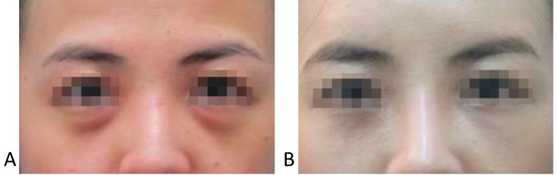
Under-eye filler should not be marketed as a guaranteed cure for dark circles. If pigment, thin skin, visible vessels or skin laxity contribute to the concern, those components may remain after contour improvement. Clear photography in consistent lighting is helpful because a hollow can look dramatically different depending on shadow, camera angle and facial expression.
How a Doctor-Led Consultation Works
A careful assessment should include the lower eyelid at rest and with expression, the cheek from multiple angles, skin thickness and colour, the presence of fat-pad prominence or fluid, and the relationship between the groove and nearby facial vessels. Previous fillers, eyelid surgery, allergies, swelling episodes, medications and relevant medical conditions should be discussed.
- Define the concern: hollow, pigmentation, puffiness, skin texture or a combination.
- Assess the anatomy: eyelid–cheek transition, mid-face support, fat pads, ligament-related tethering and skin quality.
- Review risk: prior procedures, scarring, oedema, infection, allergy history, medications and medical conditions.
- Agree on a conservative endpoint: soften the transition rather than overfill the area.
- Choose the plan: under-eye filler, cheek support, another treatment, staged care or no treatment.
How Much Filler Is Needed?
There is no universal volume. The 2025 review emphasises conservative correction and reports a commonly recommended upper range of 0.3–0.5 mL per side in a single session, but that figure is not a prescription and should never replace individual assessment, product instructions or local regulatory requirements. Some patients need less, some need staged treatment elsewhere in the mid-face, and some should not receive under-eye filler.
Natural-result Rule :More product does not necessarily mean a better result. In the under-eye, precise indication and restraint matter more than volume.
Results and Recovery Timeline
| Stage | What to expect |
|---|---|
| Immediately | The contour may look improved, but swelling, tenderness, asymmetry from local anaesthetic or small injection marks can affect the first impression. |
| First 24–72 hours | Swelling and bruising may become more noticeable before improving. Follow the personalised aftercare given by the treating clinic. |
| Around 1–2 weeks | Most early swelling is often settling and the contour can be judged more fairly. A review may be arranged when clinically appropriate. |
| Following months | The result evolves with tissue movement and gradual product breakdown. Longevity varies by product, anatomy, metabolism and treatment plan. |
Because duration varies widely, a responsible consultation should avoid promising an exact number of months. Maintenance should be based on clinical need rather than an automatic calendar date.
Aftercare: Keep It Simple and Personalised
Follow the instructions provided by your treating practitioner, as advice may differ with the product, technique and your medical history. General principles often include treating the area gently, avoiding pressure or massage unless specifically instructed, keeping the skin clean, and allowing initial swelling to settle before judging the result.
- Do not press, manipulate or attempt to reshape the area unless your practitioner specifically asks you to.
- Avoid applying unapproved products or devices to the injection area.
- Ask before scheduling dental work, intense heat exposure, vigorous exercise or another facial procedure close to treatment.
- Use the clinic’s emergency contact instructions if symptoms feel unusual rather than waiting for a routine follow-up.
- Attend the planned review, especially if treatment was intentionally staged.
Side Effects, Complications and Emergency Warning Signs
Common short-term effects can include swelling, bruising, redness, tenderness and small irregularities while the area settles. Other problems can include prolonged oedema, infection, nodules, visible product, a blue-grey Tyndall effect from superficial filler, contour irregularity or migration. Some issues may require observation, medication, hyaluronidase, drainage, surgery or specialist care, depending on the cause.
The most serious recognised filler complication is unintended injection into a blood vessel. Although uncommon, vascular occlusion can damage skin and, in rare cases, cause vision impairment, blindness or stroke. The U.S. FDA advises immediate medical attention for unusual pain, vision changes, stroke symptoms, or white, grey or blue skin near the injection site during or shortly after treatment. These are emergency symptoms, not ‘normal swelling.
Can Under-Eye Filler Cause Puffiness?
Yes. The under-eye is prone to fluid retention, and some filler gels attract water. Puffiness may be temporary after treatment, but persistent swelling can occur when the product, amount, tissue plane or patient selection is unsuitable. Existing malar oedema, festoons, prominent fat pads and a personal history of prolonged swelling deserve special attention before treatment.
A conservative plan reduces avoidable volume, but it cannot eliminate every risk. Patients with a fluid-prone lower eyelid may be better served by another strategy.
Needle or Cannula: Which Is Safer?
Both needles and cannulas can be used by experienced practitioners, and neither is universally safer in every situation. Each has advantages and limitations related to control, tissue resistance, entry point and anatomy. A prospective comparison cited by the source review reinforces that the choice should be based on the practitioner’s assessment and technique rather than marketing claims. The important question for a patient is whether the clinician is trained, experienced in the area and prepared to recognize and manage complications.

Under-Eye Filler vs Other Options
| Option | May suit | Key limitation |
|---|---|---|
| Hyaluronic acid filler | True hollow or lid–cheek contour deficit | Adds support and volume; does not primarily treat pigment or significant laxity. |
| Skin-quality treatments | Fine texture, crepiness or selected pigmentation concerns | Choice depends on skin type, diagnosis and downtime tolerance. |
| Energy-based tightening | Selected laxity or textural concerns | May improve skin quality; not a substitute for lost volume in every case. |
| Mid-cheek support | Hollow linked to reduced cheek support | May produce better balance than treating only the narrow trough. |
| Lower blepharoplasty | Prominent fat bags, skin excess or advanced structural change | Requires surgical assessment; may be more appropriate than repeated camouflage. |
| No treatment | Mild concern, high risk or uncertain diagnosis | Observation is a valid medical recommendation. |
Choosing an Under-Eye Filler Doctor in Abu Dhabi
Patients searching for the best under-eye filler in Abu Dhabi should focus less on promotional superlatives and more on verifiable safety signals. Under-eye filler is a medical procedure. A responsible provider should explain the diagnosis, the product being considered, whether the use is approved for that indication in the relevant jurisdiction, the alternatives, expected limitations and the emergency plan.
- A licensed medical practitioner with specific training and experience in facial fillers
- A consultation that evaluates the eyelid and mid-face rather than selling a fixed package
- Conservative recommendations and willingness to decline unsuitable cases
- Clear discussion of common side effects and rare vascular or visual complications
- Authentic, appropriately sourced products and traceable documentation
- A defined follow-up pathway and a plan for urgent concerns
- Clinical photography with consistent lighting and realistic, unfiltered examples
A Local, Individualized Approach in Abu Dhabi
Abu Dhabi is highly diverse, so assessment should respect variation in facial anatomy, skin thickness, pigmentation and aesthetic preferences. A treatment plan should never assume that one beauty standard, injection pattern or volume suits every face. The aim is harmony between the lower eyelid and cheek—not a generic, overfilled look.
During a consultation with Dr. Erfan Rahmani in Abu Dhabi, the first decision is whether the concern is genuinely volume-related and whether the expected benefit justifies the risk. When treatment is appropriate, the plan is designed around conservative correction and facial balance. When it is not, the safer recommendation may be a different treatment or no procedure.
