
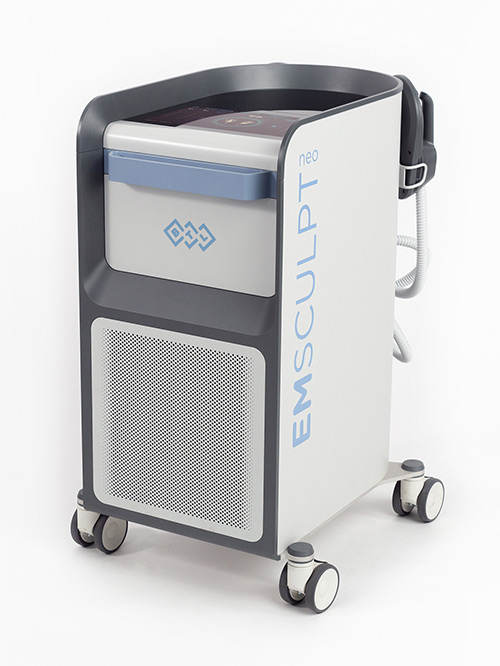
Emsculpt NEO combines high-intensity focused electromagnetic energy with synchronized radiofrequency. HIFEM produces powerful involuntary skeletal-muscle contractions, while RF adds controlled tissue heating. The combination is used for non-invasive body contouring, muscle building and selected localized fat reduction. The most commonly treated areas include the abdomen, buttocks, thighs, arms and calves.
Summary
Emsculpt NEO Non-invasive body contouring has expanded from treatments aimed mainly at reducing localized fat to technologies that also target skeletal muscle. HIFEM-based treatment is designed to stimulate motor neurons and induce intense repetitive muscle contractions. Emsculpt NEO adds synchronized radiofrequency to this electromagnetic stimulation so that muscle and localized adipose tissue can be treated during the same session.
Across the clinical data summarized in the source material, the most common treatment pattern is four sessions delivered over approximately two to four weeks, commonly with sessions lasting around 30 minutes. The abdomen is the most frequently evaluated region, followed by the buttocks, thighs, arms and calves. Objective outcome methods include MRI, CT, ultrasound, DXA, circumference measurements and standardized photography.
Reported outcomes include increased muscle thickness or volume, reduced localized fat thickness, smaller abdominal circumference, improvement in measured rectus separation, and high patient satisfaction. Results vary by body area, device configuration, treatment intensity, number of sessions and baseline anatomy. Current data are most appropriately used to support individualized expectation-setting rather than fixed guarantees.
Introduction
Body contouring is not one single clinical problem. A patient may dislike a localized fat bulge, weak abdominal definition, flat or poorly toned buttocks, thigh contour, arm definition, or a combination of muscle and adipose concerns.
Traditional surgical contouring can remove or reposition tissue directly. Non-invasive approaches aim to change contour without incisions. Fat-focused technologies include cryolipolysis, focused ultrasound and other modalities, while HIFEM introduced a different concept: skeletal muscle itself can become a treatment target.
Emsculpt uses high-intensity focused electromagnetic energy to stimulate muscle contractions. Emsculpt NEO combines this electromagnetic stimulation with synchronized RF, creating a dual-tissue strategy intended to build or tone muscle while also affecting localized adipose tissue.
The treatment should therefore be understood as body composition contouring rather than as a conventional weight-loss procedure. A reduction in localized fat can occur at the same time as an increase in muscle thickness, so scale weight may remain unchanged even when the treated area looks different.
How HIFEM Works
HIFEM produces an electromagnetic field capable of depolarizing motor neurons. This triggers rapid involuntary contractions of skeletal muscle. The contraction pattern is designed to create a workload beyond what most patients can voluntarily maintain for the same duration.
Repeated intense contraction acts as a training-like stimulus. The muscle adapts through structural remodeling, including increased muscle-fiber thickness and activation of repair pathways involved in muscle growth.
Muscle Satellite Cells and Muscle-Fiber Remodeling
Satellite cells are a small population of muscle repair cells activated by mechanical and growth signals. The biologic framework behind HIFEM includes activation of these cells, followed by muscle-fiber adaptation and remodeling.
This localized device effect should not be confused with the total-body benefits of exercise. Exercise improves cardiovascular fitness, metabolism, endurance, mobility, bone health and whole-body strength in ways a localized contouring treatment cannot reproduce.
How the Fat Layer Is Affected
The intense muscle workload substantially increases local metabolic demand. When synchronized RF is added, the treated tissue also receives controlled heating. The combined physiologic stress is associated with adipocyte apoptosis and gradual remodeling of the localized fat layer.
In human tissue evaluation, reductions in adipocyte size have also been observed after HIFEM-based treatment. The practical endpoint is localized contour improvement rather than immediate physical removal of fat.
What Synchronized Radiofrequency Adds
Emsculpt NEO combines HIFEM with synchronized RF. The RF component adds thermal energy while the electromagnetic component drives muscle contractions. This creates a simultaneous muscle-and-fat treatment environment.
In direct gluteal comparison data, combining RF with HIFEM produced a greater increase in muscle thickness than HIFEM alone, with the difference persisting into later follow-up.
Treatment Protocol and Practical Treatment Pattern
The most frequently used clinical pattern consists of four treatment sessions delivered across approximately two to four weeks. Some treatment frameworks use three sessions, while others use up to eight, depending on the area and intended outcome.
Thirty-minute sessions are common for the abdomen, buttocks and thighs. Smaller muscle-group protocols may use shorter sessions. Intensity is generally increased as the patient adapts, with many protocols working toward the highest tolerable setting.
| Treatment feature | Common pattern | Range represented in the clinical data |
|---|---|---|
| Number of sessions | 4 sessions | 3-8 sessions |
| Typical session duration | About 30 minutes | Shorter protocols used for some arms/calves applications |
| Course duration | About 2-4 weeks | Depends on spacing and treatment area |
| Follow-up | Commonly 1-6 months | Longer follow-up available in a smaller amount of data |
| Intensity | Progressive increase according to tolerance | Often advanced toward the highest comfortable setting |
Treatment Areas
The abdomen is the most extensively evaluated area. Other documented treatment regions include the buttocks, inner thighs, lateral thighs, arms and calves. Each body area should be evaluated differently because the balance between muscle, localized fat and skin laxity changes by region.
| Area | Primary contour goal | Dominant tissue target | Important planning point |
|---|---|---|---|
| Abdomen | Definition, strengthening, localized fat reduction | Rectus abdominis + subcutaneous fat | Assess skin laxity, abdominal separation and generalized adiposity |
| Buttocks | Toning, shape and lift | Gluteal muscle | The main objective is muscle contour rather than fat loss |
| Inner thighs | Localized contour refinement | Muscle + localized adipose tissue | Differentiate fat from lax skin |
| Lateral thighs | Saddlebag contour | Localized adipose tissue + adjacent muscle | Circumference and thickness are more useful than weight |
| Arms | Definition | Biceps/triceps + local fat | Useful when localized muscle definition is the goal |
| Calves | Toning | Gastrocnemius | Not a generalized leg-slimming treatment |
Clinical Outcomes
Objective outcomes have been measured with multiple imaging and body-composition methods rather than relying only on visual impressions. MRI, CT, ultrasound and DXA have all been used to evaluate tissue changes, while circumference and patient-reported satisfaction provide additional practical endpoints.
Across the clinical material, muscle mass generally increases and localized adipose thickness generally decreases in treated regions. Changes can become visible within the first month and may continue to evolve after the final session.
Abdominal Contouring Outcomes
Abdominal treatment has the broadest clinical dataset. Reported outcomes include reductions in subcutaneous fat thickness, increases in rectus abdominis thickness, decreases in measured abdominal separation and reductions in waist circumference.
| Clinical framework | Treatment pattern | Follow-up | Main outcomes retained from the source material |
|---|---|---|---|
| Abdominal imaging framework 1 | Four treatments | 2-6 months | 18.6% reduction in adipose thickness; 15.4% increase in rectus thickness; 10.4% reduction in rectus separation |
| Abdominal framework 2 | Four 30-minute treatments | About 2 months | 15.7% reduction in subcutaneous fat; measurable muscle-thickness increase; reduced circumference |
| Active-treatment comparison | Three abdominal treatments | About 6 months | 26.1% increase in rectus thickness; 2.84 cm decrease in abdominal circumference; higher satisfaction in the active-treatment group |
| Extended abdominal imaging framework | Three treatments | About 6 months | 26.1% muscle thickening; 30.8% reduction in fat thickness; 18.8% reduction in abdominal separation; 5.87 cm waist reduction |
| Four-treatment abdominal framework | Four treatments | About 3 months | 23.3% reduction in subcutaneous fat thickness; high patient satisfaction |
| Eight-treatment abdominal framework | Eight treatments | About 1 month | 17.5% reduction in subcutaneous fat; 14.8% increase in rectus thickness; 9.5% decrease in abdominal separation; 3.9 cm waist reduction |
| Longer-term abdominal framework | Four to eight 30-minute treatments | About 1 year | Approx. 14.6% fat reduction; 19.1% muscle thickening; 10.5% improvement in rectus separation |
Buttock Contouring Outcomes
Buttock treatment primarily targets gluteal muscle. Body weight is not expected to change substantially because the objective is localized muscle remodeling rather than overall weight reduction.
| Clinical framework | Treatment pattern | Follow-up | Main finding |
|---|---|---|---|
| Buttock satisfaction framework | Four 30-minute HIFEM treatments | About 1 month | Improved buttock satisfaction; body weight did not significantly change |
| Gluteal MRI volume framework | Four 30-minute treatments | About 3 months | Approx. 13.2% increase in gluteal muscle volume with lifting/toning |
| HIFEM + RF comparison | Four bilateral 30-minute treatments | About 3 months | Muscle-thickness increase was substantially greater with synchronized RF than with HIFEM alone |
Thigh Contouring Outcomes
Both inner- and lateral-thigh treatment have been evaluated. These areas demonstrate why HIFEM + RF is not simply a muscle procedure: measurable changes can occur in both muscle and localized adipose tissue.
| Area | Treatment pattern | Follow-up | Main outcomes |
|---|---|---|---|
| Inner thighs | Four 30-minute HIFEM + RF treatments | About 3 months | 27.4% reduction in fat thickness; 23.2% increase in muscle tissue; 1.52 cm reduction in thigh circumference |
| Lateral thighs / saddlebags | Four 30-minute HIFEM + RF treatments | About 6 months | Average 2.3 cm decrease in thigh circumference and measurable reduction in saddlebag-region fat thickness |
| Multi-area contour framework | Four 30-minute sessions | About 3 months | Reductions in saddlebag, inner-thigh and abdominal measurements with additional circumference changes across waist and thighs |
Arms and Calves
Biceps, triceps and gastrocnemius treatment has been used to improve localized muscle definition. A multi-muscle-group framework reported an approximately 15% reduction in local adipose measurements together with increased muscle mass.
Visceral Adipose Tissue
A CT-based abdominal assessment also identified a reduction in visceral adipose measurements after HIFEM treatment. Because the amount of information for this endpoint is limited, it should remain a secondary observation rather than a primary indication or marketing claim.
Overall Outcome Range
| Outcome domain | Representative result range or example | Clinical interpretation |
|---|---|---|
| Abdominal fat thickness | Approx. 15.7%–30.8% reduction in individual treatment frameworks | Localized subcutaneous contour change |
| Abdominal muscle thickness | Approx. 14.8%–26.1% increase | Greater rectus thickness and definition |
| Abdominal separation | Approx. 9.5%–18.8% reduction | Improved measured spacing, not surgical repair |
| Waist circumference | Approx. 2.84–5.87 cm reduction in selected frameworks | Contour change influenced by several measurement factors |
| Inner-thigh fat | Approx. 27.4% reduction in one combined framework | Localized fat-layer reduction |
| Inner-thigh muscle | Approx. 23.2% increase in one combined framework | Improved muscle tissue |
| Lateral thigh circumference | Approx. 2.3 cm reduction | Saddlebag contour improvement |
| Gluteal muscle volume | Approx. 13.2% increase in one imaging framework | Muscle-based buttock enhancement |
| Arms / calves | Approx. 15% reduction in local adipose measures with muscle increase in one framework | Improved definition |
| Visceral adipose measurement | Approx. 14.3% reduction in one CT framework | Secondary finding; evidence remains limited |
Patient Satisfaction and Treatment Experience
Patient satisfaction is generally high where it has been formally measured, frequently exceeding 80%. This is consistent with a procedure that is non-invasive, usually does not require anesthesia, and typically has no formal post-procedure downtime.
High satisfaction does not mean every patient has a dramatic objective result. Satisfaction is influenced by baseline anatomy, comfort, expectations, treatment area and whether the patient’s main problem was actually muscle, localized fat or another issue such as loose skin.
Safety and Expected Sensations
The most characteristic sensation is strong involuntary muscle contraction. With synchronized RF, patients also feel tissue warming. Temporary muscle fatigue, soreness or mild-to-moderate treatment discomfort can occur.
Across the clinical material, no major adverse-event signal is evident. Device-specific contraindications still matter, and electromagnetic/RF treatment requires screening for implanted electronic devices, relevant metal, medical conditions affecting the treatment area and other platform-specific exclusions.
Skin Tone and Body Contouring
The electromagnetic mechanism does not depend on melanin absorption. This makes HIFEM conceptually different from light-based treatments in which skin pigment directly influences energy absorption.
Discussion : What These Outcomes Mean in Practice
The most important clinical point is that HIFEM changes the body-contouring conversation from fat alone to fat plus muscle. A patient with a soft abdomen may have a very different problem from a patient with good muscle but excess skin, and both differ from a patient with generalized obesity.
Emsculpt NEO is most logical when muscle weakness or poor definition is a meaningful part of the contour concern and when localized adipose tissue is modest enough for a non-invasive approach.
The treatment is less logical when the dominant problem is major loose skin, a large-volume fat deposit, generalized obesity, a hernia, or an abdominal-wall condition requiring structural repair.
Why Scale Weight Is a Poor Primary Endpoint
Muscle can increase while localized fat decreases. These changes can partly offset each other on the scale. A patient may therefore look more defined without meaningful weight change. Standardized photography, circumference, ultrasound or other body-composition tools are more informative for a localized treatment.
Emsculpt NEO vs Exercise
The treatment can stimulate a selected muscle group, but it does not replace cardiovascular fitness, whole-body resistance training, mobility or the metabolic effects of regular exercise.
Emsculpt NEO vs Liposuction
Liposuction physically removes a larger volume of subcutaneous fat and can create a much larger structural contour change. Emsculpt NEO is non-invasive and produces a different magnitude and type of result.
Emsculpt NEO vs Fat-Only Devices
Cryolipolysis and focused ultrasound primarily target adipose tissue. Emsculpt NEO is different because muscle remodeling is central to the treatment.
Limitations and Realistic Interpretation
The clinical information is encouraging but should be interpreted with appropriate caution. The available datasets are heterogeneous in treatment area, session number, follow-up interval and outcome method.
- Many patient groups are relatively small.
- Long-term data are much more limited than short-term data.
- Demographic characteristics and medical comorbidities are not always described in enough detail to identify which subgroups respond best.
- Different protocols use HIFEM alone, HIFEM + RF, different treatment intensities and different session numbers.
- Some datasets show strong objective benefit, while others show marginal or limited benefit.
- Patient-reported satisfaction can be influenced by expectations and treatment experience.
- A result from one body area should not be copied directly to another body area.
- A percentage reported in a clinical dataset should not be presented as a guaranteed personal result.
Practical Interpretation
The strongest use of the clinical data is to define reasonable ranges and explain mechanisms. It should not be used to promise that every patient will lose a fixed percentage of fat or gain a fixed percentage of muscle.
Who Is a Good Candidate?
- Patients near a stable body weight who want more visible muscle definition
- Patients with localized resistant fat rather than generalized obesity as the main concern
- Patients seeking non-surgical abdominal sculpting
- Patients seeking buttock toning or muscle-based lifting
- Patients interested in inner-thigh, lateral-thigh, arm or calf contouring
- Patients who understand that body contouring complements rather than replaces exercise and nutrition
Who May Need a Different Strategy?
- Patients whose primary goal is major overall weight loss
- Patients with substantial skin laxity as the dominant problem
- Patients needing large-volume fat removal
- Patients with a suspected hernia or clinically significant abdominal-wall problem
- Patients expecting a surgical-level result from a non-invasive treatment
- Patients with a contraindication to electromagnetic or RF treatment
Treatment Selection by Dominant Problem
| Main concern | Dominant tissue issue | Where Emsculpt NEO fits | What may also be needed |
|---|---|---|---|
| Soft abdomen + weak definition | Muscle + localized fat | Strong fit | Weight management if overall adiposity is high |
| Flat buttocks + low muscle tone | Gluteal muscle | Strong fit | Filler or fat grafting if the goal is primarily added volume |
| Localized thigh fullness | Fat + muscle contour | Potential fit | Other fat-reduction methods if muscle is not part of the problem |
| Loose skin | Skin laxity | Limited role | Dedicated tightening or surgery depending on severity |
| Large-volume fat | Generalized / high-volume adiposity | Limited role | Medical weight management or surgical fat reduction |
| True hernia / major diastasis | Abdominal wall | Not a definitive repair | Medical or surgical assessment |
Emsculpt NEO in Abu Dhabi - Frequently Asked Questions
