
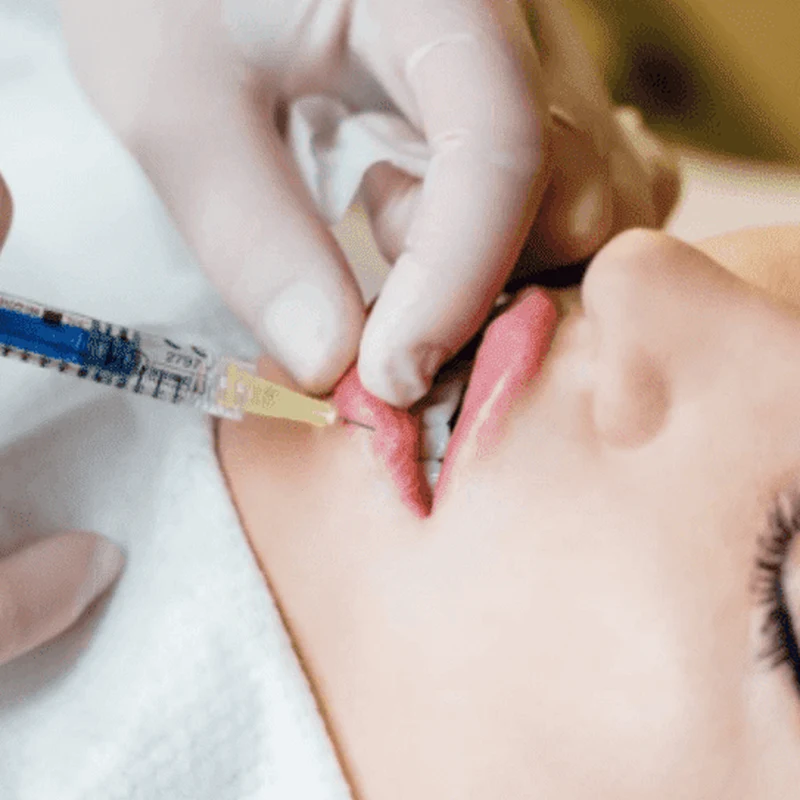
Small-Particle Hyaluronic Acid Lip Filler: A Complete Guide to Natural Lip Definition, Restylane Silk, and Perioral Lines in Abu Dhabi
Can a small-particle HA filler make lips look more refined rather than simply bigger?
Yes, in appropriately selected patients. A soft hyaluronic acid (HA) formulation can improve border clarity, subtle lip contour, the transition from skin to vermilion, and selected vertical lines around the mouth without necessarily pursuing a dramatic change in volume. The result depends on the diagnosis, the patient's baseline anatomy, the particular product's properties, the treatment amount, and the injector's clinical judgment.
A product called Restylane Silk was a key example in a 2016 expert review by Annie Chiu and colleagues because its small-particle HA formulation was developed for lip augmentation and treatment of perioral wrinkles. It remains important to separate what that publication specifically showed or recommended from what can be concluded today about other products.
The key clinical distinction is shape versus size. Some people want noticeable fullness, but others already have sufficient volume and primarily want a better-defined Cupid's bow, a softer upper-lip line, or rejuvenation of the skin immediately around the mouth. For these patients, choosing a filler solely because it gives the strongest projection may defeat the purpose. Equally, a very soft product is not automatically ideal for every lip: tissue support, elasticity, desired longevity, and existing filler all matter.
Important: Lip filler is a medical procedure, not a risk-free beauty service. Most after-effects are temporary, but any HA filler can cause bruising, asymmetry, nodules, infection, or rare vascular complications. An individual treatment plan and access to urgent complication management are essential.
This guide explains the anatomy, the science of small-particle HA, when fine-line treatments may be useful, and what patients in Abu Dhabi should expect from a responsible consultation.
What exactly is a small-particle hyaluronic acid lip filler?
Hyaluronic acid is a naturally occurring glycosaminoglycan that binds water within skin and other connective tissues. Injectable HA products are manufactured into stabilized gels that differ considerably in their cross-linking, viscoelastic response, particle characteristics, cohesivity, swelling behavior, and ability to spread or retain a projected shape. The term small particle describes a formulation concept rather than a guarantee of superior safety or a universally consistent texture across brands.
The 2016 Chiu–Fabi–Dayan–Nogueira publication centered on SP-HAL, a small-particle HA gel containing 20 mg/mL HA and 0.3% lidocaine, marketed as Restylane Silk in the United States. Its authors discussed using a comparatively fine, workable gel for delicate lip landmarks and etched perioral lines. Their article is principally an expert technique review and consensus-style practical discussion, not a randomized head-to-head trial establishing that Restylane Silk outperforms every other filler.
A critical regulatory distinction
The US FDA approved Restylane Silk in June 2014 for submucosal lip augmentation and dermal correction of perioral rhytids in adults older than 21. This does not, by itself, establish current UAE market availability, a Department of Health Abu Dhabi indication, or local authorization; these must be checked against the product actually supplied by the clinic. A manufacturer's brand name also does not establish that all products in that family have the same indication, gel characteristics, or expected duration.
Why the lip is not one uniform anatomical structure
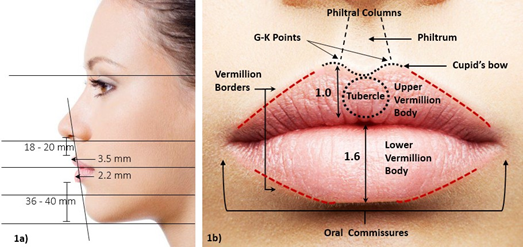
Aesthetic assessment starts before considering a needle or cannula. The lips interact with the nose, lower face, teeth, chin, skin, and facial expressions. A full-face and profile view can reveal why two people who both request a "more defined upper lip" need different approaches. The visible red portion, or vermilion, differs from the surrounding cutaneous lip, and the vermilion border marks their transition. A light-reflecting feature near this transition is often called the white roll. The Cupid's bow, paired philtral columns, central upper-lip tubercle, lower-lip contours, and oral commissures are distinctive landmarks rather than interchangeable injection targets.
In youth, the relationship among these elements typically appears smooth and harmonious. With aging, several processes converge: loss of soft-tissue volume, changes in skin elasticity, photodamage, repeated muscular activity, and changes in dental or skeletal support. The cutaneous upper lip may appear longer while the red lip shows less height. Vertical perioral rhytids can become more visible, even when the patient has little interest in increasing lip volume. This is why adding more gel to the lip body does not always treat the complaint and may produce an unnatural forward projection.
The familiar upper-to-lower lip ratio of about 1:1.6 is discussed in older aesthetic literature, including Chiu and colleagues. It is not a universal mathematical ideal. Proportions vary by individual, ethnic background, age, sex, dentition, and aesthetic preference. A competent consultation uses any ratio as one contextual observation, never as an inflexible template.
Reading the original anatomy figure responsibly
The source figure presents a side-view projection reference and a front-view map of the philtral columns, Cupid's bow, upper and lower vermilion, central tubercle, and oral commissures. These are useful for understanding visual goals, not for telling a nonclinician where to inject. The numerical measurements are historical aesthetic reference points and should not be treated as universally validated targets or promises of improvement.
Five treatment objectives that patients often confuse
- Border definition. The goal is to clarify the transition between skin and vermilion, particularly where age-related flattening has softened the outline. Too much product in this region can create an obvious raised ridge or a shelf above the lip.
- Vermilion hydration and smoothness. Fine, selected surface changes may respond to an appropriate HA product, although temporary swelling can mimic a smoother texture immediately after treatment. Improvement should be assessed after the early inflammatory phase rather than judged solely on the treatment day.
- Actual volumization. Adding visible fullness to naturally thin or deflated lips is a different goal. Some products and tissue planes are better suited to structural support than fine-line blending; a very soft filler may not provide enough projection for a patient requesting a substantial change.
- Cupid's bow and philtral definition. Selected restoration can improve landmarks that have become flat or less visible. Overcorrection can make the philtral columns look rigid or exaggerated, so the natural baseline design must be respected.
- Perioral line softening. Vertical rhytids above the upper lip may be linked to photoaging, movement, tissue thinning, or support loss. Filler can treat certain static lines, but it cannot erase every dynamic wrinkle or substitute for skin resurfacing when texture and pigment change are the primary problems.
An individualized plan may address one objective or a carefully chosen combination. There is no clinical justification for completing all five simply because they are available.
What filler rheology means in everyday language
Rheology describes how a gel behaves under force. It explains why two transparent HA products can produce noticeably different results in the same anatomic area. Several characteristics affect practical decision-making, but no single number determines clinical superiority.
Elasticity (often discussed as G′) relates to the gel's tendency to recover its shape following deformation. A more supportive material may help maintain projection in selected areas, but excessive firmness can be undesirable in mobile, thin lip tissue. Viscosity describes flow and deformation under stress. Cohesivity relates to how the gel remains integrated rather than separating or spreading. Water uptake influences the swelling behavior of the injected product and therefore the appearance during recovery.
The 2016 article emphasized small-particle gel properties for refined lip and perioral work. That is a clinically reasonable product-selection concept, but it must not be converted into a blanket claim that small particles always cause less bruising, eliminate vascular risk, or are the only appropriate choice for lips. Different formulations may achieve a similar aesthetic target through different gel architectures. Brand and formulation must be selected for the patient's anatomy and desired treatment endpoint rather than marketing terminology alone.
| Gel property | Why it matters in lip treatment | What it cannot tell us by itself |
|---|---|---|
| Low-to-moderate structural firmness | May allow a softer appearance and movement | Does not guarantee even placement or no migration |
| Appropriate cohesivity | Helps the product integrate in tissue | Does not prove the gel is superior to every alternative |
| Controlled water attraction | Can affect swelling and early fullness | Cannot predict a specific patient's swelling duration |
| Fine correction capability | May be helpful for selected perioral rhytids | Does not mean all deep creases need more filler |
| Potential HA reversibility | Hyaluronidase can be useful for selected problems | Does not make intravascular injection harmless |
Restylane Silk and the evolution of lip-focused HA products
In 2016, SP-HAL/Restylane Silk was notable for being formulated and US-authorized to address both lip augmentation and perioral rhytids. Other lip-oriented HA products have since been developed or authorized in different jurisdictions. For example, Restylane Kysse received a US FDA lip and upper-perioral-rhytid indication in March 2020. These are not the same material, and approval for one cannot be automatically transferred to another.
When patients ask whether Silk, Kysse, Juvéderm Volift, or another HA gel is "the best," the clinically useful answer is that the right product depends on the intended treatment zone and the patient's existing tissue. One person may benefit from delicate contour definition; another needs more structural support; another may be a poor candidate for more filler until a previous product has been assessed. A responsible clinician also considers cost, expected duration, prior treatment records, lidocaine allergies, local product registration, and whether appropriate emergency resources are available.
Funding disclosure: Restylane Silk's presence in the Chiu article should be interpreted alongside the manuscript's funding disclosure. Galderma supported the expert consensus meeting and preparation, and several contributing authors reported relevant relationships with the company. These disclosures do not automatically invalidate the observations; they do mean product-specific recommendations require appropriately critical interpretation and comparison with independent evidence.
Needle techniques described in the source: what their names actually mean
Several historical lip-filler techniques are described in the source paper. They are ways of describing material delivery and treatment planning, not evidence that one pattern fits every lip. The descriptions below are for understanding the research and discussing treatment with a qualified clinician; they are not home-injection instructions. Actual clinical technique must depend on vascular assessment, professional training, product labeling, and patient-specific anatomy.
Retrograde linear threading places a line of product as the injector withdraws along a controlled track. It is discussed for selected contours, body enhancement, and wrinkles. Anterograde threading describes placement during forward instrument movement; claims that forward injection necessarily pushes all vessels safely away are unproven and must not be presented as a safety guarantee. Serial puncture uses distinct small placements, which can be useful for focal correction but can also create more skin entries. Fanning covers several directions from a related access zone, potentially reducing additional surface punctures but not eliminating risk.
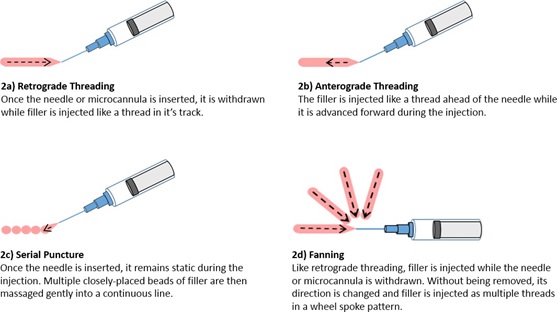
The source diagram is especially helpful for showing patients why the term "technique" refers to a delivery pattern, not the outcome. A natural result relies on judgment before, during, and after filler placement. No diagram can substitute for anatomy training, and no needle or cannula technique makes accidental intravascular delivery impossible.
How aesthetic landmarks guide individualized treatment
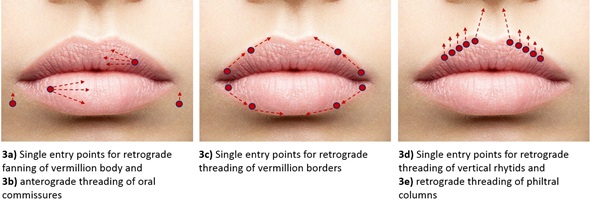
The original article groups its examples around five anatomical concerns. The vermilion body is relevant to actual fullness; the oral commissures influence whether mouth corners look supported or downturned; the vermilion border contributes to outline; the vertical perioral lines are a separate skin-texture and support concern; and the philtral columns influence central upper-lip definition.
Treating these regions as distinct helps prevent the common problem of trying to solve every complaint by depositing filler throughout the entire lip. For example, a patient with good lip volume but an indistinct Cupid's bow may only need a subtle treatment concept rather than a full-volume augmentation. A patient with substantial dynamic rhytids may respond more appropriately to a multimodal treatment plan. Conversely, a patient with true tissue deficiency may not be satisfied with surface refinement alone.
Vermilion body: avoid confusing balanced fullness with overfilling
For body augmentation, the visual objective is usually an even shape with gradual lateral tapering, maintained movement, and suitable upper-to-lower harmony. Facial anatomy includes natural asymmetry, and repeated pursuit of mathematically identical sides can overcorrect one side. Photos in repose, smiling, and profile views are useful. A conservative first session allows the patient and clinician to assess the change once swelling settles.
Commissures: downturned corners have more than one possible cause
A downturned mouth corner can reflect age-related volume loss, lower-face descent, strong depressor anguli oris activity, or a combination. An injection confined to the mouth corner cannot correct every mechanism. The optimal assessment considers whether additional filler would create bulk without much lift, whether a carefully selected neuromodulator is more appropriate, or whether more significant laxity suggests a different procedure. Patients should be told when improvement is likely to be subtle.
Vermilion border: crisp does not mean exaggerated
Overdefined lip borders can appear unnatural in oblique and profile views. Product placed too superficially can become visible or produce a blue-gray Tyndall effect, and placement that extends unnecessarily into the cutaneous upper lip may create a projected ridge. This is one reason a clinician may decline to treat a border that is already well defined. A harmonious transition generally looks more natural than a sharp, continuous outline.
Philtral columns: small landmarks, large visual influence
The paired philtral columns frame the central groove above the upper lip and contribute to Cupid's bow architecture. Aging and individual anatomy influence their visibility. Selective restoration may change upper-lip aesthetics even without substantial volume. It also demands conservative judgment: strongly raised columns or a rigid central ridge can be visually distracting. The objective is refinement that remains consistent with the patient's existing lip and nose relationships.
Perioral rhytids: distinguish movement from etched skin damage
Vertical upper-lip wrinkles arise from several causes, including repetitive orbicularis-oris motion, photodamage, loss of elasticity, and diminished structural support. Fine HA correction can sometimes soften etched lines, but filler alone may leave the underlying surface texture unchanged. Depending on skin type and clinical assessment, alternatives can include a carefully selected botulinum toxin strategy, resurfacing, energy-based treatment, skincare, and photoprotection. Combination treatments are not automatically superior and require individualized timing.
Why the cannula discussion remains relevant, and where evidence is limited
The article also discussed blunt-tipped microcannulas. Fewer skin punctures may reduce some superficial trauma in selected settings, and access to several adjacent areas from a planned entry can be convenient. That does not make a cannula risk-free: vascular entry, vessel compression, tissue injury, and aesthetically incorrect product deposition can still occur. The paper explicitly stated that microcannula use with SP-HAL was not part of the FDA-approved technique at the time and that additional clinical studies were needed to establish definitive advantages.
Modern risk-reduction reviews continue to emphasize anatomy, small aliquots, low pressure, controlled placement, patient selection, and early recognition of complications; instrument choice is one component of that system. Where clinically useful, high-frequency ultrasound may be considered for mapping previously injected filler or assessing uncertain anatomy. However, ultrasound itself does not remove risk, and routine use requirements vary by setting and clinician expertise.
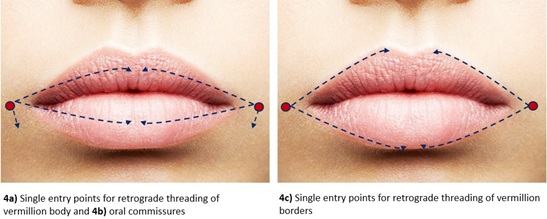
The source figure illustrates a lateral-access microcannula concept for the vermilion body and outline. It should be read as an archival depiction of the authors' described technique rather than a universal safety map. Product labeling, local practice standards, and a contemporary vascular-anatomy assessment take priority over a diagram produced in 2016.
Choosing between a needle and cannula: a clinical comparison
| Consideration | Needle | Blunt-tipped cannula |
|---|---|---|
| Point-specific placement | Often offers localized precision | Can access several areas from an entry site |
| Number of skin entries | Can require more punctures | May reduce entry sites |
| Bruising and edema | Variable with anatomy and operator | May decrease trauma in some settings, not always |
| Vascular risk | Present | Also present; not eliminated by blunt tip |
| Best use | Depends on goal, gel, anatomy, and trained clinician | Depends on goal, gel, anatomy, and trained clinician |
This comparison does not establish that one instrument is superior for every patient. The source's practical preferences reflect an expert panel and should be interpreted as historical professional experience rather than a universal protocol.
Safety: routine reactions, uncommon problems, and true emergencies
Temporary redness, mild tenderness, swelling, and bruising are common after HA lip filler. These findings are not automatically evidence of a problem and often improve over the first several days, although a sensitive lip may take one to two weeks or longer to reach a stable appearance. A patient should not attempt to judge final symmetry immediately after injection, when edema may be uneven.
Less common problems include persistent palpable nodules, delayed inflammatory reactions, infection, blue-gray discoloration from superficial product, excessive fullness, and migration or apparent displacement. Each requires diagnosis rather than automatic massage or injection of more filler. The possibility of previous products, active infection, cold sores, dental events, autoimmune or inflammatory illness, and recent procedures may modify the differential diagnosis. Hyaluronidase is a useful option for HA products in selected complications, but not every swelling episode requires dissolution.
Urgent warning signs: unusual or escalating pain, a white, gray, blue, or mottled skin appearance, worsening capillary refill, rapidly evolving discoloration, sudden visual symptoms, or neurological signs such as facial weakness or difficulty speaking. If these occur during or after injection, urgent medical assessment is necessary. The FDA explicitly warns that accidental intravascular filler injection can cause tissue necrosis, vision loss, or stroke.
Clinic readiness should include a rehearsed recognition and escalation protocol, appropriate supplies for HA-associated ischemia, and rapid ophthalmic/emergency referral pathways.
The source publication contains historical post-procedure advice, some of which is no longer suitable as a universal response. For example, a 2021 CMAC guideline recommends against routine topical nitroglycerin for filler-induced vascular occlusion because evidence for benefit is lacking and it may worsen ischemia; newer 2026 reviews also highlight rapid assessment and the clinician-led use of hyaluronidase when appropriate. A suspected vascular event is not a situation for home massage, waiting for swelling to pass, or relying on a standard cosmetic follow-up appointment.
The recovery timeline: what usually happens, and what does not
Day of treatment
Most HA fillers create visible volume promptly, but the appearance is affected by local trauma and swelling. The lip may look fuller or less symmetrical than the eventual outcome. Following the treating clinician's specific instructions is more useful than following a generic online routine.
First 24 to 72 hours
Tenderness, swelling, or small bruises may develop or become more evident. Brief cooling may be recommended; excessive direct cold exposure, especially in a numb area, should be avoided. Avoiding vigorous exercise on the day of treatment and unnecessary pressure is sensible when advised by the clinician. Neither forced massage nor aggressive manipulation should be performed without guidance.
About one to two weeks
Routine edema and bruising usually continue to settle. Photographs and a structured reassessment are more informative now than on the day of injection. If the clinician finds persistent asymmetry or a separate treatment target, any correction should be decided on examination rather than on patient anxiety during the first few days.
Later months
The gel gradually changes in appearance and may persist beyond the time at which a patient feels that the cosmetic effect has declined. Longevity is affected by product formulation, individual metabolism, location, movement, baseline anatomy, and treatment amount. No fixed schedule or number of syringes is universally correct.
How long does Restylane Silk or another HA lip filler last?
The 2016 paper described approximately six months of average cosmetic persistence for the small-particle gel in the context discussed. That historical figure is not a guarantee for a particular patient or every present-day HA product. The AAD describes a broad range of approximately four to twelve months for hyaluronic acid gels, while some product-specific investigations report longer outcomes in particular populations or with particular endpoints. Filler may remain detectable after the apparent aesthetic benefit has diminished.
Longevity should be discussed as a range rather than a promised date. Patients also need to understand the difference between a product's regulatory study endpoint, a practitioner's typical clinical experience, and their own aesthetic threshold for seeking another session. The treatment plan should follow clinical need, not a rule that everyone requires a touch-up after a fixed number of weeks or months.
Lip filler versus lip flip, laser, skincare, and surgical lip lift
Lip filler adds a material that can alter contour and fullness. A lip flip uses botulinum toxin to modify muscular activity and may change how the upper lip turns outward during movement, without directly creating the same physical volume. Resurfacing targets skin-texture changes, such as photoaged perioral rhytids, rather than simply increasing the red lip's size. Skin care and sun protection support texture and barrier health. Surgical lip lift changes the upper cutaneous lip's length or position and has a fundamentally different recovery and risk profile.
These treatments are not interchangeable. Patients with a long upper-lip skin segment, significant dental or skeletal contribution to appearance, marked skin laxity, or pronounced perioral texture changes may not receive their preferred result from filler alone. A good consultation explicitly considers situations in which not injecting is the better clinical decision.
| Treatment | Main aim | Key limitation |
|---|---|---|
| HA lip filler | Volume, shape, selective fine-line support | Temporary, can produce swelling or overcorrection |
| Botulinum toxin lip flip | Modifies muscle-related eversion | Does not directly add HA volume; off-label in many settings |
| Laser resurfacing | Texture and selected etched lines | Downtime, pigment and scarring risks; not a volumizer |
| Medical skincare | Maintain skin health and photoprotection | Cannot replace lost structural lip volume |
| Surgical lip lift | Alters cutaneous lip length/position | Surgery, scarring, longer recovery |
Three hypothetical patient journeys: why the same filler request can lead to different plans
The following scenarios are illustrative examples, not patients treated by Dr. Erfan Rahmani or clinical outcomes reported by Chiu and colleagues. They show how a thoughtful consultation can translate a broad request into a more precise clinical question.
Scenario A: adequate lip volume, indistinct upper-lip outline
A patient says, "I like my lip size but want the edges to look cleaner." In a frontal view the lips are already full, yet the upper vermilion-to-skin transition lacks definition. Here, automatically adding an entire syringe to the lip body could create unnecessary projection. A clinician might discuss whether a subtle contour-focused treatment is anatomically suitable, whether the white roll is actually deficient, and whether the desired degree of edge sharpness is realistic without producing a ridge. The essential endpoint is a restrained shape adjustment that remains soft in oblique and profile views. A conservative decision, or no procedure if the existing border is already proportionate, may be more appropriate than a dramatic augmentation.
Scenario B: early perioral lines with little interest in larger lips
Another patient is concerned that lipstick migrates into small vertical lines and that the upper lip skin looks creased even at rest. The concern is partly cutaneous: photoaging, skin elasticity, and repetitive muscle action all contribute. A finely tailored HA approach might help certain static depressions, but filling the vermilion more aggressively will not reliably correct the skin quality above it. A clinician might compare fine-line support against resurfacing, skin protection, and a cautiously selected neuromodulator approach. A combined plan is justified only when each component has a clear objective and the recovery burden is acceptable. An accurate explanation of which lines are unlikely to disappear is more valuable than promising a uniformly smooth upper lip.
Scenario C: thin lip with previous filler and changing expectations
A patient presents with naturally thin lips, several previous injections at different clinics, and a request for more central upper-lip fullness. Old product may still be present even if the patient feels that it has "worn off." The clinician first needs to assess the existing filler, the lip's dynamic profile, and any border distortion. Adding additional material without clarifying baseline anatomy may worsen migration-like appearance or produce stiff movement. Records, examination, and sometimes ultrasound help establish whether the right next step is observation, dissolving selected HA deposits, or a staged treatment. The principle is to correct the current tissue condition rather than repeat a past syringe quantity.
Patient-centered outcome measures: what counts as success?
Aesthetic medicine often uses terms such as "natural," "balanced," and "refined," yet these are subjective descriptions that benefit from a more structured consultation. Before treatment, the patient and clinician can agree on the single most important goal: a clearer border, reduced static perioral line visibility, improved smile symmetry, or increased body fullness. Photographs should include standardized frontal and angled views, and an expression view can help reveal whether the result remains harmonious with motion. The patient can also report whether the change fits their preferences and whether any swelling, tenderness, or visible irregularity interferes with everyday life.
It is important to distinguish patient satisfaction from proof that one delivery technique is safer than another. A patient may prefer a result, yet the underlying technique may not have been formally compared in a controlled study. Likewise, a series with no major recorded complications cannot establish zero risk when the true events are rare. The Chiu 2016 review gathers experience and available literature around SP-HAL; it should not be presented as a large randomized trial demonstrating that small particles prevent vascular events.
A rigorous treatment discussion therefore has three layers: the aesthetic endpoint the patient values, the medical evidence supporting the material and treatment choice, and the safety plan for predictable and rare complications. When all three are explicit, the patient is better equipped to consent without unrealistic expectations. Small-volume refinement can be a successful outcome; so can the decision not to inject when the desired change is anatomically unachievable or would compromise natural proportions.
Medical records and photography: protecting continuity of care
The clinic's records should document the brand and exact product, lot or batch information, treated area, approximate administered volume, date, relevant pre-treatment findings, consent, and adverse responses. Accurate records are especially important when patients receive treatment at multiple facilities or may later need assessment for an unexpected lump or inflammatory reaction. Documenting a patient's existing asymmetry before injection also helps differentiate a new treatment effect from a longstanding feature.
Consistent photographs are not merely marketing assets; they are useful clinical information. Lighting, head position, distance, facial expression, lipstick, and image processing can substantially affect apparent lip fullness. A before-and-after pair taken with different poses or during the initial swelling phase can be misleading. Patients should be able to distinguish immediate post-procedure appearances from results documented after edema has settled. Clinically valuable photography requires proper consent and privacy protection; images should never be assumed suitable for website publication merely because they exist in a medical record.
Questions worth asking before saying yes to a particular filler
A patient can make an informed decision by asking for the product's full name, whether its indication is suitable for the proposed treatment, and why it was selected over other available gels. Ask what the clinician expects to improve and what will remain unchanged. Discuss the expected short-term swelling, realistic longevity, likely staged approach, total price, follow-up policy, and who to contact after hours. It is reasonable to ask how the medical team recognizes vascular compromise and whether hyaluronidase and emergency referral pathways are available. If an answer promises perfect symmetry, permanent naturalness, no swelling, or no vascular risk, the claim deserves skepticism.
A consultation can also end in a decision to wait. A patient may choose to seek a second opinion, gather previous treatment records, defer while an infection resolves, or reconsider whether more volume fits their long-term preference. The purpose of education is to improve the quality of the decision, not to convert every reader into an injection appointment.
The consultation in Abu Dhabi: how a responsible plan is built
At consultation, the most useful starting question is not "Which brand is best?" but "What exactly would you like to change, and why?" A clinician should assess the face in repose and motion, profile balance, upper-to-lower ratio as a contextual measure, border and tubercle anatomy, previous fillers, oral health, existing asymmetry, skin texture, and the patient's tolerance for visible change. Medical screening matters just as much as aesthetics: recent infection, cold sore history, allergies, medication use, bleeding disorders, and possible pregnancy or breastfeeding need consideration.
A treatment proposal should distinguish between what the clinician expects to improve and what filler is unlikely to correct. Patients should know which specific product is planned, why its properties are suitable, whether its relevant indication and local supply are verified, what typical swelling looks like, how the clinic manages urgent complications, and when follow-up is recommended. Before-and-after comparisons should use consistent lighting and pose; immediate after-images must be identified as immediate, not a settled final result.
For patients researching lip filler in Abu Dhabi, a general introduction is available on Dr. Erfan Rahmani's Lip Filler service page. This article intentionally focuses on small-particle HA, subtle line correction, and technique selection rather than duplicating the general service page. Visit Dr. Erfan Rahmani's website for current consultation information; any location, phone, price, or appointment availability should be confirmed directly.
An evidence-based reading of the 2016 source paper
The article by Chiu, Fabi, Dayan, and Nogueira remains useful because it organizes the lip into distinct anatomical treatment priorities and explains common delivery patterns using understandable illustrations. Its practical discussion also gives substantial attention to fine perioral rhytids and the importance of choosing gel properties for the intended endpoint. The major interpretive limitation is that the publication synthesizes existing literature and author experiences; it is not a prospective randomized comparative trial of all available lip fillers.
Restylane Silk was the central product. Galderma supported the expert meeting and writing assistance, and relevant professional relationships were disclosed. The guidance reflects the regulatory and clinical environment of 2016. It should therefore be complemented by current FDA product labeling, independent and contemporary research on filler complications, and current local professional requirements. The source figures are valuable as archived teaching materials but must not be represented as new clinical findings, current product availability claims, or images of Dr. Erfan Rahmani's own cases.
The article's core lesson survives scrutiny: a good lip result starts with the correct aesthetic diagnosis, not a fixed injection pattern. Natural enhancement is most likely when gel selection, anatomy, tissue movement, and realistic expectations align, and when the practitioner can recognize and manage complications promptly.
Clinical takeaway
Small-particle HA lip fillers illustrate an important principle in modern aesthetic medicine: refinement and restoration are different from indiscriminate enlargement. A patient may benefit from subtle definition, smoothing of selected perioral lines, or measured changes to the visible lip. Others need a different HA formulation, a combination strategy, or no filler at all. The safest meaningful result is an individualized outcome planned around anatomy and supported by informed consent, realistic expectations, and an emergency-ready medical setting.
Frequently Asked Questions: Small-Particle HA and Natural Lip Filler
1. What is small-particle hyaluronic acid filler?
It is a stabilized HA gel formulation characterized in part by relatively small gel particles. The clinical properties depend on the complete manufacturing process and rheology, not particle size alone. Restylane Silk was the example discussed in the 2016 Chiu and colleagues paper.
2. Is Restylane Silk the same as Restylane Kysse?
No. They belong to a broadly related HA filler family but are separate products with distinct formulations and product-specific studies and labeling. A clinician should not assume that the behavior, approval, treatment duration, or indication of one product automatically applies to the other.
3. Does a fine-particle filler give more natural lips?
A suitable softer formulation may help with delicate correction, but natural results depend on anatomy, product choice, placement, treatment amount, and restraint. A gel labeled "fine" can still produce an unnatural result if the aesthetic diagnosis or treatment plan is wrong.
4. Can small-particle HA be used only to define the lip border?
Some patients seek definition without significant new volume, and fine correction may be appropriate in selected cases. However, an overdefined border can create an artificial ridge. Examination in frontal, oblique, and profile views should determine whether the border actually needs treatment.
5. Can it be used for vertical smoker's lines?
Selected etched lines around the mouth may respond to suitable fine HA gel. Deep photoaging and dynamic muscle-related wrinkles often require a different or combined approach. Smoking is not the sole cause of these lines, and filler alone cannot reverse every contribution to skin aging.
6. How is HA filler different from Sculptra?
HA gels primarily provide direct structural or volumetric correction, whereas poly-L-lactic acid stimulates collagen formation over time. PLLA is generally not used for direct augmentation of the mobile lip body because of nodule concerns. The two materials should not be treated as interchangeable.
7. Is Radiesse appropriate for the red lip?
Calcium hydroxylapatite is not generally recommended for direct lip-body injection because of nodule concerns and different material behavior. Its applications elsewhere in the face should not be interpreted as permission to use it in every facial site.
8. Can a patient get beautiful lips with less than 1 mL?
Sometimes. The required volume depends on the starting anatomy, gel, aesthetic goal, and degree of correction. A small targeted change can have a noticeable visual effect. Conversely, some patients will not reach a particular goal with a tiny quantity, and more product is not always advisable.
9. Is 1 mL the standard amount for everyone?
No. One milliliter is a familiar package quantity, not a universal clinical dose. Ethical planning starts with the anatomical target and desired result. Treatment may be staged, deferred, or declined when adding volume would produce imbalance or excessive swelling.
10. How long does HA lip filler last?
Duration varies by product and patient. The AAD describes a broad four-to-twelve-month range for many HA fillers. The 2016 Silk review described an average cosmetic persistence of around six months in the context it discussed, not a guarantee applicable to all products today.
11. Will lips be swollen the next day?
Swelling can be greater after the procedure than it was immediately afterward, and mild asymmetry may be visible while it settles. Progressively severe pain, pallor, a blue or mottled skin change, visual symptoms, or neurological changes are not routine recovery and require urgent assessment.
12. When should the final lip filler result be judged?
It is generally more informative to reassess after early swelling has substantially resolved, often around one to two weeks, although some patients need longer. A clinician should explain the specific follow-up schedule and distinguish ordinary edema from symptoms needing faster evaluation.
13. Can filler migrate above the lip?
Apparent or true displacement and overprojection can occur. Some concerns labeled "migration" are actually an overfilled border, residual product, or altered anatomy. The cause should be assessed clinically rather than assumed from a photograph alone; ultrasound may help in selected cases.
14. Is the Tyndall effect dangerous?
A blue-gray appearance can occur when certain HA products are placed too superficially. It is an aesthetic problem that requires proper diagnosis, because skin discoloration can also have other causes. Sudden mottling, pallor, or pain after injection is an emergency warning sign and should not be dismissed as Tyndall effect.
15. What causes lumps after lip filler?
Early swelling, product boluses, preexisting anatomy, inflammatory nodules, and infection are distinct possibilities. Some lumps resolve as swelling improves; others require medical assessment. Avoid attempting aggressive massage or home dissolution without the treating clinician's instructions.
16. Can HA lip filler be dissolved?
Hyaluronidase can break down hyaluronic acid filler and may be used for selected aesthetic complications or urgently for suspected HA-associated vascular occlusion. The decision, drug dose, timing, and clinical monitoring require a qualified medical professional, and dissolution is not a substitute for safe technique.
17. Is a cannula safer than a needle?
A blunt cannula may reduce the number of skin entries and some trauma in certain settings, but it does not eliminate vascular complications. Safety depends on anatomy, instrument selection, injection pressure, volume, technique, product properties, and the practitioner's preparedness.
18. What is fanning in lip filler treatment?
Fanning is a historical term for placing material along several controlled directions from a related access area. The pattern itself does not determine the cosmetic result. Patients should discuss desired changes and complications rather than selecting a delivery pattern based on its name.
19. What is linear threading?
Linear threading describes filler delivered along a linear path. It can be performed using different instrument movements and is one of several techniques mentioned in the source paper. The precise location and extent of treatment are clinical decisions, not instructions that should be copied from an online illustration.
20. What is serial puncture?
It describes separate focal placements rather than one continuous line. It may be useful for selected details, but more entry points can also mean more superficial tissue trauma. Technique selection is individualized and does not override sterile practice or vascular safety.
21. Can fine HA soften a downturned mouth corner?
In certain patients, structural support near the commissure may improve the appearance, but a downward corner may also reflect muscle activity, laxity, or skeletal structure. The clinician should identify the main cause and explain whether filler, botulinum toxin, or another approach is more appropriate.
22. Can lip filler create a new Cupid's bow?
Careful treatment can sometimes refine the visible Cupid's bow, especially where definition has flattened. Filler does not provide unrestricted reshaping, and exaggerated central projection may look unnatural. Planning should preserve the patient's facial identity and natural movement.
23. Will HA filler make my lips feel hard?
A properly chosen and placed soft formulation may feel relatively natural after settling, but temporary firmness or localized bumps can occur. Persistently hard or tender nodules require assessment. Product properties alone do not guarantee a particular tactile outcome.
24. Can people with naturally full lips benefit from filler?
Possibly, but not always. A person with adequate volume may have a limited contour or symmetry concern, or may need no treatment. The responsible goal is harmony, not maximization of a feature that is already full.
25. Is lip filler suitable for people with cold sores?
A history of herpes labialis should be disclosed before treatment because injections can precipitate recurrence. A clinician can assess timing and whether preventive antiviral medication is appropriate. Active infection or inflammation at the intended treatment site is generally a reason to postpone the procedure.
26. Should I stop my blood thinners before filler?
Never stop a prescribed anticoagulant or antiplatelet medication on your own. Tell the treating clinician about medicines and supplements that affect bruising or bleeding so risk can be assessed and any changes coordinated with the prescribing doctor.
27. Can I get fillers during pregnancy or breastfeeding?
There is insufficient safety evidence for elective cosmetic filler treatment during pregnancy or breastfeeding. Discuss plans with your clinician; postponement is generally the cautious approach. This is distinct from making assumptions about the safety of an individual brand.
28. How soon can I exercise after the treatment?
Your clinician's instructions and the treatment details take priority. The AAD generally advises waiting until the next day for strenuous exercise after filler. Exercise restrictions do not substitute for monitoring for unusual pain or vascular warning signs.
29. Can I wear lipstick immediately afterward?
Advice varies depending on punctures, irritation, hygiene, and the treating clinician's instructions. Avoid applying potentially contaminated cosmetics to fresh injection sites until the clinician says it is appropriate. Do not massage or manipulate the lip simply to apply a cosmetic product.
30. What is the difference between a lip flip and lip filler?
Filler adds material and can provide physical contour or fullness. A lip flip uses a small targeted botulinum toxin effect on muscle behavior; it does not deliver the same volumizing material. Neither is inherently the better choice for every patient.
31. Can laser be combined with lip filler?
Some patients benefit from treating structural and texture concerns separately, but sequence and interval depend on device settings, skin type, treatment depth, and the filler involved. It is unsafe to assume every energy-based device can be applied immediately after any filler.
32. What happens if I already have older filler?
The treating clinician should review product history, timing, previous complications, and the current examination. In selected cases, ultrasound can clarify deposits. Additional material may not be appropriate if the lip is already overfilled or the previous filler is causing problems.
33. Is Restylane Silk approved in the United States?
Yes. The FDA's June 2014 approval described specific lip and perioral uses in adults older than 21. That is US regulatory information. Availability and authorized use in the UAE must be verified separately with the treating facility and relevant local requirements.
34. Are results the same across different ethnic backgrounds?
No single ideal ratio or one-size-fits-all lip pattern applies to all people. Individual morphology, preference, age, dentition, profile, and facial proportions must guide treatment. The historical literature's reference ratios are descriptive aids, not universal beauty standards.
35. How can I reduce the chance of an unnatural result?
Choose an appropriately licensed clinician, clearly describe the change you want, accept conservative staging when advised, and do not insist on treating every anatomical zone. Review consistent before-and-after photographs and agree on what the clinician expects can realistically be achieved.
36. What should I do if the skin becomes white or gray after filler?
Sudden pallor, mottling, unusual or escalating pain, visual symptoms, or neurological signs require immediate medical attention. Contact the treating clinic immediately and seek emergency care as indicated. Do not wait for a routine follow-up or attempt home treatment.
37. Can filler blindness really happen?
It is rare but recognized. The FDA and the American Academy of Ophthalmology have documented vision-threatening complications caused by accidental filler entry into blood vessels. Any sudden visual disturbance after injection is an emergency requiring immediate action.
38. Can I book a lip consultation without committing to treatment?
A consultation should be a decision-making appointment, not an obligation to receive filler. You can discuss desired changes, product options, risks, and alternatives, and decline treatment if the expected benefit does not justify it. Current booking information should be confirmed through the clinic's official channels.
39. Is there a special best lip filler doctor in Abu Dhabi?
"Best" is subjective and not a verified medical ranking. A more useful assessment considers relevant professional licensing, experience, informed consent, individualized aesthetic planning, patient communication, and emergency readiness. Review real clinical qualifications rather than search-result superlatives.
40. How much does natural lip filler cost in Abu Dhabi?
Prices vary with product authenticity, quantity, clinical setting, assessment, and follow-up policy. A posted starting price does not automatically include every part of care. Request a current written quotation and clarify what is included instead of relying on historical online price examples.
41. How can I see more information about Dr. Erfan Rahmani's approach?
The website's lip filler service page describes individualized goals and natural-looking outcomes, with broader information on the clinician's aesthetic services. Any individual treatment, outcome, price, or appointment should be confirmed during direct clinical consultation.