
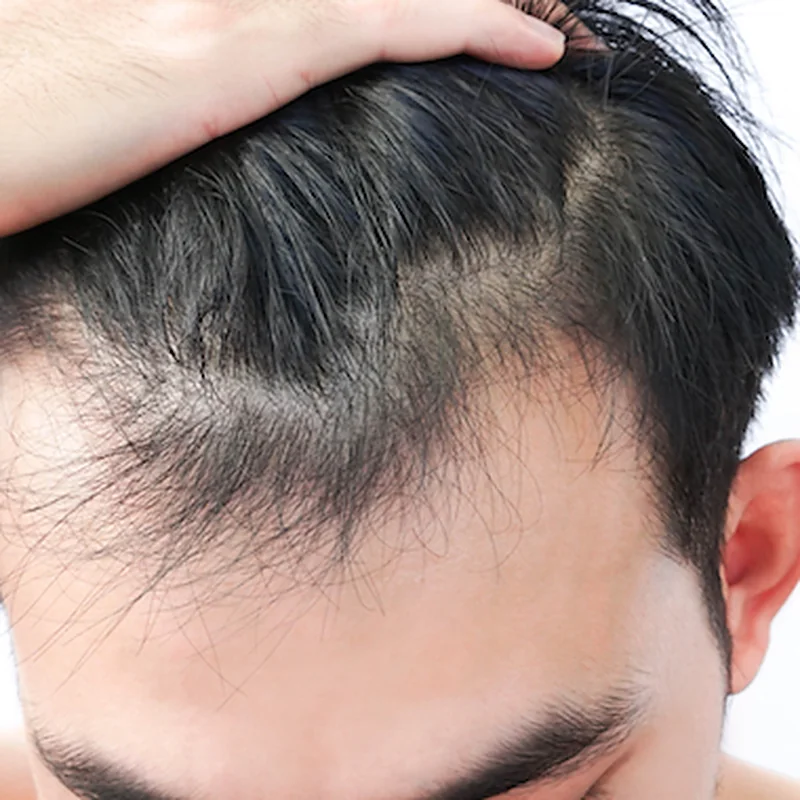
PRP for Hair Loss in Abu Dhabi: Does It Really Work for Pattern Baldness?
If you are considering PRP for hair loss in Abu Dhabi, the real question is not "Does PRP work?" but: What type of hair loss do I have, how many viable follicles remain, what am I already using, and can a specific PRP protocol add worthwhile benefit? Those answers matter more than a dramatic before-and-after photo or an impressive platelet number with no laboratory characterization.
The Evidence in One Minute
| Question | Evidence-led answer | Important qualification |
|---|---|---|
| Did Khatu 2014 report improvement? | Yes. Mean count rose from 71.00 to 93.09 follicular units/cm² (+22.09). | Eleven men, uncontrolled, short follow-up. |
| Did the hair-pull test improve? | Negative in 9 of 11 men after four sessions. | Pull tests vary with technique, washing and timing. |
| What do later controlled studies suggest? | A 2024 meta-analysis found +27.55 hairs/cm² versus placebo. | Hairs and follicular units are different measures; heterogeneity was extremely high. |
| How broad is the newest evidence? | A 2025 synthesis covered 43 randomized trials and 1,877 participants. | It mixed alopecia types and non-standard protocols. |
| Does PRP thicken each hair shaft? | Less consistently than it increases density. | Several pooled analyses found no clear diameter benefit. |
| Is PRP a cure? | No. Results differ, repeat sessions may be needed and progression can continue. | Decisions should rest on diagnosis, evidence, cost and realistic expectations. |
What Is Androgenetic Alopecia (and What Isn't It)?
AGA is a chronic, progressive thinning of genetically susceptible follicles. Dihydrotestosterone (DHT) contributes to follicular miniaturization: hairs become finer, shorter and less visible over time. In men it typically affects the temples and vertex; in women, the central part and crown.
Hair loss is a symptom, not a diagnosis. Telogen effluvium (after illness, childbirth or crash dieting), alopecia areata, scarring alopecias, inflammatory scalp disease and nutritional or endocrine causes can mimic or coexist with AGA. Diagnosis comes before any injection. Trichoscopy and a targeted history (family history, medications, recent illness, hairstyles) help establish the baseline.
What Is PRP and How Might It Work on Hair Follicles?
PRP is an autologous (from your own blood) preparation with platelet concentration higher than whole blood. Platelets release growth factors such as PDGF, VEGF, IGF, EGF and FGF, which may influence follicle cycling, blood supply and cell survival. Laboratory work points to pathways such as Wnt/beta-catenin, Akt and ERK.
Inside the Khatu 2014 Study
This prospective single-arm pilot enrolled 11 men aged 20–40 with AGA (Hamilton grades II–IV) who had not responded well to at least six months of topical minoxidil and oral finasteride. About 20 mL of blood was processed with a double-spin method, activated with calcium chloride, and 2–3 mL was injected across the scalp. Four sessions were given two weeks apart, with assessment at about 12 weeks. This describes a historical research protocol, not a do-it-yourself recipe.
| 2014 outcome | Baseline | After four sessions | What it means |
|---|---|---|---|
| Follicular units in a marked 1 cm² area | 71.00 | 93.09 | Mean within-group gain of 22.09 units/cm² (about 31%) |
| Hair-pull test | 11/11 positive | 9/11 negative | Less measured shedding in most participants |
| Mean hairs removed on pull test | About 10 | About 3 | Reduced shedding test, not proof of permanent regrowth |
| Photographic appearance | Baseline photo | "Moderate improvement" | Qualitative, unblinded |
| Patient satisfaction | N/A | Mean 7/10 | Subjective rating in 11 people |
| Adverse events | N/A | Mild pain, redness, pinpoint bleeding | Too few patients to estimate rare risks |
What the study did not show
It did not compare PRP with placebo, test activated versus nonactivated PRP, define an optimal platelet dose, show long-term durability, or include women. The ~31% figure is simple arithmetic on mean values, not a promise for each patient. A negative pull test also does not guarantee a visibly fuller hairline.
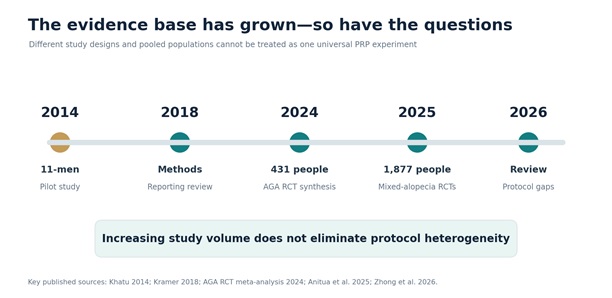
How the Evidence Evolved: 2014 to 2026
| Publication | Design and population | Main finding | Key limitation |
|---|---|---|---|
| Khatu et al., 2014 | Uncontrolled prospective study, 11 men | +22.09 follicular units/cm²; 9/11 negative pull test | No placebo; 12 weeks; tiny sample |
| Meta-analysis, 2024 (RCTs) | 14 RCTs, 431 patients | +27.55 hairs/cm² versus placebo (95% CI 14.04–41.06) | I² about 96%; low-quality evidence; publication bias |
| Aesthetic Plastic Surgery meta-analysis, 2024 | 10 trials, 555 treatment units | +25.09 hairs/cm²; diameter benefit not established | Varying outcomes; small studies |
| Dermatology and Therapy, 2025 | 43 RCTs, 1,877 people, several alopecia types | Support for density, reduced shedding, patient-reported outcomes | Not an AGA-only standardized protocol |
| Zhong et al., 2026 | Review of PRP methods in AGA | Mechanisms explained; protocol variability persists | Review, not a new patient trial |
Why PRP Results Differ: Preparation Matters
- Single vs double spin: different cell fractions; neither label guarantees a better outcome.
- RPM vs g-force: rpm alone is meaningless without rotor radius (RCF). Copying historical rpm settings onto another centrifuge can change the product.
- Platelet dose and leukocytes: final platelets per mL, white-cell and red-cell content all vary between systems.
- Activated vs nonactivated: some pooled analyses favor activation, but heterogeneity prevents a universal rule.
Quality PRP care means validated equipment, documented settings and traceable, sterile preparation, not slogans about "spinning blood twice."
PRP vs Minoxidil, Finasteride, Microneedling, LLLT and Hair Transplant
These options do different jobs. PRP is best viewed as a possible adjunct, not a replacement for established therapy. Do not stop an effective medication just to start PRP, and never stop prescribed blood thinners without your prescriber's approval.
| Option | Main role | Evidence perspective | Time and commitment |
|---|---|---|---|
| Topical minoxidil | Ongoing growth support | Established for pattern hair loss | Continuous use; months to assess |
| Oral finasteride (appropriate men) | Reduce DHT-related miniaturization | Established prescription option | Ongoing use; risk counselling needed |
| PRP scalp injections | Potential biological adjunct | Supportive but heterogeneous trials | Session series; possible maintenance |
| LLLT / photobiomodulation | Noninvasive device adjunct | Several sham-controlled trials | Frequent, consistent sessions |
| Microneedling | Procedural adjunct under study | Protocol and combination effects vary | Operator skill and skin safety matter |
| Hair transplantation | Redistribute donor follicles | Surgical option for suitable anatomy | Planning, recovery and native-hair management |
Who May Benefit From PRP and Who Needs a Different Plan?
A reasonable candidate is an adult with a clinically supported AGA diagnosis, miniaturized but viable follicles, a documented baseline and realistic expectations, particularly when medication alone has been insufficient or poorly tolerated.
Diagnosis should come first if you have sudden diffuse shedding, patchy loss, pain, scaling, pustules, shiny scalp without follicular openings, or active infection. Scarring and inflammatory alopecias may need urgent disease-directed treatment. Longstanding smooth bald areas are unlikely to respond dramatically to injections alone. Women, and anyone pregnant or planning pregnancy, need individualized assessment.
What to Expect Before, During and After PRP
Before
Expect a history, scalp examination, trichoscopy and standardized photographs with consistent lighting, length and styling. Agree on the outcome you will judge: shedding, counted density, shaft thickness or daily confidence.
During
Blood is drawn, processed and injected into targeted scalp areas using aseptic technique, patient identification and sharps safety. Expect stinging and pressure; ask about pain management.
After
Temporary tenderness, redness, pinpoint bleeding, bruising or swelling are common. Seek prompt care for fever, spreading redness, drainage or worsening pain. Follow your clinician's aftercare instructions rather than a generic rule.
How many sessions?
No universal schedule exists. Khatu used four sessions two weeks apart; other protocols use monthly sessions followed by maintenance. A sensible monitoring plan: baseline, early tolerance check, objective review at about 3 months, repeat measurement at 6 months, and a durability and cost review at 12 months. If objective measures do not improve after an adequate course, indefinite extra sessions are hard to justify.
PRP Safety: "Your Own Blood" Does Not Mean Risk-Free
Autologous PRP avoids donor-related concerns, but collection, processing and injection still breach the skin barrier. Infection control, traceability and trained staff are essential. Common effects are short-lived pain, swelling and bruising. Pooled data do not show a clear increase in adverse events, but rare harms may go undetected in small trials. Do not attempt DIY PRP kits or home injections.
How to Judge Before-and-After Photos and Marketing Claims
Lighting, flash, hair length, wetness, parting, fibers and styling can change how thick hair looks. Ask whether the photos were standardized and whether other treatments were used during the same period.
| Overstated claim | Evidence-conscious alternative |
|---|---|
| "PRP cures genetic hair loss permanently." | "PRP may provide an additional density benefit in selected AGA patients; maintenance and long-term response vary." |
| "PRP grows 22 new hairs per cm² in everyone." | "An uncontrolled 2014 study observed a mean gain of 22.09 follicular units/cm² in 11 men." |
| "Clinically proven to beat minoxidil." | "Superiority depends on the specific comparator and trial design." |
| "A double spin guarantees a stronger treatment." | "Centrifugation affects composition; clinical superiority of a spin label is not settled." |
| "No side effects because it is your own blood." | "Minor procedural effects are common, and infection or other complications remain possible." |
| "FDA-approved PRP hair regrowth procedure." | "Regulatory status of devices and indications varies; clearance of a device is not approval for a hair-loss claim." |
| "A photo proves a universal response." | "Standardized, paired trichoscopic and photographic evaluation helps interpret one person's result." |
10 Questions to Ask a Clinic Offering PRP in Abu Dhabi
- What diagnosis explains my thinning, and what findings support it?
- Do I have viable miniaturized follicles that can be measured at follow-up?
- Would medication, lab investigation or another specialist help first?
- What is PRP meant to do in my case: shedding, density, maintenance or transplant support?
- Which PRP system and quality-control process will be used?
- How will you record a baseline and compare progress under standard conditions?
- What response is realistic for my pattern, severity and treatment history?
- Which side effects, exclusions and follow-up visits should I understand?
- What happens if objective measures do not improve?
- What is the total cost and time commitment, including maintenance?
In the UAE, you may also meet terms such as GFC, PRF, mesotherapy, stem cells and exosomes. These are not interchangeable with autologous PRP. Ask for the exact product, its regulatory status under current Abu Dhabi and UAE rules, and the human evidence behind it. Abu Dhabi's heat and sun do not by themselves explain AGA or make PRP uniquely effective locally.
Bottom Line
The 2014 paper was an important early signal. Later studies give stronger, though heterogeneous, support for a possible density benefit, while formulation, schedule and durability questions remain open. In 2026, PRP is best described as an evidence-supported potential adjunct, not a guaranteed biological reset. The most credible clinician explains what was measured, what is uncertain and how your individual response will be tracked.
Frequently Asked Questions About PRP for Hair Loss
Is PRP scientifically proven to grow hair?
Controlled studies and meta-analyses support a potential improvement in hair density in androgenetic alopecia, but effect sizes vary and certainty is limited. It is not guaranteed for everyone.
Does PRP create completely new follicles?
No. The 2014 study counted follicular units in a mapped area. A change may reflect improved detection of miniaturized units, measurement variability or true biological response, not 22 newly created follicles.
Can PRP cure genetic baldness permanently?
No. AGA is progressive, and PRP does not remove genetic sensitivity to androgens. Some patients gain density or less shedding, but durability and maintenance needs vary.
How long until I see results?
Hair cycles take months. Changes in shedding may be noticed earlier than density, but subjective impressions are unreliable; objective review at 3, 6 and 12 months is more informative.
How many PRP sessions do I need?
There is no validated universal schedule. Khatu used four sessions two weeks apart; others use monthly sessions plus maintenance. More sessions do not automatically mean more hair.
Are maintenance sessions required forever?
Evidence does not establish an indefinite maintenance interval. If standardized measurements show no meaningful response, ongoing sessions are difficult to justify.
Does PRP work on a completely bald, smooth scalp?
The rationale is strongest where miniaturized follicles remain. Smooth, longstanding bald areas are less likely to respond, and transplantation may be a better option.
Is PRP better than minoxidil?
It cannot be ranked simply. Minoxidil is established and used continuously; PRP is a procedure with heterogeneous evidence. Do not stop minoxidil for PRP without medical advice.
Can I combine PRP with finasteride?
It may be discussed because the mechanisms differ, but combination is not automatically superior. Finasteride requires counselling on side effects and reproductive considerations.
What if minoxidil and finasteride did not work for me?
First recheck the diagnosis, dose, duration and other causes of shedding. PRP can be considered among options after re-evaluation, but it is not a guaranteed fix for medication non-response.
Can women receive PRP for female pattern hair loss?
PRP has been studied in women with encouraging results, but the Khatu cohort was male only. Women need workup for hormonal, nutritional and pregnancy-related factors.
Does PRP work for alopecia areata or telogen effluvium?
These are different conditions with their own management. Findings in AGA do not transfer automatically, and diagnosis should guide treatment.
Is PRP safe during pregnancy or breastfeeding?
Do not assume so because it uses your own blood. Anesthetics and other agents matter and dedicated trials are lacking. Seek individualized medical advice.
How painful is scalp PRP?
Pain varies. Expect stinging and pressure during injections and tenderness afterward. Ask your clinician about analgesia options.
What are the side effects of PRP for hair?
Temporary pain, redness, pinpoint bleeding, bruising and swelling are common. Infection and significant inflammation are less common but need prompt attention.
Can PRP cause infection even though it uses my own blood?
Yes. Contaminated tubes, equipment, needles or skin can cause infection. Seek care for fever, spreading redness, discharge or escalating pain.
Is higher platelet concentration always better?
Not necessarily. Dose, volume, leukocytes and activation all matter, and no single optimal concentration has been established for AGA.
Is activated PRP stronger than nonactivated PRP?
Evidence is mixed. Khatu used calcium chloride activation but had no nonactivated comparison group, so it cannot prove superiority.
Does PRP increase hair thickness as well as density?
Density is the more consistent signal. Pooled increases in shaft diameter have been less reliable.
How long do PRP results last?
Long-term durability is not well defined. Khatu followed patients for only 12 weeks, and underlying AGA may continue to progress.
Should I stop blood thinners or minoxidil before PRP?
Never stop prescribed anticoagulants, antiplatelets or effective treatments without approval from the prescribing clinician.
Can I do PRP or microneedling at home?
No. Blood handling, centrifugation and injection carry infection and safety risks unsuited to home use, and home microneedling can cause infection or scarring.
How should I compare PRP prices in Abu Dhabi?
Compare the total plan: consultation and diagnosis, PRP characterization, number of sessions, follow-up measurements and maintenance. Price alone does not indicate quality.
Is there an FDA-approved PRP injection for androgenetic alopecia?
Device clearance is not the same as approval for a specific hair-loss claim, and the UAE has its own framework. Ask the clinic to verify the authorization relevant to the product offered.
Start with a proper diagnosis and a measurable baseline. Read more evidence-based patient education at www.drerfanrahmani.com. Suitability for any treatment must be confirmed through a clinical assessment and current local regulations.
This article is for education only and is not a substitute for personal medical advice, diagnosis or treatment.