

Pure PDGF After RF Microneedling in Abu Dhabi : Randomized Trial Evidence for Healing, Skin Quality and Patient Satisfaction
Quick Answer
A 2025 prospective, randomized, evaluator-blinded pilot trial tested PDGF after RF microneedling, comparing recombinant pure PDGF with standard emollient care after a single Morpheus8 treatment. Twelve women completed the study: 8 received topical PDGF immediately after treatment and 4 received standard care.
- Day 7: The aesthetic-improvement score (CGAIS) favored PDGF numerically, but the difference was not statistically significant.
- Day 30: The PDGF group scored significantly better, about one full point higher on the 5-point scale.
- Objective imaging (VISIA-CR): PDGF outperformed standard care in 6 of 7 skin measures, including pores, spots, wrinkle coarse area and wrinkle mean thickness.
- Patient experience: Better soothing, less redness and a better overall experience.
- Safety: No serious or treatment-related adverse reactions were reported.
The trial is encouraging but small, single-center, female-only and limited to 30 days.
Why This Trial Matters
Many post-procedure skincare strategies rest on convention, clinician preference or indirect evidence. This study is more useful than an uncontrolled before-and-after series because participants were randomized, the main evaluator was blinded, and PDGF was compared directly with an active standard post-Morpheus8 emollient.
It also used three complementary outcome layers: a blinded global aesthetic scale, automated image analysis and patient-reported experience. The sample is very small, though, so treat this as a controlled pilot signal, not definitive proof of long-term superiority.
You can read the original trial here: published study on PubMed. For treatment details at our clinic, see our Morpheus8 treatment page.
What Is PDGF?
Platelet-derived growth factor (PDGF) is a signaling protein involved in wound healing and tissue regeneration. This study focused on the BB isoform of recombinant human PDGF.
PDGF binds receptors on multiple mesenchymal-origin cell types and is linked to mitogenesis, differentiation, chemotaxis, cell survival and angiogenesis. That is relevant after RF microneedling, which intentionally creates controlled tissue injury. Growth-factor signaling may influence the inflammatory, proliferative and remodeling phases of healing.
What Does “Recombinant Pure PDGF” Mean?
The study did not use platelet-rich plasma (PRP) or platelet-rich fibrin (PRF). The test material was recombinant PDGF-BB (pure, single-factor) at a known concentration of 300 µg/mL in sterile physiologic solution.
PRP and PRF contain complex mixtures of platelets, plasma proteins and variable concentrations of many growth factors. A recombinant single-factor product is more standardized in composition.
Why Use PDGF After RF Microneedling?
RF microneedling creates controlled micro-injuries with simultaneous radiofrequency heating in the dermis. This triggers collagen and elastin remodeling, but also short-term redness, irritation, dryness and discomfort.
The idea is to apply PDGF immediately after treatment, when tissue-repair pathways are activated by injury: create a controlled regenerative stimulus, then supply a defined signaling factor during the early healing window.
How the Trial Was Done
The RF Microneedling Procedure
All participants had a single Morpheus8 fractional RF microneedling treatment according to the manufacturer’s instructions for use. A topical anesthetic containing benzocaine, lidocaine and tetracaine was applied beforehand. Follow-up visits took place at days 1, 3, 7 and 30.
How PDGF Was Applied
- PDGF-group participants received the recombinant solution immediately after treatment.
- Up to 1.0 mL was applied to the skin surface and spread over the treatment area with sterile technique.
- Ten minutes later, emollient was applied.
- The control group received the emollient only.
This design isolates the added value of PDGF more directly than a comparison against no aftercare.
Who Was Studied?
Thirteen women were recruited and one was lost to follow-up, leaving 12 participants. Ages ranged from 43 to 64 years (mean 53.6). Half had moderate Glogau photoaging and half advanced; none were mild or severe. The group skewed toward lighter Fitzpatrick skin types.
Skin-Type and Photoaging Profile
| Characteristic | Study distribution |
|---|---|
| Fitzpatrick I | 2/12 (17%) |
| Fitzpatrick II | 6/12 (50%) |
| Fitzpatrick III | 3/12 (25%) |
| Fitzpatrick IV | 1/12 (8%) |
| Glogau moderate | 6/12 (50%) |
| Glogau advanced | 6/12 (50%) |
How Objective Skin Change Was Measured
The study used VISIA-CR standardized facial photography with Canfield image-analysis software. Frontal and bilateral 45-degree views were captured at defined time points. Makeup and jewelry were removed, hair was held back, and standardized analysis masks improved consistency.
The Seven Objective Endpoints
| Endpoint | What it broadly reflects |
|---|---|
| Pore count | Number of algorithm-detected visible pores |
| Pore fractional area | Proportion of analyzed skin area occupied by visible pores |
| Texture fractional area | Algorithmic measure of visible surface texture irregularity |
| Spot count | Detected visible spots within the defined region |
| Wrinkle coarse area | Area occupied by coarser wrinkle signal |
| Wrinkle count | Number of algorithm-detected wrinkle structures |
| Wrinkle mean thickness | Average thickness of detected wrinkle structures |
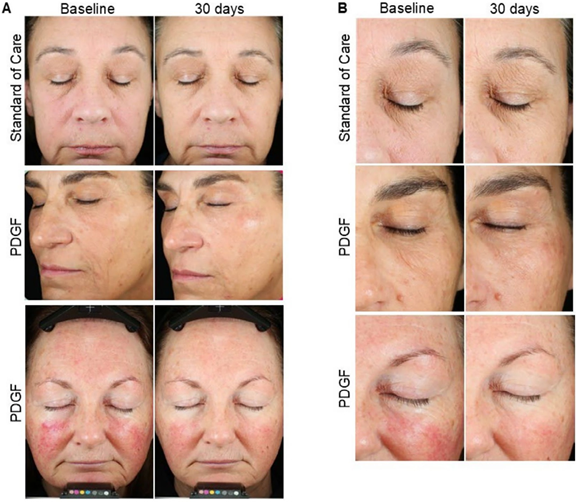
Representative Clinical Photographs
The source publication includes baseline and day-30 photographs for the standard-care and PDGF groups, plus closer periocular views. These are supportive, but should not be read independently of the small sample and the objective imaging results. Photographs are sensitive to lighting, expression and positioning, which is why the automated Canfield analysis adds real value.
Results: PDGF Improved 6 of 7 Objective Categories
Image analysis is one of the strongest parts of the trial. PDGF participants improved in six of seven categories, while improvement in the standard-care group was less frequent and more limited.
| Objective endpoint | PDGF group | Standard-care group |
|---|---|---|
| Pore count | 6 of 7 improved | 0 of 4 improved |
| Pore fractional area | 5 of 7 improved | 0 of 4 improved |
| Texture fractional area | Improvement observed | Limited improvement |
| Spot count | 4 of 7 improved | 1 of 4 improved |
| Wrinkle coarse area | 4 of 7 improved | 0 of 4 improved |
| Wrinkle count | No PDGF advantage | Only endpoint where PDGF did not outperform control |
| Wrinkle mean thickness | 7 of 7 improved | 0 of 4 improved |
Pores: One of the Clearest Signals
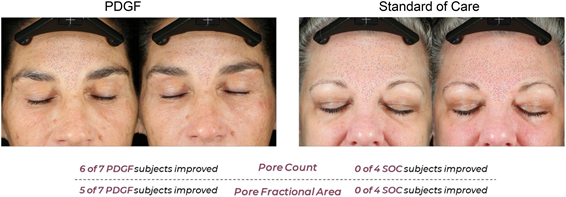
Six of seven analyzed PDGF participants improved in pore count, versus none of four controls. For pore fractional area, five of seven improved versus none of four. The denominators are tiny, but the direction and size of the difference make pores an important hypothesis for larger confirmatory trials.
Visible Spots and Overall Skin Appearance
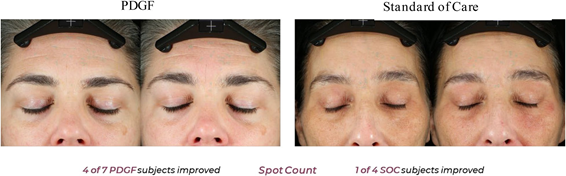
Four of seven PDGF participants improved in spot count, compared with one of four in the standard-care group. The authors interpret the wider pattern as improved overall post-RF-microneedling skin appearance rather than a change in one narrow variable.
Wrinkle Coarse Area and Wrinkle Thickness
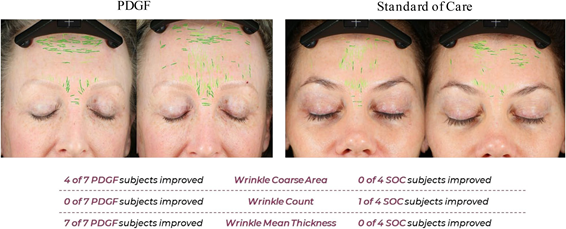
PDGF improved wrinkle coarse area in four of seven participants versus none of the controls. The most striking result was mean wrinkle thickness: seven of seven PDGF participants improved, compared with zero of four controls.
Wrinkle count did not favor PDGF. Wrinkle number, depth, thickness and area are different image-analysis constructs and shouldn’t be collapsed into one claim.
Patient-Reported Experience
Patient-reported outcomes generally matched the blinded and objective assessments. PDGF participants more consistently agreed that the post-procedure product:
- Alleviated pain or discomfort
- Soothed or calmed the skin
- Reduced redness and irritation
- Improved dryness and provided hydration
The standard-care group was less likely to agree that their product soothed, cooled or calmed the skin.
Would Patients Repeat or Recommend the Treatment?
- At 30 days, all participants in both groups were interested in a second RF microneedling procedure.
- In the PDGF group, 100% strongly agreed they would recommend the post-procedure product to friends or family.
- In the standard-care group, only 50% agreed.
This suggests a meaningful experience difference, but the small sample should stay visible whenever percentages are quoted.
Pain and Early Tolerability
Participants recorded pain and tolerability in the office and during the first 12–16 hours. All subjective tolerability sensations resolved after day 1 and stayed unremarkable afterward. Most reported zero to very little pain, and the PDGF group more consistently described soothing and relief.
Safety Findings
No adverse reactions were reported by participants, providers or investigators in the PDGF group during the 30-day study, and no serious adverse events occurred in either group. This is useful short-term tolerability data, but the trial is too small and too short to detect rare or delayed complications.
How PDGF May Support Healing After RF Microneedling
The authors describe PDGF as coordinating several wound-healing processes at once: survival and proliferation of repair cells, recruitment of cells to injury sites and stimulation of extracellular-matrix production. The discussion names collagen, hyaluronic acid and fibronectin as matrix components influenced by PDGF signaling, along with angiogenesis and new-vessel formation.
These mechanisms offer a plausible biological explanation for the reduced redness and irritation and the improvements in several image-analysis metrics.
PDGF vs PRP / PRF: What the Authors Argue
The authors note that platelet concentrates vary with platelet count, age, health status and preparation method, whereas a recombinant product has a defined growth-factor concentration. They also cite adverse-event reports associated with PRP in the broader literature.
However, this trial did not compare PDGF with PRP or PRF. It compared PDGF with an emollient after Morpheus8. Any claim that PDGF is clinically superior to PRP or PRF goes beyond the data.
Strengths of the Study Design
- Randomization reduces systematic differences between groups.
- Evaluator blinding reduces the risk that the main CGAIS assessment was influenced by knowledge of allocation.
- Objective image analysis adds a quantitative layer beyond physician impression.
- Patient-reported outcomes capture comfort, soothing, redness and satisfaction that imaging cannot.
Main Limitations
- Only 12 completers, with just four controls
- All participants were women, limiting generalizability to men
- Single-center design
- Only one RF microneedling session evaluated
- Follow-up ended at 30 days, so durability, delayed adverse events and multi-session effects are unknown
- No comparison with PRP, PRF, polynucleotides, exosomes or growth-factor cocktails
Conflict-of-Interest and Sponsorship Context
The study material was supplied by Lynch Regenerative Medicine. Two authors were company employees, and Dr. Michael Gold was a consultant to the company and received funding for the clinical study. The article states the company had no role in study design, implementation, data collection, manuscript review or approval.
These disclosures don’t invalidate the randomized findings, but they matter when interpreting a small company-linked pilot and underline the need for independent replication.
Who Might Be Worth Assessing for This Approach?
The study enrolled women with visible skin aging (moderate or advanced Glogau) who underwent one full-face RF microneedling treatment. Patients interested in this kind of adjunct are typically focused on reducing post-procedure irritation, supporting early healing and improving short-term skin quality.
The study does not establish eligibility rules for all skin types, all ages, men, patients with active inflammatory disease or those receiving multiple simultaneous regenerative treatments.
PDGF After Morpheus8 vs Standard Aftercare
This is the comparison the trial actually answers. Versus standard emollient care, PDGF produced a statistically significant day-30 CGAIS advantage and a broader pattern of objective image-analysis improvement. Patients also reported a better experience with soothing, redness, irritation and willingness to recommend the product.
PDGF vs Exosomes, PN/PDRN or Skin Boosters
The trial does not compare recombinant PDGF with exosomes, polynucleotides, PDRN, HA skin boosters, PRP or biostimulators. These products differ in composition and mechanism and shouldn’t be lumped under one generic “regenerative” label. Only a future comparative study can say whether PDGF gives better results than other adjuncts.
Does PDGF Make Morpheus8 Work Better?
Within this trial’s limits, PDGF improved short-term aesthetic outcomes after Morpheus8 more than standard emollient at 30 days, supporting an additive post-procedure benefit in this small cohort. The study does not show whether PDGF alters long-term collagen remodeling, reduces the number of treatments needed or whether the benefit lasts beyond 30 days.
What This Trial Supports
- Immediate topical recombinant PDGF after one RF microneedling session was feasible in a randomized pilot
- Day-30 CGAIS significantly favored PDGF
- Objective imaging favored PDGF in six of seven categories
- Pore count, pore area, spot count, wrinkle coarse area and wrinkle mean thickness showed favorable signals
- Patients reported better post-procedure comfort and satisfaction
- No PDGF-related adverse reactions were reported over 30 days
What This Trial Does Not Prove
- Long-term efficacy beyond 30 days
- Safety in large populations or detection of rare adverse events
- Superiority to PRP, PRF, exosomes, polynucleotides or other regenerative products
- Results in men
- Outcomes after multiple RF microneedling sessions
- A current UAE or Abu Dhabi regulatory indication
- Equivalence of every PDGF formulation to the study material
PDGF After RF Microneedling in Abu Dhabi with Dr. Erfan Rahmani
For patients researching Morpheus8 aftercare or regenerative recovery options after RF microneedling in Abu Dhabi, this study offers early randomized evidence that a defined recombinant PDGF product can improve 30-day recovery-related aesthetics and skin-quality outcomes compared with standard emollient care.
Dr. Erfan Rahmani can assess your treatment goals, skin type, degree of photoaging, previous energy-based procedures, pigmentation risk, scar tendency and whether an adjunctive regenerative strategy suits your individual plan.
Frequently Asked Questions
What is recombinant pure PDGF?
A laboratory-produced, defined form of platelet-derived growth factor BB. The study used a 300 µg/mL sterile physiologic solution.
Was PDGF injected in this trial?
No. It was applied topically immediately after RF microneedling.
How much PDGF was used?
Up to 1.0 mL was applied to the treated facial skin.
How many patients completed the study?
Twelve women completed follow-up.
How were patients randomized?
Eight were assigned to PDGF and four to standard emollient care (2:1).
What device was used?
Morpheus8 fractional RF microneedling.
How long was follow-up?
30 days.
Did PDGF improve CGAIS at day 7?
Numerically, yes, but the difference was not statistically significant.
Did PDGF improve CGAIS at day 30?
Yes. The PDGF group was significantly better than standard care.
Which objective outcomes improved?
Six of seven image-analysis categories, including pore and several wrinkle-related measures.
Did wrinkle count improve?
No. It was the one category where PDGF did not outperform standard care.
What happened to pore count?
Six of seven analyzed PDGF participants improved versus zero of four controls.
What happened to wrinkle mean thickness?
Seven of seven analyzed PDGF participants improved versus zero of four controls.
Did patients report less irritation?
The PDGF group more consistently reported soothing, reduced irritation and redness, and better comfort.
Were adverse events reported?
No PDGF-related adverse reactions or serious adverse events were reported in the 30-day study.
Is PDGF better than PRP?
This trial can’t answer that, as PRP was not a comparator.
Is PDGF better than exosomes or polynucleotides?
The study provides no head-to-head comparison.
Is the study large?
No. It is a small single-center pilot with 12 completers.
Were men included?
No. All final participants were women.
Where can I learn more in Abu Dhabi?
Visit www.drerfanrahmani.com for consultation information with Dr. Erfan Rahmani.