
Ozempic Face After Rapid Weight Loss
The Short Answer
"Ozempic Face" is a popular, non-medical term describing facial hollowing, wrinkles and skin laxity that may become noticeable after substantial or rapid weight loss. The 2024 source paper links the appearance to loss of facial fat together with reduced skin elasticity, and highlights fillers, collagen- and elastin-stimulating procedures, and surgery as treatment categories depending on the dominant problem.
What Is "Ozempic Face"?
"Ozempic Face" is not a formal medical diagnosis. It is a popular term used to describe facial changes that may become visible after significant or rapid weight loss, particularly in people using GLP-1 receptor agonist medications.
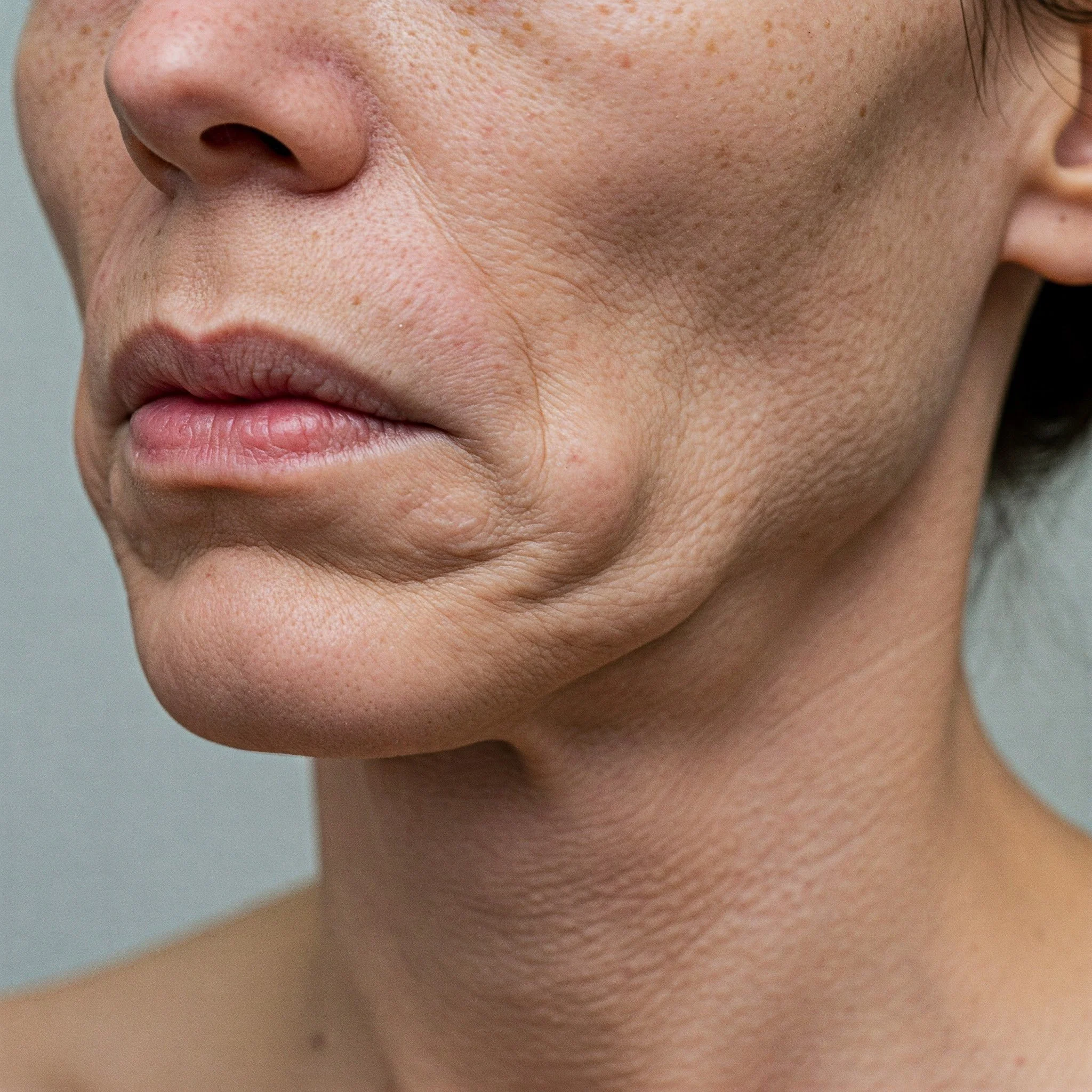
The 2024 correspondence published in the Journal of Plastic, Reconstructive & Aesthetic Surgery describes a pattern of facial fat loss associated with cosmetic concerns such as wrinkles, sunken eyes, a hollowed appearance, sagging jowls around the neck and jaw, and changes in the cheeks, lips and chin.[1]
The key point is that the appearance is not simply a "thin face." Rapid loss of soft-tissue volume can change facial support, while age-related reduction in skin elasticity may make laxity more visible at the same time.
Commonly Reported Facial Changes
- Hollowing or deflation of the cheeks
- More prominent under-eye hollows or a sunken-eye appearance
- Greater visibility of facial lines and wrinkles
- Jowling and reduced definition around the jawline
- Loose or sagging skin of the lower face and neck
- Changes in the apparent volume or contour of the lips and chin
Clinical Distinction
The source paper frames "Ozempic Face" as a consequence of rapid facial weight loss and tissue changes. It does not establish that semaglutide directly and selectively damages facial tissue. That distinction is important when counseling patients.
Why Can Rapid Weight Loss Make the Face Look Older?
Two mechanisms emphasized in the source article are especially important: loss of subcutaneous facial fat and reduced skin elasticity.[1]
1. Loss of Facial Volume
Facial fat is part of the soft-tissue architecture that supports contour and transitions between the cheeks, eyes, jawline and mouth. When this volume decreases quickly, the face may look more hollow, angular or deflated.
2. Reduced Elastic Recoil
The paper notes that elastin decreases with age and contributes to stretching, elasticity and recoil. When loss of facial fat is combined with lower elastic support, loose or sagging skin may become more apparent. Collagen also contributes to skin strength and structure.
3. The Face May Change Faster Than the Skin Can Adapt
A rapid change in facial volume can expose pre-existing laxity or age-related structural changes. This is why treatment planning should identify whether the dominant issue is volume loss, laxity, or a combination of both rather than treating every patient the same way.
Why "Ozempic Face" Became a Major Search Trend
The source paper analyzed Google Trends data in the United States from June 2019 to June 2024. It reported that searches for "Ozempic Face" increased more strongly over time than searches for specific gastrointestinal terms such as Ozempic nausea, vomiting or diarrhea. At some time points, search volume for "Ozempic Face" even exceeded searches for the broader term "Ozempic Side Effects."[1]
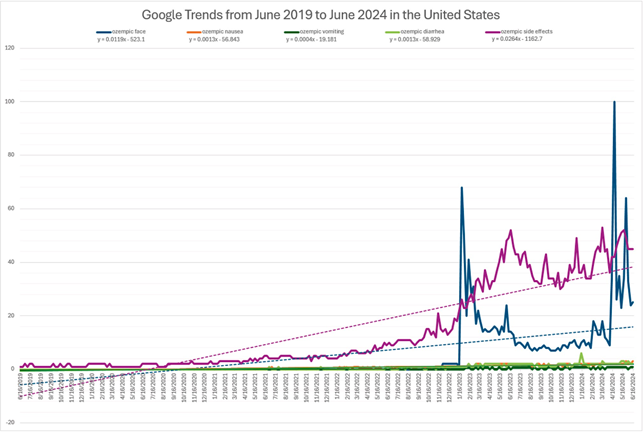
The authors also reported the highest relative U.S. search volumes in the District of Columbia, Idaho, Maine, West Virginia and Oregon. This geospatial result is specific to the United States and should not be presented as evidence of demand in Abu Dhabi or the UAE.

Treating Ozempic Face: Start With the Anatomy, Not the Trend
The most important treatment question is not "Which procedure treats Ozempic Face?" but "What changed in this individual face?" The source article describes two major treatment targets — volume loss and skin laxity — and warns that future weight regain can complicate filler-based correction.[1]
Source-Based Treatment Framework
| Dominant finding | Primary concern | Source-supported option | Important planning issue |
|---|---|---|---|
| Facial deflation / hollowing | Loss of soft-tissue volume | Dermal filler | Weight regain may alter the result or create overcorrection |
| Loose or sagging skin | Reduced elasticity / tissue laxity | Microneedling, laser skin tightening, radiofrequency | Treatment should match the degree and location of laxity |
| More severe excess skin | Significant tissue redundancy | Facelift or neck lift assessment | Non-surgical volume replacement may not correct major skin excess |
Dermal Fillers: Useful, but Timing Matters
The paper describes fillers as a typical first-line treatment for facial volume loss. Their role is conceptually straightforward: replace selected areas of lost volume and improve facial support.[1]
However, the authors highlight a specific challenge: if a patient later regains facial weight after stopping weight-loss medication, previously injected filler may become excessive and may require correction or dissolution.[1]
Why This Matters
For a patient whose weight is still changing, aesthetic planning should account for the possibility that facial volume may continue to decrease — or later return. The safest strategy is not necessarily the largest immediate correction.
Skin Tightening and Collagen / Elastin Stimulation
When laxity is a major component, restoring volume alone may not address the full problem. The source article identifies microneedling, laser skin tightening and radiofrequency treatments as techniques used to stimulate new collagen and elastin production.[1]
This supports a combined-treatment concept: some patients may require volume restoration, others skin tightening, and some a staged combination based on examination rather than a single universal protocol.
When Surgery May Be More Appropriate
For more severe cases with significant excess skin, the source paper notes surgical options such as face or neck lifting.[1] This is an important limit of non-surgical treatment: adding volume cannot reliably substitute for removal or repositioning of substantial skin redundancy.
A Practical Assessment Before Treatment
A structured consultation should define the dominant anatomical change before choosing a treatment. The following checklist translates the source paper's treatment challenges into practical clinical questions:
- Is the main concern facial volume loss, skin laxity, or both?
- Is body weight still decreasing, relatively stable, or likely to increase again?
- Which areas have changed most: temples, under-eyes, cheeks, jawline, neck, lips or chin?
- Would replacing volume improve support, or would it risk making lax tissue look heavier?
- Is the degree of skin redundancy mild enough for non-surgical treatment, or should surgery be discussed?
- What degree of improvement is realistic if weight continues to change?
The best treatment for Ozempic Face depends on what rapid weight loss has changed. Filler may help facial volume loss; microneedling, laser or radiofrequency may be considered for laxity and skin quality; and more severe excess skin may require surgical assessment. Ongoing weight change is a key planning factor.
Ozempic Face Treatment in Abu Dhabi
Patients in Abu Dhabi who notice facial hollowing, jowling or skin laxity after substantial weight loss can benefit from an assessment that separates volume loss from skin laxity. This allows treatment planning to focus on the actual anatomical problem rather than the label "Ozempic Face."
Because the published Google Trends analysis in the source article was performed in the United States, it should be used as evidence of global interest in the topic — not as local UAE prevalence data. Local SEO positioning should therefore focus on patient questions, treatment intent and Abu Dhabi location relevance without overstating epidemiology.
Frequently Asked Questions
What exactly is Ozempic Face?
It is a popular, non-medical term for facial hollowing, wrinkles and skin laxity that may become noticeable after significant or rapid weight loss, including weight loss associated with GLP-1 agonist use.
Is Ozempic Face caused directly by Ozempic?
The supplied source paper associates the appearance with rapid facial weight loss and loss of subcutaneous fat together with reduced skin elasticity. It does not establish a direct, selective toxic effect of semaglutide on facial tissue.
What does Ozempic Face look like?
Reported changes include hollow cheeks, sunken eyes, wrinkles, jowling around the jaw and neck, and changes in the cheeks, lips and chin.
Can dermal filler treat Ozempic Face?
Filler is described in the source article as a common first-line approach for volume loss. However, future weight regain may alter the result and, in some cases, previously placed filler may need correction or dissolution.
Can skin tightening help after rapid weight loss?
The source paper identifies microneedling, laser skin tightening and radiofrequency as techniques used to stimulate collagen and elastin production when laxity is part of the problem.
Does every patient need filler?
No. The source supports different treatment categories depending on whether the main issue is volume loss, laxity or severe excess skin. Some patients may require skin-focused treatment or surgical assessment rather than filler alone.
When might a facelift or neck lift be considered?
The paper notes surgical lifting as an option for more severe excess skin. This becomes relevant when non-surgical treatments are unlikely to adequately address tissue redundancy.
Is Ozempic Face permanent?
The source article does not establish that the condition is permanently fixed. It specifically notes that facial weight can return after medication cessation, which may change the appearance and complicate previous filler treatment.
Should treatment wait until weight is stable?
The paper does not prescribe a specific waiting period, but it highlights continuing weight loss and possible weight regain as important treatment challenges. Clinically, those factors should be considered before major volume correction.
What is the most important first step?
A facial assessment to determine whether the dominant issue is loss of volume, reduced skin elasticity, or both — and whether weight is still changing.