
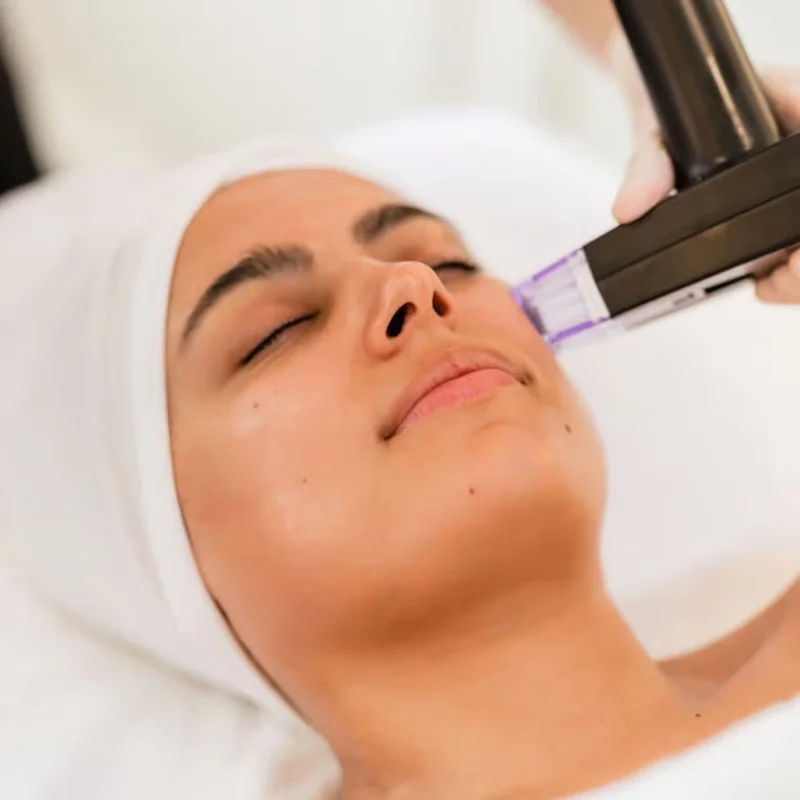
Morpheus8, FaceTite and AccuTite in Abu Dhabi: An Anatomy-First Guide to RF Facial Rejuvenation
Quick answer: If you are researching Morpheus8 in Abu Dhabi, the most useful question is not which device is best, but which tissue layer needs treatment. A 2025 Aesthetic Surgery Journal study describes an anatomy-first approach that combines fractional bipolar RF microneedling (Morpheus8) with minimally invasive bipolar RF (FaceTite or AccuTite). The authors treated 364 foreheads, 364 periorbital regions, 353 perioral regions and 233 jawline/neck cases, plus 43 stand-alone AccuTite nasolabial folds, and reported no hyperpigmentation, hypopigmentation, scarring or prolonged erythema.
The evidence is Level 4, all patients were women, there were no objective efficacy measurements, and the supplement was sponsored by InMode. Treat the settings as high-volume expert protocols, not universal standards.
What Is the "Treatment Gap"?
The study uses "treatment gap" for patients who fall between two traditional options: a noninvasive treatment that may be too weak for their laxity, and a facelift or neck lift that may be more than they want or need. The authors describe three groups:
- Younger patients whose skin redundancy is too mild for excisional surgery but not reliably corrected by liposuction or noninvasive devices alone.
- Patients with recurrent laxity after a previous facelift or neck lift.
- Patients who would likely benefit from surgery but prefer to avoid scars and long recovery, and accept a more modest improvement.
Aesthetic treatment is not simply "device versus surgery." The anatomical problem, the size of the expected correction and your tolerance for downtime all matter.
Two RF Methods That Work at Different Depths
Full-field bipolar RF (FaceTite, AccuTite) uses an internal cannula and an external surface electrode. Current passes between them, heating the subdermal compartment and the fibroseptal network.
Fractional bipolar RF microneedling (Morpheus8) places RF-emitting needles through the skin at programmable depths. The source describes depth changes in 1-mm increments from 1 to 4 mm, with adjustable energy and number of passes.
The paper sometimes calls fractional RF "noninvasive," although the needles cross the skin. This guide calls it transdermal RF microneedling, and calls FaceTite/AccuTite minimally invasive cannula-based RF.
Morpheus8 vs FaceTite vs AccuTite
| Technology | Delivery method | Main role | Typical use in the article |
|---|---|---|---|
| Morpheus8 | Fractional bipolar RF through needles | Dermal/subdermal coagulation, collagen remodeling, skin quality and contraction | Forehead, periorbital, cheek, perioral, jowl, jawline, submental and neck |
| FaceTite | Longer bipolar RF cannula plus surface probe | Full-field subdermal heating and fibroseptal contraction over larger zones | Lower face, mandibular border, neck |
| AccuTite | Smaller bipolar RF cannula plus surface probe | Focal full-field RF in small or confined zones | Nasolabial fold, focal jowl and smaller facial areas |
Why Facial Anatomy Decides the Treatment
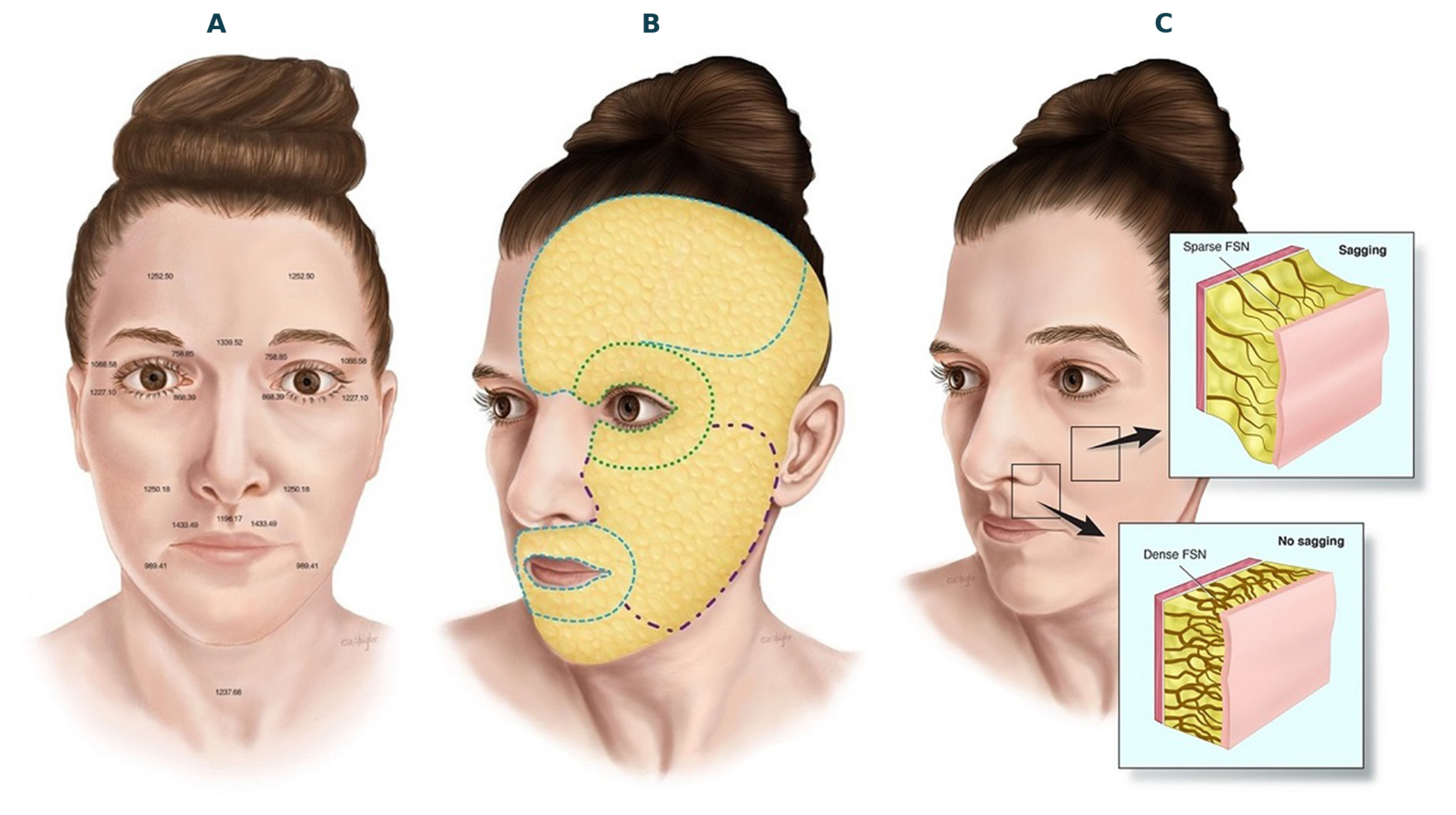
The face is not uniform. Dermal thickness, subcutaneous fat, fibroseptal density, ligament position and nearby nerves and vessels vary widely between regions. A setting that suits the cheek can be excessive around the eyelid, and a depth that remodels jowl fat can be wrong for a very thin forehead. The authors adjust depth, energy, passes and even the device by zone.
They also stress that facial aging combines volume loss with tissue laxity. Heat can improve laxity through collagen contraction and later neocollagenesis, but indiscriminate fat reduction can worsen facial contour.
The Fibroseptal Network and Sagging
The fibroseptal network links skin to deeper structures and organizes superficial fat. In the cheek, fat is thicker and the septa are longer and less dense, so as the network weakens and the fat pad descends, the skin sags and the nasolabial sulcus deepens. The upper lip is the opposite: thin fat and dense septa make the skin fixed and less prone to classic sagging, which is why perioral treatment needs its own strategy.
Study Design and Strength of Evidence
This is a retrospective single-practice review designed to teach anatomy-based technique and document safety. Patients were aged 32 to 78 (mean 58), all were female, and follow-up ranged from three months to two years (average about six months). Its strengths are procedural volume and detailed anatomical reasoning. Its weaknesses are the lack of a control group, randomization or standardized objective measures of tightening.
Zone-Specific RF Microneedling Parameters
The table below reproduces the authors' 2025 expert-practice protocol for fidelity to the source.
| Anatomic zone | Energy (J) | Depth(s) | Passes | Sessions / interval |
|---|---|---|---|---|
| Forehead | 15–20 | 3 / 2 / 1 mm | 1–2 at 3 mm; 2–3 at 2 and 1 mm | 1–3 sessions, ~4 weeks apart |
| Crow's feet | 15–20 | 2 / 1 mm | 2–3 at 2 mm; 2 at 1 mm | 2–3 sessions, ~4 weeks apart |
| Orbital rim / lower eyelids | 15–17 | 2 / 1 mm | 2 at each depth | 2–3 sessions, ~4 weeks apart |
| Cheeks | 20–25 / 15–20 / 10–17 | 3 / 2 / 1 mm | 3 at each depth | 3–4 sessions, ~4 weeks apart |
| Upper/lower lip and chin | 17–20 / 12–15 | 2 / 1 mm | 3–4 | 3–4 sessions, ~4 weeks apart |
| Fixed perioral resurfacing | 15 | 0.5 mm | 1–2 | 1–3 sessions, ~4 weeks apart |
| Neck | 15–17 | 2 / 1 mm | 3 at each depth | 3–4 sessions, ~4 weeks apart |
| Submental | 25–30 / 17–20 / 15–17 | 4 / 3 / 2 / 1 mm | 2–3 at 4/3 mm; 2 at 2/1 mm | 3–4 sessions, ~4 weeks apart |
| Nasolabial fold | 25–27 / 15–17 | 4 / 3 / 2 mm | 1–2 at 4 mm; 2–3 at 3/2 mm | 2–3 sessions, ~4 weeks apart |
| Jowl | 20–25 / 15–17 | 4 / 3 / 2 / 1 mm | 2 at each depth | 1–2 sessions, ~4 weeks apart |
Settings warning: Depths, joules, overlap and session counts are transcribed from an expert protocol. They must not be copied to a patient without device-specific training, IFU review, anatomical assessment and clinical judgment.
Treatment by Facial Area
Forehead: Thin Tissue and Brow Stability
The forehead has little subcutaneous fat. In thinner foreheads the authors treat at 2 and 1 mm; in thicker tissue they add 3 mm. RF microneedling improves pores, dermal thickness and skin quality, but deep transverse lines are hard to eliminate with RF alone, so neuromodulators are commonly combined. The authors also hypothesize that RF-driven dermal contraction may partly offset brow lowering caused by heavy neuromodulator dosing. Since 2018 they report 364 forehead treatments (268 isolated, 96 alongside face/neck lift) with no minor or major RF complications.
Periorbital Skin: The Most Anatomy-Sensitive Zone
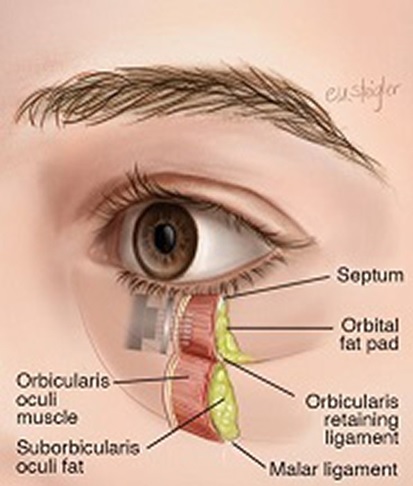
Eyelid and infraorbital skin is among the thinnest in the body, with very little fat. The authors use a smaller 12-pin tip, work over the orbital rim as a bony platform, keep upper-lid skin under controlled tension and never direct the handpiece toward the globe. Lateral orbicularis neuromodulation is sometimes combined with RF. They report 364 periorbital cases (268 isolated, 96 adjunctive) without minor or major RF complications.
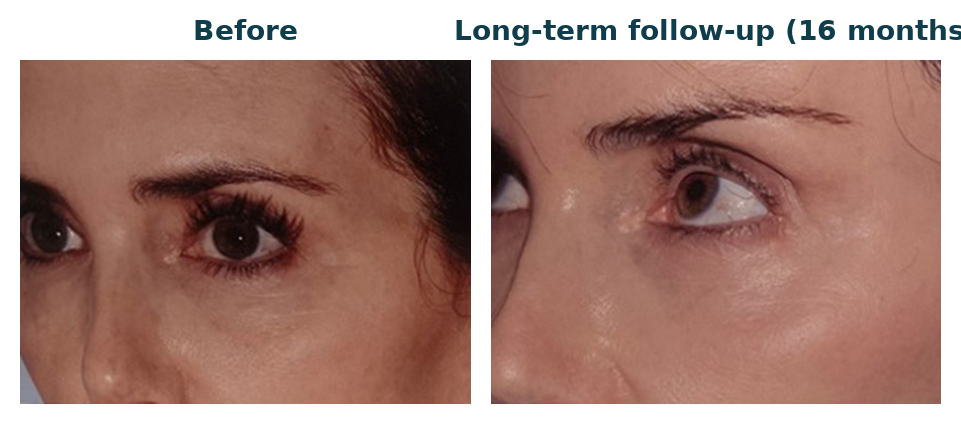
Source inconsistency: the narrative says periorbital energy "remains at 20–25 J," while Table 1 lists 15–20 J (crow's feet) and 15–17 J (orbital rim/lower eyelids). We preserved the discrepancy rather than choosing one value.
Nasolabial Folds: Treating the Structure, Not Just the Line
The nasolabial fold is structurally fixed by dense muscular attachments, a condensed SMAS configuration and a dense fibroseptal network, with thicker, descending malar fat above it. For pronounced folds, the authors pass an AccuTite cannula through a small puncture at the fold base, parallel to the crease, then follow with deeper-to-shallower RF microneedling. From 2020 they report 43 stand-alone AccuTite cases and 24 alongside lift surgery, with no minor or major complications. Their clinical example included a facelift, so it cannot isolate AccuTite's effect.
Perioral Region: Fixed Skin and Static Lines
Upper-lip aging involves a longer cutaneous lip, lost vermilion height and vertical static lines, linked to dermal atrophy and altered collagen, elastin and fibroseptal support. Because the lip is a fixed unit that does not benefit from facelift repositioning, fractional RF is used as a direct skin-quality treatment. The first two sessions use 4-, 3-, 2- and 1-mm depths; later sessions focus on 2 and 1 mm, with an optional 0.5-mm resurfacing tip for fine lines. The 12-pin applicator suits the small, convex lip. Very deep lines remain difficult and may need multimodal care. The authors report 353 perioral zones (259 stand-alone, 94 with surgery) with no complications.
Jowls, Mandibular Border and Neck
The aging jawline shows weaker fibroseptal support, variable fat excess and descent of fat compartments near the mandibular ligament, blurring the jawline and creating a pre-jowl sulcus. The authors mark zone 1 (above the mandibular border) and zone 2 (below it), plus a no-go triangle related to the marginal mandibular nerve. Cannula RF reduces focal jowl fat and contracts the fibroseptal network, then RF microneedling improves skin contraction, a combination they call synergistic.
For submental and neck skin, treatment is layered at 3, 2 and 1 mm over three to four monthly sessions. A key message: preserve an adequate layer of subdermal fat over the platysma. Over-removal can leave loose skin and exaggerate platysmal bands.
For cannula RF in the neck, the source describes an internal cutoff of 68°C and an external surface cutoff of about 38–40°C, with treatment continuing for roughly one minute after target temperature is reached. These are device-specific expert settings, not a universal protocol.
Thermal safety: cannula RF and RF microneedling can cause burns, nerve injury, fat loss or contour irregularity if depth, temperature or energy is wrong. Treatment should be performed by clinicians trained on the specific platform.
Recovery and Downtime
RF microneedling: mild redness and swelling for about one to two days, with needle entry points healing over a few days. The practice used antibiotic ointment early on and allowed makeup as sites recovered. Bruising was uncommon with topical anesthetic alone and more often tied to injected local anesthetic.
Cannula-based RF: bruising and swelling vary more. For jowl, jawline and neck work, a facelift-style compression dressing is used for about two days. Recovery is shorter than a facelift because there are no long incisions or sutures, but it should not be marketed as identical to a noninvasive device.
How Many Sessions Are Needed?
The study commonly uses two to four RF microneedling sessions about four weeks apart, depending on region and goal. Some patients notice change after the first session, with further gains as collagen and elastin remodeling continue. The right number for you depends on tissue thickness, laxity, fat distribution, device, prior procedures and the correction you want.
Reported Safety Experience
| Area / procedure | Source experience | Reported complications |
|---|---|---|
| Forehead Morpheus8 | 364 treated | No minor or major RF complications |
| Periorbital Morpheus8 | 364 treated | No minor or major RF complications |
| Perioral Morpheus8 | 353 zones | No complications |
| Neck / jawline Morpheus8 | 233 patients | No complications; no marginal mandibular palsy |
| AccuTite nasolabial folds | 43 stand-alone + 24 with facelift | No minor or major complications |
"No complications" does not mean "no risk." This was a retrospective review from a very high-volume surgeon, not prospective surveillance. Rare events can be missed even in hundreds of procedures, and results may differ with other operators, devices or patients.
What the Paper Supports, and What It Does Not
Supported
- Varying depth, energy and passes by facial zone instead of using one fixed protocol.
- Fractional RF microneedling for skin quality and contraction in thin areas (forehead, periorbital, perioral).
- Cannula-based RF for deeper subdermal and fibroseptal remodeling in the jowl, neck and pronounced nasolabial fold.
- A multimodal plan, with neuromodulators, surgery or other treatments covering what RF cannot.
- Deliberate preservation of facial volume.
Not proven
- Superiority of Morpheus8, FaceTite or AccuTite over other RF, ultrasound, laser or surgical options.
- Randomized or standardized objective tightening data.
- That Table 1 settings are optimal for every patient or current device generation.
- A zero complication rate outside this experienced practice.
- RF-only results in photos where a facelift, platysmaplasty or chin implant was also performed.
- Outcomes in men, since all patients were women.
Limitations and Conflict of Interest
The authors name the lack of objective, measurable outcomes as a major limitation. Mixing stand-alone and surgical cases makes it hard to separate RF's contribution, and safety likely depends on operator expertise. The supplement was sponsored by InMode Ltd.; Dr Sherrell Aston is disclosed as an InMode consultant, while Drs Stein and Vranis reported no disclosures. A fair summary is: "A high-volume expert practice reported favorable safety using anatomy-specific RF protocols," not "Morpheus8 or FaceTite is proven complication-free."
Where RF Fits in a Modern Facial Rejuvenation Plan
RF is one tool in a structural plan. Dynamic lines may need neuromodulators, true volume loss may need filler or a biostimulator, significant skin excess may need surgery, and pigment or texture may respond better to other technologies. The anatomical question matters more than the brand: is the target thin dermis, lax fibroseptal support, excess fat, a fixed perioral zone, a descended jowl or surgical-level redundancy? Asking it first also reduces overtreatment.
RF Facial Rejuvenation in Abu Dhabi with Dr. Erfan Rahmani
A good consultation starts with anatomy, not a device name. Dr. Erfan Rahmani can assess dermal thickness, fat distribution, laxity, jowl anatomy, submental fullness, periorbital tissue and prior treatments, and advise whether microneedling RF, another energy device, injectables or a surgical referral suits you best.
Medical and regulatory disclaimer: This article is educational and based primarily on a 2025 Aesthetic Surgery Journal article. It is not an individualized treatment prescription. Exact energy, depth, overlap, temperature and session parameters require device-specific training, current instructions for use, anatomical assessment and compliance with current UAE / Abu Dhabi regulations.
Frequently Asked Questions
What is RF-assisted facial rejuvenation?
Treatments that use radiofrequency energy to heat dermal and/or subdermal tissue to create contraction and stimulate remodeling. The source combines fractional RF microneedling with cannula-based bipolar RF.
What is the difference between Morpheus8 and FaceTite?
Morpheus8 uses RF-emitting microneedles at adjustable depths. FaceTite uses an internal cannula and external electrode to heat a broader subdermal field.
What is AccuTite used for?
A smaller cannula-based bipolar RF device used for focused areas such as pronounced nasolabial folds and selected jowl treatment.
What does "treatment gap" mean?
Patients whose laxity is more than a noninvasive procedure can reliably correct, but who are not ready for, do not need or do not want a facelift or neck lift.
Can Morpheus8 treat the forehead?
Yes. The source uses shallower fractional RF microneedling and adjusts depth to the palpated thickness of forehead tissue.
Can RF microneedling improve forehead lines?
It may improve skin quality and static components, but deep transverse dynamic lines are hard to eliminate with RF alone, so neuromodulators are often added.
Can Morpheus8 be used around the eyes?
The source describes a precise, shallow periorbital protocol and stresses never directing the tip toward the globe.
Can RF improve nasolabial folds?
For severe folds, the source uses focused bipolar RF plus fractional RF microneedling to target deeper fixed structures and the overlying skin.
Can Morpheus8 treat upper-lip lines?
Yes. The paper uses multi-depth fractional RF and, when needed, a 0.5-mm resurfacing tip for fine perioral lines.
Can RF improve jowls and jawline?
The source combines subdermal bipolar RF with fractional RF microneedling to reduce selected jowl fat and contract the supporting fibroseptal network.
Can RF reduce a double chin?
It can be part of treatment when submental fullness coexists with laxity, but the source warns against excessive fat removal and stresses preserving fat over the platysma.
How many Morpheus8 sessions are needed?
Typically two to four, depending on region, often about four weeks apart.
What downtime should I expect?
RF microneedling usually causes mild redness and swelling for one to two days. Cannula-based RF can cause more variable bruising and swelling.
Were hyperpigmentation or scarring reported?
In the abstracted series, no hyperpigmentation, hypopigmentation, scarring or prolonged erythema were reported, but this is not zero risk.
Is RF microneedling equivalent to a facelift?
No. The article states surgical excision remains the gold standard for moderate-to-severe skin laxity.
Can RF be used after a previous facelift?
Yes. Recurrent laxity after a face or neck lift is one of the treatment-gap groups in the source.
Does RF always reduce facial fat?
No. The source emphasizes intentional fat preservation and warns that unwanted fat loss can distort contours.
Are the settings in this article universal?
No. They are expert protocols that must be adapted to device, anatomy, tissue thickness and current training.
How strong is the evidence?
Level 4 therapeutic evidence: a retrospective high-volume practice review with detailed technique but no randomized control or standardized objective efficacy endpoint.
Where can I learn more in Abu Dhabi?
Visit www.drerfanrahmani.com for consultation information with Dr. Erfan Rahmani.