
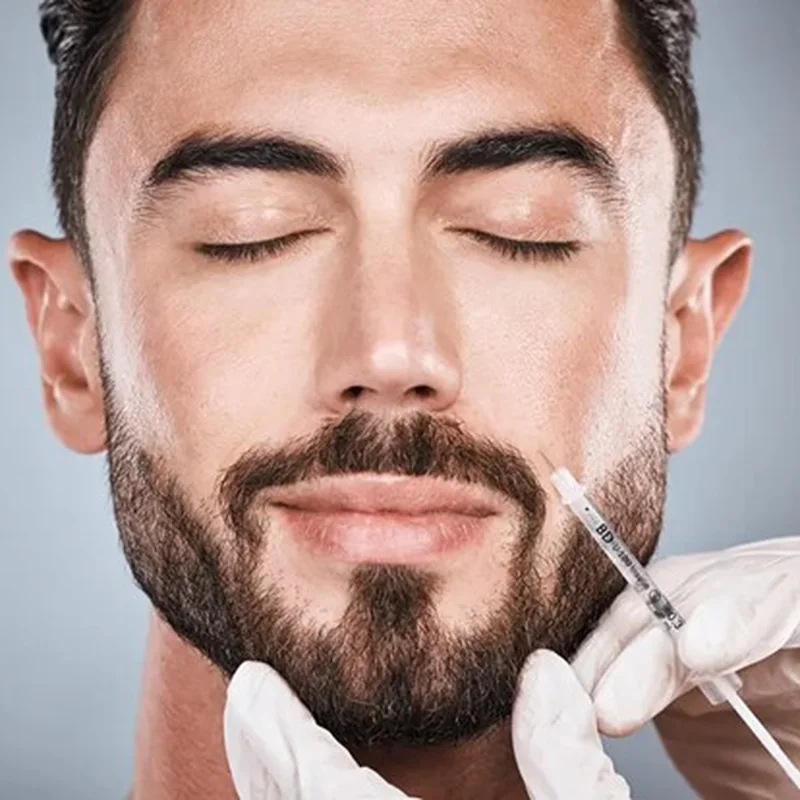
Male Facial Fillers in Abu Dhabi: The Complete Anatomy-First Guide
Quick Answer
Male facial fillers in Abu Dhabi are minimally invasive injectable treatments used to restore lost facial support, refine proportions and improve selected contours. In men, a plan may address under-eye hollows, cheeks, temples, brows, chin or jawline while preserving natural facial identity. Product choice, injection site and the decision not to inject depend on anatomy, skin quality, age-related change, medical history and risk, not a fixed number of syringes. Some sites, particularly the nose and periorbital region, carry important risks and may involve uses that are not FDA-approved. A qualified medical assessment is essential.
Reviewed for the website of Dr. Erfan Rahmani. This guide connects the anatomical approach in Rossi, Fitzgerald and Humphrey (2017) with patient-focused decision-making, risk communication and current regulatory cautions. It is educational and is not a substitute for in-person medical advice or a guide to self-injection.
What Male Facial Filler Can and Cannot Do
| Can potentially help | Cannot reliably do |
|---|---|
| Improve selected hollows and shadowing when volume loss is the cause | Reverse all skin laxity or replace a facelift |
| Improve chin-to-nose balance and jawline definition | Reduce bone size, remove excess tissue or correct an airway problem |
| Rebuild proportion gradually with carefully selected HA, CaHA or PLLA | Promise a permanent result or eliminate natural asymmetry |
| Support natural-looking male features when the plan is individualized | Make any high-risk facial site complication-free |
Why Men Are Choosing Non-Surgical Facial Rejuvenation
Men who ask about facial fillers usually describe concerns rather than a wish to look transformed: looking persistently tired, deepening under-eye hollows, a softer jawline or diminished facial volume. The source research cites treatment-naive men whose top concerns included tear troughs, crow's feet, forehead lines and submental fullness, and many simply wanted to look good for their age.
A successful result is often subtle: reducing a shadow that makes the eyes look fatigued, restoring continuity to the upper cheek, supporting an under-projected chin or softening a temporal hollow. Some men prefer a broader, more angular lower face; others a leaner contour. Neither is more correct, so the plan should follow your preferences, bone structure, heritage and expression.
Dr. Erfan Rahmani's approach, described at www.drerfanrahmani.com, starts by asking what is causing the unwanted appearance. An under-eye shadow caused by pigmentation or a bulging fat pad, for example, may not respond to added volume.
Understanding the Male Face: Anatomy and Proportion
Male and female faces overlap extensively, but group-level differences in skull, soft tissue and proportion can be clinically relevant. These are assessment cues, not rigid aesthetic rules, and individual and ethnic variation is substantial.
- Upper third: often a taller, wider, more posteriorly sloped forehead, a more pronounced brow ridge and a straighter brow close to the orbital rim.
- Middle third: a broader, flatter-based malar platform with more even medial and lateral projection. The goal is continuity from lower eyelid to cheek without an oversized cheek apex.
- Lower third: a broader chin, stronger anterior chin projection and more defined mandibular angle. Projection should be judged in profile and three-quarter views.
| Area | Commonly described male pattern | Clinical implication |
|---|---|---|
| Upper face | Broad forehead; posterior slope; prominent brow ridge; straighter lower eyebrow | Preserve brow character and avoid unwanted arching |
| Midface | Wider glabella and nasal bridge; relatively even medial/lateral cheek projection | Avoid excessive central cheek fullness |
| Lower face | Wider chin and jaw; stronger chin projection; defined mandibular angle | Reassess chin, jaw, lips and nose as one profile |
Important: these are population-level observations, not universal standards of attractiveness. Ethnicity, anatomy, gender identity, style and your goals take priority.
How the Aging Male Face Changes
Facial aging affects skin, fat compartments, retaining ligaments, muscles and bone. Male skin is generally thicker and has less superficial fat in several regions, and sun exposure, smoking and inconsistent photoprotection add pigment change, roughness, laxity and wrinkles. Different regions age at different rates: temples hollow, the lid-cheek junction becomes more distinct, and lower-face fullness descends into the jowl. A weak-looking jawline may reflect both reduced structural definition and soft-tissue descent, which is why the whole face is assessed before deciding which area, if any, needs treatment.
What a High-Quality Consultation Includes
- Medical history: previous fillers (brand and date), hyaluronidase, surgery, threads, trauma, dental work, infections, allergies and medication.
- Facial analysis: standardized frontal, profile and three-quarter photos at rest and in expression.
- Tissue assessment: skin texture, pigmentation, laxity, fat pads, skeletal projection, muscle activity and asymmetry.
- Aesthetic objective: restoration versus enhancement, and obvious versus nearly imperceptible change.
- Product and risk discussion: suitability, material, reversibility, high-risk sites, swelling and emergency preparedness.
- A realistic plan: stages, review intervals, indicative cost after examination and a clear route for urgent advice.
Sometimes the most natural intervention is small and targeted, sometimes another region should be treated first, and sometimes the right decision is not to inject at all.
Filler Materials Explained: HA, CaHA and PLLA
G-prime (G′) describes a gel's resistance to deformation. Higher G′ is associated with greater structural projection, while more flexible gels smooth soft-tissue transitions. Cohesivity describes how well a gel holds together. The highest number is not automatically the safest or most natural option.
Hyaluronic acid (HA) gels vary in firmness, spread and water attraction, and can generally be treated with hyaluronidase when clinically appropriate. This is meaningful for first-time patients but does not guarantee prevention or reversal of ischemia or visual injury. Calcium hydroxylapatite (CaHA) offers structural contouring plus collagen stimulation, but cannot be dissolved by standard hyaluronidase. Poly-L-lactic acid (PLLA) is biostimulatory and works gradually over a series of visits, so it is not suited to delicate lower-eyelid correction.
| Category | Typical role in an individualized plan | Important limitation |
|---|---|---|
| HA gel | Focused volume restoration, contour refinement, structural support depending on formulation | Swelling, migration, nodules and vascular injury remain possible; duration varies |
| CaHA | Selected structural augmentation and collagen stimulation | Not HA-reversible; inappropriate for fine superficial or periorbital concerns |
| PLLA | Gradual restoration of selected diffuse volume loss | Delayed result, multiple visits, risk of nodules; no instant sculpting |
Under-Eye Hollows and Tear Troughs in Men
Looking tired despite adequate sleep is one of the most common male concerns. Dark under-eyes can reflect volume loss, but also pigmentation, thin translucent skin, visible vessels or shadow from protruding fat. These look similar in photos yet need very different treatment.
The tear trough is not always an isolated hollow. Assessment should include the adjacent cheek, and in some faces supporting the midface changes how the tear trough looks. Men usually prefer a rested look without overcorrection. Too much volume, wrong product properties or superficial placement can cause persistent puffiness, irregularity or a bluish cast (the Tyndall effect). Significant bags, malar edema or loose skin may make you a poor candidate.
Male Cheek Fillers: Support Without Excess Roundness
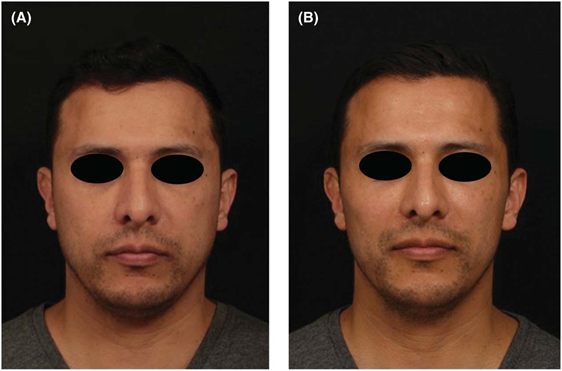
Male cheek rejuvenation does not mean building conspicuous cheekbones. Correction should preserve existing facial width and the natural transition into the infraorbital region. The ogee curve is the soft S-shaped contour across the cheek; in men its lower concavity is often flatter, so an overly projected apex can look unintended. The aim is proportional support, not maximum projection.
Historical landmark methods (Hinderer and Wilkinson) approximate the malar apex but are not injection templates, since real faces need three-dimensional assessment. Staged treatment suits cheek changes accumulated over years, and heavier sagging or jowling may need a different category of treatment rather than more volume.

Temple Hollowing and Brow Support
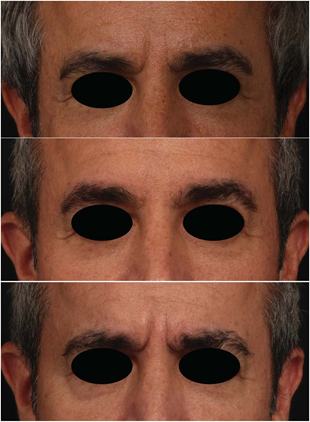
Temples become more concave with age, which can make a lean male face look gaunt. Male brows are often straighter and sit closer to the orbital rim, so raising the lateral brow too much can change the character of the face. Fillers change support and contour, while neuromodulators change muscle pull (for example corrugator and procerus). Neither treats significant redundant eyelid skin or functional brow ptosis.
The temple contains vessels and nerves in distinct fascial layers, including the superficial temporal artery, and their position varies. Any treatment must be justified by a clear benefit relative to risk, and a naturally slim or rugged temple may reasonably be left alone.
Male Nose Filler: Limitations and Exceptional Risks
Many men who feel their nose is too large are partly dealing with an under-projected chin, so side-view analysis of the nose, lip and chin should come first. Filler can add small amounts of contour support but cannot remove bone or cartilage, make the nose smaller or treat breathing problems. Reduction goals, functional obstruction or lasting change call for a discussion of surgical rhinoplasty.
Chin and Jawline Filler for Men: Proportion Before Volume
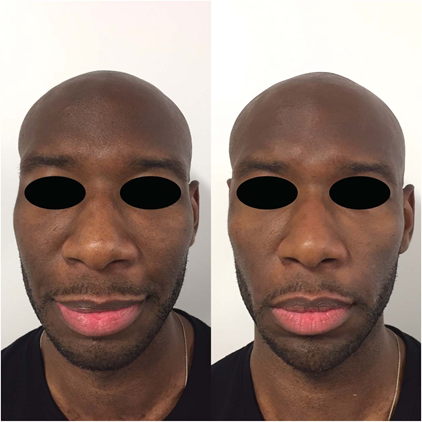
The chin prominence and posterior mandibular angle act as structural anchoring points for the lower face. Often an under-projected chin is the main reason the jawline lacks definition, and widening the rear jaw can add unnecessary bulk. The Riedel plane is a conceptual profile reference for lip and chin prominence, but ethnic and individual variation means no geometric ratio suits every face.
| Treatment focus | What it principally influences | Common misconception |
|---|---|---|
| Chin contouring | Projection, length, width and profile harmony | More chin filler always improves the face |
| Mandibular-angle contouring | Posterior lower-face shape and angularity | Every man needs a wider square jaw |
| Mandibular-body transition | Continuity from jaw to chin | Every irregularity is missing volume |
| Prejowl region | Selected hollows in front of a jowl | Filler lifts advanced jowling or excess neck skin |
With substantial skin laxity or heavy jowls, filler can make the face look heavier rather than lifted. Surgery or skin tightening may be more appropriate.
Male Lip Shape and Perioral Balance
Men rarely request lip augmentation by name, but lost lip definition, unbalanced upper and lower lips or a recessed chin can alter the whole profile. A subtle improvement may involve shape or hydration rather than forward projection, and mobile lip tissue needs different product decisions than a static cheek. No lip filler may be needed at all.
Why a Combined, Staged Plan Often Looks More Natural
A pan-facial strategy means examining how one region affects another, not injecting every region. Supporting a depleted lateral cheek can change the lid-cheek junction, improving chin projection can make the nose look less dominant, and restoring a deep temple hollow can reconnect the forehead and cheekbone outline. Staging lets swelling settle before deciding on further correction and allows adjustment for asymmetry, preference and budget.
| Main concern | Questions to resolve | Pathway to discuss |
|---|---|---|
| "I look tired." | Hollow vs bag, pigmentation, skin issues, midface support | Skin evaluation, cheek assessment, limited filler only if justified |
| "My face looks hollow." | Temples, cheeks, weight loss, symmetry | Measured restoration in selected structural areas |
| "My jaw is disappearing." | Projection loss vs jowling, laxity, neck fullness | Chin/jaw evaluation; tightening or surgery when relevant |
| "My nose looks too prominent." | True nasal size vs chin retrusion | Whole-profile analysis; surgical referral when indicated |
| "I want a fresher expression." | Brow position, muscle activity, photodamage | Neuromodulation, skincare, non-injectable options, limited filler |

Safety: Risks, Consent and Emergency Warning Signs
Every filler injection is a medical procedure. The most serious complication is unintentional intravascular injection, which can obstruct circulation and cause tissue injury, visual impairment, blindness or stroke. These events are uncommon, but some may be irreversible.
Common, usually temporary effects: swelling, redness, bruising, tenderness, mild asymmetry and firmness. Persistent under-eye puffiness, delayed nodules, granulomas, infection and contour change need separate assessment.
Hyaluronidase can break down HA filler and helps manage selected complications, but it does not reverse CaHA or PLLA the same way and cannot promise that tissue damage or blindness can be undone. Your clinician should have a documented emergency pathway and supplies before starting.
Precautions for Male Patients
- Thicker or oilier skin does not remove injection risk.
- Sunscreen and skincare may matter more than filler for texture or pigmentation.
- Previous filler can persist longer than expected, so disclose all past treatments.
- Avoid volume for its own sake around jowls or under-eye bags.
- Needles and cannulas both carry risk; neither replaces anatomical knowledge.
- Do not copy 2017 research doses; your anatomy, the product label and current standards decide.
Filler may be inappropriate with active infection, uncertain prior filler, severe edema, unrealistic expectations, planned surgery, label contraindications or unfavorable risk-benefit anatomy. Pregnancy and breastfeeding are usually reasons to postpone.
Filler vs Botox, Skin Tightening and Surgery
| Option | Main mechanism | Best discussion point |
|---|---|---|
| Dermal filler | Adds or restores localized volume and contour | Hollows, structural balance, selected projections |
| Botulinum toxin | Reduces activity of selected muscles | Dynamic lines, selected brow or lower-face muscle patterns |
| Energy-based tightening | Applies controlled energy to targeted tissues | Selected laxity or skin quality; results vary |
| Surgery | Repositions tissue or changes skeletal/cartilaginous structure | Substantial laxity, nasal reduction, major contour or functional issues |
A good consultation chooses the appropriate mechanism, not the most procedures.
Appointment, Recovery, Results and Maintenance
Before: prepare a medication and history list, disclose prior procedures and bring photos of your preferred look or your previous natural appearance. Never stop prescribed anticoagulants without your prescriber's approval, and ask exactly which material is planned and its risks.
During and after: volume and number of areas are tailored to you. Early swelling can mislead, so results are judged after settling and often at follow-up. HA can show immediate change, while biostimulatory products develop gradually. Seek urgent evaluation if any warning sign appears.
How long does it last? There is no universal duration. It varies with filler chemistry, region, volume, movement, metabolism and treatment history. HA effects are often described over months and sometimes longer, and CaHA and PLLA follow different timelines. A responsible clinic discusses variability and maintenance up front.
Cost in Abu Dhabi: price depends on areas treated, product, complexity, sessions and follow-up. A per-syringe price says little about value if the underlying problem hasn't been assessed, and research case volumes are not personal quotations. Dr. Rahmani's team provides individualized advice after consultation via www.drerfanrahmani.com.
Why Choose an Anatomy-First Assessment in Abu Dhabi?
Choose a physician on the quality of assessment, anatomical knowledge, respect for your identity, informed consent, product traceability and readiness to manage complications, not on a promotional image. Dr. Erfan Rahmani is an aesthetic physician in Abu Dhabi whose profile emphasizes medical training, facial harmony and individualized non-surgical care, including dermal fillers, chin and jawline contouring, cheek enhancement, under-eye evaluation and nasal filler limitations. The best male facial enhancement is not a standardized square jaw; it is an appropriate improvement for your individual face.
Book a Consultation with Dr. Erfan Rahmani
Frequently Asked Questions: Male Facial Fillers in Abu Dhabi
What are male facial fillers?
Injectable products that add or restore volume in selected facial tissues, such as the cheeks, chin or jawline. They do not replace surgery or treat every cause of facial aging.
Are fillers different for men and women?
The same material categories may be used, but assessment and endpoints differ. Men may prioritize straight brows, even cheek projection or chin-jaw balance, though goals are always individual.
Which filler is best for male jawline definition?
There is no single best product. Choice depends on anatomy, product labeling, tissue characteristics and reversibility preferences.
Can fillers make my face more masculine without looking artificial?
They can enhance selected structural features when the plan is proportionate. Avoiding excess width, overfilled cheeks and unnatural brow change matters as much as where support is added.
Can a man get natural-looking cheek filler?
Yes, in suitable cases. The goal is usually a broader malar platform and smoother lid-cheek transition, not round, highly projected cheeks.
Can filler help tired-looking under-eyes?
Only when the look is substantially due to correctable volume or contour deficit. Pigmentation, fat, edema and laxity need other approaches, and the area carries significant risk.
Can cheek filler improve tear trough shadows without direct under-eye filler?
Sometimes, by improving the lid-cheek transition, but it is not guaranteed and the cheek must genuinely need support.
Does temple filler make the face look younger?
It may soften a truly hollow, gaunt temple, but a lean temple can be a normal, preferred feature, and the area contains important vessels and nerves.
Is nose filler safe for men?
It carries risks of vascular occlusion, tissue necrosis and rare visual injury, and the US FDA does not approve nasal filler. Appropriateness must be judged by a qualified clinician under local rules.
Can nose filler make a large nose smaller?
No. Filler only adds volume and may camouflage contour irregularities or change how the profile looks.
Can chin filler improve my side profile?
It may, if under-projection is the cause of imbalance among nose, lips and chin. Significant skeletal or bite issues need separate evaluation.
Will jawline filler tighten loose skin?
No. Significant jowling or loose skin may not improve with filler and can become more prominent.
Do I need filler across my entire face?
Usually not. Assessing the whole face is not the same as injecting the whole face.
Is hyaluronic acid filler reversible?
Often, with hyaluronidase when appropriate, but reversal is imperfect and cannot reliably undo tissue injury or visual loss.
Are CaHA and PLLA the same as HA fillers?
No. Their onset, duration, uses and complication management differ from HA.
How much filler will I need?
There is no universal number. Published case volumes are not templates, and dose depends on in-person anatomy and product.
Will filler make my face look puffy?
It can with excessive volume, mismatched material or swelling-prone regions. A conservative plan reduces but does not eliminate this risk.
How long do results last in men?
It depends on product, site, movement and individual response, and no fixed duration can be guaranteed.
Can I combine fillers with Botox or skin tightening?
Sometimes, since they act through different mechanisms. The mix depends on whether the main issue is volume, muscle activity or laxity.
What are the most common side effects?
Swelling, redness, tenderness and bruising. Infection, inflammation, delayed nodules and asymmetry can also occur.
What symptoms after filler need emergency care?
Any visual change, sudden vision loss, double vision, stroke-like symptoms, severe unusual pain, or white, gray, blue, mottled or rapidly darkening skin.
Are cannulas always safer than needles?
No. Safety depends on training, anatomy, product, technique, patient selection and response to complications.
Can fillers correct a double chin?
Not directly. Submental fat, anatomy, laxity or posture drive it, and filler does not remove fat.
How do I choose a male filler doctor in Abu Dhabi?
Ask about licensure, anatomy training, consent process, product traceability, alternatives, high-risk site experience and emergency protocol.
Where can I learn more about Dr. Erfan Rahmani's approach?
Visit www.drerfanrahmani.com for treatment information and consultation options.