
Jawline Filler in Abu Dhabi : An Anatomy-Based Guide to Sculpting the Lower Face
Jawline filler in Abu Dhabi is most successful when it starts with anatomy, not a syringe count. This guide explains how the jaw angle, chin and pre-jowl each shape the lower face, what hyaluronic acid (HA) filler can and cannot do, and the safety questions to ask before treatment with Dr. Erfan Rahmani.
What does jawline sculpting with filler really mean?
A defined jawline is not a line of filler from ear to chin. It is the visible border created by the mandible, chin, facial fat, retaining ligaments, skin quality, neck contour and the way light falls across them. When these are balanced, the jaw looks continuous from the angle to the central chin. When they are not, you may see a recessed chin, an indistinct angle, a pre-jowl hollow or a jowl that interrupts the line.
Jawline sculpting uses injectable gels, commonly HA, to modify contour without repositioning bone or removing lax skin. It can enhance the mandibular angle, support an under-projected chin, or camouflage the hollow in front of a jowl. This is about proportion, not a "snatched jawline" for everyone.
Dr. Rahmani's patient education follows three steps: identify the anatomical cause, decide whether filler is appropriate, then choose a conservative, individual plan rather than a fixed checklist of injection sites.
Why does the jawline lose definition with age?
Facial ageing is layered. The mandible remodels, fat shrinks in some compartments and descends or bulges in others, and ligaments and skin offer less support. The mandibular septum separates soft-tissue compartments along the lower jaw; as support changes, jowl fat can descend and break a once-smooth border [1,2].
This creates a clinical paradox. Filler in a hollow beside a jowl can improve the transition, but filler placed into a bulky jowl can make it look heavier. A patient with advanced skin laxity may become fuller without being lifted. Good planning separates loss of support, descent, localised fat and excess skin before any injection.
The three anatomical subunits of lower-face sculpting
The framework described by Dr David Ong divides treatment into the angle of the mandible, the chin and the pre-jowl region. Each has a different aesthetic job and different structures to protect [2].
| Subunit | Main aesthetic question | Planning consideration |
|---|---|---|
| Mandibular angle (gonion) | Is the back corner of the jaw supported and proportionate? | Posterior jaw contour, preauricular volume, facial artery, parotid and facial nerve relationships |
| Chin (pogonion) | Is the chin projected, wide and long enough for this face? | Nose–lip–chin balance, vertical thirds, mentalis muscle, mental neurovascular bundle |
| Pre-jowl / mandibular line | Does a hollow interrupt the border before a visible jowl? | Camouflage the depression without adding bulk to the jowl; assess true laxity |
1. The mandibular angle: contour at the back of the jaw
The gonial region, where the ramus meets the body of the mandible, strongly influences the transition from cheek to neck. Research cites a mean female gonial angle near 125°, but this is an observation, not a target; many angles look harmonious [4–6]. A good endpoint is a clearer version of your natural architecture. The angle sits close to the masseter, SMAS, parotid gland, and the facial artery crossing the mandibular border, so treatment demands a trained medical professional with a complication plan.

2. The chin: projection, length and width
A chin can be short, under-projected, too broad or narrow, or asymmetric. A slightly retruded chin can make a proportionate nose look larger, while added width on a strong chin can make the lower face heavier. The patient's goal must be defined first. The mentalis muscle can cause a pebbled chin; botulinum toxin and HA filler are complementary but do different things, and not every deep mental crease can be corrected by injection alone.
3. The pre-jowl: restore continuity without enlarging the jowl
The pre-jowl sulcus is the depression between the chin and the start of a jowl. Filling it can create a smoother, longer border, but filler does not remove the jowl or tighten skin. The source article advises assessing the angle and chin first, then deciding whether the pre-jowl needs direct treatment, and never adding volume to an already prominent jowl. A hollow is a different target from a sagging fat pad.

Facial analysis before treatment
A thorough consultation reviews front, oblique and profile views at rest and in motion, ideally with standardised photographs. The cheek, temple, preauricular area, angle, chin, mental crease, masseter, submental tissue and neck are assessed as one system. Frameworks such as facial thirds and fifths and Ricketts' esthetic plane can flag disproportion but must never override ethnic diversity, skeletal variation or personal preference [7–9].
Your clinician should also ask about previous filler, surgery, dental or orthodontic work, bite problems, TMJ symptoms, medications, allergies, infection risk, pregnancy or breastfeeding, and prior complications. A true skeletal or bite discrepancy may need dental, orthodontic or maxillofacial assessment instead of large filler volumes.

Should the midface or preauricular area be assessed first?
Some lower-face concerns are partly driven by volume loss in the temples, cheeks or preauricular region. That does not mean every patient needs those areas treated. It means the injector should understand the whole face, explain all options and avoid defaulting to larger jaw volumes. For some patients, doing less is the most natural choice.
Choosing a hyaluronic acid filler for the jawline
HA gels differ in G′ (elastic modulus), cohesivity, viscosity and tissue integration. A firmer gel is not automatically better everywhere: layer, tissue thickness, mobility, required projection, lump risk, reversibility and product-specific indications all matter, and selection should follow current local labeling.
The 2018 source names Restylane Volyme, Lyft and Defyne as its author's preferred examples, with Princess Volume, Belotero Volume and Juvéderm Voluma as alternatives. These are historical examples, not endorsements or statements of approval or availability in Abu Dhabi. Ask your clinician: Which exact filler is proposed? Why is it suited to my anatomy? Is it HA-based and potentially reversible? What local regulatory authorisation applies? Who manages a complication?
The 2018 clinical technique and how to read it today
| Area | Reported method (2018) | Illustrative quantity | Qualification today |
|---|---|---|---|
| Mandibular angle | Subdermal cannula contouring; 25G × 5 cm cannula, 23G entry needle | 0.5–1 mL per side | Protect facial artery, facial nerve and parotid; no device or plane removes vascular risk |
| Chin | Periosteal support and/or subdermal contouring | 1–2 mL total | Mental neurovascular anatomy and skeletal/dental diagnosis govern candidacy |
| Peri-jowl | Subdermal camouflage beside the jowl; avoid a full jowl | 0.5 mL per side (1 mL total) | Camouflage only; volume is not a skin lift |
The mental foramen position varies, so textbook landmarks are not a guarantee. Too much chin projection or width can distort the smile and the whole lower-face profile.
Needle vs cannula, and the aspiration myth
Neither instrument is automatically safer. Cannulas can still enter vessels, and sharp needles carry their own hazards. The 2018 article recommends aspiration, but later literature shows false negatives, so a negative result never proves safety [11,12]. Current thinking stresses anatomical knowledge, low-pressure placement, small aliquots, continuous tissue monitoring and a clear response plan.
How filler sharpens the jaw without looking overfilled
Contour is an interplay of light and shadow. A supported angle defines the cheek-to-neck transition, subtle chin projection changes profile balance, and a small pre-jowl correction reconnects the line without enlarging the lower face. The best endpoint is not maximum visible filler; it is improved proportion without artificial widening, a heavy lower third or a rounded, inflated border.
Masculine, feminine and individual jawline goals
Searches such as "masculine jawline filler" or "V-shaped face filler" describe preferences, not biological rules. Some patients want a broader gonial region and angular chin; others prefer a softer, narrower transition. Neither should be imposed by gender, nationality or age. In Abu Dhabi's diverse population, photographs and conversation, not influencer templates, should guide the plan.
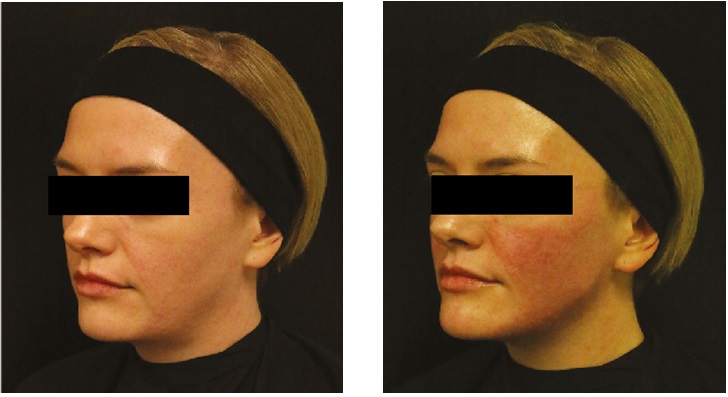
What do the original before-and-after photos show?
The source publication includes two cases. Case 1 reports Restylane Lyft 1 mL per angle side plus 0.5 mL per side for the chin. Case 2 reports 1 mL per side of Restylane Defyne at the angle, 0.5 mL per side of Restylane Lyft in the chin and 0.5 mL per side in the peri-jowl. These are Dr David Ong's 2018 cases, not outcomes from Dr. Erfan Rahmani, and individual results and risks vary.

What results can jawline filler realistically achieve?
Likely changes include a clearer angle, more chin projection, better continuity across a small pre-jowl depression, or improved balance with upper-face features. Filler cannot reliably remove excess skin, treat significant neck laxity, correct a major skeletal or bite problem, eliminate a large jowl fat pad or replicate a facelift. Early photos may reflect swelling, so a review after recovery is valuable.
Who is a suitable candidate?
Suitable candidates are adults with proportionate goals and mild-to-moderate chin or jawline deficiency, a recessed angle, a small pre-jowl hollow or soft-tissue asymmetry. A clinician may defer or decline treatment for an active skin or dental infection, an unresolved filler reaction, a major structural discrepancy, certain bleeding or immune considerations, pregnancy-related uncertainty or unrealistic expectations. Advanced jowling, marked neck skin excess or heavy submental fullness usually need a different discussion, because filler can make them look heavier.
Jawline filler safety: vessels, nerves and complications
Jawline filler is a medical procedure, not a simple beauty service. The facial artery near the mandibular border, chin vessels, the mental nerve and the parotid gland all demand careful planning.
Common short-term effects include swelling, redness, tenderness, bruising and temporary unevenness. Other risks include persistent nodules, delayed inflammatory reactions, infection, migration, allergy and an unsatisfactory or heavy result, which can sometimes appear later [11].
The most serious risk is injection into a blood vessel, causing vascular occlusion, skin necrosis and, rarely, visual impairment, blindness or stroke. Ultrasound, aspiration or a cannula cannot remove this risk. HA can often be dissolved with hyaluronidase, but that is not a guaranteed rescue. The clinic should have protocols, emergency supplies, trained staff and rapid escalation arrangements.
What a thorough consultation should cover
Expect a detailed history, a clear statement of your main concern (width, angle definition, projection, length or pre-jowl shadow), and optional standardised photos. You should receive plain-language information on the exact product, benefits, uncertainty, complications, staging, cost, alternatives and the emergency plan. Ask whether upper-face volume loss, dental alignment or a non-filler approach is relevant, and whether filler could make your face look wider.
What happens during the procedure?
After consent, the team cleanses the area, may photograph and mark landmarks, and discusses anaesthesia. Product, device, injection points and volume are chosen during examination, not from an online recipe. Expect pressure and brief discomfort. A careful clinician monitors colour, pain and symptoms throughout, and may stop or decline treatment if proceeding is not appropriate. You should leave with written aftercare and emergency contacts.
Downtime, settling and follow-up
Bruising and swelling are common, so avoid treatment right before major events. The jaw can look bulkier early on, and mild tenderness may last several days. Persistent or painful lumps need medical evaluation. Follow product-specific instructions, avoid massaging or pressing the area unless told to, and never self-treat possible vascular symptoms. A review visit can check symmetry and whether further treatment is needed.
How long does jawline filler last?
Duration varies with the formulation, location, tissue movement, metabolism, volume and any residual earlier filler. Top-ups should not be automatic, as accumulated material can lead to overfilling. Ask for the expected duration of the exact product proposed, the evidence behind that estimate, and how follow-up is scheduled.
Jawline filler vs chin filler, Botox, XERF, Endolift and surgery
The right option depends on the underlying problem. Masseter botulinum toxin may reduce muscle bulk in selected patients but can worsen lower-face laxity. XERF is an energy-based device that may suit skin-quality or mild laxity concerns, and Endolift is a minimally invasive laser procedure; neither replaces structural filler. Marked skin excess or a skeletal discrepancy may call for surgery or dental/maxillofacial input.
| Main concern | Modality to discuss | Important limitation |
|---|---|---|
| Recessed chin or small contour deficit | Chin and/or jawline HA filler | Adds volume; does not move bone or correct the bite |
| Mild pre-jowl depression | Selective pre-jowl contouring | Does not remove jowl fat or lift advanced laxity |
| Broad lower face driven by masseter | Masseter botulinum toxin (selected patients) | Can change lower-face support and may worsen jowling |
| Skin quality or mild laxity | Energy-based approaches such as XERF | Results vary; not an alternative to structural contouring for everyone |
| Pronounced jowls or excess skin | Surgical facial rejuvenation consultation | Non-surgical filler cannot recreate a facelift |
Jawline filler cost in Abu Dhabi
There is no honest universal price per jawline. Cost depends on the authorised product, number of areas, amount genuinely needed, clinician assessment, staging and the pre- and post-treatment care provided. Historical case volumes from 2018 should not be used as a pricing formula. Contact Dr. Rahmani through drerfanrahmani.com for an individual quote, and ask what is included, whether reviews are available and how complications are managed. A low price is no substitute for verified products and a trained medical provider.
Frequently asked questions about jawline filler in Abu Dhabi
What is jawline sculpting with filler?
A non-surgical technique using injectable filler, often HA, to modify lower-face contours. The angle, chin and pre-jowl are assessed separately.
Can jawline filler make my face look slimmer?
Sometimes, through better proportions and a continuous border. But filler adds volume, and widening the angle can make the face look broader. Front and profile views must be assessed.
Does jawline filler lift sagging jowls?
Not reliably. It can camouflage selected pre-jowl hollows but does not remove descended tissue or loose skin, and injecting a heavy jowl directly can emphasise it.
How is chin filler different from jawline filler?
Chin filler targets projection, width or length of the chin. Jawline filler can also define the posterior angle and the continuity of the mandibular border. Not everyone needs both.
Can men and women both have jawline filler?
Yes, with individual goals. Men with a true contour deficiency may want more angle or chin definition; many women prefer a smooth, subtle transition rather than added width. Plans should follow existing anatomy, not a gender template.
How many millilitres will I need?
There is no safe universal number. The 2018 volumes are case illustrations, not dosing advice. A medical assessment determines product and quantity.
Is jawline filler reversible?
Many HA fillers can be treated with hyaluronidase, but reversal is not always simple and cannot guarantee complication-free outcomes. Non-HA fillers may not dissolve.
Is it painful, and when can I return to work?
Expect pressure or stinging, managed with anaesthetic strategies that vary by clinician. Many people resume normal activity quickly, but swelling or bruising may occur. Severe or unusual pain needs immediate assessment.
What are the most serious risks?
Vascular occlusion leading to skin necrosis and, in rare reported cases, visual injury or stroke. Experienced technique and an emergency plan reduce but never eliminate risk.
Is a cannula completely safe, and is aspiration reliable?
No to both. Needles and cannulas each have limits, and a negative aspiration never rules out intravascular placement.
Can filler fix asymmetry or a double chin?
It may improve selected soft-tissue asymmetries but not skeletal, dental or muscular differences. It does not remove submental fat and may add heaviness if fullness or laxity is the issue.
When will I see the final result?
Shape changes may show immediately, but swelling distorts early results. A follow-up visit helps judge the settled outcome.
How do I choose a provider in Abu Dhabi?
Choose a licensed, trained medical practitioner who explains anatomy, realistic outcomes, complications, product details, emergency procedures and alternatives. Avoid promises of risk-free treatment or guaranteed results.
Can XERF or Endolift replace jawline filler?
Not universally. They target different tissues through different mechanisms and suit selected indications.
Visit drerfanrahmani.com for consultation and location details. This guide is educational and does not replace an in-person examination by a qualified clinician.