
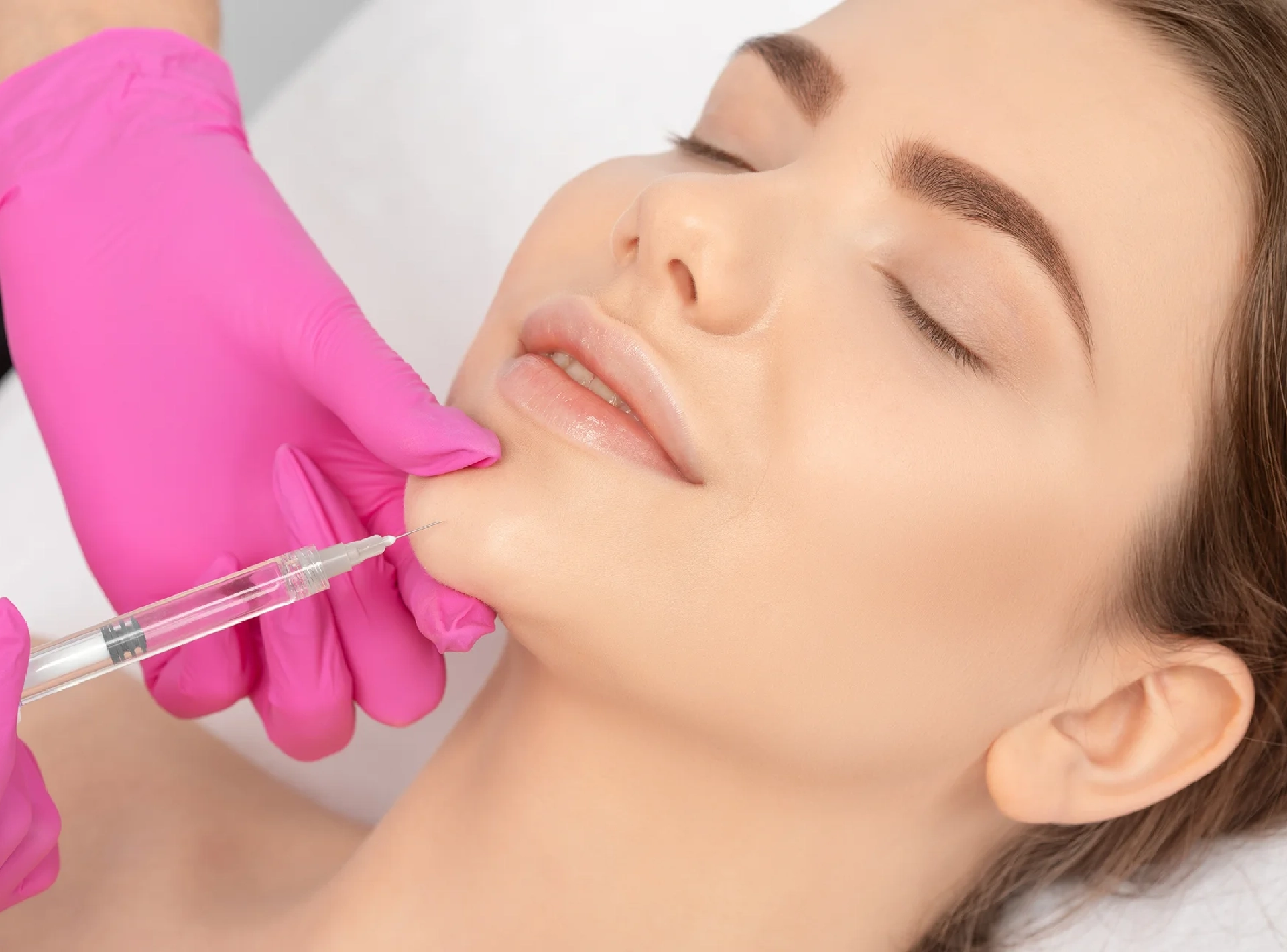
Jawline Filler in Abu Dhabi: A Complete Guide to Nonsurgical Jawline Rejuvenation
A sharp, balanced jawline is strongly associated with facial youth and proportion in both women and men. With aging, however, the lower face changes at several levels at the same time: bone support decreases, fat compartments reposition, soft tissues descend and skin laxity becomes more visible. The result may be jowling, a less distinct mandibular border, deeper marionette lines and loss of the smooth transition between the chin and jawline.
Nonsurgical jawline rejuvenation with injectable fillers aims to restore support and contour without surgery. The clinical review supplied for this article emphasizes that safe, effective treatment depends on regional anatomy, patient selection, gender-specific aesthetic goals (see male vs. female jawline design) and a realistic understanding of what filler can — and cannot — achieve.
- Why does the jawline lose definition with age?
- Evaluation before jawline filler
- Male vs. female jawline filler
- What types of fillers can be used?
- Can jawline filler treat jowls?
- Jawline filler vs. chin filler
- Jawline filler risks and safety
- Can it be combined with other treatments?
- What should patients in Abu Dhabi look for?
- What results can jawline filler create?
- Who may not be an ideal candidate?
- Frequently asked questions
Why Does the Jawline Lose Definition With Age?
Facial aging is not simply a skin problem. It is a three-dimensional process involving the skeleton, fat compartments, retaining ligaments, muscles and skin. In the lower face, age-related mandibular resorption together with downward movement of superficial facial fat contributes to blunting of the jawline, formation of jowls and more prominent marionette lines.
Muscular forces also matter. The depressor muscles and platysma continue to exert downward pull while the bony platform beneath them gradually changes. This is why effective lower-face rejuvenation often requires an assessment of structure, volume and laxity — see the evaluation criteria below — rather than a single isolated injection point.
Evaluation Before Jawline Filler
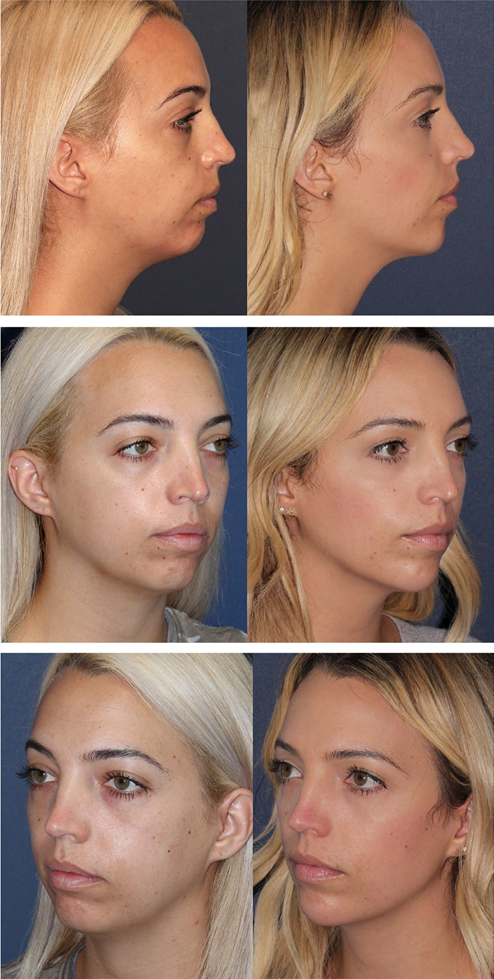
A high-quality jawline consultation should assess the whole lower face in an upright position, at rest and during facial movement. The source recommends special attention to the mandibular angle, jawline continuity, chin projection and length, prejowl sulcus and marionette region.
- Mandibular angle prominence and symmetry
- Chin projection, width and vertical length — see jawline filler vs. chin filler
- Prejowl hollowing and jowl position
- Skin quality and degree of laxity
- Masseter width and lower-face shape
- Existing facial asymmetry
- Male versus female facial proportions
- Whether filler alone is likely to meet the patient's expectations
Male vs Female Jawline Filler: The Design Should Be Different
The ideal male and female lower face are not identical. A masculine jaw is generally wider, more angular and more prominent, while an aesthetically balanced female face typically preserves a relatively wider upper-face-to-lower-face proportion rather than creating excessive bigonial width.
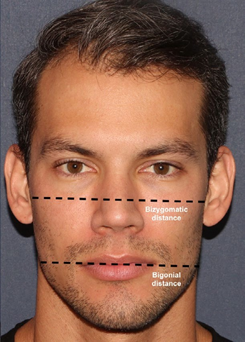
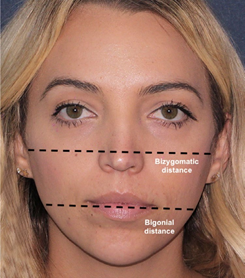
For women, overfilling the masseteric or mandibular region may create unwanted squareness or masculinization. In men, greater angle projection and lower-face width may be intentional. This is why gender, facial width, chin shape and overall skeletal proportions should guide the plan, using the filler options below best suited to structural goals.
What Types of Fillers Can Be Used for Jawline Rejuvenation?
The supplied review discusses hyaluronic acid (HA), calcium hydroxylapatite (CaHA), poly-L-lactic acid (PLLA) and autologous fat as options used in lower-face rejuvenation. For structural jawline work, the authors specifically discuss HA and CaHA products because of their ability to provide support and contour.
| Material | Main Strength | Useful When | Key Consideration |
|---|---|---|---|
| Hyaluronic Acid (HA) | Structural contour and adjustability | Definition, chin-jawline balance, targeted volume | Product rheology and reversibility vary by product |
| Calcium Hydroxylapatite (CaHA) | Firm structural support | Jawline definition and lower-face support | Requires careful patient selection and technique |
| PLLA | Biostimulatory volume support | Broader facial volume restoration in selected patients | Results are gradual rather than immediate |
| Autologous Fat | Volume restoration using patient's own tissue | Selected full-face or surgical-context rejuvenation | More invasive than office-based filler treatment |
Can Jawline Filler Treat Jowls?
Filler may improve the appearance of mild jowling when part of the problem comes from loss of structural support or a visible prejowl hollow. By restoring contour around the mandibular border, the transition can appear smoother.
However, filler does not remove excess skin. In patients with significant laxity, adding too much volume can make the lower face heavier rather than more defined. The source specifically notes that injectable jawline rejuvenation should not be expected to produce the same result as a surgical neck lift or facelift.
- Mild structural deficiency → filler may be useful.
- Prejowl hollowing → carefully placed structural support may improve continuity.
- Significant skin laxity → energy-based treatment or surgery may need to be discussed.
- Heavy lower face or advanced jowling → simply adding filler may not be the best strategy (see who may not be an ideal candidate).
Jawline Filler vs Chin Filler
The chin and jawline work as one aesthetic unit, but they solve different problems. Chin filler primarily changes anterior projection, width, length and profile balance. Jawline filler is used to improve the mandibular border, jaw angle and continuity between the chin and posterior jaw.
Jawline Filler Risks and Safety
Common temporary effects described in the source include redness, bruising, tenderness and swelling. Less common complications include infection and delayed granuloma formation. The most important rare complications are related to unintended vascular injection or injury to nearby structures.
The review highlights the facial artery and vein, marginal mandibular nerve, parotid gland and parotid duct as structures that deserve particular attention during lower-face treatment. Vascular occlusion can cause ischemic injury and requires urgent recognition and management.
| Category | Examples | Why It Matters |
|---|---|---|
| Expected / temporary | Swelling, tenderness, redness, bruising | Usually self-limited |
| Uncommon | Infection, inflammatory nodule or granuloma | Requires medical assessment |
| Rare but serious | Vascular compromise / tissue ischemia | Needs immediate recognition and treatment |
| Anatomy-related | Parotid or nerve injury | Highlights the importance of expert anatomical knowledge |
Can Jawline Filler Be Combined With Other Treatments?
Yes. The supplied review notes that lower-face contouring can be combined with other noninvasive modalities when the problem includes more than volume loss. Depending on the patient, a comprehensive plan may address muscle activity, skin laxity and tissue quality alongside filler.
- Neuromodulators for selected muscular contributors
- Radiofrequency-based treatments for skin laxity in suitable patients
- Ultrasound-based treatments for selected tightening indications
- Other facial filler areas when global facial balance requires them (see chin and jawline balance)
Jawline Filler in Abu Dhabi: What Should Patients Look For?
For patients searching for jawline filler in Abu Dhabi, the most important differentiator is not simply the brand of filler. A safe, natural result depends on facial assessment, lower-face anatomy, correct patient selection and a treatment plan that respects individual proportions.
- A medical consultation before treatment
- Assessment of the face from front, oblique and profile views
- A plan that differentiates male and female facial goals
- Clear discussion of filler limitations when skin laxity is significant
- Knowledge of lower-face vascular and parotid anatomy — see risks and safety
- A complication-management pathway and appropriate follow-up
What Results Can Jawline Filler Create?
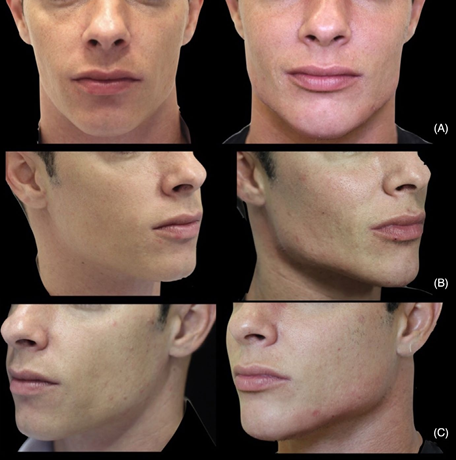
In suitable patients, nonsurgical jawline rejuvenation may create a straighter mandibular border, improved jaw-angle definition, a smoother transition around the prejowl region and better balance between the chin and lower face. Results should remain proportional to the rest of the face rather than creating an isolated, overprojected jaw.
Who May Not Be an Ideal Candidate for Filler Alone?
Patients with marked skin laxity, very heavy jowls or expectations equivalent to surgical lifting may not be ideal candidates for filler-only treatment. The source emphasizes setting realistic expectations and discussing combination or surgical options when appropriate.
- Advanced lower-face skin laxity
- A very heavy or already wide lower face where added volume could worsen contour
- Expectation of a surgical lifting effect from injections
- Anatomical or medical factors that make injectable treatment unsuitable
- Active infection or other temporary contraindications identified during medical assessment
Frequently Asked Questions About Jawline Filler
Is jawline filler good for a weak jawline?
It can be useful when a weak-looking jawline is related to limited mandibular definition, mild structural volume deficiency or prejowl hollowing. The entire lower face should be assessed before deciding where filler is needed.
Is jawline filler the same as chin filler?
No. Chin filler changes chin projection, width or length. Jawline filler focuses on the mandibular border and angle. They are often evaluated together — see jawline filler vs. chin filler — because the chin strongly affects lower-face balance.
Can filler remove jowls?
Filler can camouflage mild jowling in selected patients by improving support and the prejowl transition, but it does not remove excess skin and cannot replace a facelift in patients with substantial laxity. More detail is in can jawline filler treat jowls.
What filler is used for jawline contouring?
The source review discusses hyaluronic acid, calcium hydroxylapatite, poly-L-lactic acid and autologous fat. HA and CaHA are specifically discussed as structural options for jawline support — see the filler comparison table.
Is jawline filler different in men and women?
Yes. Male treatment often aims for greater width and angularity, whereas female treatment usually aims to preserve a narrower, more tapered lower face and avoid unwanted masculinization. See male vs. female jawline filler.
Is jawline filler painful?
Temporary tenderness and swelling can occur. Pain experience varies with product, anatomy, technique and individual sensitivity.
Is jawline filler safe?
It can be performed safely in appropriately selected patients by medically trained practitioners with detailed anatomical knowledge. However, fillers have uncommon and rare complications, including vascular injury, so emergency preparedness is important. See risks and safety.
Can jawline filler replace surgery?
No. Injectable filler may improve contour and support in selected patients but does not reproduce the tissue lifting or skin removal achieved with surgery.
How much jawline filler do I need?
There is no universal syringe number. Treatment amount depends on facial size, jaw angle, chin projection, prejowl hollowing, asymmetry and whether the goal is subtle rejuvenation or stronger structural contour.
What should I ask during a jawline filler consultation in Abu Dhabi?
Ask whether your concern is primarily bone structure, volume loss, jowling or skin laxity; which areas need treatment; what result is realistically achievable; what complications are possible; and what follow-up plan is available. See what patients in Abu Dhabi should look for.