

HIFU for Upper Arm Skin Tightening in Abu Dhabi: What the Evidence Really Shows
Quick answer: HIFU (high-intensity focused ultrasound) may improve mild-to-moderate upper-arm skin laxity by delivering focused energy at a selected tissue depth. A small five-patient study reported measurable circumference changes and visible tightening 90 days after one session. The evidence is preliminary, and the protocol cannot be generalized to every patient or device.
Loose skin under the upper arms is one of the harder aesthetic concerns to treat without surgery. The area can combine skin laxity, variable fat thickness, age-related collagen loss and changes after weight fluctuation. Because surgery leaves a scar and requires recovery, interest in non-surgical tightening has grown. One published clinical report evaluated HIFU for upper-arm laxity using a deep body transducer in five patients.
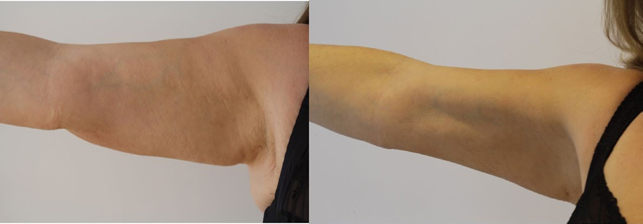
Five patients do not prove HIFU works for everyone. What the report does give us is a concrete protocol, measurable 90-day changes, before-and-after photography, patient and physician assessments, and a safety follow-up. Used carefully, it helps set realistic expectations.
Can HIFU tighten loose upper-arm skin?
Yes, HIFU may improve selected cases of upper-arm skin laxity, but the available evidence is limited. In the five-patient report this article is based on, every participant showed clinical improvement at 90 days after a single treatment. The study was small, uncontrolled and used one device and one research protocol, so the result is preliminary, not universal.
| Parameter | Reported detail |
|---|---|
| Study type | Small clinical case series |
| Participants | 5 women |
| Age | Mean 62 ± 12.63 years (range 46–74) |
| Treatment area | Skin laxity under the upper arms |
| Device | Doublo-S (Hironic Co., Ltd) |
| Research transducer | 13 mm depth, 4 MHz, 2 J |
| Treatment exposure | Approximately 75 shots per arm |
| Anesthesia | None used |
| Treatment time | Approximately 30–45 minutes per arm |
| Primary efficacy visit | 90 days |
| Safety follow-up | 1 year |
| Main safety findings | Pain and erythema during treatment; transient redness; tenderness around 10 days; one delayed edema/erythema episode; no adverse effects observed at one year |
Why upper-arm laxity is difficult to treat
The underside of the upper arm can become lax for several reasons, and different causes do not respond the same way. Some patients have mainly loose skin. Others have a combination of laxity and subcutaneous fat. In more advanced cases, the amount of redundant skin may exceed what a non-surgical procedure can realistically correct.
The original study did not enroll patients with excessive skin laxity, so its results are most relevant to selected patients rather than to severe "bat wing" deformity or large amounts of loose skin after major weight loss. A consultation should separate four questions:
- How much true skin laxity is present?
- How much fat contributes to the contour?
- How thick is the tissue?
- Is the expected degree of tightening compatible with a non-surgical approach?
How HIFU works for skin tightening
HIFU delivers focused ultrasound energy to a predetermined depth instead of heating the whole skin surface evenly. The source paper describes micro-focused thermal injury within the dermis and superficial musculoaponeurotic tissue, followed by collagen denaturation and new collagen formation (neocollagenesis). In simple terms, the procedure creates controlled focal heating below the skin, which may lead to tissue contraction and remodeling over time.
This differs from a superficial peel or surface laser. Body treatments may use deeper transducers than the cartridges typically discussed for facial tightening. The paper used a 13 mm body transducer, so the results should not be extrapolated directly to every "HIFU" device marketed for arms.
Does HIFU also reduce fat in the arms?
The study's primary objective was laxity, not a formal fat-reduction trial. The discussion notes that HIFU can raise tissue temperature and may affect subcutaneous fat, but no imaging or dedicated method was used to quantify fat-volume change. The safest reading is that the paper supports tightening and contour improvement, not a precise claim about fat destroyed.
What the five-patient study actually did
Five women with under-arm laxity were treated by a single physician without topical anesthesia. The authors used a Doublo-S device with a 13 mm, 4 MHz, 2 J transducer and delivered approximately 75 shots to each arm. Ultrasound gel was applied, the transducer was pressed firmly and perpendicularly to the skin, and successive shots were moved horizontally by about 3–5 mm. Treating the lax area of one arm took roughly 30–45 minutes.
The investigators marked and measured the upper-arm area before treatment and again at day 90, and took standardized photographs at both points. A dermatologist who did not perform the procedures reviewed randomized before-and-after photographs using the Investigator Global Aesthetic Improvement Scale (IGAIS). Patients graded satisfaction on the Subject Global Aesthetic Improvement Scale (SGAIS), and pain was recorded on a 0–10 visual analog scale (VAS).
Study-specific exclusion criteria
- Open wounds or active skin lesions in the treatment area
- Excessive upper-arm skin laxity
- Metallic implants
- Previous aesthetic procedure in the treatment area
These are the exclusions used in this publication. They are not a complete universal contraindication list for all modern HIFU systems.
Results at 90 days: what changed?
All five participants showed clinical improvement according to physician and patient assessments. Measured change was reported for all ten treated arms. Six arms fell into the study's "50% improvement" category, corresponding to a measured decrease of about 0.6–1.5 cm, while four arms fell into the "75%" category, corresponding to about 1.6–2.5 cm.
These percentage labels were categories the investigators created from measured differences. They do not mean the skin became "50% tighter" or "75% tighter." For patient communication, the centimeter ranges are more meaningful.
| Patient | Age | Right arm change | Left arm change | IGAIS (R / L) | SGAIS | Pain (VAS) |
|---|---|---|---|---|---|---|
| 1 | 50 | 1.75 cm | 2.0 cm | 3 / 2 | 4 | 6–7 |
| 2 | 70 | 1.0 cm | 1.5 cm | 2 / 1 | 3 | 6–7 |
| 3 | 75 | 1.8 cm | 1.0 cm | 2 / 1 | 3 | 6–7 |
| 4 | 47 | 2.0 cm | 2.0 cm | 3 / 2 | 4 | 8–9 |
| 5 | 68 | 1.0 cm | 1.30 cm | 2 / 1 | 2 | 4–5 |
IGAIS = investigator assessment (right/left arm); SGAIS = patient satisfaction; VAS = pain score range. Consult the original publication for the authors' exact scale definitions.
How satisfied were the patients?
At 90 days, three patients described themselves as somewhat satisfied and two as satisfied. No participant was reported as "very satisfied." Visible improvement does not necessarily mean a dramatic or surgical-level transformation.
Pain, redness, swelling and tenderness
Pain was not a minor footnote. Every participant experienced pain and erythema during treatment, with VAS ranges of 4–5, 6–7 or 8–9 depending on the patient. Treatment without topical anesthesia proved feasible, but the discomfort was clinically meaningful.
Redness was transient and generally lasted about 2–3 hours. Tenderness was reported for roughly 10 days. One patient had edema and erythema on day 7 that resolved after oral medication. The authors did not observe treatment-related adverse effects during one year of follow-up.
Does that mean arm HIFU is risk-free?
No. A five-person series can identify common tolerability issues but is too small to define how often uncommon or rare complications occur. The absence of a complication in five people cannot prove it never happens. The authors themselves called for larger, controlled studies with longer follow-up.
Who may be a reasonable candidate?
Based on the population the authors studied, the strongest candidate profile is a patient with upper-arm skin laxity that is not excessive, who wants a non-surgical option with short downtime. The discussion frames these technologies for non-obese patients.
A clinical assessment should also determine whether the appearance is driven mainly by skin, mainly by fat, or both. If there is severe redundant skin, the study provides no evidence that HIFU can match surgical correction.
Who should not use this paper as proof of expected results?
- Patients with severe or excessive upper-arm skin laxity
- Patients expecting a scarless equivalent of brachioplasty (arm lift)
- Patients seeking a guaranteed centimeter reduction
- Patients assuming every HIFU machine and cartridge reproduces a 13 mm research protocol
- Patients reading the study as a dedicated fat-loss trial
When should results be judged?
The formal efficacy assessment was at 90 days. Collagen remodeling is a biological process, not an instant lift, so early tightness, swelling or redness should not be mistaken for the final result. Approximately three months is the most evidence-faithful checkpoint.
The authors followed patients for one year for safety but state they did not know how long the tightening itself lasted. A claim such as "results last one year" would go beyond what this report proved.
Is one session enough?
One session produced measurable and photographic improvement in this report, which supports the possibility that a single session can create a response in selected patients. It does not establish the ideal number of sessions, the retreatment interval, or whether repeat treatment improves outcomes. Those questions need larger controlled trials.
HIFU versus surgery, radiofrequency and other options
These approaches solve different levels of the problem. HIFU is non-surgical and aims to tighten tissue through focused thermal stimulation. Brachioplasty surgically removes redundant skin and can achieve a much larger correction in severe laxity, but involves an incision, a scar and surgical recovery. Because the HIFU study excluded excessive laxity, it should not be used to imply equivalence with surgery.
The source paper lists radiofrequency, laser-based treatments, cryolipolysis and nonthermal ultrasound as other non-surgical options but provides no head-to-head trial. A responsible comparison focuses on mechanism, depth, comfort, tissue composition and the patient's goal rather than a blanket "best device" claim.
| Approach | Primary concept | Potential advantage | Key limitation / question |
|---|---|---|---|
| HIFU | Focused ultrasound at a selected tissue depth | Non-surgical; focal deep energy | Outcome depends on device, anatomy and protocol; limited upper-arm evidence |
| Radiofrequency | Thermal stimulation using RF energy | Broad range of devices and depths | No head-to-head superiority established by this source study |
| Surgery | Excision of redundant skin | Can correct severe excess skin | Scar, anesthesia and surgical recovery |
| Fat-reduction procedures | Target adipose tissue rather than skin alone | Useful when fat drives the contour | May not adequately correct true redundant skin |
What this study does not prove
- That every patient will lose 1–2.5 cm in arm measurement
- That the reported improvement is permanent
- The ideal HIFU device, depth, energy or shot count for all patients
- Equivalence to a surgical arm lift
- Any imaging-confirmed arm-fat reduction
- Rare-complication rates, because the sample was only five patients
- That results are the same in men, younger patients, very high BMI patients or severe post-weight-loss laxity
Why the study is still useful
Small does not mean meaningless. The paper offers a clearly described body-HIFU protocol, objective arm measurements at 90 days, and transparent reporting of pain and short-term side effects. It works well as a hypothesis-generating report and a reminder that "non-invasive" does not mean painless or suitable for every degree of laxity.
Upper-arm HIFU in Abu Dhabi: how to approach a consultation
For anyone searching for HIFU upper-arm tightening in Abu Dhabi, the most useful consultation is not "How much is one session?" but an anatomy-first assessment. The clinician should determine whether the concern is true skin laxity, localized fat, loss of tissue support, or a combination, and treatment should follow that diagnosis.
A high-quality consultation should explain which device and focal depth are intended, why that depth suits your arm thickness, how discomfort will be managed, what improvement is realistic, and what alternatives exist if the laxity is too advanced for a non-surgical approach.
Questions to ask before treatment
- Is my main problem loose skin, fat, or both?
- Is my degree of laxity appropriate for a non-surgical treatment?
- Which HIFU device and focal depth will be used, and why?
- How do you protect deeper structures and control treatment depth?
- What discomfort should I expect during and after the session?
- When should I judge the result?
- What result would make you recommend surgery or another technology instead?
- How will you document the result: standardized photographs, measurements, or both?
HIFU is best understood as a tightening technology, not a scarless surgical arm lift. In suitable patients, the goal is gradual improvement in firmness and contour. The amount of change varies, and severe loose skin may need a different plan.
Frequently asked questions
Can HIFU tighten loose skin on the upper arms?
A small five-patient clinical report found visible and measurable improvement 90 days after one HIFU session. The evidence is preliminary, so HIFU should be considered for selected laxity rather than marketed as a guaranteed arm lift.
How many HIFU sessions are needed for the arms?
The source study used one session. It does not establish the ideal number of sessions or the best retreatment interval.
How long does upper-arm HIFU take?
In the published protocol, treating the lax area of one arm took approximately 30–45 minutes. Time can differ with device, area size and treatment plan.
Is HIFU for the arms painful?
Pain occurred in all five patients. Individual VAS ranges were generally moderate and in one patient reached 8–9. The study was performed without topical anesthesia.
What side effects were reported?
Transient erythema, tenderness and occasional edema were reported. Redness usually lasted about 2–3 hours and tenderness around 10 days. One patient had delayed edema and redness that resolved after oral medication.
When are results visible?
The study formally compared results at 90 days, which is the most evidence-based time point from this publication for judging treatment effect.
How long do the results last?
The authors followed patients for one year for safety, but they stated that the duration of the tightening effect was unknown.
Can HIFU replace an arm lift?
The study excluded excessive laxity, so it does not support HIFU as a substitute for surgery in severe redundant skin.
Does HIFU remove arm fat?
The paper discusses HIFU effects on subcutaneous tissue, but this study was designed around laxity and did not quantify fat loss with imaging. Fat-reduction claims should be kept separate from the tightening result.
Is the 13 mm setting right for everyone?
No. The paper reports a specific research protocol with a 13 mm body transducer. It should not be copied as a universal treatment setting.
Who was excluded from the study?
People with open wounds or skin lesions, excessive laxity, metallic implants, or a prior aesthetic procedure in the treatment area.
Was body HIFU FDA-approved in this paper?
At the time of the 2020 publication, the authors stated that HIFU for body laxity had not yet been FDA-approved. Regulatory status should always be checked for the specific device and current date.
Conclusion
HIFU can be considered a non-surgical option for selected upper-arm skin laxity, particularly when the goal is gradual tightening rather than removal of large amounts of excess skin. In the published five-patient study, one treatment produced measurable and photographic improvement at 90 days, while the main short-term issues were pain, transient redness, edema in one patient and tenderness lasting around 10 days.
The evidence is encouraging but preliminary. The key decision is not simply whether HIFU "works," but whether your anatomy, severity of laxity and expectations match what a non-surgical tightening procedure can realistically deliver.
Medically reviewed by: [Physician name, credentials]. Last reviewed: [date].