
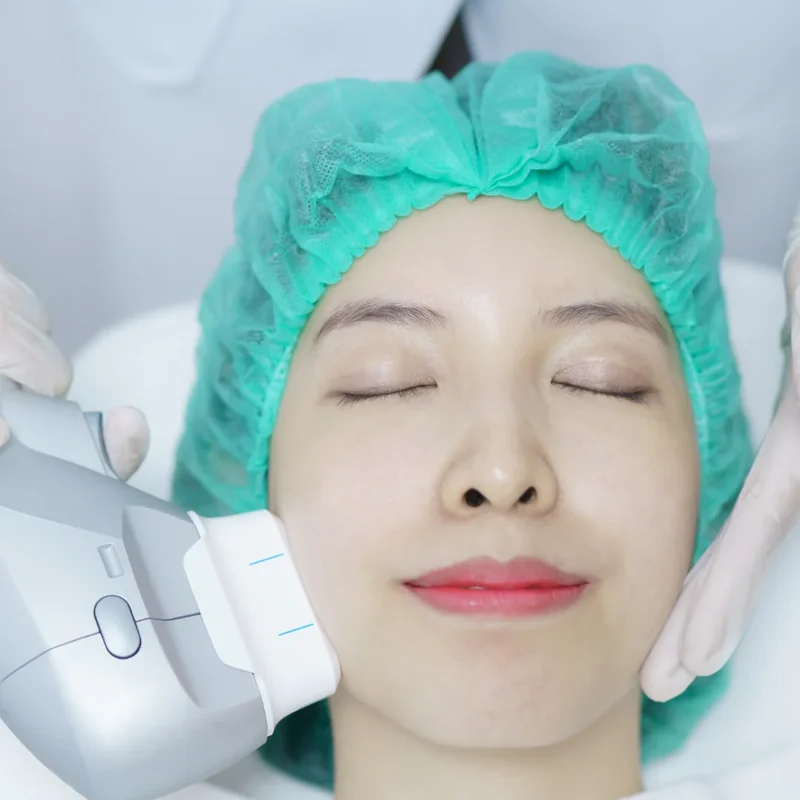
HIFU Skin Tightening in Abu Dhabi: The Complete Clinical Guide
Considering HIFU skin tightening in Abu Dhabi? This in-depth guide explains how high-intensity focused ultrasound works, what the research actually shows, who makes a good candidate, the risks to know about, realistic results and timelines, and how HIFU compares with Ultherapy, radiofrequency, Endolift and a surgical facelift. It is written for adults considering aesthetic skin-tightening treatment.
At a Glance : What Patients Should Know
HIFU skin tightening uses focused ultrasound energy to create controlled heating at selected depths below the skin surface. The body's response may stimulate collagen remodeling and produce a gradual, generally modest lifting or firming effect. For the best-studied microfocused ultrasound platforms, changes are commonly evaluated around two to three months, while tissue remodeling may continue afterwards.[1–4]
The strongest evidence concerns microfocused ultrasound with visualization (MFU-V). It must not be taken as proof that every device marketed as "HIFU" performs identically. Patients with mild-to-moderate skin laxity usually make better candidates than those with substantial excess skin. Redness, swelling, tenderness and discomfort can occur; uncommon but important risks include burns, pigment changes, unwanted fat loss and temporary nerve symptoms.[1–5]
In one sentence: HIFU is a non-incisional option for carefully selected people seeking incremental firmness and contour improvement, not a substitute for surgical removal of excess skin.
What Exactly Is HIFU Skin Tightening?
HIFU stands for high-intensity focused ultrasound. Unlike a skincare product that works mainly at the surface, a focused ultrasound device delivers acoustic energy into a defined treatment zone. Where the beam converges, some of that energy converts into heat. Controlled thermal effects may initiate tissue contraction and subsequent wound-healing responses, including new collagen formation and remodeling of the extracellular matrix. These effects are tissue- and device-dependent.[3–5]
In aesthetic practice, the terms HIFU, microfocused ultrasound (MFU) and microfocused ultrasound with visualization (MFU-V) are often used interchangeably in advertising, but they are not exact synonyms. MFU describes focused ultrasound intended for superficial aesthetic tissues. MFU-V additionally provides real-time ultrasound imaging to identify tissue planes and guide treatment. Separately, certain focused-ultrasound systems are designed mainly for body fat reduction. The distinction matters for safety, expected outcomes and published research.[1,3,4]
HIFU is often described as a targeted, non-surgical technique for facial and body rejuvenation. That is a fair broad description, but claims of universal effectiveness, permanent fat destruction or the absence of collateral injury are not supported by the evidence.
How Does Focused Ultrasound Stimulate Collagen?
Collagen is a principal structural protein of the dermis and connective tissue. With time, photodamage, intrinsic aging, and changes in facial volume and retaining structures, the skin and soft tissue may look less firm. The goal of microfocused ultrasound is not to replace lost facial volume; it is to promote a controlled remodeling response within appropriately selected tissue layers.
1. Focused acoustic energy and controlled heating
A transducer places acoustic energy at a predetermined focal depth. In the target zone, ultrasound waves produce localized heating rather than widespread surface abrasion. Device technology, coupling, energy settings and treatment precision determine whether the effect stays appropriately confined. The sometimes-quoted focal temperature of around 60–70°C applies to some MFU-V technology. It is not a patient-facing skin-surface temperature and not a universal setting for every HIFU device.[4,5]
2. Immediate contraction is not the same as mature collagen remodeling
Some patients notice early tightening or post-treatment fullness. Early impressions can reflect several mechanisms, including temporary swelling, and should not be treated as the final result. Collagen remodeling develops progressively over the following weeks and months. This is why standardized photographs taken after several months are more informative than photographs taken on treatment day.[1–3]
3. Heat-shock responses are a mechanism, not a guarantee
Heat-shock proteins, changes to the connective-tissue matrix and molecular reorganization under thermal stress are useful concepts in tissue-repair biology. But a plausible mechanism does not establish that a particular machine will erase wrinkles, regenerate elastin to a clinically meaningful degree, or achieve a specific percentage of lift in an individual patient. Clinical endpoints and high-quality human studies remain decisive.[1–3]
Which Skin Layers Are Treated, and What Is the SMAS?
The superficial musculoaponeurotic system (SMAS) is a fibromuscular connective tissue layer important in facial anatomy and surgical lifting. Some aesthetic ultrasound systems use transducers with nominal focal depths such as 1.5 mm, 3.0 mm and 4.5 mm, aiming at different dermal and subdermal planes. However, the tissue actually present at a given depth varies by individual, facial region, age, sex and previous procedures. A 4.5 mm target does not guarantee that the SMAS is reached safely or effectively at every location.[3–5]
Aesthetic ultrasound and a surgical facelift are fundamentally different. A surgeon can reposition tissue and remove redundant skin; ultrasound may trigger tightening without an incision but cannot reproduce surgical dissection, repositioning or skin excision. "SMAS-level treatment" should never be taken to mean "the same result as a SMAS facelift."[2,3]
How Effective Is HIFU? What Current Clinical Research Shows
The most informative assessments are systematic reviews, not individual promotional photos. They generally support some improvement in skin laxity for selected patients, while noting differences in devices, protocols, follow-up length, assessment tools and study quality.[1–3]
The 42-study MFU-V meta-analysis
A systematic review and meta-analysis in Aesthetic Surgery Journal included 42 studies. Across the groups contributing to those analyses, 89% were judged by investigators to have some degree of global aesthetic improvement, 84% of participants assessing themselves reported improvement, and 84% reported at least some satisfaction. The pooled average procedural pain score was approximately 4.85 out of 10. The authors cautioned that heterogeneity and the handling of neutral responses could inflate estimates. These figures describe specific study populations; they do not mean 89% of every clinic's HIFU patients will see a visible facelift.[1]
A 2025 comparative review: HIFU vs radiofrequency
A 2025 systematic review of microfocused ultrasound for sagging skin included 12 studies and 475 participants, with only two randomized studies eligible for quantitative comparison of neck tightening with radiofrequency. No statistically significant difference between HIFU and radiofrequency was found at short-, medium- or long-term follow-up. The review considered HIFU promising but called for larger, better-standardized studies. The claim that HIFU is categorically superior to radiofrequency is therefore not supported.[2]
An earlier 16-study review
A review of 16 facial-tightening studies found measurable but generally small changes in eyebrow and submental outcomes and emphasized the importance of mild-to-moderate laxity. It also highlighted gaps in long-term durability, objective measurement and representation of male patients. Some benefits were seen up to one year, but reliable long-term comparative evidence remains limited.[3]
Evidence snapshot
| Clinical question | What the evidence supports | What it does not establish |
|---|---|---|
| Does MFU-V improve mild-to-moderate facial laxity? | Improvement is reported in multiple human studies and reviews. | A guaranteed lift or uniform response for every person. |
| Does it work for jowls or the submental area? | Some improvement in jawline and submental appearance is plausible in selected patients. | Surgical correction of heavy jowls or marked neck redundancy. |
| Is HIFU more effective than radiofrequency? | Both can be reasonable skin-tightening modalities. | Reliable universal superiority of HIFU. |
| Is the treatment painless? | Most patients can complete treatment. | No pain: pooled evidence indicates moderate procedural discomfort. |
| Does every HIFU machine have Ultherapy's evidence? | Studies support particular technologies and protocols. | Interchangeability of all machines or identical regulatory indications. |
| Does it permanently destroy facial fat? | Certain energy settings and technologies can affect adipose tissue. | Safe, predictable and desirable permanent facial-fat removal as a standard outcome. |
Which Areas Can Be Considered for HIFU?
Forehead and eyebrow region
Some MFU-V systems have specific indications for lifting the brow. Suitable candidates may seek a subtle improvement in brow position or upper-face appearance. Treatment near the eye needs careful anatomical assessment; do not assume ultrasound should be delivered to the mobile eyelids or inside the orbital rim. Brow lifting is not a replacement for blepharoplasty when redundant eyelid skin is the main problem.[3–5]
Lower face, jowls and jawline definition
For early loss of jawline definition, ultrasound may improve the appearance of mild soft-tissue laxity. It will not correct pronounced jowling caused by complex tissue descent as comprehensively as a surgical lift. A good examination distinguishes skin laxity, facial fat, bone structure, volume loss and platysmal effects instead of labeling every concern "loose skin."[2,3]
Double chin and submental tissue
A double chin can reflect localized fat, skin laxity, muscle anatomy, a recessed chin, or a combination. MFU-V research and certain clearances support improvement in lax submental tissue. Skin tightening and fat reduction, however, are different goals. Promising every patient "permanent fat elimination" is clinically imprecise and potentially undesirable in a thin face.[3,4]
Neck and jaw–neck transition
The neck is a popular site for early laxity and loss of definition. Evaluation should identify heavy skin redundancy, marked platysmal bands, significant adiposity and thyroid-region anatomy, and sensitive structures must be avoided. Patients with substantial skin excess may get only limited benefit from device-based tightening and deserve an honest discussion of surgical options.[3–5]
Cheeks, under-eye region and facial volume
Improvements in texture and firmness are reported in some studies, but under-eye hollows, dark circles, tear-trough anatomy, true lower-eyelid bags and skin laxity are different diagnoses. HIFU is not guaranteed to remove dark circles or eye bags, and sensitive periorbital areas carry specific safety restrictions in device labeling.[4,5]
Body laxity: abdomen, arms, thighs, buttocks and cellulite
Some MFU-V evidence concerns body skin laxity, particularly the abdomen and arms, and the FDA's current Ulthera indication includes improving laxity of the abdomen and anterior/posterior arms. This is not the same as clearance for permanent fat removal from the waist, thighs, buttocks or cheeks. Ultrasound devices built for fat reduction exist, but their evidence and approvals must be evaluated separately. Cellulite reduction and "permanent destruction of fat cells everywhere" are overly broad claims.[4,6]
Who Is a Good Candidate for HIFU?
Candidacy depends more on the reason for laxity than on age. A person with mild-to-moderate tissue laxity, reasonable skin thickness, stable weight, realistic goals and no major contraindications in the treatment area may be more suitable than someone with severe loose skin, very thin facial fat pads, or expectations of a surgical transformation.[2,3]
Potentially suitable: adults seeking a gradual, nonsurgical improvement in mild brow, jawline, neck or appropriate body-area laxity, after an individual examination and review of prior fillers, thread lifts, surgery, active skin conditions and implanted devices.
Less likely to be satisfied: patients with very pronounced skin excess, major tissue descent, volume loss as the primary concern, unstable weight or unrealistic expectations. Very lean faces need careful risk-benefit evaluation because unintended fat reduction may worsen hollowness. It is not medically sound to promise benefit simply because someone is over 30, or to treat people under 30 preventively when laxity is not present.[3,5]
When Should HIFU Be Avoided or Postponed?
Contraindications and precautions are device-specific and must be checked against the manufacturer's current instructions for use. For the current Ulthera system, manufacturer material lists open wounds or lesions in the treatment area, severe or cystic acne in the area, and active or metallic implants in the area among contraindications. It also identifies precautions for treatment over dermal fillers, mechanical implants, keloids, anticoagulant therapy and other circumstances. Pregnancy, breastfeeding and pediatric use have not been adequately evaluated, so such patients should not be treated under a routine elective protocol.[4,7]
| Finding or circumstance | Clinical significance | Appropriate next step |
|---|---|---|
| Open wound, local infection, severe cystic acne | Device-specific contraindication at the treatment site | Postpone until evaluated or resolved |
| Pacemaker/defibrillator or metallic implant in the area | May be contraindicated under device labeling | Verify exact device IFU and implant location |
| Pregnancy or breastfeeding | Insufficient evidence for elective aesthetic treatment | Defer and discuss later |
| Dermal filler, threads, facial implants or prior surgery | Tissue planes and treatment interactions may differ | Detailed history, timing and device-specific review |
| Anticoagulant use or bleeding disorder | Bruising or hematoma risk may be relevant | Assess medically; never stop prescriptions independently |
| Active systemic disease, impaired healing, autoimmune disorder | Requires individualized risk evaluation | Seek clinician assessment, not automatic blanket exclusion |
| Very thin face or substantial prior fat loss | Potential risk of unwanted facial volume change | Consider an alternative or avoid treatment |
| Marked laxity or major jowls | May be an efficacy limitation more than a safety contraindication | Discuss surgical and alternative treatments |
Conditions often cited as exclusions, such as pacemakers, fillers, keloids, bleeding conditions, autoimmune disease, diabetes, epilepsy and Bell's palsy, deserve discussion with your clinician. True label contraindications differ from conditions needing individualized assessment, and a one-size-fits-all ban is not an adequate clinical decision rule.[4,7]
Is HIFU Safe? Side Effects, Uncommon Injuries and Warning Signs
With a properly selected device and a trained operator, effects are often transient, but non-invasive does not mean risk-free. Mild redness, swelling, sensitivity, tingling and treatment discomfort are relatively common. Bruising, temporary altered sensation and prolonged tenderness have also been described. A 2025 meta-analysis reported mostly mild-to-moderate events in its study populations; it cannot prove that serious events never happen.[1,3]
Uncommon or less well-characterized harms include burns, blistering, linear marks, pigment change, unwanted fat loss (lipoatrophy), and temporary sensory or motor nerve injury. A safety consensus and adverse-event review describes injuries involving the epidermis, fat compartment and nerves, and stresses anatomical knowledge, proper device coupling, visualization where available, patient selection and operator training.[5,8]
Seek prompt clinical assessment for: severe or escalating pain, unusual persistent redness, blistering or discoloration, new facial weakness or asymmetry, persistent numbness, or unexpected hollowing. New neurological or eye symptoms should not be dismissed as normal post-treatment soreness. Follow your clinician's evaluation and the device's adverse-event instructions rather than an internet "home reversal" protocol.[5,8]
Does treating a deeper layer guarantee a safer or stronger result?
No. Depth needs to match actual anatomy. Overtreating thin tissue or inadvertently exposing nerves and other vulnerable structures may cause harm rather than more lift. Anatomical variation, precise treatment mapping, appropriate coupling and evidence-based training matter at least as much as the nominal depth selected, particularly around the jawline, temples, orbital region and anterior neck.[5]
Does HIFU Hurt, and Is There Downtime?
Patients may feel brief prickling, heating, deep aching or sensitivity as energy is delivered. Pain varies by device, treatment site and individual. The pooled mean pain score of 4.85 out of 10 in MFU-V studies is a useful reality check against claims of "completely painless." Discomfort should be discussed beforehand, monitored during treatment and managed according to the clinician's plan.[1]
Many patients resume ordinary non-strenuous activities promptly because there is no incision or surgical wound. However, "zero downtime" can mislead if redness, bruising, soreness or swelling interferes with your plans. Allow for this when scheduling treatment before a major social or professional event.[1,3]
What Happens During a Professional HIFU Appointment?
A responsible appointment begins with diagnosis, not a machine setting. The clinician assesses skin quality, fat distribution, facial asymmetry, jawline and neck anatomy, medical history, medications, prior aesthetic procedures and your desired result. Standardized baseline photographs help compare outcomes over time. You should know which device is used, whether it offers tissue visualization, the exact treatment indication, and which areas are not appropriate.[4,5]
The clinician then prepares the area and delivers energy according to device-specific instructions and anatomical safety guidance. Power settings, focal depths, shot counts and passes depend on the machine, treatment area, tissue thickness and practitioner training, so no honest guide can prescribe universal values. Afterwards you should receive device-specific aftercare and be told which symptoms merit a call or examination.[4,5]
When Do HIFU Results Appear, and How Long Do They Last?
Many published aesthetic ultrasound studies assess improvement at around 90 days, and some follow participants to six months or one year. A gradual benefit developing over two to three months is a reasonable expectation, although change can continue later. An immediate impression should not be confused with fully remodeled collagen. Duration is not firmly established across devices and individuals.[1–3]
Clinics quote varied timelines, such as early change within 15–20 days, collagen reorganization at about 21 days, fuller results at two to three months, and final results at four months, with appointments of roughly 45 to 90 minutes. Treat these as illustrative estimates, not fixed biological milestones. Timing depends on your treatment plan and response.
How Many HIFU Sessions Are Needed?
No universal evidence-based rule says every patient needs three to six sessions or repeated treatment several times a year. Research protocols vary: some microfocused ultrasound studies assess a single treatment, while others include additional sessions, different regions or maintenance. Repeating treatment simply to meet a package quota can increase cost and exposure without necessarily improving results. A plan should be individualized and reviewed against clinical benefit.[1–3]
HIFU vs Ultherapy, Radiofrequency, Endolift and Surgical Facelift
| Treatment | Primary approach | Typical advantage | Important limitation |
|---|---|---|---|
| Generic aesthetic HIFU | Focused ultrasound delivered below the skin surface | No incision; potential gradual tightening | Performance varies across devices; may lack imaging and equivalent clinical evidence |
| Ultherapy / MFU-V | Microfocused ultrasound with real-time tissue visualization | Device-specific evidence, imaging and cleared indications | Cost, pain, dependence on anatomy; not a surgical facelift |
| Monopolar radiofrequency (e.g. XERF-type systems) | Controlled tissue heating by RF | Non-incisional tightening for appropriate cases | Different depth and thermal distribution; not inherently inferior to HIFU |
| RF microneedling | Needles deliver radiofrequency into the skin | Texture and scar goals plus tightening for selected patients | Needles, downtime and device-specific fat-loss risks |
| Endolift / subdermal laser | Optical fiber delivers laser energy beneath the skin | Physician-guided localized subdermal remodeling | Minimally invasive, with a different recovery and risk profile |
| Surgical facelift / neck lift | Tissue repositioning and removal of excess skin | Stronger correction for significant laxity | Surgery, recovery, scars and surgical risks |
Choose based on anatomy, goals, safety and clinician competence, not on a simplistic claim that a device "works on every skin layer" or has the strongest marketing. The head-to-head meta-analysis available in 2025 found no significant superiority of HIFU over RF in the limited neck-sagging comparison studied.[2]
Can HIFU Be Combined with Fillers, Biostimulators or Lasers?
Sometimes a combined plan is reasonable, because structural laxity, volume deficits, pigmentation, surface quality and dynamic wrinkles are different problems. But combination therapy is not automatically better: sequencing, tissue interactions, cost and cumulative inflammatory risk all matter. A 2025 systematic review of combined MFU-V and calcium hydroxylapatite found encouraging outcomes across small, heterogeneous studies while noting evidence limitations.[9]
Existing dermal fillers, facial implants and threads require treatment-specific review. Manufacturer instructions for a given MFU-V system may advise against treating directly over certain fillers or materials. Controlled evidence on how best to sequence HIFU with every injectable, microneedling session or laser is lacking, so avoid generic same-day combination promises.[4,7,9]
What to Ask Before Choosing a HIFU Clinic in Abu Dhabi
The best consultation is an informed medical assessment, not a sales pitch. Ask for the exact brand and model, whether ultrasound visualization is available, the clinician's training and licensing, the evidence for the proposed area, and what the clinic would do if a complication occurred. A careful clinic should explain why your laxity suits ultrasound and, equally, when another procedure would give a more meaningful result.[1,4,5]
People searching for "HIFU face lifting in Abu Dhabi," "jawline skin tightening Abu Dhabi," "Ultherapy vs HIFU" or "non-surgical neck lift Abu Dhabi" may be comparing procedures that use different technologies. Ask for the exact platform rather than assuming a generic HIFU appointment equals Ultherapy, Ultraformer, Liftera or another branded system. Device availability, authorization, clinician privileges and current services must be confirmed with the treating clinic directly.
Practical consultation checklist
- What part of my concern is excess skin, fat, anatomy or loss of volume?
- What improvement is realistic, and when would it be evaluated?
- What is the exact device model, and is this use within its relevant local labeling?
- Is tissue visualization included, and why is it or is it not needed here?
- Which prior fillers, implants, threads, surgery or medications change my risk?
- What discomfort, swelling, injury risks and costs should I expect?
- At what point should I consider a surgical consultation instead?
HIFU Skin Tightening FAQs
1. What does HIFU stand for?
HIFU means high-intensity focused ultrasound. In aesthetic treatment, focused ultrasound is used to create controlled energy effects below the skin to encourage tightening and tissue remodeling.
2. Is HIFU the same as Ultherapy?
No. Ultherapy is a particular MFU-V platform with real-time ultrasound visualization and device-specific studies and indications. The HIFU category includes other technologies that may not be equivalent.
3. Is HIFU a facelift without surgery?
It is a nonsurgical skin-tightening option, not the same procedure or result as a surgical facelift. It does not remove excess skin or surgically reposition deeper tissues.
4. What is the best age for HIFU?
There is no universal best age. Mild-to-moderate laxity, tissue thickness, anatomy and realistic goals matter more than an arbitrary age threshold.
5. Can HIFU tighten a double chin?
It may improve mild laxity under the chin, but a double chin can arise from fat, skin, muscle or skeletal anatomy. Treatment should be based on the actual cause.
6. Does HIFU remove jowls completely?
No treatment can be guaranteed to remove jowls completely. A mild jowl appearance may improve; substantial tissue descent may need a different approach.
7. Is HIFU effective for neck laxity?
Some clinical evidence supports improvement in selected patients with mild-to-moderate neck laxity, though outcomes vary and severe laxity often responds poorly.
8. Can HIFU lift eyebrows?
Certain specific MFU-V devices have cleared indications for brow lifting. The expected change tends to be subtle, and the orbital region requires careful safety precautions.
9. Can HIFU treat dark circles or eye bags?
Not reliably as a general promise. Pigment, vascular shadows, under-eye hollowing and prolapsed fat have different causes and often need different treatments.
10. Is it safe to treat directly over the eyelid?
Do not assume it is safe. The Ulthera instructions advise against energy delivery to the eyes, eyelids and within the orbital rim. Device-specific rules always apply.
11. Does HIFU stimulate collagen?
Focused thermal effects can stimulate a tissue-repair response associated with collagen remodeling, although the magnitude and visible outcome differ among patients and devices.
12. Does HIFU regenerate elastin?
Elastin-related remodeling is discussed mechanistically, but claims of predictable, clinically meaningful elastin regeneration need stronger direct evidence than marketing brochures provide.
13. When will I see the result?
Many patients are evaluated at two to three months. Some changes may be noticed earlier and some may evolve later, but timing is not guaranteed.
14. Are the results permanent?
No. Natural aging continues. Published follow-up varies, and there is no single evidence-based permanent-duration claim across all HIFU devices.
15. How many treatments are needed?
It depends on the device, anatomy, clinical objective and response. Do not assume everyone needs three to six sessions or frequent maintenance.
16. Is HIFU painful?
It can cause moderate discomfort. A pooled MFU-V analysis reported an average procedural pain score around 4.85/10, with wide variability.
17. Is there downtime after HIFU?
Many people resume routine activities promptly, but redness, tenderness or swelling may be noticeable for a period afterwards.
18. Can HIFU cause burns?
Yes. Burns and other thermal injuries are uncommon but recognized complications, especially with poor coupling, inappropriate technique or insufficient anatomical knowledge.
19. Can HIFU damage facial nerves?
Temporary numbness or weakness has been reported. Qualified operators should follow device-specific anatomy and safety precautions.
20. Can HIFU cause unwanted facial fat loss?
Unwanted fat-compartment injury or atrophy has been reported. Risk assessment matters especially in people with thin faces or limited soft-tissue volume.
21. Is HIFU safer than surgery?
It avoids incisions and general surgical recovery in many cases, but that does not make it risk-free or equivalent in benefit. The right choice depends on the correction you want.
22. Does HIFU work on darker skin tones?
Because it is not a pigment-targeting surface laser, some ultrasound platforms can treat a broad range of skin tones, but safe use still depends on device specifications and clinical assessment.
23. Does HIFU work for very loose skin?
Outcomes tend to be less impressive when skin redundancy or tissue descent is marked. A surgical evaluation may be more suitable.
24. Is HIFU better than radiofrequency skin tightening?
Not categorically. A 2025 evidence review found no significant differences between HIFU and RF in the limited randomized neck-tightening comparison available.
25. What is the difference between HIFU and Endolift?
HIFU delivers focused ultrasound without placing a fiber under the skin, while Endolift is a minimally invasive subdermal laser-fiber procedure. Their candidacy and risks differ.
26. Can HIFU eliminate cheek or buccal fat permanently?
That is not an appropriate blanket claim for facial skin-tightening HIFU. Deliberate facial fat reduction may produce contour problems or premature hollowness in some patients.
27. Can HIFU treat cellulite?
Certain ultrasound technologies are studied for body contouring, but evidence for a named device must be considered separately. Facial HIFU should not be sold as proven permanent cellulite removal.
28. Can HIFU improve the abdomen or upper arms?
Some MFU-V technology has research and indications for skin laxity in these areas; the exact machine and local regulatory status matter.
29. Is HIFU safe during pregnancy or breastfeeding?
Elective aesthetic use should be deferred because these populations have not been adequately evaluated in relevant device instructions.
30. Can I have HIFU if I already have dermal filler?
Possibly, but the filler type, area, age and device labeling must be reviewed. Some instructions discourage treatment directly over fillers.
31. Can I have HIFU with a pacemaker?
Active implanted devices are listed among contraindications for certain platforms; consult the exact device instructions and your treating clinician.
32. Can HIFU be combined with Sculptra or Radiesse?
A combination may be considered in selected treatment plans, but product placement, timing, adverse effects and evidence should be assessed individually.
33. Why do some people see little difference after HIFU?
Possible reasons include severe laxity, a mismatch between treatment and diagnosis, device or protocol limitations, individual biology, or unrealistic expectations.
34. Is a 4.5 mm cartridge always the SMAS layer?
No. Facial anatomy varies by site and individual, so nominal focal depth does not guarantee the intended tissue plane.
35. How much does HIFU cost in Abu Dhabi?
Pricing depends on the clinic, device, treated areas and treatment plan. A proper quote should identify the machine and what is included rather than relying on a vague generic HIFU price.
36. What is the most important question to ask my doctor?
Ask: "What specific anatomical problem do I have, and why is this exact ultrasound device the right tool to treat it?" A clear, individualized answer is more valuable than a promised percentage of lifting.
Key Takeaways
- HIFU is a nonsurgical option for mild-to-moderate laxity, not a surgical facelift.
- Results build gradually over about two to three months and are not permanent.
- Not all "HIFU" devices are equivalent; always ask for the exact platform.
- Discomfort is typically moderate, and uncommon risks include burns, nerve symptoms and unwanted fat loss.
- Choose a clinic that begins with diagnosis and is willing to recommend alternatives, including surgery.