
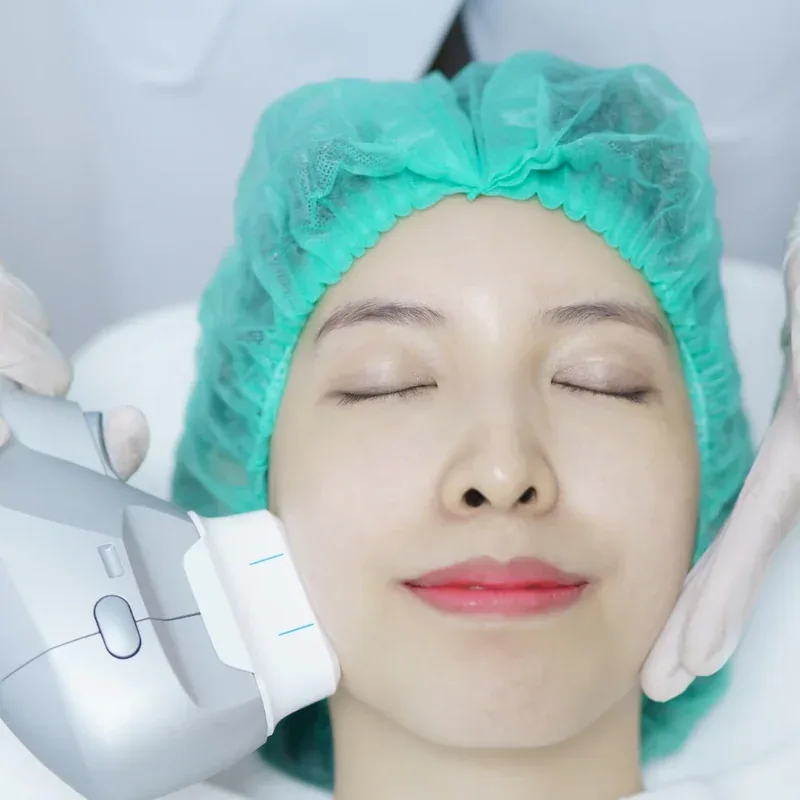
HIFU Skin Tightening in Abu Dhabi: What the Systematic Review Really Shows
HIFU skin tightening in Abu Dhabi is one of the most searched non-surgical options for lax skin on the face, jawline and neck. But what does the research say about results, pain, safety and who benefits? This guide is based on a 2023 systematic review of 16 studies and 693 screened records. It shows what microfocused ultrasound (MFU/HIFU) can deliver, and where the evidence stops.
What Is Microfocused Ultrasound (HIFU)?
MFU is a non-invasive, energy-based treatment designed to tighten lax facial skin. Ultrasound energy is converted into heat inside small, predetermined tissue zones of about 1 mm³.
The main targets are:
- Subdermal connective tissue
- Deep dermal layers
- At deeper settings, the SMAS (superficial musculoaponeurotic system)
How HIFU Tightens Skin: Collagen Remodeling
The review describes temperatures of roughly 60–70°C within the focal zones. The goal is not to heat the whole face evenly. Many small thermal injury zones are placed along planned treatment lines.
Collagen in these zones contracts and denatures. The body's healing response then replaces it with new collagen and elastin over the following months. The review also references HSP47, a heat-shock protein linked to fibroblast activity, as a possible marker of this prolonged remodeling.
This is why results often look modest early on and keep evolving over 90, 180 and, in some studies, 360 days.
Treatment Depths Used in the Studies
| Depth | Tissue concept | Clinical implication |
|---|---|---|
| 1.5 mm | Dermal, relatively superficial | Thinner tissue and superficial targets |
| 3.0 mm | Subdermal / deeper dermal | Common in face and periocular areas |
| 4.5 mm | SMAS-level, deeper soft tissue | Deeper structural tightening in suitable anatomy |
Not All HIFU Devices Are the Same
The review is not a study of one machine:
| Device | Studies |
|---|---|
| Ulthera / Ultherapy | 11 |
| Ultraformer | 2 |
| UTIMS A1 | 1 |
| Doublo IFUS | 1 |
| Microson | 1 |
Transducer frequencies ranged from about 2 to 10 MHz, and energy per thermal zone from about 0.25 to 1.2 J (most between 0.3 and 0.9 J). Because settings varied so widely, a published line count or joule setting should never be treated as a universal prescription.
Is more energy better? Not automatically. Some protocols with more energy, more lines or multiple depths gave better results. One study found greater lifting with superolateral or vertical vectors than with horizontal lines in selected areas. But safety, anatomy, device design and depth all matter.
What Results Can You Realistically Expect?
Objective measurements
| Outcome | Finding |
|---|---|
| Brow lift | About 0.47–1.7 mm across quantitative studies |
| Brow lift at 6 months | About 1.22 mm in one study |
| Submental area reduction | About 26–45 mm² |
| Marionette-line displacement | About 2.4–3.8% in one study |
A measurable change is not always visible to the eye, and it is not automatically more attractive. For brows, the evidence supports the phrase "subtle non-surgical brow lift", not surgical-scale repositioning.
Submental and lower-face tightening
- Oni et al.: about 45 mm² average submental reduction at 90 days. A quantitative lift was found in 56 of 78 patients.
- Lu et al. (Asian patients): about 26 mm² at 3 months, falling to about 14 mm² at 6 months.
Response over time is not always a steady upward curve. It depends on the protocol, population and measurement method.
Jawline, cheeks and regional response
Some studies found better improvement along the jawline and cheek. Others found no single best area. Facial regions are mechanically connected, and muscle tone and tissue thickness vary, so a good plan is anatomical rather than a set of identical shots.
Investigator vs Patient Ratings
| Category | Day 90 (n=337) | Day 180 (n=249) |
|---|---|---|
| No change | 7% | 5% |
| Mild improvement | 47% | 34% |
| Moderate improvement | 36% | 52% |
| Significant improvement | 8% | 8% |
| Worsening | 1% | 0% |
At day 90, 92% of cases were rated as improved. Moderate improvement rose from 36% to 52% by day 180, which fits progressive remodeling rather than an instant, filler-like result.
| Category | Day 90 (n=81) | Day 180 (n=86) | Day 360 (n=19) |
|---|---|---|---|
| No change | 25% | 17% | 5% |
| Mild improvement | 42% | 59% | 53% |
| Moderate improvement | 25% | 13% | 32% |
| Significant improvement | 9% | 10% | 11% |
Patients were more conservative than investigators. The one-year figures come from only 19 patients, so they should be read cautiously.
How Long Do HIFU Results Last?
Improvement can continue through about one year in some datasets, but longer follow-up is not available. Some brow and submental measurements declined after an earlier peak. Longevity is variable, not guaranteed.
Is HIFU Painful?
Yes, it can be. Pain data from 565 patients across 13 studies showed an average score of about 3.8, with study averages from roughly 2.5 to 6.1. Periorbital and submandibular areas tended to be more painful. Many scores were recorded after topical anesthetic or analgesics, so MFU should not be described as painless.
Safety: What Happens Across 573 Patients
| Finding | Summary |
|---|---|
| Transient redness ± swelling | Occurred in almost all patients in several studies |
| Bruising | Uncommon; 4 cases |
| Transient dysesthesia | 4 cases |
| Burns | 2 cases |
| White linear striations of the neck | 2 cases |
| Wheal | 1 case |
| Dermal white papule | 1 case |
| Overall uncommon adverse effects | 14/573 patients (about 2%) |
The 2% figure excludes the expected short-term redness and swelling. Rare complications are a reminder that non-invasive does not mean risk-free. Correct depth, coupling, device selection, anatomical knowledge and conservative planning are essential.
Who Is Most Likely to Benefit?
Good candidates typically have mild-to-moderate laxity. Outcomes declined as baseline laxity became more severe, and excessive laxity was an exclusion criterion in several studies. A thermal-remodeling treatment cannot remove large amounts of redundant skin or reposition advanced descent the way surgery can.
BMI matters. Several studies found better patient-reported outcomes at lower BMI. In one study, only 3 of 11 patients with BMI above 30 improved. The authors suggest greater facial volume may increase skin tension and partly oppose the shrinkage. BMI above 30 and excessive laxity are relative reasons to expect a weaker response, not absolute contraindications.
What About Men?
Every included study involved female patients, and populations were often over 90% female. The authors specifically call for male-focused research because male skin thickness, collagen characteristics and facial anatomy differ. The published evidence is not equally robust for men and women.
One Session or Multiple Sessions?
The review looked at the effect of a single session, which leaves open whether repeat treatment adds meaningful benefit. A second session could theoretically target untreated dermis or SMAS, but no optimal schedule was established. Be wary of any fixed "one session is enough" or "three sessions are required" claim.
What the Review Supports, and What It Doesn't
It supports
- MFU as a legitimate non-invasive option for mild-to-moderate laxity
- Small but measurable brow elevation and submental reduction in selected patients
- Gradual improvement over months through collagen remodeling
- The importance of depth, energy, line direction, device, BMI and baseline laxity
It does not prove
- That every HIFU/MFU device performs equally
- That one session works for everyone
- That the treatment is painless
- That small measured changes are always visibly meaningful
- Equivalence to a facelift or neck lift
- Outcomes beyond one year
- Strong male-specific results
- A universal line count, joule setting or depth combination
Limitations of the Evidence
- Wide variation in devices, settings, depths and outcome tools
- Heavy reliance on subjective ratings
- A mix of prospective, retrospective and nonrandomized studies
- Sparse long-term data (19 patients at one year)
Even so, the same direction of effect, modest tightening in well-selected patients, appeared repeatedly across diverse studies.
Where HIFU Fits in Facial Rejuvenation
Aging involves bone remodeling, fat redistribution, muscle activity, ligament change and skin quality, not only laxity. MFU is a tissue-tightening tool, not a complete solution. Patients with volume loss, dynamic wrinkles, pigmentation, severe skin excess or significant submental fat may need other or additional treatments. The review did not compare MFU with dual-frequency RF, RF microneedling, lasers, fillers, biostimulators or Endolift.
HIFU Consultation in Abu Dhabi with Dr. Erfan Rahmani
The key question is whether your concern is mild-to-moderate laxity that can respond to thermal remodeling, or a different problem needing another strategy. Dr. Erfan Rahmani can assess tissue thickness, baseline laxity, jawline and submental anatomy, facial volume, skin quality, BMI-related tissue load, previous procedures and your expectations before deciding whether ultrasound is appropriate.
Learn more or book a consultationFrequently Asked Questions
What did the 2023 systematic review conclude?
MFU is effective for tightening mildly to moderately lax facial skin, with weaker outcomes in severe laxity and higher BMI.
How many studies were included?
Sixteen studies, after screening 693 records following duplicate removal.
How much brow lift was measured?
About 0.47 to 1.7 mm across quantitative studies.
How much submental tightening was measured?
About 26 to 45 mm² in lateral-photograph analyses.
Can results keep improving after three months?
Yes. Pooled data and the biology support continued remodeling through 6 to 12 months in some patients.
How painful is HIFU?
Moderately painful on average (about 3.8 on a pain scale), with higher scores in some regions.
How common are serious side effects?
Uncommon adverse effects occurred in about 2% of 573 patients. Redness and swelling are common but temporary.
Does BMI affect results?
Yes. Several studies found weaker outcomes at higher BMI, and BMI above 30 was often a relative negative predictor.
Can HIFU replace a facelift?
No. It can create modest tightening in selected patients but cannot reproduce surgical repositioning or remove major skin excess.
Is one session always enough?
The review evaluated single-session treatment and did not establish an ideal number or interval of sessions.