
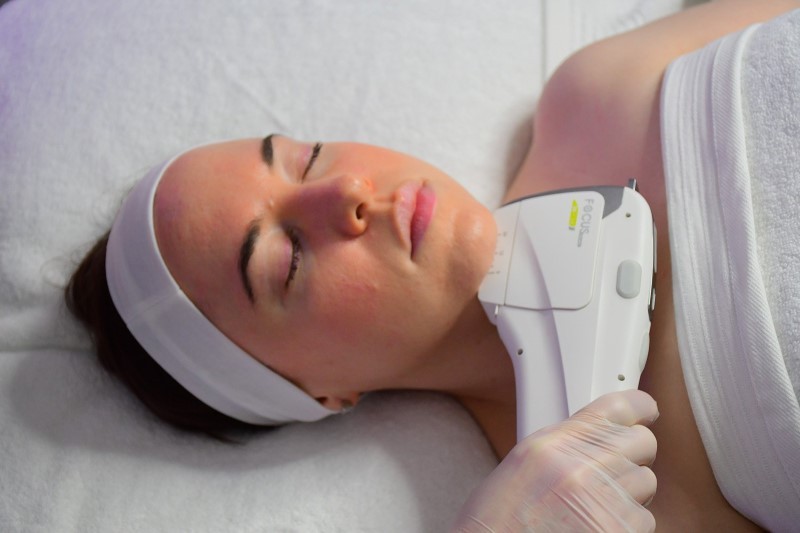
HIFU for Double Chin in Abu Dhabi
Submental Fat Reduction, Jawline Contouring & Skin Tightening — A Complete Evidence-Based Guide
A double chin can be created by several different anatomical problems: excess submental fat, skin laxity, reduced jawline definition, age-related tissue descent, skeletal proportions, or a combination of these factors. That is why the phrase "double chin treatment" should describe a clinical problem rather than a single device or a fixed protocol.
High-intensity focused ultrasound (HIFU) is one non-surgical option for selected patients. The 2025 Aesthetic Plastic Surgery study supplied for this article specifically evaluated HIFU for unwanted submental fat using a defined Ultraformer MPT protocol. The study combined clinical grading, patient-reported outcomes, standardized photography and Vectra 3D imaging, making it useful evidence for understanding what HIFU can — and cannot — be expected to do under the chin.
This article preserves the technical depth of the supplied paper while translating the evidence into patient-facing language. Where a statement comes directly from the study, the wording remains evidence-based; where broader treatment context is added, it is clearly identified as clinical context rather than a result proven by this single trial.
What Is a Double Chin?
A double chin refers to visible fullness in the submental region — the area between the underside of the chin and the upper neck. In the supplied study, the authors describe submental fat as excess fat accumulating between the chin and neck. They note that aging, rapid weight gain and genetics can contribute to this appearance.
Submental fullness does more than increase volume. It can blur the cervicomental transition, make the neck appear thicker and reduce mandibular definition. The paper also emphasizes that this appearance can make a person look heavier or older regardless of age or sex. From a treatment-planning perspective, the key question is therefore not simply "Do I have a double chin?" but "Which tissue is creating the fullness?"
How HIFU Works for Submental Fat and Skin Tightening
HIFU delivers ultrasound energy to a selected focal depth without making an incision. At the focal point, absorbed ultrasound energy generates controlled thermal coagulation. The supplied paper explains that these microthermal lesions can produce selective tissue injury at the target depth while limiting damage to the skin surface and adjacent tissues.
The biological response is relevant to both contour and tightening. The study discussion describes coagulative injury to fat cells and cites prior histologic work demonstrating adipocyte destruction after focused ultrasound. It also discusses new collagen formation and elastin-fiber regeneration, mechanisms that may contribute to tissue tightening and improved skin elasticity.
This dual mechanism is the reason HIFU is discussed for double-chin treatment: deeper focal depths can target submental adipose tissue while shallower or appropriately selected focal levels can contribute to tightening around the lower face and jawline. The result is not surgical excision of fat and it is not a facelift; it is controlled energy-based remodeling.
2.1 Thermal Coagulation and Targeted Tissue Injury
The principle described in the paper is selective volume reduction through instant microthermal lesions at a chosen depth. Different transducers are used to place the focal zone in different tissue layers. The treatment therefore depends on matching the transducer depth to the patient's anatomy rather than simply delivering a large number of shots.
2.2 Collagen and Elastin Remodeling
The authors cite histologic evidence showing not only fat-cell injury but also collagen and elastin changes after HIFU. These findings are consistent with clinical studies reporting improved skin elasticity and facial contour. In practice, this means a double-chin treatment plan should evaluate the skin envelope as well as the fat compartment.
Why HIFU Depth Matters Under the Chin
HIFU is not a single-depth technology. The supplied 2025 protocol used 4.5 mm and 6.0 mm focal-depth transducers in Micro Pulsed mode for the submental region. The paper specifically links these deeper focal depths with submental fat reduction and tissue tightening.
Depth is not a cosmetic setting that should be copied blindly from a publication. Tissue thickness, jawline anatomy, fat distribution and the location of nerves and other structures vary between patients. The scientific value of the study is that it demonstrates a defined protocol with measurable outcomes; it does not convert 4.5 mm or 6.0 mm into a universal prescription for every face.
Anatomy and Safety: Why Precision Matters Around the Mandibular Border
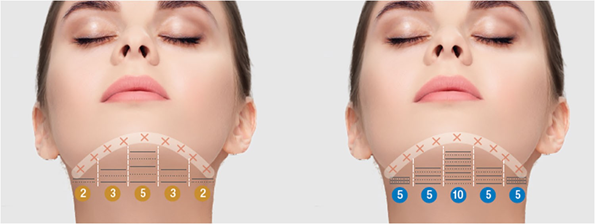
The lower face and submental region contain clinically important anatomy. The study protocol specifically addressed the marginal mandibular branch of the facial nerve. To reduce risk, the investigators spared a 1.0 cm area along the marginal mandibular nerve from the treatment zone.
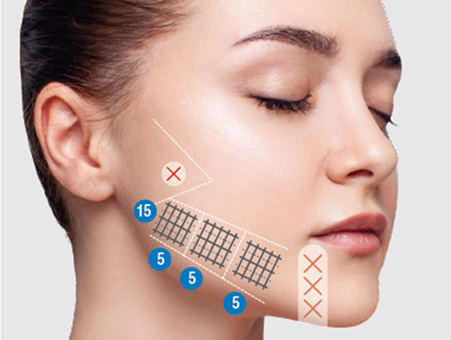
This is a major practical lesson from the paper. A HIFU treatment map should not be designed only around where fat is visible. It should also respect nerve course, mandibular anatomy, the thickness of the soft tissues and areas where deflation could worsen contour. The study's cheek diagram, for example, marked a deflated cheek area with an X and avoided delivering shots there.
What Did the Clinical Study Actually Do?
The study was designed to evaluate both efficacy and safety of HIFU for unwanted submental fat. Participants were assessed before treatment and again at a four-week follow-up. Outcomes included clinician grading, patient self-rating, body weight monitoring, standardized photography and three-dimensional Vectra analysis. Adverse events were assessed using questionnaires.
5.1 Study Population
The paper reports a total sample of 30 Asian participants aged 25–60 years in the abstract and states that all 30 completed follow-up. The results section reports a mean age of 42 years, mean BMI of 26 kg/m² and Fitzpatrick skin types III–IV.
5.2 Exclusion Criteria
The study excluded patients with a history of keloid scars, pregnancy, open wounds or lesions in the treatment area, skin infection, hemorrhagic disorders and BMI above 35 kg/m². People actively undergoing a weight-reduction program or considering a diet were also excluded, because ongoing weight change could confound submental-volume assessment.
All participants provided informed consent, and the study states that patients were informed about expected outcomes, possible side effects and adverse effects. The protocol was conducted in accordance with the Declaration of Helsinki.
The Published HIFU Protocol: Device, Energy, Depths and Shot Count
A central strength of the paper is that it reports a specific treatment protocol rather than using the term HIFU generically. The device was Ultraformer MPT (Classys, Seoul, Korea) using Micro Pulsed mode for the submental region.
- 4.5 mm focal-depth transducer: 100 shots at 0.5 J in the submental area, as reported in the methods.
- 6.0 mm focal-depth transducer: 120 shots at 0.7 J in the submental area, as reported in the methods.
- Additional jawline treatment: 4.5 mm focal depth, 30 shots at 0.7 J in normal mode for a synergistic tightening effect.
- Average total treatment: approximately 250 shots.
- Topical anesthetic cream was applied for 30–40 minutes before treatment.
- A 1.0 cm zone along the marginal mandibular nerve was spared.
These values describe the study protocol, not a universal treatment recipe. Different HIFU platforms have different transducer designs, pulse patterns, focal geometries and energy delivery. A website should therefore avoid implying that reproducing the same shot count on another device guarantees the same biological or clinical effect.
Clinical Results: How Much Did Double-Chin Severity Improve?
The primary clinician-rated outcome was the Clinician Reported Submental Fat Rating Scale (CR-SMFRS), a five-point scale from 0 to 4 used to grade localized submental fat according to submental convexity and visible fullness.
The mean CR-SMFRS score was 2.37 before treatment and 1.37 one month after treatment. The authors reported a highly statistically significant change, with p < 0.000005 in the text and an even smaller two-tailed value in Table 2. The reported Pearson correlation coefficient was 0.87 and the t-statistic was 12.04.
The categorical distribution also shifted toward milder submental-fat grades. At baseline, the abstract reports 10 mild, 10 moderate, 8 severe and 2 extreme cases. After one treatment, the distribution was reported as 16 mild, 8 moderate, 5 severe and 1 extreme. This pattern supports an overall movement toward lower clinical severity at four weeks.
Patient Satisfaction: What Did Participants Report?
Patient-reported outcome was measured using the Subject Self-Rating Scale (SSRS), scored from 0 to 3. At one month, the total SSRS score was 72 out of a possible 90 points, which the paper describes as an 82% improvement or satisfaction level.
Among the 30 treated patients, 15 reported noticeable improvement, 14 reported mild improvement and 1 reported no change. The abstract also notes that many patients experienced immediate visible improvement, although the formal study endpoint was four weeks.
For patient education, the safest interpretation is that early change may be noticed, but the published evidence in this paper is based on a one-month evaluation. The study does not establish the final result at three, six or twelve months.
Photography and Vectra 3D Analysis
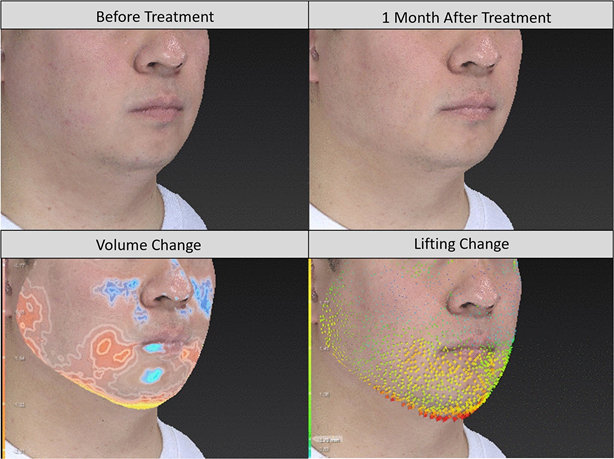
The study did not rely only on subjective impressions. Standard two-dimensional clinical photographs and three-dimensional Vectra imaging were obtained before treatment and at one month. The authors report that the 2D images showed a noticeable reduction in submental fat and that Vectra analysis demonstrated corresponding changes in submental volume and facial contour.
Figure 3 is particularly valuable for patient education because it displays the visual comparison together with color-mapped volume change and a lifting analysis. It should be presented as a study example, not as a guaranteed before-and-after result for every patient.
Side Effects, Pain and Downtime
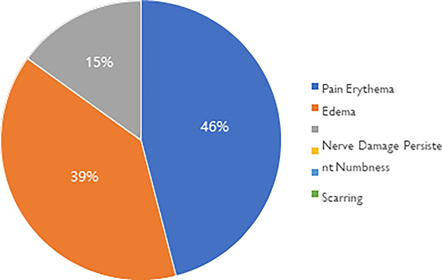
The study reported a favorable short-term safety profile. During treatment, patients experienced minimal pain and none requested systemic analgesics or sedation. The reported temporary effects were mild pain in 46%, erythema in 39% and edema in 15%.
In the results section, these effects are described as resolving within three days. No nerve damage, persistent numbness or scarring was reported, and participants returned to daily activities immediately after treatment without downtime.
Who May Be a Good Candidate for HIFU Double-Chin Treatment?
The supplied paper does not provide a universal candidacy algorithm, but its inclusion/exclusion framework and treatment mechanism support a practical evidence-informed approach. HIFU is most logically considered when the visible concern includes localized submental fat and/or tissue laxity that can reasonably be treated non-surgically.
A high-quality consultation should separate the following contributors before treatment:
- Localized submental fat versus generalized neck fullness.
- Skin laxity and the ability of the skin envelope to contract after volume change.
- Jawline and chin projection, which can influence whether the same amount of submental tissue looks prominent.
- Pre-existing hollowing or deflated areas that should not receive unnecessary energy.
- Medical and skin conditions that may increase risk or make treatment inappropriate.
- Whether the patient expects subtle-to-moderate non-surgical contour improvement or a surgical-level transformation.
Because the study excluded patients with BMI above 35 kg/m² and people actively changing weight, its results should not be generalized to those populations without additional evidence. Similarly, the sample represented Asian patients with Fitzpatrick III–IV skin types, so wider ethnic and skin-type generalization requires caution.
How Soon Are HIFU Double-Chin Results Seen?
The study assessed outcomes one month after a single session and documented measurable clinical and three-dimensional change at that time point. Some patients reportedly noticed early improvement, but the strongest source-based statement is that improvement was demonstrated at four weeks.
HIFU also triggers tissue remodeling, so in general aesthetic practice clinicians may discuss continued evolution after treatment. However, this specific paper followed participants for only 30 days and therefore cannot establish the magnitude or durability of later collagen-remodeling effects. Website claims about three- or six-month results should be supported by other evidence if they are included.
How Many HIFU Sessions Are Needed for a Double Chin?
The source study demonstrated improvement after one session. That is evidence that a single session can produce measurable change under the defined protocol. It does not prove that one session is optimal for every patient, nor does it define a universal maintenance schedule.
Session number should be individualized according to the amount and distribution of submental fat, skin laxity, treatment response, device type and patient goals. Repeated treatment should be based on reassessment rather than on a fixed package that ignores anatomy.
HIFU vs Other Double-Chin Treatments
The introduction of the supplied paper mentions several approaches used to improve a double chin, including contour injections, thread lifting and submental liposuction. The authors position HIFU as a non-invasive alternative for patients who want to avoid surgical procedures, anesthesia and longer recovery.
The study itself was not a head-to-head comparative trial, so it cannot establish that HIFU is superior to injections, threads or liposuction. A clinically responsible comparison should present the options according to the problem they address rather than ranking them without comparative evidence.
- HIFU: focused ultrasound; non-invasive; studied here for submental fat reduction and tissue tightening.
- Submental liposuction: surgically removes fat and can produce a larger immediate volume reduction, but involves an invasive procedure and recovery. This comparison is general clinical context, not a result tested in the supplied HIFU study.
- Injectable fat-reduction treatments: the source reference list includes randomized trials of ATX-101/deoxycholic acid, but the 2025 HIFU study did not directly compare HIFU with ATX-101.
- Threads: mentioned by the authors as another option for double-chin improvement, but not directly compared in this study.
- Other energy-based treatments such as RF microneedling or minimally invasive laser tightening are separate treatment pathways; their performance should not be inferred from this HIFU trial.
HIFU for Double Chin in Abu Dhabi: What Should Patients Look For?
For a patient searching for HIFU for double chin in Abu Dhabi, the most important question is not simply whether a clinic owns a HIFU device. The supplied paper demonstrates why protocol, anatomy and operator judgment matter. Its treatment map deliberately protected the marginal mandibular nerve, excluded deflated areas and used different focal depths for different tissue targets.
A consultation should therefore identify the cause of the double chin, assess submental fat thickness and skin laxity, examine the jawline and chin in multiple views, discuss realistic non-surgical outcomes and explain which device and transducers will be used. If the device differs from Ultraformer MPT, the clinician should avoid presenting the exact results of this paper as if they automatically apply to another platform.
What This Study Proves — and What It Does Not
What the study supports
- A single defined Ultraformer MPT HIFU protocol can improve clinician-rated submental fat severity at one month in the study population.
- Patient-reported improvement/satisfaction was high at one month, with an overall SSRS result described as 82%.
- 2D photography and Vectra 3D analysis showed visible contour and volume changes.
- Short-term tolerability was favorable, with temporary pain, erythema and edema and no persistent numbness or nerve injury reported in this sample.
- Using 4.5 mm and 6.0 mm focal depths can target deeper submental tissue in a defined protocol.
What the study does not establish
- Long-term durability beyond the 30-day follow-up.
- Superiority over liposuction, deoxycholic acid, threads or other energy-based devices.
- Equivalent results with every HIFU brand, cartridge, energy level or pulse mode.
- Results in very high-BMI patients, people actively losing weight, or populations outside the studied demographic.
- A universal shot count, number of sessions or maintenance interval.
The authors themselves identify the small sample, the absence of a direct comparator, patient-to-patient variation and the short follow-up as major limitations. They also note the need for larger and more diverse studies to understand outcomes across different ethnic groups.
Frequently Asked Questions About HIFU for Double Chin
Does HIFU really reduce a double chin?
The supplied 2025 clinical study found a statistically significant reduction in clinician-rated submental-fat severity after one HIFU session, with corresponding photographic and Vectra 3D changes at one month. Results vary by anatomy, device and protocol.
Is HIFU for a double chin non-surgical?
Yes. HIFU delivers focused ultrasound energy without an incision. In this study, participants returned to normal daily activities immediately after treatment.
Does HIFU remove fat or only tighten skin?
The paper describes both effects. Deeper focal treatment was used for submental fat reduction, while thermal injury and collagen remodeling can contribute to tightening. The relative contribution varies by tissue and protocol.
What depths were used in the study?
The submental protocol used 4.5 mm and 6.0 mm focal-depth transducers in Micro Pulsed mode, with additional 4.5 mm treatment along the jawline.
How many shots were used?
The methods report 100 shots with the 4.5 mm transducer and 120 shots with the 6.0 mm transducer in the submental area, plus 30 additional 4.5 mm jawline shots — about 250 shots on average. These numbers belong to the study protocol and should not be copied automatically to other devices or patients.
How painful is HIFU for a double chin?
The study reported minimal pain during treatment; no participant requested analgesics or sedation. Mild pain was later recorded in 46% as a temporary side effect.
What are the common side effects?
In this study, temporary effects included mild pain, erythema and edema. No persistent numbness, nerve damage or scarring was reported in the 30-day follow-up.
Is there downtime?
The study reports that all participants returned to daily activities immediately. Individual experiences can vary.
How soon can I see results?
The paper demonstrated measurable improvement at one month. It does not provide long-term follow-up beyond 30 days.
Is one HIFU session enough?
One session produced measurable improvement in the study, but the paper does not establish that one session is optimal for everyone. Treatment should be reassessed according to response and anatomy.
Who should avoid HIFU?
The study excluded pregnancy, active wounds or lesions, skin infection, hemorrhagic disorders, a history of keloid scarring, BMI above 35 kg/m² and people actively changing weight. A clinician must also consider device-specific contraindications and individual medical history.
Can HIFU replace liposuction?
Not necessarily. HIFU is non-invasive and may suit selected patients seeking modest-to-moderate contour improvement. Liposuction is an invasive fat-removal procedure and may be considered when larger-volume reduction is required. The supplied trial did not directly compare the two.
Is HIFU safe around the jawline nerve?
The study specifically protected the marginal mandibular nerve by sparing a 1.0 cm area along its course. This highlights why anatomical mapping and trained medical assessment are important.