
The Aging Face
Why Facial Aging Happens — and How Modern Rejuvenation Can Be Planned in Abu Dhabi
Facial Aging in Abu Dhabi: Understanding What Changes — and Why
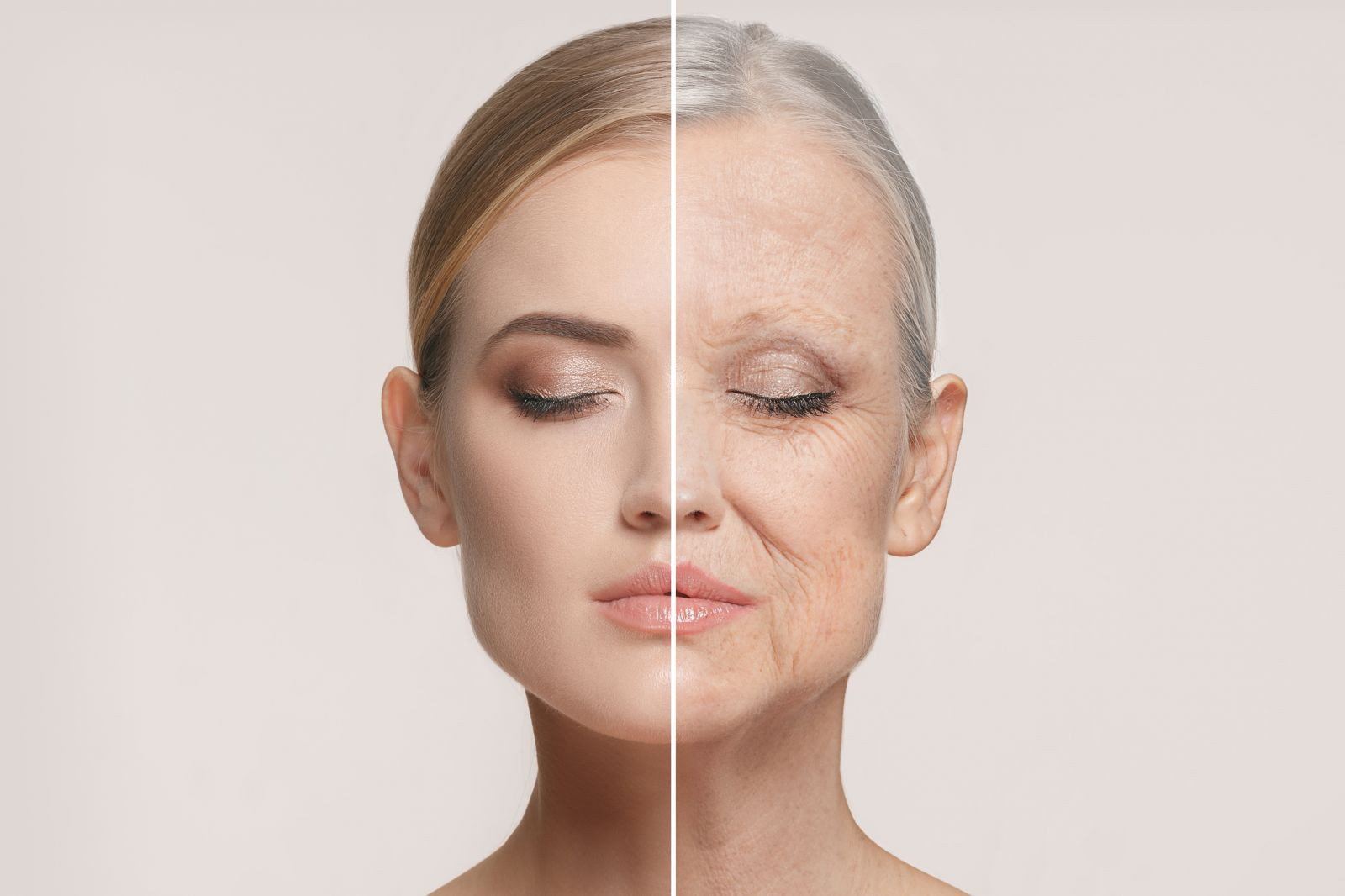
Facial aging is not caused by skin changes alone. It is a layered process involving collagen and elastin loss, slower skin renewal, fat-pad atrophy and descent, muscle-related changes, and gradual remodeling of facial bone. The most natural rejuvenation plans therefore address the dominant aging mechanism rather than treating every face with the same procedure.
The face does not age as a single surface. The supplied review describes aging as a progressive interaction between the skin, subcutaneous tissues, facial fat compartments, muscles and skeletal support. This is clinically important because two people with similar wrinkles may have very different underlying causes — one may have mainly photoaging and texture change, while another may have volume loss, tissue descent or reduced skeletal support.
For patients considering facial rejuvenation in Abu Dhabi, a useful starting point is therefore not "Which procedure is best?" but "Which layer is creating the visible change?" A treatment that is effective for dynamic wrinkles may not restore midface support; a filler that restores volume may not correct surface photodamage; and a skin-tightening procedure cannot reproduce the structural change of a surgical lift in patients with advanced laxity.
What Causes the Face to Age?
Intrinsic aging
Intrinsic aging refers to the biologic changes that occur with time. The article describes thinning of the epidermis, flattening of the dermal-epidermal junction, slower epidermal turnover, reduced fibroblast activity, collagen fragmentation and an age-related reduction in overall collagen content. Together, these changes contribute to thinner, more fragile and less resilient skin.
Evidence point: The source reports that some studies estimate an approximately 1% annual reduction in collagen content per unit area of skin surface, while the ratio and organization of collagen also change with age.
Extrinsic aging and photoaging
Extrinsic aging is driven by external exposures. In the source, ultraviolet-related photoaging is emphasized as a major contributor, while smoking and gravitational effects are also discussed. Photoaged skin is not simply "older" skin: it can show more disorganized collagen and elastin architecture and elastotic change beneath the epidermal-dermal junction.
Abu Dhabi local relevance: In a high-sun-exposure environment, photoprotection is particularly relevant to a long-term rejuvenation strategy. This is a local editorial adaptation of the article's broader discussion of ultraviolet exposure as a major driver of extrinsic aging.
How Facial Aging Changes the Shape of the Face
Aging changes facial shape because support is lost at multiple levels. The article describes progressive skin wrinkling and loss of elasticity, descent and atrophy of soft tissues, and remodeling of the facial skeleton. This explains why modern facial rejuvenation increasingly focuses on proportions, support and tissue quality rather than simply filling individual lines.
Facial fat pads: atrophy, descent and contour change
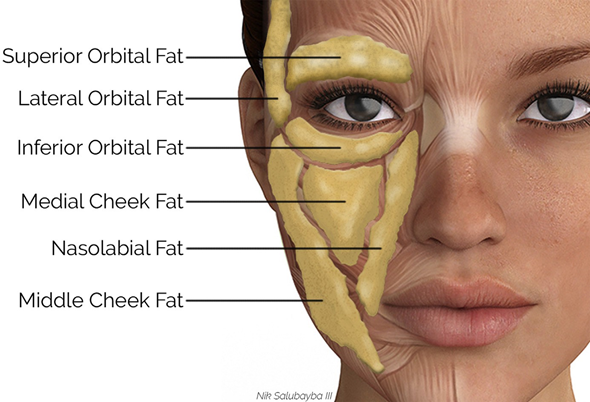
Facial fat is distributed in organized compartments. With age, these compartments can lose volume and descend. The visible result may include temporal hollowing, flattening of the cheek, a deeper nasolabial fold, more apparent tear-trough shadowing and loss of smooth transitions between facial zones.
Bone remodeling and loss of structural support
The source highlights that facial bone changes with age as well. Orbital dimensions change, maxillary and alveolar support can decrease, and mandibular remodeling may reduce chin projection and accentuate the prejowl sulcus. These skeletal changes help explain why aging can alter the apparent size, position and relationship of the eyes, nose, lips, chin and jawline.
What Happens to Different Areas of the Face as We Age?
| Area | Common age-related change | Clinical implication |
|---|---|---|
| Forehead & brow | Hairline recession, brow descent and lateral hooding | Dynamic muscle activity, skin laxity and brow position may all need assessment. |
| Periorbital area | Volume loss, dermatochalasis, orbital change, tear-trough shadowing | Treatment may involve neuromodulation, volume restoration, resurfacing or surgery depending on the dominant issue. |
| Temple | Fat loss and hollowing | Deep or superficial volume restoration requires anatomical planning. |
| Midface | Malar fat-pad descent and volume loss | Cheek support and midface contour may influence nasolabial folds and lower-face appearance. |
| Nose | Loss of support and more apparent tip ptosis | Age-related nasal change is structural, not simply a skin problem. |
| Lower face & chin | Jowls, prejowl sulcus, reduced chin projection | Often reflects a combination of soft-tissue descent, mandibular change and volume loss. |
| Perioral area | Longer upper lip, thinning vermilion and fine rhytides | Muscle, skin quality and volume all contribute. |
| Neck | Skin laxity, volume loss and visible platysmal bands | Treatment selection depends on skin, fat, muscle and structural support. |
Why the Midface Matters So Much in Facial Rejuvenation
The source describes the midface as a central zone of age-related change. Descent of the orbicularis oculi and malar soft-tissue complex, loss of facial fat, and reduction in maxillary and alveolar support can create hollowing and deepen the nasolabial folds. This is one reason why simply treating the fold itself may not always address the underlying structural cause.
Why Jowls and the Jawline Become More Visible
Jowling develops from several interacting factors: soft-tissue descent, changes in mandibular support, chin-volume loss and gravitational change. The review also describes how reduced chin projection and the prejowl sulcus can make the lower face appear heavier or less defined even when the total amount of facial fat is not dramatically increased.
Why the Neck Ages Differently From the Face
The neck combines skin laxity, reduced tissue volume, gravitational change and changes in muscular support. As skin becomes thinner and loses elasticity, the platysma can become more visible as vertical bands. The mandible and chin also contribute to neck contour, so facial and neck aging are often best assessed together.
Modern Facial Rejuvenation: Match the Treatment to the Aging Mechanism
AEO answer: There is no single "best" anti-aging treatment. The best plan depends on whether the dominant concern is muscle-driven lines, surface photoaging, collagen loss, facial volume loss, tissue descent, submental fat, or advanced structural laxity. Combination treatment is often more logical because facial aging is multifactorial.
1. Prevention and skin-quality strategy
The review places photoprotection and topical therapy at the foundation of anti-aging care. Sunscreen helps limit ultraviolet-driven photoaging. Retinoids are discussed for their effects on epidermal biology and collagen-degrading pathways. These measures do not replace procedural rejuvenation, but they can support skin quality and help protect results over time.
2. Neuromodulators for dynamic expression lines
Botulinum toxin reduces acetylcholine release at the neuromuscular junction and temporarily relaxes selected facial muscles. In the source, neuromodulators are discussed for wrinkles associated with facial muscle activity, with expected effects developing over approximately a week and lasting for several months. Their role is different from fillers: neuromodulators treat muscle-driven lines, while fillers mainly restore or reshape volume.
3. Dermal fillers for volume loss and contour support
The article describes hyaluronic acid as the largest filler category and explains that filler properties differ according to factors such as cross-linking and rheology. Firmer products are generally used for deeper structural applications, while softer products may be chosen for more superficial lines, lips or tear-trough regions. Hyaluronic-acid filler has the practical advantage of reversibility with hyaluronidase.
Other biostimulatory or longer-lasting filler categories discussed in the source include calcium hydroxyapatite and poly-L-lactic acid. Importantly, filler is not simply a "wrinkle injection"; appropriate use depends on the anatomic deficit, tissue plane, desired support and the safety profile of the region being treated.
4. Collagen-stimulating and regenerative approaches
The source discusses platelet-rich plasma (PRP) as a growth-factor-rich derivative of whole blood with applications in regenerative medicine. It also discusses poly-L-lactic acid as a material that stimulates fibroblast activity and collagen production over time. These approaches are conceptually different from immediate volumization because part of the desired result depends on a biologic tissue response.
5. Laser resurfacing for photoaging, texture and fine lines
Laser therapy creates a controlled injury that can improve fine lines, photoaging, dyspigmentation and some forms of scarring. The article distinguishes ablative from nonablative approaches and fractional from nonfractional delivery. It also emphasizes that laser results are cumulative and that final remodeling can take time. Treatment choice should therefore consider skin type, risk factors, downtime and the primary clinical objective.
6. Radiofrequency and skin tightening
The review includes radiofrequency-based approaches among options for tissue tightening and neck rejuvenation. These technologies aim to create controlled thermal effects that lead to tissue contraction and remodeling. They may be useful for selected patients with mild to moderate laxity, but they should not be presented as equivalent to surgical lifting in advanced cases.
7. Thread lifting
Thread lifting can provide temporary mechanical suspension with relatively limited recovery time. The source notes that outcomes and longevity vary by suture material and that complications such as displacement, infection, dimpling or extrusion can occur. Patient selection and realistic expectations are therefore essential.
8. Surgical rejuvenation
For more advanced tissue descent or excess skin, surgical procedures may offer a more definitive structural correction. The source reviews brow lift, blepharoplasty, midface lift, chin augmentation, rhinoplasty and rhytidectomy. The key principle is that surgery addresses anatomy that minimally invasive treatments may only partially improve.
Treatment Selection by Dominant Aging Pattern
| Dominant concern | Usually assessed treatment families | What the consultation should clarify |
|---|---|---|
| Dynamic forehead / glabellar / crow's-feet lines | Neuromodulator | Muscle strength, brow position, asymmetry and eyelid support |
| Diffuse photoaging / texture / fine lines | Photoprotection, retinoids, resurfacing or energy-based treatment | Skin type, pigmentation risk, downtime and degree of photodamage |
| Temple / cheek / periorbital volume loss | HA filler, biostimulatory treatment, fat restoration in selected cases | True volume deficit versus tissue descent; vascular anatomy and tissue plane |
| Mild facial laxity | Energy-based tightening, collagen-stimulating approaches, selected thread techniques | Skin quality, amount of descent and realistic magnitude of improvement |
| Jowls / neck laxity | Combination nonsurgical strategy or surgical lifting depending on severity | Skin, fat, platysma, chin/mandibular support and degree of tissue descent |
| Submental fullness | Fat-reduction approaches with concurrent assessment of skin laxity | Whether fat reduction alone could worsen visible laxity |
| Advanced structural descent | Surgical assessment | Whether minimally invasive treatments would under-correct the anatomy |
Combination Treatment: Why One Procedure Is Often Not Enough
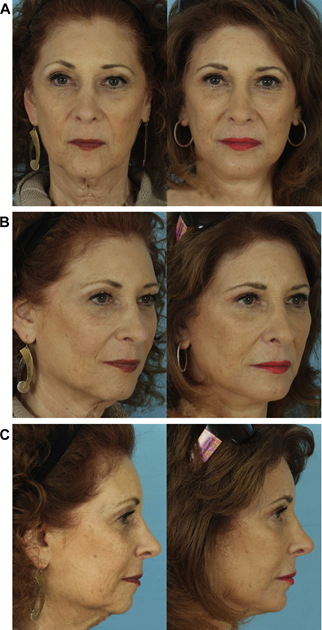
One of the strongest principles in the source is that facial aging is multifactorial and comprehensive rejuvenation often requires a combination of treatments. An effective plan may combine muscle relaxation, restoration of structural volume, improvement of skin quality and treatment of laxity. The sequence matters: treating the dominant structural problem first can reduce the temptation to overfill individual lines.
What Makes a Facial Rejuvenation Result Look Natural?
- Treat the cause of the visible change, not just the line or shadow.
- Preserve facial identity and avoid creating excessive or uniform volume.
- Respect age-related skeletal proportions, especially the midface, chin and jawline.
- Use different modalities for different tissue layers rather than expecting one procedure to solve everything.
- Plan treatment in stages when this improves safety, assessment and control of the final result.
- Set realistic expectations: minimally invasive treatment should not be marketed as a substitute for surgery when the anatomy requires surgical correction.
Facial Rejuvenation in Abu Dhabi: A Practical Consultation Framework
For a website visitor searching for facial rejuvenation in Abu Dhabi, the most useful consultation is a full-face assessment rather than a product-first discussion. The evaluation should identify the dominant aging layers, establish the patient's priorities, review previous treatments, assess skin quality and pigmentation tendency, and then decide whether the goal is prevention, restoration, contour refinement, tightening or a combination.
| Consultation step | Clinical question |
|---|---|
| 1. Skin quality | Is the main issue dryness, texture, fine lines, pigmentation or photodamage? |
| 2. Dynamic movement | Which lines are created or amplified by muscle activity? |
| 3. Volume map | Where is there true loss of volume versus apparent hollowing from descent? |
| 4. Structural support | Are chin, jawline, midface or orbital support changes influencing the appearance? |
| 5. Laxity | Is the laxity mild enough for minimally invasive tightening, or is surgical assessment more appropriate? |
| 6. Risk profile | What skin type, medications, prior procedures, scars or medical factors affect treatment choice? |
| 7. Expectations | What degree of change, downtime and treatment duration is acceptable to the patient? |
Frequently Asked Questions
What are the main causes of facial aging?
Facial aging is caused by a combination of intrinsic biologic aging and extrinsic factors such as ultraviolet-related photoaging. Visible change also reflects collagen loss, slower skin renewal, fat-pad atrophy and descent, muscle-related changes and remodeling of facial bone.
At what age does facial aging start?
Biologic aging is gradual rather than beginning at a single age. Early changes may involve skin quality and expression lines, while volume loss, tissue descent and skeletal changes become more noticeable over time.
Can facial aging be reversed?
Aging cannot be completely reversed, but many visible features can be improved. The most appropriate approach depends on the tissue layer involved and may include skin care, neuromodulators, fillers, collagen-stimulating treatments, lasers, radiofrequency or surgery.
What is the best non-surgical treatment for an aging face?
There is no single best treatment. Neuromodulators are suited to muscle-driven lines, fillers to selected volume deficits, resurfacing to texture and photodamage, and energy-based treatments to selected laxity. Combination treatment is often more appropriate than a single procedure.
Why does the face lose volume with age?
The supplied review describes both fat-compartment atrophy and descent, together with changes in facial bone. These structural changes can create hollowing around the temples and eyes, flatten the cheeks and deepen lower-face folds.
Why do jowls develop?
Jowls reflect a combination of soft-tissue descent, changes in mandibular support, chin-volume loss and skin laxity. Treating only the jowl itself may not address all of these contributing factors.
Can fillers lift the face?
Fillers can restore support and improve contour in selected areas, particularly when volume loss is a major contributor. They do not reproduce the tissue repositioning of a surgical facelift and should not be used to overfill a face in an attempt to compensate for advanced laxity.
Is Botox the same as facial rejuvenation?
No. Botulinum toxin mainly reduces selected muscle activity and is useful for dynamic expression lines. Facial rejuvenation is broader and may also need treatment of skin quality, volume, contour, laxity or skeletal support.
How important is sunscreen for anti-aging?
The source identifies ultraviolet exposure as a major driver of extrinsic photoaging. Consistent photoprotection is therefore a foundational part of preventing additional visible skin damage.
How should I choose a facial rejuvenation treatment in Abu Dhabi?
Choose treatment after a medical assessment that identifies the main aging mechanism, reviews your skin type and risk factors, and matches the expected benefit and downtime to your goals. A procedure-first approach is usually less precise than an anatomy-first plan.
Definition — facial aging: A progressive, multilayer change involving the skin, subcutaneous tissue, facial fat compartments, muscles and bony support. Visible aging may include wrinkles, pigment irregularity, hollowing, tissue descent, jowls and neck laxity.
Key relationship: Skin aging explains only part of an aging face. Structural aging of fat compartments and bone can change facial shape even when skin quality is relatively good.
Clinical principle: Natural facial rejuvenation starts by identifying the dominant tissue-level cause and then choosing a treatment that targets that layer.
Local intent statement: Patients searching for facial rejuvenation in Abu Dhabi may benefit from a full-face medical assessment that considers skin quality, facial proportions, volume distribution, laxity, previous treatments and individual risk factors before selecting a procedure.