

Chin Augmentation in Abu Dhabi : HA Filler, Implants, Safety and What to Expect
Chin augmentation in Abu Dhabi covers any treatment that improves the position, volume, shape or definition of the chin relative to the rest of the face. The goal is rarely a bigger chin; it is better facial harmony between the forehead, nose, lips, jaw and neck in front, oblique and profile views. This guide explains the options, how hyaluronic acid (HA) chin filler works, what research shows, how long results last, the risks, and how to choose a safe consultation.
1. What Is Chin Augmentation?
A well-designed treatment can improve the relationship between the chin, lips, nose and neck. For a recessed chin, more forward projection may help. For a short or asymmetrical chin, vertical height, width or side-to-side shape may matter more.
Options include hyaluronic acid dermal fillers, selected biostimulatory or structural fillers, surgical implants, osseous (sliding) genioplasty and autologous fat grafting. HA filler is popular because it gives a visible, adjustable result without an operating theatre, but it is not right for every type of retrusion or bite-related problem.
Patients often first complain of a prominent nose, weak jawline, jowling or poor neck definition. Sometimes a modest change in the chin-to-lip or chin-to-neck relationship changes how these areas look. In other cases, the real issue is skin laxity, submental fat, skeletal retrusion or dental occlusion, which chin filler alone cannot correct. Accurate diagnosis matters more than simply injecting volume.
How is chin augmentation different from chin filler?
Chin augmentation is the umbrella term for reshaping or advancing the chin by any appropriate method. Chin filler is one non-surgical type, using an injectable gel placed by a trained clinician. It can alter the appearance of projection, height, width and contour, but it does not surgically relocate the jaw or correct malocclusion. Where the deficiency is substantial and skeletal, a surgical opinion is more relevant than escalating filler volume.
Five questions that should guide any treatment plan
- Projection: does the chin sit too far behind the lower lip or nose in profile?
- Height: is the lower third of the face short or disproportionately long?
- Width and shape: is the chin narrow, rounded, broad, squared or asymmetric relative to your goals?
- Transition: is there an indentation at the prejowl sulcus between chin and jowl?
- Function and tissue quality: is the concern linked to the bite, skeleton, active mentalis muscle, fat distribution or skin laxity?
2. Why the Chin Matters to Facial Proportion
The chin is the most forward point of the lower facial skeleton and a visual anchor for the nose-lip-chin profile. Weak chin support can make a balanced nose look too large, accentuate submental fullness or soften the jawline. Excess projection creates a heavy lower face, distorts the labiomental fold and looks unnatural. The most convincing results respect the patient's own facial identity instead of copying a template.
A meaningful assessment looks at symmetry at rest, smile and speech, chin movement with lip closure, lip competence, dental relationships, lower-face volume and the jaw-to-neck relationship. There is no universal millimetre value that suits every patient.
Projection
Pogonion, the most forward bony point of the chin, is a standard landmark. The classic González-Ulloa concept drops a vertical line from the nasion perpendicular to the Frankfurt horizontal plane, and the chin may meet or approach it. Another historical approximation places the male pogonion near the lower-lip vermilion plane and the female chin about 1-2 mm behind it. These are descriptive conventions, not clinical targets for every individual.
Height and lower-face thirds
The menton is the lowest skeletal point of the chin. Clinicians review facial thirds using the hairline, nasion, subnasale and menton. This shows whether the lower third looks short, whether the chin lacks vertical length, or whether a dental or skeletal pattern explains it. Filler can change perceived soft-tissue height but cannot replace skeletal correction in orthognathic problems.
Width, symmetry and shape
The paragonion regions describe the lateral chin contours. Older design conventions align a narrow chin with the medial canthi and a broader chin with the corners of the mouth. Modern planning is individualised: one patient wants a subtle rounded contour, another a cleaner squared lower face, another simply more symmetry. Frontal and oblique views matter as much as the profile.
3. Essential Chin Anatomy for Safe, Natural-Looking Results
The chin contains bone, periosteum, retaining structures, fat compartments, muscle, nerves and an interconnected arterial network. It is not a uniformly safe filler zone. Vessels and nerves vary between people, and deeper injection does not remove risk.
Four skeletal landmarks
- Pogonion: most forward point of the bony chin; central to profile projection.
- Menton: most inferior point of the mandibular symphysis; defines chin height.
- Gnathion: intermediate reference between pogonion and menton; useful for the lower contour.
- Paragonion: lateral chin eminence defining the widening of the chin toward the jaw.
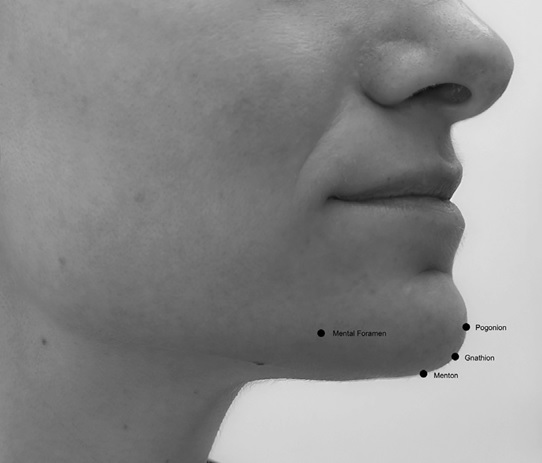
Muscles and movement
The paired mentalis muscles affect lower-lip elevation, chin dimpling and protrusion. The depressor labii inferioris lowers the lip, and the depressor anguli oris pulls the mouth corners down. With a hyperactive mentalis, chin shape changes during speech, smiling or lip closure, so dynamic evaluation is essential.
Nerves and arteries
The inferior alveolar nerve emerges as the mental nerve through the mental foramen, supplying sensation to the chin and lower lip. The foramen usually lies in the premolar region but varies. The mental, inferior labial, labiomental and submental arteries form an anastomotic network, and the facial artery passes around the lower border of the mandible in front of the masseter. The often-cited figure of about 1.5 cm above the inferior border is an approximate published landmark, not a safe-distance rule. Severe vascular injury is uncommon, but no one should promise a risk-free chin injection.
4. How Chin Augmentation Should Be Assessed
A professional consultation is a structural and medical evaluation, not a discussion of syringe count. It should include the nose, lips, mouth corners, teeth, bite, jaw border, submental area, neck angle and jowl tissue. Skin quality, asymmetries, age-related change and bony support all affect what filler can realistically achieve.
Photo documentation and dynamic assessment
Standardised images include frontal, right and left oblique, and right and left lateral views under consistent lighting, at rest and with smiling and lip closure. This separates true projection deficits from mentalis overactivity, asymmetric movement or head-position changes.
Medical and dental history
Your clinician should review previous fillers, complications, allergies, medications, bleeding risk, skin infection, inflammatory conditions, trauma, oral surgery, orthodontics and planned dental work. Tell them about any implants, permanent or unknown filler, unusual reactions or earlier hyaluronidase. Some practices separate elective filler from invasive dental work by roughly one to two weeks, but this is not a universal rule.
When a surgical or dental referral may be better
Marked skeletal retrusion, significant malocclusion, congenital deformity, complex asymmetry, suspected jaw-joint or orthodontic problems and requests for major permanent advancement merit maxillofacial, plastic-surgical or orthodontic assessment. Filler can camouflage certain contours but cannot correct occlusion or reposition bone.
Who may be a reasonable candidate for HA chin filler?
A good candidate has a modest to moderate contour or projection concern, prefers a temporary non-surgical approach, accepts that touch-ups or maintenance may be needed, and has realistic goals and no contraindication. Marked excess skin, major skeletal discrepancy, active local infection or unrealistic expectations may call for a different plan. Candidacy is a medical judgement, not a conclusion from a photograph.
5. Chin Filler vs Chin Implant vs Sliding Genioplasty vs Fat Grafting
The best technique depends on what must change anatomically. Weak forward projection differs from a short vertical chin, a recessed mandible, a prejowl shadow or submental fat.
| Approach | Main capability / strongest use | Limitations and trade-offs |
|---|---|---|
| HA dermal filler | Temporary profile projection, vertical or lateral contour refinement, smoothing selected prejowl shadows; non-surgical and sometimes dissolvable. | Does not reposition bone or correct the bite; repeat assessment or treatments; bruising, swelling, nodules, rare vessel compromise. |
| CaHA / structural non-HA filler | Structural soft-tissue contour in selected cases when indicated by a trained medical clinician. | Cannot be dissolved with hyaluronidase; product-specific considerations; vascular and inflammatory risks. |
| Alloplastic implant | Long-lasting surgical improvement of projection; custom 3D options may help selected asymmetries. | Surgery, scar or incision risk, infection, hematoma, displacement, bone or dental effects in some cases. |
| Sliding / osseous genioplasty | True bony advancement or multidimensional repositioning for selected deformities and microgenia. | More invasive, with bone healing and hardware; specialist surgery and longer recovery. |
| Autologous fat grafting | Soft-tissue volume, potentially in multiple dimensions; sometimes an adjunct to surgery. | Variable retention or resorption; limited for major skeletal retrusion; possible repeat sessions or irregularity. |
Chin implants: permanent structure with surgical trade-offs
Implants are an established way to add forward projection. Off-the-shelf and custom 3D options exist, and the appeal is a long-lasting result without repeat filler. They are less able to solve complex vertical or asymmetry problems than moving the bone itself. Reported complications include hematoma, infection, wound breakdown, scarring, malposition and, in some settings, bone remodelling beneath the implant.
Sliding genioplasty: moving the bone, not adding surface volume
Sliding genioplasty uses an osteotomy and fixation to reposition the bony chin. It can address projection, height and some asymmetries with three-dimensional control that filler or an implant cannot match. It is more invasive, has a longer recovery and is performed by qualified surgical specialists. Associated bite and jaw problems need wider orthognathic assessment.
Fat grafting: soft tissue with variable retention
Fat grafting uses your own tissue and can be done alone or with surgery. Survival varies and repeat sessions may be needed. One prospective study reported mean resorption of about 17.7% at six months, but that figure belongs to that study and is not a prediction for every patient. Large advances in projection are not reliably achieved with fat alone.
Why many patients choose HA filler first
HA filler lets you trial a new shape without surgery, is a short outpatient procedure, shows early results and allows refinement. However, reversibility is not absolute, filler does not replace skeletal surgery, and you still need an expert who can manage complications.
6. Hyaluronic Acid Chin Fillers: How They Work and How They Are Chosen
HA is a water-binding material used to make injectable gels with different particle, cross-linking and rheological properties. Chin augmentation tends to favour products that provide structural support while adapting to facial movement. The choice depends on anatomy, the correction intended and gel properties, not brand popularity.
What do G-prime, viscosity and cohesivity mean?
G-prime (G′) is a gel's elastic modulus, often discussed as its resistance to deformation. Viscosity is resistance to flow; cohesivity is how the gel behaves as a mass. They are related but distinct. Higher-G′ gels can help where support is needed, but no single number determines the ideal chin product. Formulation, anatomy, tissue plane, degree of correction and movement all matter.
HA vs calcium hydroxyapatite (CaHA)
CaHA fillers such as the Radiesse family are discussed as options for selected lower-face structural indications. Unlike HA, CaHA cannot be dissolved with hyaluronidase, so selection needs careful product knowledge and a frank discussion of reversibility and adverse effects.
Clinical products and the difference between approvals
A 2025 review identifies Juvéderm Voluma XC and Restylane Defyne as US FDA-authorised examples for the chin, and discusses Juvéderm Volux / VYC-25L in chin-jawline research. In US records, Voluma XC received a chin indication in 2020, Restylane Defyne an expanded chin indication in 2021, and Volux XC a jawline indication in 2022. A jawline approval is not automatically a chin approval, so always check the exact product, indication and market at the time of treatment.
7. How a Non-Surgical Chin Augmentation Appointment Works
Good treatment starts with consent, anatomical planning and safety rather than a fixed number of millilitres. This describes what patients can generally expect; it is not an injection protocol.
Step 1: Decide what needs correction
A recessed apex, short vertical length, broad or narrow lateral chin, asymmetry and a prejowl indentation each need a different strategy. Looking only at the front view can miss profile changes; looking only at the side can add too much width.
Step 2: Review history, consent and product suitability
The clinician reviews contraindications and prior treatments, discusses risks including vascular occlusion, and confirms the identity and suitability of the product. Consent should cover expected limits, settling time, possible follow-up and alternatives, including no treatment. If you want a dramatic change, surgical referral can be safer than unlimited filler layering.
Step 3: Prepare the area under clinical conditions
Makeup is removed, photos and markings are completed, and the skin is cleaned with antiseptic. Topical anaesthetic and a supported semi-reclined position may be used, depending on the setting, allergies and clinician judgement.
Step 4: Shape the central chin and transitions
Published approaches describe structural placement near the central pogonion or menton, with softer transition work laterally or at the prejowl area. Some studies used needle-based supraperiosteal deposits centrally and superficial or cannula-assisted placement laterally. These describe studied professional practice, not universal “safe planes”, because the mental nerve, mental artery, facial artery and vessel variation need constant consideration.
Step 5: Reassess from multiple angles
Projection, smile and speech, labiomental fold, width and chin-to-jowl transition are checked during and after treatment. A balanced result may mean stopping before every small asymmetry disappears; chasing perfect symmetry in a naturally asymmetric face can do more harm than good.
Step 6: Written aftercare and an emergency pathway
You should leave knowing which effects are expected, which symptoms need urgent assessment and how to reach medical help. The clinic must have complication protocols, including access to hyaluronidase for HA-related vascular events, and should monitor tissue color, pain and abnormal blanching during and after injection.
8. Chin Filler Techniques in the Published Literature
The research does not endorse one universal placement method. Pogonion, menton and prejowl sulci are common regions of consideration, but depth, distribution and device depend on expertise and individual anatomy. Common descriptions include central structural boluses, smaller contour-adjusting depots and lateral transition blending.
Published volumes vary: an experience-based review described about 1-2 mL in selected cases, Chen and colleagues reported a mean of about 1.85 mL in a retrospective series, and a controlled Voluma study averaged about 2.6 mL for initial treatment, with some participants receiving later enhancement. Because populations, endpoints and approaches differ, these figures should not be used as fixed treatment packages.
The prejowl sulcus is the hollow in front of a developing jowl. Filling it can improve lower-face continuity in suitable patients, but it does not replace correction of heavy jowls, significant ptosis or submental fullness. Nearby vasculature, especially the facial artery at the jaw border, makes expert evaluation essential.
9. What Does the Research Actually Show?
Research generally supports improved chin appearance with selected HA fillers, but results are not promises. Trials differ in product, severity, baseline anatomy, outcome scale, time point, technique and whether touch-up was allowed. Percentages from different papers are not directly comparable.
| Study | Population / design | Selected findings | Interpretation |
|---|---|---|---|
| Ou et al., 2023 | Systematic review; 917 participants across HA studies | High overall satisfaction; adverse events generally uncommon. | Study quality and varied definitions limit certainty; uncommon severe harms need vigilance. |
| Bertossi et al., 2021 | Prospective chin/jawline grid approach; 30 adults | 96% reported much or very much improved appearance. | Small, selected cohort; patient-rating endpoint. |
| Chen et al., 2022 | Retrospective international series; 326 people | Mean HA volume 1.85 mL; improvement described at 6 months. | Not a universal dose; no direct comparison with all alternatives. |
| Beer et al., 2021 | Evaluator-blinded controlled HA trial | 56.3% ACRS response at 6 months; 91.2% investigator global improvement; about 87% patient global improvement. | Different scales yield different response percentages. |
| Marcus et al., 2022 | Randomised evaluator-blinded study; 107 treated, 33 controls | 81% responder rate at 12 weeks; 96% assessed as improved at 48 weeks. | Time point and endpoint matter; not generalisable to all products. |
| Ogilvie et al., 2019 | Controlled VYC-25L chin/jaw study; 90 treated, 29 controls | Mean angle change 2.12° vs −0.38° at 3 months; 1.28° at 12 months in the treated group. | Angular profile outcomes differ from satisfaction scales; study-specific. |
Systematic review: 917 patients
Ou and colleagues reviewed HA chin augmentation across studies totalling 917 patients and reported generally favourable satisfaction with a low frequency of significant complications. Uncommon vascular outcomes are hard to quantify in samples powered mainly for aesthetic endpoints.
Prospective and controlled-study signals
In the controlled VYC-20L / Voluma research, 56.3% met a ≥1-point Allergan Chin Retrusion Scale responder criterion at six months, 91.2% were rated improved by investigators and about 87% rated themselves improved, with meaningful results in 12-month analyses. The percentages differ because the outcome definitions differ, not because they contradict each other. In the randomised Restylane Defyne study, 81% met the responder definition at 12 weeks and 96% of treated participants remained improved at 48 weeks.
What chin-jawline studies add
A 30-patient grid-based study reported 96% much or very much improved. A 326-person retrospective series reported contour improvement at six months. A VYC-25L controlled study found a mean profile-angle change of about 2.12° at month three versus about −0.38° in controls, with some improvement at month 12. These are encouraging, study-specific results, not proof that the same product or amount is best for you.
What research still cannot tell us
Large head-to-head trials comparing filler products, or filler with implants, genioplasty and fat grafting, remain limited. We still lack a definitive answer on the single best material, safest plan or optimal amount for every facial type, and long-term tissue behaviour, retreatment patterns and delayed nodules need further study.
10. How Long Does Chin Filler Last?
Duration depends on formulation, amount, placement, individual tissue, facial movement and how the outcome is measured. Visible or palpable product may remain after the obvious shaping benefit has faded, which does not mean the original configuration is unchanged.
Some chin fillers are designed or discussed as lasting up to about two years, and clinicians sometimes see longer persistence, but this is not a guarantee. Some US FDA or manufacturer information reports results maintained for around one year, and the Restylane Defyne US summary documents observations through 48 weeks.
Before any maintenance treatment, your clinician should reassess residual volume and tissue condition. More filler is not automatically better: layering without accounting for retained product can overproject the chin and distort the lower face. If you want a major, enduring skeletal change, surgical options have different permanence, risks and recovery.
11. Pain, Downtime, Swelling and Recovery
Chin filler is an outpatient treatment with limited interruption to daily life, but it is not zero-risk or zero-recovery. Discomfort, tenderness, redness, minor bleeding, swelling and bruising are common early effects. Swelling or firmness can take days to weeks to resolve, and chewing may feel tender if the injection is near active muscle. Judge the final result only after swelling has settled.
Practical aftercare principles
- Follow the clinic's written aftercare, which should reflect the specific product and procedure.
- Avoid heavy pressure, self-massage or reshaping the chin unless instructed.
- Use gentle cool compresses only if advised, without pressure or prolonged direct ice contact.
- Keep the area clean and report unexpected pain, changing color or marked swelling promptly.
- Ask about timing for dental work, sport, strenuous activity and other cosmetic treatments.
- Attend follow-up to assess symmetry, contour, tissue response and any need for adjustment.
12. Safety: Bruising, Nodules, Vascular Occlusion and Emergency Signs
Common effects are transient pain, tenderness, bruising, swelling, redness and localised firmness. Less frequent events include persistent irregularity, palpable nodules, delayed inflammation, infection, asymmetry and dissatisfaction with shape. Delayed nodules need diagnosis, not an assumption that every lump should be dissolved.
Vascular compromise is rare but serious
If filler blocks or compresses a vessel, blood supply to tissue can fall, leading to skin ischemia or necrosis. The chin is not usually grouped with the highest-risk zones, but variable anatomy and vascular connections matter, and cases involving the mental and submental arteries have been published. More broadly, the FDA warns of rare ocular, neurologic and other severe consequences of facial filler.
What an appropriate clinical safety system includes
Safe practice means licensed, trained professionals; legitimate, traceable products; knowledge of variable anatomy; written consent; real-time monitoring; documentation; and a ready response to complications. For suspected HA vascular occlusion, protocols emphasise stopping injection, urgently assessing perfusion and arranging prompt treatment, often including hyaluronidase. Ocular symptoms or uncertain diagnoses need immediate escalation. Home massage, heat or waiting it out are not supported.
Can hyaluronidase dissolve chin filler?
Hyaluronidase breaks down HA filler and is important in selected complications or unwanted results. Its effect depends on product, location and presentation. It does not dissolve CaHA, silicone implants or surgically repositioned bone, and it cannot guarantee reversal of every adverse event.
13. Chin Filler for Women, Men and Different Facial Structures
Generic “perfect chin” formulas fail because shape is personal. A rounded chin may suit one face while the same width or projection looks unbalanced on another, and forcing a square shape or excess projection is neither an aesthetic necessity nor a clinical goal.
Feminine facial-design considerations
Patients seeking a softer look often favour restrained central projection, a gentle transition to the jawline and good chin-to-lip balance. More vertical length is not always better; overly pointed augmentation can look unnatural in motion or deepen the labiomental fold.
Masculine facial-design considerations
Some faces benefit from broader lateral support and clear projection, but jawline, gonial angle, lip posture and facial height must be considered together. There is no single “male millimetre target” for all populations.
Asymmetry, aging and facial movement
Natural asymmetry is common; aim to improve an important imbalance without overcorrecting one side. With aging, skin laxity, bone remodelling and jowling can create a prejowl depression even when the chin bone was never deficient. In patients with active mentalis contraction, botulinum toxin has been studied alongside HA filler, but this is an individual medical decision, not a default add-on.
14. Chin Augmentation and Other Lower-Face Treatments
Chin filler vs jawline filler
Chin filler mainly addresses central projection, contour and sometimes vertical shape; jawline filler addresses the mandibular outline. Some patients need both, others only the chin, and unnecessary jawline volume can make the lower face wider or heavier.
Chin augmentation and double-chin concerns
A recessed chin can exaggerate submental fullness without being its sole cause. Adding chin volume does not remove fat or correct significant laxity. Assess chin projection, submental tissue, muscle and neck angle before choosing augmentation, tightening, fat management or surgery, and avoid expecting filler to treat a double chin.
Chin shape, nose balance and lip filler
The nose, lips and chin form one profile, so changing one alters how the others look. In some patients, small chin changes improve perceived nasal balance; in others, orthodontic findings, lip position or nasal anatomy need separate attention. Lip and chin filler should be planned on their own indications, not bundled to hit an arbitrary ratio.
Where device-based rejuvenation fits
For suitable patients with dominant laxity, a clinician may discuss tightening technologies such as XERF, Ultraformer MPT or Endolift. These target different tissues from dermal filler, do not reposition the jaw bone, and should be considered only after individual assessment. There is no claim that combining them gives a proven additive effect for every patient.
15. Chin Augmentation in Abu Dhabi: Choosing a Safe Consultation
If you are looking for chin filler in Abu Dhabi, prioritise medical evaluation, anatomy, product traceability and complication readiness over dramatic advertising, flattering before-and-after angles or promises of a “perfect V-shaped chin”. A responsible clinician should explain why a request may not be suitable and when surgical referral is better.
Dr. Erfan Rahmani offers an aesthetic-medicine perspective for patients exploring non-surgical facial contouring in Abu Dhabi. This article is educational and helps you ask informed questions about projection, lower-face proportions, filler selection, longevity, downtime and complications. Availability, product choice and eligibility are confirmed at an assessment in an appropriately licensed setting.
Questions to ask at an Abu Dhabi chin-filler consultation
- What is my primary concern: projection, width, height, asymmetry, jowling or dental/skeletal retrusion?
- Would HA filler, a different treatment or a surgical assessment suit me best?
- Which product would you use, and why is it appropriate for my anatomy and the local regulatory setting?
- What are the realistic limits and downsides for my chin and jawline?
- Which early effects are normal, and which need an urgent call or emergency care?
- What is your follow-up plan, and how will the clinic respond to an adverse event?
- How is total pricing explained, including future reviews or treatments?
How much does chin filler cost in Abu Dhabi?
There is no single defensible price, because the amount and type of filler, anatomy, goals, complexity, assessment and follow-up all vary. A low quote does not prove value or safety. The consultation should explain the intended product and total cost transparently, without recommending extra volume to fit a package. This guide does not publish an unverified clinic price.
Visit www.drerfanrahmani.com for Dr. Erfan Rahmani's facial aesthetic content. An in-person assessment is needed before any personalised diagnosis or treatment recommendation.
16. Frequently Asked Questions About Chin Filler and Chin Augmentation
What is the best chin augmentation treatment in Abu Dhabi?
There is no best method for everyone. HA filler suits selected patients with moderate contour deficiencies, while an implant or genioplasty can suit substantial structural change. Examination, priorities and risk tolerance decide.
Can a chin filler fix a recessed chin?
It can improve the appearance of projection in appropriate cases, but it cannot reposition bone, correct a bite discrepancy or camouflage every degree of retrusion.
Is chin filler the same as jawline filler?
No. Chin filler shapes the central lower face; jawline filler targets the mandibular contour. They may be planned together but are not interchangeable.
How long does HA chin filler last?
It varies by product and person. Research and labeling for selected products often report improvement around one year or longer at specified endpoints, but results can be shorter or longer and are not guaranteed.
Can chin filler last two years?
Some patients retain visible change for longer, but no one should promise two years for every HA product. Published duration, labeling and retreatment practice differ.
Is chin filler reversible?
Many HA fillers can be reduced with hyaluronidase, though complete reversal is not assured. Non-HA products and surgical changes have different reversal considerations.
Does chin filler hurt?
Temporary discomfort or tenderness is possible, depending on sensitivity, product, site and technique. Severe or unusual pain, especially with skin-color change, needs urgent assessment.
Is there downtime after chin filler?
Many patients resume usual activities quickly, but swelling, bruising, firmness or chewing tenderness may last days or longer. Follow individual aftercare advice.
How much chin filler will I need?
There is no universal amount. Published research uses different volumes for different patients, products and endpoints. Planning should rest on anatomical assessment and staged, restrained correction.
Will chin filler make my face look too long?
It can if vertical extension is excessive for your proportions. Height must be reviewed with projection, width, smile, facial thirds and your goals.
Can chin filler make my nose look smaller?
Better chin projection can change the perceived balance of the profile and sometimes make the nose look less dominant, but filler does not change nasal size or anatomy.
Is chin filler suitable for men?
Yes, in appropriately selected patients. Width, contour and projection should reflect individual anatomy and goals, not stereotypes or generic measurements.
Can chin filler soften a prejowl indentation?
It may improve the chin-to-jawline transition when a localised prejowl deficiency is present. It cannot replace a surgical lift or reliably correct significant jowling.
Does chin filler remove a double chin?
No. Filler changes chin shape rather than removing submental fat. It may alter perceived balance, but fullness from fat or laxity needs its own assessment.
Is chin filler safer than chin surgery?
Non-surgical treatment avoids incisions and long surgical recovery, but has its own risks, including rare vascular injury. Safety depends on indication, anatomy and operator expertise, not on “non-surgical equals risk-free”.
What are the most important chin-filler risks?
Common effects are bruising, swelling, tenderness and temporary lumps. Uncommon risks include infection, delayed nodules and asymmetry. Rare vascular compromise needs immediate evaluation and can cause serious injury.
What is a sign of vascular occlusion after chin filler?
Sudden intense or escalating pain, a white or mottled area, dusky discoloration or poor perfusion are concerning. Visual change or neurologic symptoms are emergencies. Seek immediate care rather than self-treating.
Can chin filler affect the mental nerve?
The chin contains important sensory nerves near the mental foramen, so altered sensation or other unexpected neurologic symptoms need clinical assessment. Knowledge of patient-specific anatomy is vital.
Is a chin implant permanent?
A properly selected implant is intended as a long-lasting structural option, though revision or removal may sometimes be needed. It involves surgery and potential complications.
Is sliding genioplasty better than filler?
For substantial bone-position changes or specific skeletal deformities it offers capabilities filler cannot, but it is invasive and needs specialist evaluation. “Better” depends on diagnosis and priorities.
Does fat grafting give permanent chin volume?
Some transplanted fat may remain, but retention is variable and early resorption is expected. No specific long-term volume can be promised.
Can Botox be combined with chin filler?
Selected studies have examined botulinum toxin in patients with relevant mentalis activity. Whether it helps depends on examination and medical judgement; it is not a routine requirement.
When can I have dental treatment after chin filler?
Discuss planned dental work with your treating clinicians. Some practices separate invasive dental treatment and filler by about one to two weeks, but the right plan depends on circumstances.
Is chin filler FDA-approved?
Some specific HA products, such as Juvéderm Voluma XC and Restylane Defyne, have US FDA approval for chin augmentation, while others have different indications. FDA approval does not establish authorisation or professional scope in Abu Dhabi.
Can I combine chin augmentation with skin tightening?
Potentially, when you have both a contour deficit and an independently assessed laxity concern. Different treatments address different targets, so an individual plan should cover timing, contraindications and expected benefit.
How do I choose a chin filler doctor in Abu Dhabi?
Choose a suitably licensed medical professional who performs a full-face assessment, explains realistic outcomes and alternatives, uses traceable products, and has clear consent, follow-up and emergency protocols. Avoid promises of a guaranteed perfect result.