
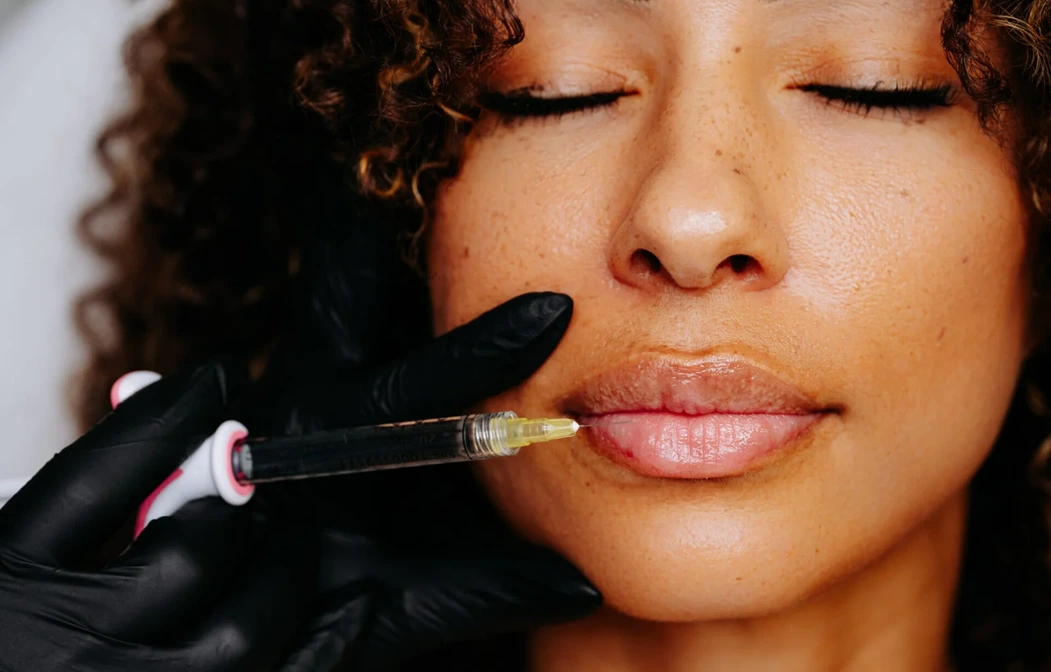
Russian lip filler is a lip-shaping approach that emphasizes vertical lift, central height and Cupid’s-bow definition rather than simply making the lips wider or uniformly fuller. The technique is still based on lip anatomy and hyaluronic-acid filler principles, and the best result depends on the patient’s baseline lip volume, vermilion show, philtral shape, symmetry, age-related change and desired profile. A natural result should preserve normal lip movement, avoid overprojection and respect the vascular anatomy of the upper and lower lip.
Summary
Lip augmentation is one of the most visible facial aesthetic treatments because the lips are central to smile design, facial expression and lower-face proportion. A successful result is not simply “more volume.” It requires preservation or improvement of the vermilion border, Cupid’s bow, philtral columns, central tubercles, symmetry, projection and the relationship between the upper and lower lip.
Hyaluronic-acid fillers remain the most widely used injectable option because they can create volume, definition and contour with a material that is hydrophilic and reversible. Autologous fat and tissue grafting offer alternative volumization approaches in selected patients.
The Russian lip technique adds a particular shaping philosophy: filler is concentrated more centrally and placed with a more vertical vector to create height, central lift and a heart-shaped contour. This differs from conventional horizontal or linear lip filling, which more often distributes volume along the body of the lip.
Introduction : Lip Augmentation Is More Than Volume
Perioral aging and lip shape are influenced by genetics, intrinsic aging, sun exposure, repetitive orbicularis oris activity, soft-tissue volume, skin quality and the structural relationship between the cutaneous lip and the vermilion.
Some patients need only subtle enhancement of an already well-proportioned lip. Others have congenitally thin lips, age-related loss of vermilion show, vertical perioral lines, longer upper-lip skin or asymmetry. The treatment plan should therefore be individualized rather than based on one fashionable shape.
Perioral Anatomy
The lip is composed of epidermis, subcutaneous tissue, orbicularis oris muscle fibers and mucosa. The upper lip extends from the base of the nose to the oral mucosa and laterally toward the nasolabial folds; the lower lip extends toward the mandible and oral commissures.
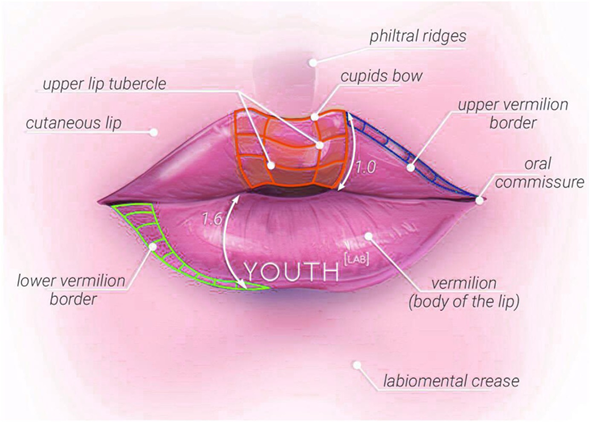
The white roll at the vermilion-cutaneous junction is an important aesthetic landmark. At the center of the upper lip, the vermilion contour forms the Cupid’s bow. The philtral columns are created by decussating orbicularis oris fibers and frame the central philtral depression.
These landmarks should be preserved during augmentation. Overfilling or poorly placed filler can blunt a naturally defined vermilion border or distort the Cupid’s bow instead of enhancing it.
Labial Arteries and Vascular Safety
The upper and lower lips are supplied by the superior and inferior labial arteries, branches of the facial artery. Their exact course varies between individuals. Deep injection in the upper lip near the muscle-mucosa interface may approach the superior labial arterial arcade, so anatomy and depth control are central to safety.
No lip-injection plane should be described as “risk free.” A safe approach combines conservative volume, slow injection, awareness of arterial variability and an immediate plan for vascular complications.
Lip Proportion, Measurement and the Golden-Ratio Concept
Facial proportion has historically been described with mathematical concepts such as the golden ratio. In lip aesthetics, a classic upper-to-lower lip relationship around 1:1.6 has often been used as a reference, but this is not a universal rule.
Preferences change across eras, ethnic groups and individual faces. In modern aesthetic practice, a balanced result may range from a more classic lower-lip-dominant proportion to a fuller 1:1 relationship, depending on the patient’s facial features and goals.
What Defines an Aesthetic Lip ?
- A recognizable but natural Cupid’s bow.
- A visible vermilion border without a shelf-like or overfilled appearance.
- Central fullness that tapers toward the oral commissures.
- Right-left symmetry while accepting normal human asymmetry.
- Balanced upper- and lower-lip volume
- Preserved philtral columns and central upper-lip anatomy
- Appropriate projection in profile without a duck-lip appearance
- Lip shape that remains natural at rest, smiling and speaking
Lip Enhancement and Contour Definition
Lip filler can target volume, shape, projection or asymmetry. A retrograde linear-threading concept can distribute product along the intended contour while reducing focal accumulation. Larger-area volumization may be performed with a blunt cannula, while a needle can provide greater precision for fine contour refinement.
The upper lip can be approached in segments so that the central lip, philtral columns and Cupid’s bow are treated deliberately rather than filled as one continuous structure. The treatment plan should be checked repeatedly for symmetry as volume is added.
Why Hyaluronic Acid Is Commonly Used
Hyaluronic acid is a naturally occurring glycosaminoglycan found throughout connective tissues. Its hydrophilic behavior allows it to bind water and support tissue hydration and volume.
Because native HA is rapidly degraded by hyaluronidase, injectable filler products use chemical crosslinking to slow degradation and create a clinically useful gel. Different products vary in HA concentration, crosslinking, particle behavior and mechanical properties, which is why not every HA filler behaves the same in the lips.
Why is HA popular for lip filler ?
HA can create soft-tissue volume, integrate with mobile lip tissue and can be dissolved with hyaluronidase if correction is required. Product selection still matters because lip movement and the thin vermilion demand a gel suited to dynamic tissue.
Assessment, Photography and Treatment Planning
Pretreatment photography should include frontal and lateral views as well as static and dynamic expressions such as smiling or puckering. Baseline asymmetry should be documented before injection so that normal facial asymmetry is not incorrectly attributed to treatment afterward.
The lip should be evaluated for vermilion volume, border definition, Cupid’s bow shape, philtral columns, upper-lip length, oral-commissure position, perioral lines and the relationship between upper and lower lip in both frontal and profile views.
Lipofilling With Autologous Fat
Autologous fat transfer is an alternative to manufactured filler. Fat can be harvested from another body area, processed and reinjected into the lips under local anesthesia. The advantage is use of the patient’s own tissue and the possibility of long-lasting volume.
Fat retention is less predictable than a measured syringe of HA because graft survival varies. Bruising, swelling, pain, infection, necrosis, calcification and contour irregularity are potential complications.
Tissue / Dermal Grafting
Autologous dermal or fascial tissue can also be used for lip augmentation. Tissue may be harvested from an existing scar or another surgical procedure, prepared and inserted into the lip as a graft.
This is a more involved strategy than injectable HA and is generally considered when an autologous surgical approach is preferred. It should not be presented as a routine replacement for minimally invasive lip filler.
Injection Technique : Technical Framework
Clinician-facing noteThe technical values below preserve the detailed framework in the supplied material. They should not be treated as universal instructions. Actual product, depth, volume and instrument choice must be individualized to anatomy, filler rheology, regulatory labeling and injector training.
The source technique uses a crosslinked HA filler and separates the objectives of volume restoration and border definition. Product is placed progressively rather than as one large bolus, with reassessment of symmetry throughout the session.
| Treatment objective | Source-derived technique concept | Source-derived volume framework | Why it matters |
|---|---|---|---|
| Restore lip volume | Oblique entry into vermilion with retrograde linear threading and controlled depth | Small aliquots around 0.05-0.1 mL per site; total around 1-1.5 mL for both lips in a session | Build volume gradually while limiting focal product accumulation |
| Define vermilion border | Parallel placement along the intended vermilion-border contour | Very small controlled amounts; source range extends from 0.02 mL upward depending on the area | Border definition requires less product than bulk volume restoration |
| Correct asymmetry | Targeted additional placement only where needed | Approx. 0.05-0.1 mL in selected points in the source framework | Treat asymmetry deliberately instead of globally overfilling |
| Reassessment | Review after initial swelling has settled | Around 15 days in the source framework | Allows conservative touch-up rather than overcorrection at the first session |
The source material also cautions against indiscriminate product placement into the white roll because hydrophilic filler can blur the lip margin if used inappropriately.
Normal-Volume Lips : Enhancement Without Overfilling
Some patients already have attractive vermilion volume and border definition but want slightly more projection, symmetry or central fullness. These lips should not be treated as if they were volume-deficient.
The source approach uses modest vermilion augmentation, careful symmetry checks and a later reassessment rather than trying to create the final volume in one aggressive session.
Thin Lips
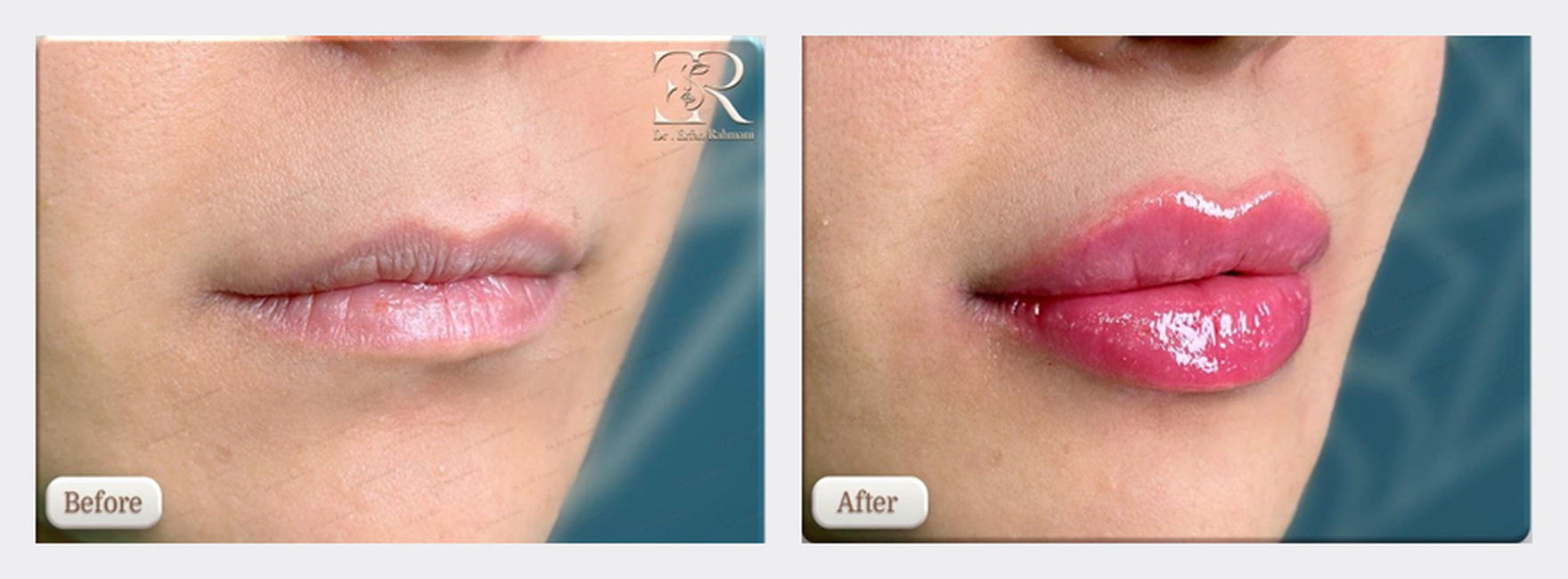
Genetically thin lips require respect for tissue expansion. The upper lip is often more volume-deficient, but some patients have globally thin upper and lower lips.
The source framework builds volume gradually, typically beginning with the thinner lip and reassessing before additional volume is added. Staged treatment allows the tissue to adapt and reduces the risk of producing an unnatural projection.
Treatment sessions in the source approach are separated by approximately one month when additional volume is required. Once the desired upper-to-lower balance is achieved, border definition and minor asymmetry can be refined.
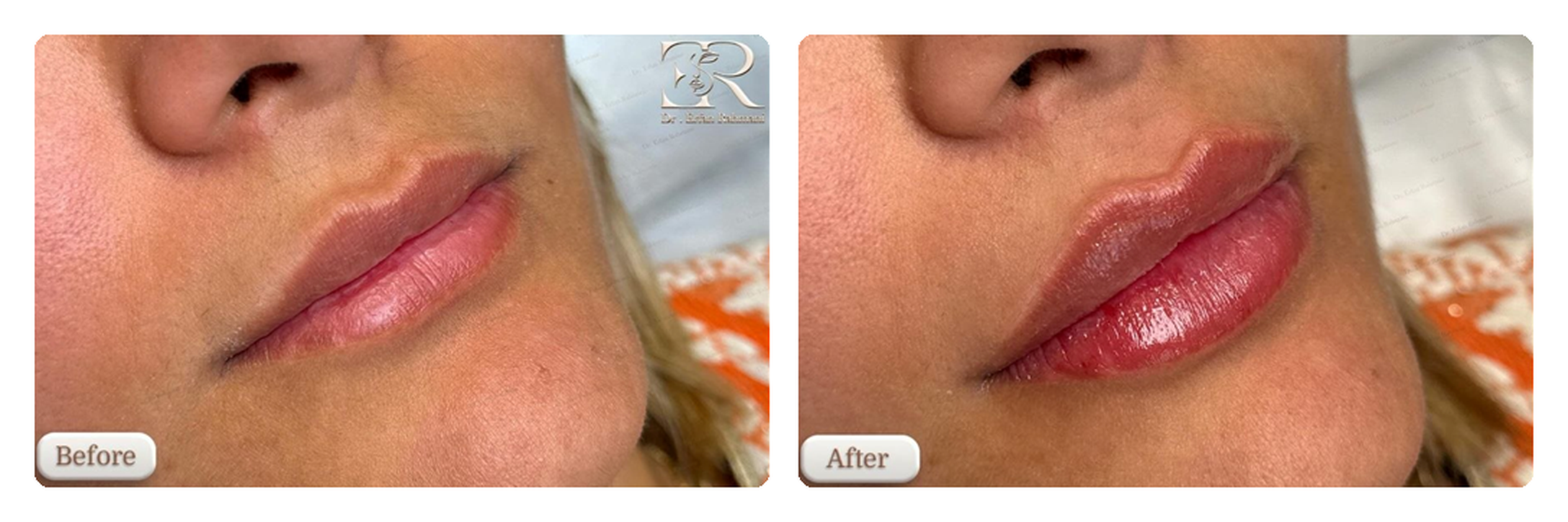
Aged Thin Lips and Perioral Rejuvenation
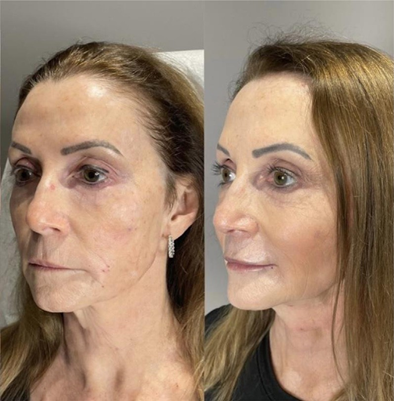
Aging lips differ from congenitally thin lips. Common changes include loss of vermilion-border definition, reduced soft-tissue volume, upper-lip lengthening and vertical perioral lines.
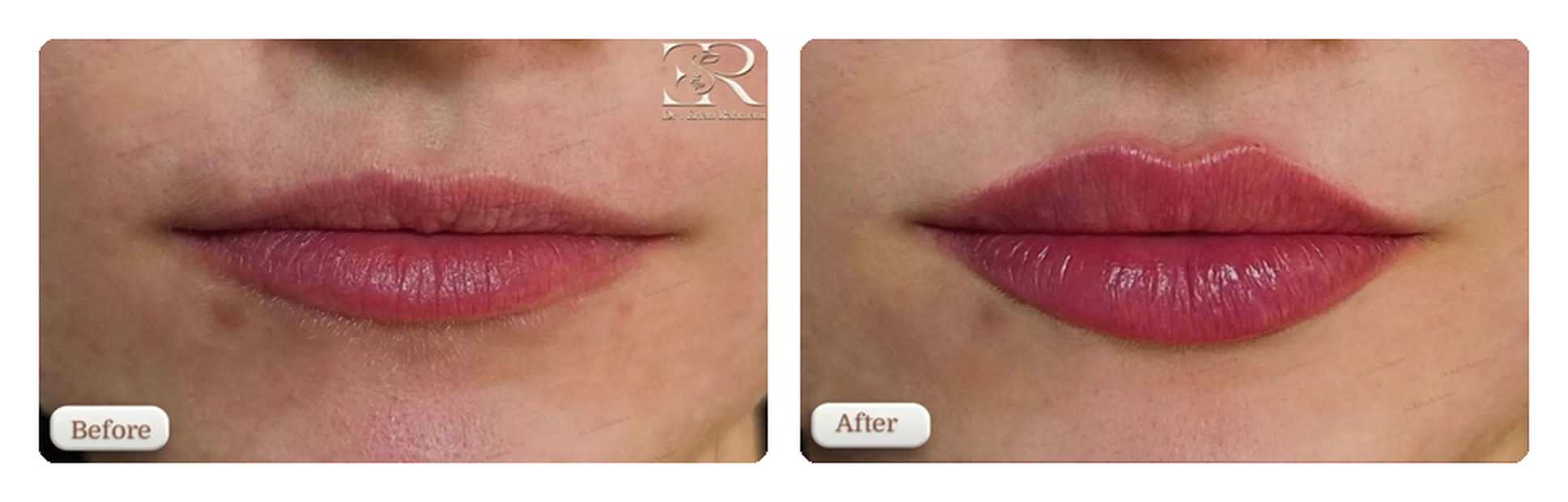
Because aging tissue may expand less predictably, a staged plan with smaller volumes can be more natural than aggressive one-session augmentation. The source framework prioritizes volume restoration first, then border definition, with perioral-line correction added where appropriate.
Maintenance intervals vary considerably by product and patient. The source clinical experience describes longer maintenance intervals after staged correction, but no fixed duration should be guaranteed because lip movement, filler type and metabolism affect longevity.
Russian Lip Filler Technique
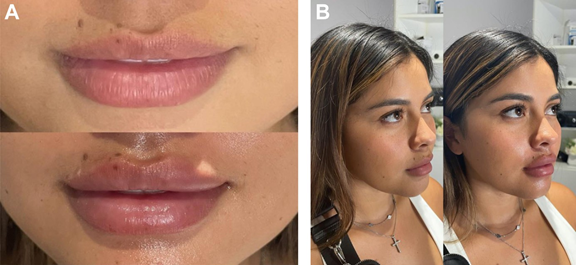
The Russian lip technique is designed around vertical lift and central shaping. Instead of primarily adding width or uniform fullness along the lip, the technique concentrates more volume toward the central lip and Cupid’s-bow region to create height and a heart-shaped contour.
The classic description uses small vertical deposits that begin closer to the body/root of the lip and progress outward toward the vermilion border. This requires precise control because the objective is shape, not simply more filler.
A well-executed Russian-style result should not automatically mean a very large lip. The aesthetic principle is central lift, a defined Cupid’s bow and a controlled lateral profile. Patients who prefer a softer, more horizontally distributed lip may be better suited to a conventional or hybrid approach.
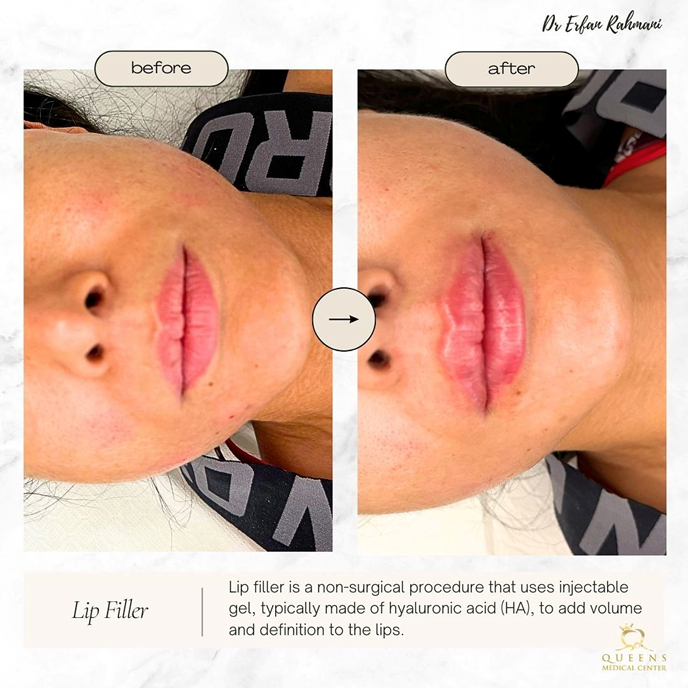
Do Existing Lip Fillers Need to Be Dissolved First ?
The source material recommends beginning the Russian technique from a clean baseline when previous filler significantly alters the intended central-vector design. In real practice, dissolving should not be automatic for every patient.
Whether previous HA should be dissolved depends on product location, migration, overfilling, asymmetry, time since treatment and the desired new shape. Well-positioned filler may sometimes be incorporated into a revised plan, whereas migrated or distorted product may need staged correction before new shaping.
Russian Lip Filler vs Conventional Lip Filler
| Feature | Conventional lip-filler approach | Russian lip-filler approach |
|---|---|---|
| Primary objective | Distributed volume, contour and/or projection | Central height, vertical lift and Cupid’s-bow emphasis |
| Typical vector | More horizontal / linear distribution along lip body | More vertical, small-volume shaping toward the vermilion |
| Visual effect | Uniform fullness can be created across the lip | Heart-shaped central fullness with controlled lateral spread |
| Best candidate | Patient wanting general volume restoration or soft contour enhancement | Patient wanting central lift and defined upper-lip shape |
| Appointment complexity | Can be relatively straightforward depending on anatomy | Often requires more meticulous point-by-point shaping |
| Downtime | Swelling and bruising possible | Swelling and bruising possible; precision may require more treatment time |
| Longevity | Product and patient dependent | Generally product and patient dependent rather than technique-dependent alone |
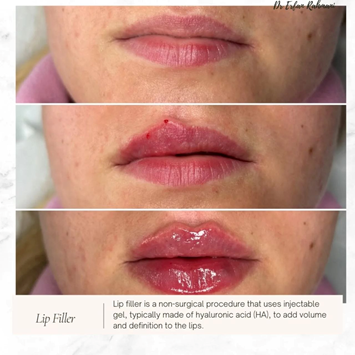
Who Is a Good Candidate for Russian Lips ?
- Patients who want more upper-lip height rather than simply more width.
- Patients who want stronger Cupid’s-bow definition.
- Patients with relatively flat central upper-lip projection.
- Patients who prefer a heart-shaped or doll-like contour when it suits their facial proportions.
- Patients with enough tissue quality to accept the planned vector without excessive tension.
- Patients who understand that natural asymmetry may not disappear completely.
Who May Be Better Suited to Another Lip-Filler Style ?
- Patients who want only subtle hydration or very soft volume.
- Patients whose lips are already vertically tall and need only lateral or body-volume support.
- Patients with significant migrated or poorly positioned previous filler that first requires correction.
- Patients with age-related perioral structural change requiring broader rejuvenation rather than a single fashionable shape.
- Patients whose facial proportions would be distorted by exaggerated central height.
Side Effects and Complications
Most routine lip-filler reactions are temporary: swelling, bruising, tenderness, redness and injection-site discomfort. Cold-sore reactivation can occur in susceptible patients. Asymmetry, lumps and contour irregularity can also develop and may require observation, massage, touch-up or HA reversal depending on the cause.
More serious complications include infection, significant overfilling, tissue injury and vascular occlusion. Vascular compromise is rare but time-sensitive and requires immediate clinical assessment and a current emergency protocol.
| Possible issue | Typical significance | Management principle |
|---|---|---|
| Swelling / bruising | Common and usually temporary | Cooling, observation and patient-specific supportive care |
| Tenderness / redness | Common early response | Monitor expected recovery and assess if worsening |
| Cold-sore reactivation | Relevant in patients with history | Prevention/treatment according to clinical history and local protocol |
| Asymmetry | Can reflect baseline anatomy, swelling or product placement | Reassess after swelling settles; touch-up or HA correction when appropriate |
| Lumps / irregularity | May reflect superficial or focal product accumulation | Differentiate edema, product, inflammation and infection before treatment |
| Infection | Uncommon but important | Prompt medical assessment and antimicrobial management when indicated |
| Vascular occlusion | Rare, potentially severe | Immediate emergency recognition and clinic occlusion protocol |
Safety Priority
Lip filler should be performed in a setting that can recognize and manage vascular compromise immediately. Because hyaluronic-acid filler can be dissolved, the clinic should have an up-to-date HA-filler emergency pathway and appropriate reversal material available.
Aftercare and Early Recovery
- Expect swelling to be most visible early and to change during the first several days.
- Avoid judging final symmetry while significant edema is present.
- Use the treating clinician’s specific instructions for cooling, cleansing, exercise, makeup and pressure on the lips.
- Contact the clinic urgently for increasing severe pain, progressive blanching or dusky discoloration, rapidly worsening asymmetry, unusual coldness of the skin, visual symptoms or other signs outside the expected recovery pattern.
- A planned review after initial swelling settles is more useful than repeated early manipulation of the lips.
Russian Lip Filler Consultation in Abu Dhabi : What Should Be Assessed ?
- Do I want central height, overall volume, projection, border definition or hydration ?
- What is my natural upper-to-lower lip relationship ?
- How defined are my Cupid’s bow and philtral columns ?
- Do I have baseline asymmetry that should be documented before treatment ?
- Do I have previous filler, migration or overprojection that changes the plan ?
- Would conventional, Russian or hybrid technique suit my face better ?
- Which HA product and rheology are being selected for my specific lip tissue ?
- How much filler is realistic in one session ?
- Will I need staged treatment rather than one large-volume appointment ?
- What is the clinic’s emergency plan for vascular complications ?
Common Mistakes in Lip Augmentation
- Choosing a fashionable technique before assessing the patient’s anatomy.
- Trying to correct every lip with the same upper-to-lower ratio.
- Overfilling the lip body instead of separating volume, shape and projection goals.
- Blunting the vermilion border with poorly placed hydrophilic filler.
- Ignoring baseline asymmetry and oral-commissure position.
- Using large boluses where incremental placement would give more control.
- Trying to complete major volume expansion in one session.
- Failing to account for previous filler or migration.
- Judging the final result during peak swelling.
- Performing lip filler without a vascular-occlusion emergency pathway.
