
What Are Exosomes ?
Exosomes are one class of extracellular vesicles—small membrane-bound particles released by cells. Their lipid bilayer encloses a biologically complex cargo that can include proteins, nucleic acids, microRNAs, cholesterol, sphingomyelin and other signaling molecules. Instead of behaving like a passive fragment of a cell, an exosome can function as an intercellular communication package: it is released by one cell, travels through the extracellular environment and can be taken up by another cell, potentially altering the recipient cell’s behavior.
The source review highlights several features that make exosomes attractive to regenerative-medicine researchers: relative biocompatibility, low immunogenicity compared with many cell-based strategies, tissue permeability and their ability to act as delivery vehicles. The exosomal membrane also protects cargo from rapid degradation and may influence how long active molecules remain available in the local environment.
Exosomes are not the same thing as living stem cells. A stem cell is a living, self-renewing cell with the capacity to differentiate. An exosome is a vesicle secreted by a cell. This distinction is clinically important because the theoretical appeal of an exosome-based product is that it may carry some signaling components associated with a parent cell without administering the living cell itself. However, “cell-free” should never be interpreted as “automatically proven,” “automatically standardized” or “risk-free.” Product source, processing and quality control remain central.
What Is Inside an Exosome ?
- Membrane proteins and tetraspanins such as CD63, CD81 and CD9, commonly used in exosome characterization.
- Proteins involved in vesicle trafficking and membrane fusion, including RAB-family proteins and annexins.
- Heat-shock proteins and other functional proteins.
- MicroRNAs and other nucleic acids that may influence gene expression in recipient cells.
- Lipids that contribute to membrane integrity and vesicle signaling.
- Cargo that reflects the parent cell and its environment—one reason different exosome products cannot be assumed to be biologically identical.
How Exosomes Are Formed
Exosome biogenesis begins inside the endosomal system. Cell-membrane components are internalized into early sorting endosomes, which mature into later endosomal compartments and multivesicular bodies. Small intraluminal vesicles form inside these structures. A multivesicular body can then be degraded through lysosomal pathways or fuse with the plasma membrane and release its vesicles outside the cell. Those released vesicles are commonly described as exosomes.
The review describes both ESCRT-dependent and ESCRT-independent mechanisms. For aesthetic translation, the importance of this biology is practical: if manufacturers want to produce exosomes reproducibly at scale, they have to control cell source, culture conditions, release pathways, purification and storage. Changing those variables may change not only yield but also cargo and biological activity.
Why Exosomes Are Being Studied in Aesthetic Medicine
Aesthetic medicine overlaps with regenerative medicine wherever the goal is not simply to fill a space or relax a muscle, but to influence tissue behavior: inflammation, collagen remodeling, pigmentation pathways, wound healing, cellular senescence or hair-follicle signaling. Exosomes are attractive in this context because their cargo can affect multiple biological pathways at the same time.
The 2022 review organizes the aesthetic applications into four major domains: wound repair, anti-aging and photoaging, hyperpigmentation and hair loss. These areas are biologically distinct. That means an exosome preparation that appears promising for one target should not automatically be assumed to work for another. The parent-cell source, cargo, dose, route of administration and outcome measure all matter.
1. Exosomes and Wound Healing
Wound healing is a coordinated process involving hemostasis, inflammation, tissue formation and remodeling. The review summarizes preclinical evidence suggesting that exosome signaling may influence several phases at once. Proposed effects include modulation of inflammation, promotion of angiogenesis, support of fibroblast migration, extracellular-matrix deposition and control of excessive scar formation.
One frequently discussed mechanism is macrophage polarization. In the cited work, mesenchymal stem cell-derived exosomes carrying microRNA signals were associated with changes in macrophage behavior and inflammatory mediators. In other models, endothelial-progenitor-cell exosomes activated ERK-related signaling and were associated with endothelial proliferation, migration, tube formation and faster tissue remodeling. These are mechanistically relevant findings for regenerative medicine because an aesthetic procedure intentionally creates a controlled tissue injury in many settings—microneedling, laser resurfacing and other energy-based treatments are obvious examples.
However, an important distinction is required: showing that exosomes can modify wound-healing pathways in cell cultures or animal wounds does not prove that any commercially available topical “exosome serum” will shorten downtime or improve scar quality in a human aesthetic patient. Translation depends on dose, formulation, skin-barrier access, sterility, source and how the product was processed.
Angiogenesis and Tissue Remodeling
Tissue remodeling depends heavily on endothelial cells and fibroblasts. The review describes experiments in which exosome exposure was associated with enhanced endothelial proliferation, capillary-like tube formation, fibroblast migration, collagen deposition and wound closure. These mechanisms help explain why exosome research attracts interest in scar care and post-procedure recovery.
Scar Formation : Why the TGF-β Pathway Matters
A scar is not simply “too little healing.” It can reflect dysregulated remodeling and excessive fibroblast activity. The review discusses exosomal microRNA signaling involving the TGF-β/SMAD pathway and experimental findings in which exosome preparations reduced markers associated with excessive scar formation. This is scientifically interesting because TGF-β signaling is deeply involved in fibroblast activation and extracellular-matrix remodeling.
For a patient-facing website, the appropriate conclusion is not that exosomes are a proven scar cure. A more accurate statement is that exosome-based approaches are being investigated as cell-free regenerative tools that may influence pathways relevant to wound repair and scar formation, but optimal formulations, indications and clinical protocols still require stronger human evidence.
2. Exosomes, Skin Aging and Photoaging
Skin aging is driven by multiple processes: cellular senescence, oxidative stress, chronic low-grade inflammation, extracellular-matrix degradation and repeated ultraviolet exposure. The exosome literature reviewed by Zhang and colleagues focuses mainly on cellular and animal models examining senescence markers, NAD-related pathways, matrix metalloproteinases and collagen expression.
One concept is cellular senescence. Senescent cells stop dividing and develop altered metabolic and inflammatory behavior. The review describes experimental systems in which exosome-like nanovesicles derived from induced pluripotent stem cells reduced senescence-associated β-galactosidase activity and the expression of p53 and p21 in fibroblast models. It also discusses extracellular-vesicle-associated NAMPT and NAD biosynthesis in aging research. These findings are biologically interesting but are not equivalent to a clinical claim that an aesthetic exosome treatment reverses human aging.
Photoaging is a more directly skin-related target. Ultraviolet exposure increases matrix metalloproteinases such as MMP-1 and MMP-3, which contribute to collagen breakdown. Several preclinical studies reviewed in the paper reported lower MMP expression and higher type I collagen, type III collagen or elastin-related markers after exposure to particular exosome preparations. Again, the signal is promising; the human cosmetic evidence base was still limited in the review.
3. Exosomes and Hyperpigmentation
Pigmentation is controlled by a network of melanocyte signaling pathways. Melanin production is influenced by tyrosinase, MITF, ERK, AKT/GSK3β and multiple upstream mediators. The review summarizes preclinical studies in which exosome-derived microRNAs were associated with lower melanogenesis or greater melanosome degradation.
Examples include human amniotic stem cell-derived exosomal microRNAs that reduced MITF expression in experimental systems, umbilical-cord mesenchymal stem cell-derived exosomes associated with ERK activation and lower melanin synthesis, and milk-derived exosomal miR-2478 affecting the AKT-GSK3β pathway. These data make pigmentation a biologically plausible area of exosome research.
Nevertheless, pigmentation disorders are heterogeneous. Melasma, post-inflammatory hyperpigmentation, lentigines and pigment after acne or procedures do not have identical biology. A treatment that influences melanogenesis in a laboratory model cannot be assumed to treat every pigmentation diagnosis. Clinical diagnosis, sun protection, trigger control and evidence-based pigment therapies remain essential parts of real-world care.
4. Exosomes and Hair Loss
Hair biology is another major focus of exosome research. Dermal papilla cells sit at the base of the hair follicle and function as an important signaling center. The review describes exosomal effects on pathways including Wnt/β-catenin, BMP2, BMP4, AKT, Bcl-2 and TNF-α. In experimental models, these signals were associated with dermal papilla cell proliferation, migration, preservation of hair-inductive behavior and transition of follicles from resting toward growth phases.
Different exosome sources have been studied, including dermal papilla cell-derived vesicles and adipose-derived mesenchymal stem cell exosomes. The review also discusses apoptotic extracellular vesicles and activation of skin and hair-follicle mesenchymal stem cells through Wnt/β-catenin signaling in animal models.
The clinically responsible message is again one of calibrated enthusiasm. Exosome-based hair treatments are biologically promising, but the review states that they were still in their infancy and that stronger clinical studies were needed to define efficacy, safety, benefits and limitations. Hair loss also has many causes—genetic, endocrine, nutritional, immune, drug-related and age-related—so a diagnostic assessment should precede any regenerative treatment plan.
How Are Exosomes Applied in Aesthetic Research ?
The source review describes two broad administration strategies in aesthetic research: topical/transdermal delivery and local injection. The route matters because exosomes are biologically active vesicles and intact skin is a strong barrier. Simply placing a product on the surface is not equivalent to delivering it into viable skin layers.
Topical and Transdermal Delivery
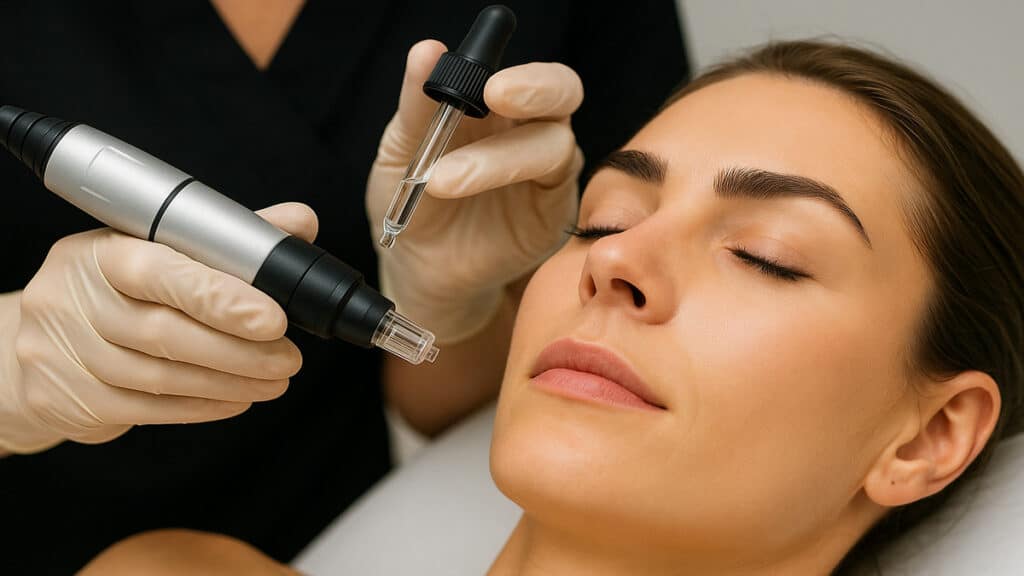
Topical use is attractive because it is noninvasive and easy to combine with local care. Research approaches have included direct application to experimental wounds and delivery technologies such as microneedles or other transdermal systems. In aesthetic practice, the concept is often discussed alongside procedures that temporarily disrupt the epidermal barrier. The key scientific question is not just whether the product touches the skin, but whether relevant vesicles remain intact, penetrate to the intended depth and retain biological activity.
Local Injection
Local injection bypasses the skin barrier and can deliver material directly to a target area, which is why injection appears in experimental literature. But this route also raises a higher bar for product quality, sterility, characterization and regulatory compliance. A vial described commercially as “exosomes” should not be assumed to have the same biological composition, purity or evidence as a preparation used in a published study.
Why Manufacturing Quality Matters More Than the Word “Exosome”
Two products can both be marketed with the word “exosome” and still differ substantially. Exosome cargo reflects the parent cell, culture environment, production method, purification process and storage conditions. The review therefore devotes a large section to engineering production, isolation and preservation. This is not an academic side issue; it is central to reproducibility and safety.
The authors describe efforts to increase exosome yield through gene manipulation, altered culture conditions and three-dimensional culture systems. Some strategies can markedly increase vesicle production. But increasing quantity is only one goal. A high-yield system is not useful if it changes cargo unpredictably, introduces contaminants or produces a preparation that cannot be standardized between batches.
The review emphasizes Good Manufacturing Practice (GMP) as a critical consideration for large-scale translational production. For aesthetic medicine, a sensible patient-facing principle follows: quality assurance should focus on source traceability, sterility, identity, purity, reproducibility and storage—not on marketing terminology alone.
Storage and Preservation
Biological activity can change during storage. The review discusses cryopreservation, freeze-drying and spray drying, noting that preservation is a major barrier to reliable clinical translation. Temperature, repeated freeze-thaw cycles, stabilizers and formulation can alter vesicle integrity or function.
The review describes −80°C as a common long-term storage condition and 4°C for short-term storage, while also discussing freeze-drying as a strategy for transport or longer-term product development. Those statements should be interpreted as technical review findings rather than instructions for patients to store or handle a medical product themselves. Commercial products should be used only according to validated manufacturer and regulatory instructions.
From a clinical-quality perspective, storage is part of the treatment. A biologic product that has been exposed to inappropriate temperature or repeated freeze-thaw cycles may not be equivalent to the preparation that was originally manufactured and characterized.
What Exosomes Can and Cannot Be Claimed to Do
| Reasonable evidence-led wording | Wording to avoid without product-specific human evidence |
|---|---|
| “Exosomes are being studied for pathways involved in wound healing and tissue remodeling.” | “Exosomes guarantee faster healing.” |
| “Preclinical studies suggest effects on MMPs and collagen-related signaling in photoaging models.” | “Exosomes reverse skin aging.” |
| “Experimental studies report changes in melanogenesis pathways.” | “Exosomes cure melasma or pigmentation.” |
| “Hair-follicle and dermal-papilla signaling is an active research area.” | “Exosomes regrow hair in everyone.” |
| “Results may depend on product source, purity, route, dose and patient factors.” | “All exosome products are equivalent.” |
Exosomes vs Stem Cells
No. Exosomes are not stem cells. Stem cells are living cells capable of self-renewal and differentiation. Exosomes are non-living extracellular vesicles released by cells. They may carry proteins, lipids and genetic signals from their parent cells, but they do not divide or become new tissue. This distinction is one reason exosomes are being explored as a cell-free regenerative platform, but it does not remove the need for rigorous manufacturing, safety testing and clinical evidence.
Exosomes vs PRP : Are They the Same ?
They are not the same category. PRP is an autologous blood-derived preparation enriched in platelets and associated growth factors. Exosome preparations are extracellular-vesicle products whose composition depends on their biological source and manufacturing process. A meaningful comparison should therefore be indication-specific and product-specific. The 2022 exosome review does not establish that exosomes are universally superior to PRP, nor does it provide a head-to-head aesthetic trial proving one approach is better across skin or hair indications.
Who Might Ask About Exosome-Based Treatments ?
In an aesthetic clinic, patients may ask about exosomes when their goals include skin quality, post-procedure recovery, acne-scar support, photoaging, uneven pigmentation or hair thinning. The scientific review provides a rationale for why these areas are being studied, but it does not define a standardized candidate profile, dose or protocol for routine cosmetic use. That means consultation should start with the diagnosis and the goal—not with the device or vial.
For example, hair thinning should be classified before treatment. Pigmentation should be diagnosed before attempting to suppress melanin. Acne scarring may require structural treatments such as subcision, fractional resurfacing or collagen remodeling depending on scar type. And photoaging may be treated with a combination of sun protection, topical therapy, energy-based procedures, injectables or regenerative approaches depending on the patient. Exosome-based care, where appropriate and compliant, should sit inside that broader plan rather than replace diagnostic thinking.
Safety : What Patients Should Understand
The review does not provide a definitive standardized safety profile for all aesthetic exosome products because “exosomes” are not one uniform formulation. Safety depends on source material, donor screening where relevant, manufacturing controls, purification, sterility, contamination risk, storage, route and dose. In addition, allogeneic biologic materials may raise immunologic questions, and the paper highlights the need for further work on donor variability, biodistribution, absorption and long-term effects.
The safest way to communicate this topic is to avoid describing exosomes as inherently harmless because they are “natural.” Biological activity is exactly why they are scientifically interesting, and that same activity makes quality control important. Patients should be informed about the specific product and protocol being considered, the available human evidence, alternatives and uncertainties.
Exosomes in Abu Dhabi - Frequently Asked Questions

1. What are exosomes in aesthetic medicine ?
Exosomes are extracellular vesicles released by cells. They can carry proteins, lipids and nucleic-acid signals between cells. In aesthetic research they are being studied for wound repair, photoaging, pigmentation and hair-follicle biology.