
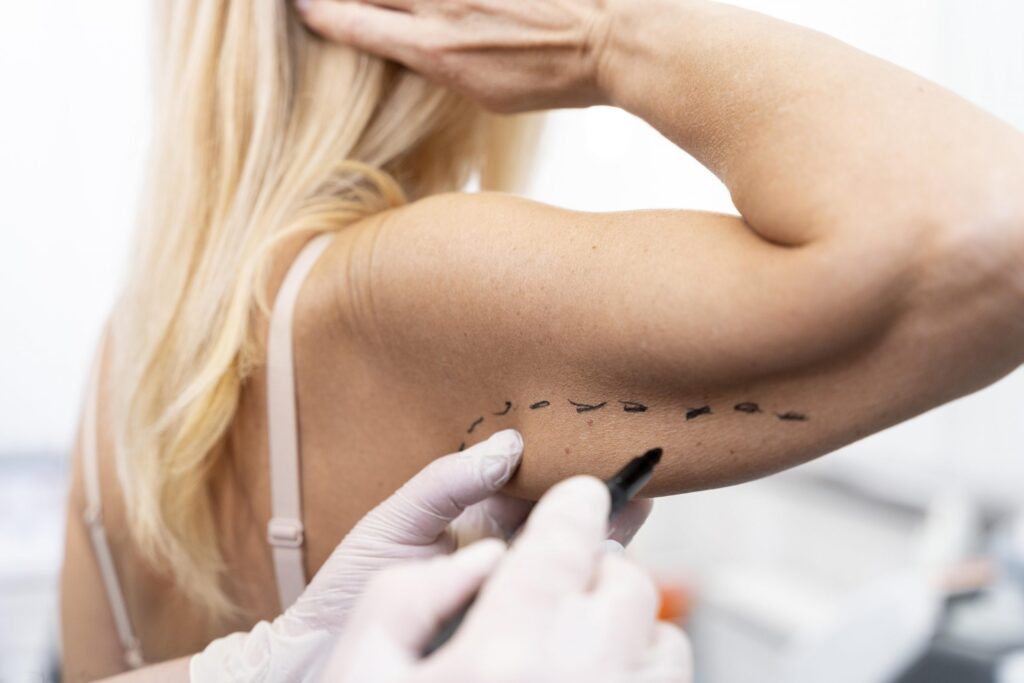
Endolift for Abdomen Fat Reduction in Abu Dhabi
Persistent lower-abdominal fat can remain despite diet, exercise and stable weight. Endolift is a minimally invasive laser-based contouring technique that has been clinically evaluated for under-abdominal fat reduction. The most accurate way to present the evidence is to focus on localized lower-abdominal contouring rather than weight loss or full-abdomen transformation.
What can lower-abdomen Endolift target?
- Localized subcutaneous fat in the under-abdominal / lower-abdominal region.
- Contour concerns in patients who want a less invasive option than surgical fat removal.
- Skin quality and tightening alongside fat reduction; the paper discusses dermal tightening as an advantage of laser-based contouring.
- Patients prioritizing limited recovery and avoidance of general anesthesia, when clinically appropriate.
How the treatment works
The source study used Endolift with a fine optical fiber in the treatment area under local anesthesia. The authors describe laser effects on adipose tissue and the dermis, with the aim of reducing localized fat while supporting skin tightening. Treatment frequency in the protocol ranged from one to three sessions depending on the amount of adipose tissue, cellulite, age and treatment area.
Clinical evidence for lower-abdominal contouring
Ten women and men aged 25–55 years with excess fat in the arms and under abdomen were enrolled. Under-abdominal circumference was measured before treatment and again at 2 and 3 months. Patient satisfaction and blinded physician assessment were also used as outcome measures.
| Outcome | 2 months | 3 months |
|---|---|---|
| Under-abdominal circumference | 80% achieved ≥2 cm decrease | 80% showed a 3 cm reduction |
| Well satisfied patients | 7 of 10 (70%) | 8 of 10 (80%) |
| Reported adverse effects | No adverse side effects reported in the study | No adverse side effects reported in the study |

Results are progressive, not instant
The study found significant reductions from baseline to 2 months and additional change between 2 and 3 months. That makes a 2–3 month review period more scientifically aligned with the source than promising an immediate final abdominal result.
Who may be a suitable candidate?
A flat or protruding abdomen can result from multiple factors, including subcutaneous fat, visceral fat, skin laxity, abdominal-wall anatomy and overall body weight. Endolift targets a specific component: localized treatable tissue in a selected area. A physical assessment is therefore essential before deciding that Endolift is the right treatment.
- Adults with localized lower-abdominal fat and realistic contouring goals.
- Patients seeking a minimally invasive approach rather than a surgical procedure.
- Patients whose weight and lifestyle are sufficiently stable to assess a local contouring result.
Who needs extra caution or may not match the study population?
- Pregnancy or breastfeeding.
- Active wounds, infection or trauma in the treatment area.
- Coagulation disorders or anticoagulant medication.
- Lidocaine sensitivity.
- Certain chronic illnesses, cancer, cardiovascular disease, diabetes, or conditions associated with weight fluctuation, swelling or edema were excluded from the study.
- Recent abdominal sculpting procedures or local slimming treatments were excluded from the protocol.
What Endolift cannot promise
- It is not a treatment for visceral fat inside the abdomen.
- It is not a weight-loss program or a substitute for treating obesity.
- It should not be described as equivalent to abdominoplasty or liposuction for patients who need major fat removal or excision of significant excess skin.
- The published study does not establish a universal centimeter reduction for every patient.
Downtime and recovery
In this study, the authors report that the procedure did not require general anesthesia or a formal recovery period, and patients did not report adverse effects during follow-up. Individual recovery still depends on the treatment area, tissue volume, protocol and patient factors.
How Endolift fits into body-contouring choices
The source paper discusses Endolift in the wider context of liposuction, cryolipolysis, radiofrequency, focused ultrasound and other laser-based body-contouring methods. It does not provide a direct head-to-head trial against these options, so treatment selection should be based on anatomy, amount of fat, skin quality, goals and tolerance for downtime.
| Option | Main role | Downtime / invasiveness | Important note |
|---|---|---|---|
| Endolift | Targeted contouring with subdermal laser energy | Minimally invasive; local anesthesia in the study | Evidence here is a small clinical cohort. |
| Liposuction | Surgical fat removal | More invasive; anesthesia and surgical recovery | May be preferred when a larger-volume surgical change is required. |
| Cryolipolysis / RF / HIFU | Non-surgical body contouring | Device-dependent | The paper lists these as alternatives; it did not compare them directly with Endolift. |
Why abdominal assessment is especially important
The abdomen is not a single layer of fat. A consultation should distinguish pinchable subcutaneous fat from visceral fullness, skin laxity and abdominal-wall issues. This avoids overpromising a laser contouring procedure when the visible concern is driven by anatomy that the treatment is not designed to correct.
