
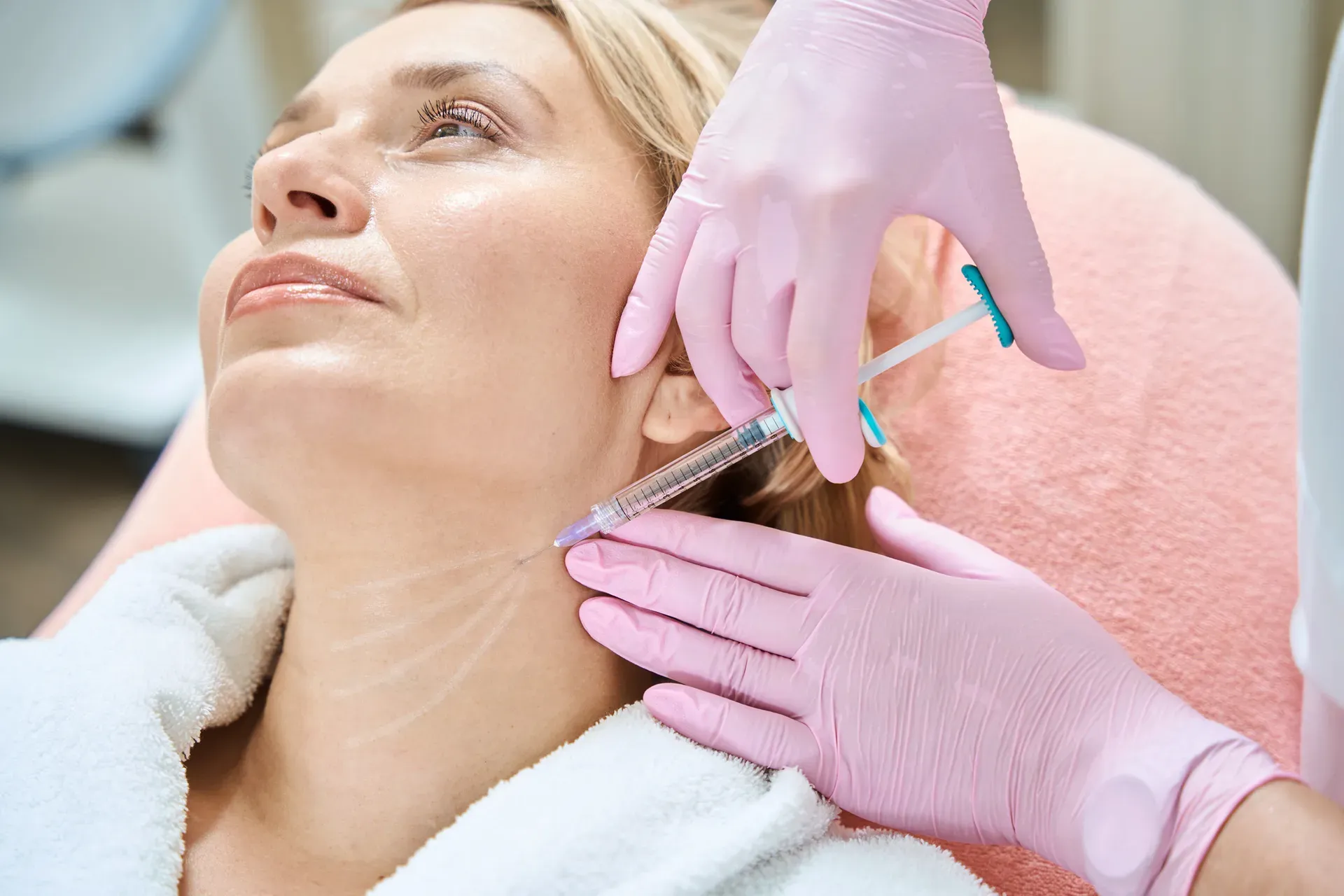
Hyperdilute calcium hydroxylapatite (CaHA) is a biostimulatory injectable approach designed to improve skin quality with little or no intentional volumization. CaHA microspheres stimulate fibroblast activity, collagen, elastin and tissue remodeling; dilution is selected according to skin thickness, laxity and treatment area.
What Is Hyperdilute Radiesse?
Radiesse is a calcium hydroxylapatite (CaHA) injectable. Its smooth CaHA microspheres are suspended in a carrier gel. In its conventional form, CaHA can provide immediate structural support; when diluted or hyperdiluted, the goal shifts toward broad dermal biostimulation with much less intentional volume.
In simple terms: traditional CaHA can be used as a structural filler; hyperdilute CaHA is used more like a collagen-and-elastin biostimulator spread over a larger area of skin.
The source chapter describes a two-stage mechanism: the carrier gel creates the early volume effect and gradually dissipates, while CaHA microspheres stimulate fibroblasts and the endogenous production of collagen and elastin. Neocollagenesis has been observed from about four weeks, with remodeling continuing for months.
How Does CaHA Biostimulation Work?
- CaHA microspheres are placed in an appropriate dermal or subdermal tissue plane.
- Fibroblast activity is stimulated around the microspheres.
- New collagen develops progressively; type III collagen appears earlier and type I collagen becomes more prominent later in the remodeling process.
- Elastin expression and angiogenesis may also increase, supporting improved dermal quality.
- The visible result is gradual improvement in firmness, texture and tissue quality rather than a sudden “filled” appearance.
Why this matters for patients: the treatment is not simply chasing individual lines. It is intended to improve the quality of the tissue itself, which is why results evolve over time.
Hyperdilute Radiesse vs Regular Radiesse
| Feature | Conventional / minimally diluted CaHA | Dilute / hyperdilute CaHA |
|---|---|---|
| Main objective | Volume, projection and contour | Skin quality, firmness and biostimulation |
| Immediate volume | More noticeable | Minimal or intentionally reduced |
| Typical distribution | More focal / structural | Thin, smooth, broad coating over larger area |
| Best suited for | Selected facial contour and volume deficits | Mild laxity, crepiness and dermal rejuvenation |
| Treatment planning | Depth depends on anatomic objective | Dilution and plane depend strongly on skin thickness and laxity |
Which Areas Can Be Treated?
The medical chapter describes dilute or hyperdilute CaHA across multiple facial and body locations. Many of these rejuvenation indications are off-label and should be discussed during consultation.
- Mid and lower face for dermal rejuvenation
- Neck and décolletage for mild laxity and skin quality
- Upper arms for crepiness and mild laxity
- Abdomen for selected skin flaccidity and dermal thinning
- Buttocks and thighs for surface irregularity, laxity and selected cellulite-related concerns
- Dorsal hands for volume loss and visible tendons/veins
- Selected stretch marks, usually as part of a combination strategy
- Knees and elbows: described by experts, but the chapter notes a lack of clinical studies for these areas
Hyperdilute Radiesse for the Face
For facial rejuvenation, dilute and hyperdilute CaHA may be used in the mid and lower face as an adjunct to volumizing treatments. The source chapter describes a commonly preferred 1:1 dilution for facial treatments, with higher dilutions such as 1:3 considered where skin is thin or lax and more superficial distribution is desired. A published 1:2 hyperdilute approach improved mid- and lower-face aging severity scores at four months and showed collagen remodeling on noninvasive imaging.
Hyperdilute Radiesse for the Neck and Décolletage
The neck is a particularly anatomy-sensitive region because the skin is thin and closely related to the platysma. The chapter reports improvement in skin quality, elasticity, pliability and dermal thickness with dilute CaHA, with greatest benefit described in patients with mild laxity. Dilution is adjusted to tissue thickness, and careful plane selection is important to reduce product visibility and nodule risk.
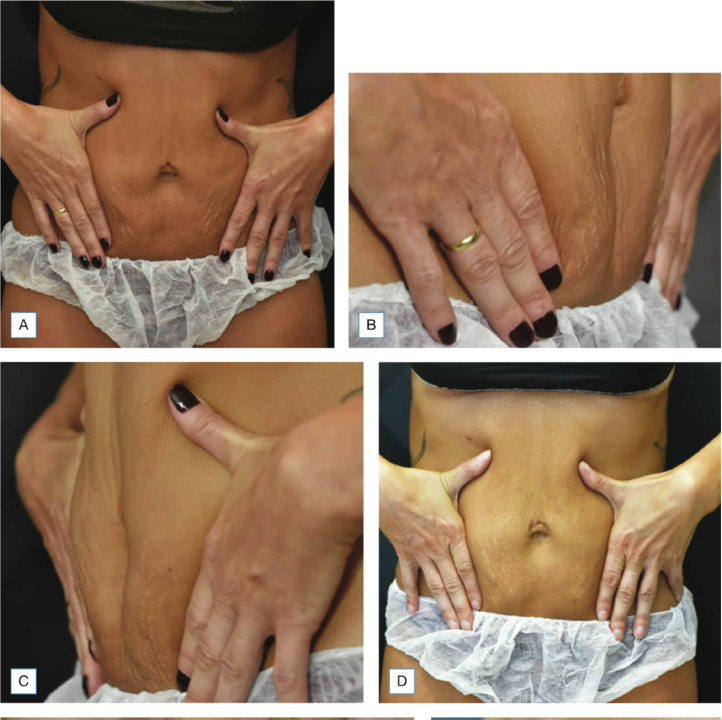
Hyperdilute Radiesse for the Abdomen
For selected abdominal skin laxity, CaHA has been studied as a skin-remodeling treatment. One case series described a 27% increase in dermal thickness after subdermal CaHA diluted 1:4. The chapter also notes that deeper contour deficits may need correction before superficial biostimulation is layered over the area.

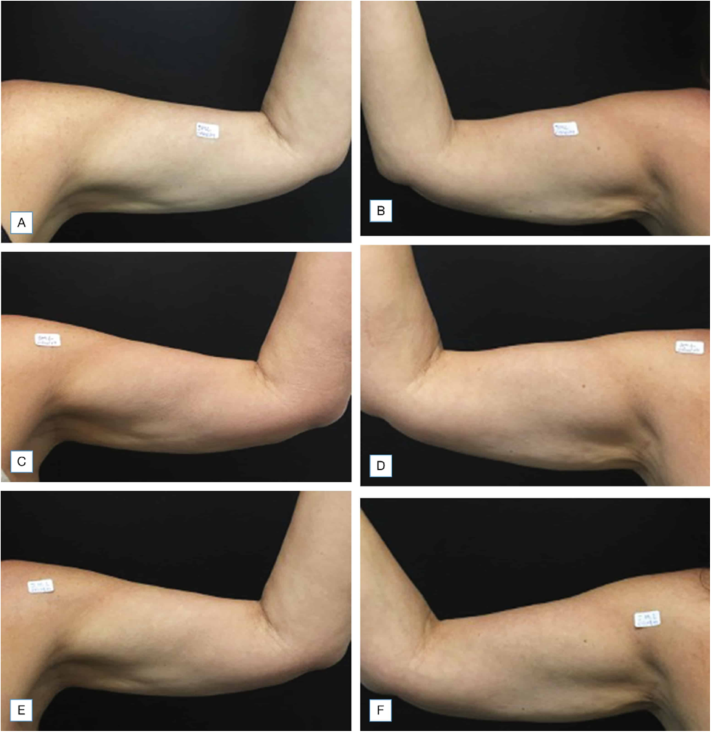
Hyperdilute Radiesse for the Upper Arms
Upper-arm treatment is aimed at mild laxity and crepey skin. The source chapter reports progressive improvement in skin elasticity after subdermal diluted CaHA and describes particularly useful outcomes in appropriately selected patients with mild rather than severe excess skin.
Radiesse for Hand Rejuvenation
Aging hands often show skin thinning, loss of intermetacarpal fat and greater visibility of veins and tendons. CaHA has an FDA-approved indication for correction of dorsal hand volume loss. Dilution can improve spread and may reduce edema, bruising and nodule formation when the goal is broader rejuvenation rather than concentrated volumization.

Can Hyperdilute Radiesse Help Cellulite or Thigh Skin?
The chapter describes CaHA as a potential component of combination treatment for buttock and thigh surface irregularities. In one study, CaHA diluted 1:1 and used immediately after microfocused ultrasound was associated with an almost 50% improvement in cellulite severity at 90 days, together with histologic evidence of neocollagenesis. Patient selection is important: mild laxity and surface irregularity without major excess fat are more favorable targets than severe laxity or large-volume contour problems.
Can CaHA Be Used for Stretch Marks?
The source describes improvement in dermal collagen and elastin when diluted CaHA was combined with microneedling and topical ascorbic acid for atrophic striae. This is a combination approach rather than evidence that CaHA alone is universally appropriate for every stretch mark.
When Do Results Start?
Collagen remodeling is gradual. The chapter cites neocollagenesis beginning from approximately four weeks, with peak deposition of new collagen and elastin around several months in some studies. For this reason, many experts reassess patients around three to four months after an initial session before deciding whether additional treatment is required.
| Time | What patients may notice |
|---|---|
| Immediately | Temporary fullness or swelling related to injection and carrier fluid. |
| ~4 weeks | Early collagen remodeling may begin. |
| 3–4 months | A useful reassessment window for skin quality and need for further treatment. |
| 6–12+ months | Ongoing tissue remodeling and maintenance planning; longevity varies by area, technique, age and metabolism. |
How Many Sessions Are Usually Needed?
There is no single protocol for every patient. Expert panels cited in the chapter recommend either two to three sessions at roughly one- to two-month intervals, or one to three sessions during the first year followed by maintenance around every 12 to 18 months. Larger body areas and higher dilutions may require additional treatment. The correct plan depends on anatomy, laxity, skin thickness, treatment area and desired degree of change.
Who Is a Good Candidate?
- Patients with mild to moderate skin laxity rather than severe excess skin
- Patients seeking gradual improvement in skin quality rather than dramatic immediate volume
- People with crepey skin or dermal thinning in selected face or body areas
- Patients who understand that results build over weeks to months
- Patients willing to follow a staged, anatomy-based treatment plan
Not every patient with laxity is a CaHA candidate. Severe skin excess, major fat-related contour problems or anatomy requiring surgical correction may need a different strategy.
Safety and Side Effects
Common injection-site reactions include bruising, swelling, redness, tenderness, pain and itching. These are usually transient. The chapter’s safety review reports that nodules are the most common filler-specific adverse event with CaHA, while serious reactions were uncommon in the cited literature.
Important : CaHA is not hyaluronidase-dissolvable. Correct product selection, dilution, depth, distribution and anatomic knowledge are therefore especially important.
The chapter emphasizes that nodules are more likely to reflect product accumulation than a true granulomatous reaction. Dynamic facial areas such as the lips and periorbital region have higher nodule risk and are generally avoided for CaHA. Superficial placement of less diluted product can also make it visible, especially in thin or darker skin.
Is Radiesse Suitable for Skin of Color?
The source chapter reports a study of 100 patients with Fitzpatrick skin types IV–VI treated with CaHA in the nasolabial folds, with no keloid formation, hypertrophic scarring, dyspigmentation or other clinically significant adverse events reported through six months. However, the risk profile still depends on indication, technique and individual skin response, so treatment should be individualized.
Hyperdilute Radiesse vs Sculptra
Both CaHA and poly-L-lactic acid (PLLA/Sculptra) are used as collagen-stimulating injectables, but they are not identical. CaHA contains mineral microspheres in a carrier gel and can be used either structurally or in a diluted skin-remodeling approach. PLLA creates gradual volume through fibroplasia and is typically planned as a progressive biostimulatory course. The best choice depends on whether the primary goal is structure, broad skin quality, volume replacement, treatment area and desired timeline.
Hyperdilute Radiesse vs Skin-Tightening Devices
Injectable biostimulation and energy-based tightening are not mutually exclusive. The source chapter describes synergistic use of CaHA with radiofrequency, ultrasound and laser treatments in selected body areas. A combination plan may make sense when the patient has both dermal quality changes and laxity that would benefit from different mechanisms of action.
My Approach to Hyperdilute CaHA in Abu Dhabi
The treatment should begin with diagnosis, not a syringe count. I assess the thickness and quality of the skin, degree of laxity, underlying volume, fat distribution, previous procedures and the patient’s actual goal. From there, the decision is whether the patient needs structural correction, biostimulation, an energy-based treatment, a combination plan, or no injectable treatment at all.
The goal is not “more product.” The goal is the right layer, the right indication and the right degree of correction for that patient.
