
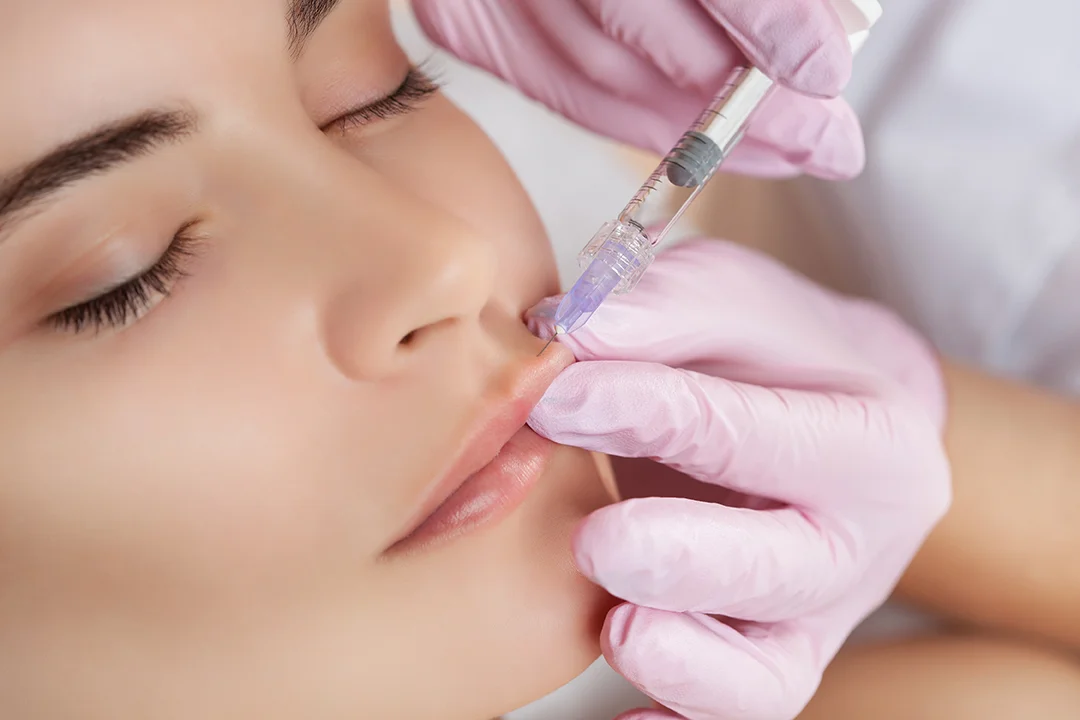
Botulinum toxin can be used conservatively around the lips to soften dynamic vertical perioral lines and create a subtle “lip flip” by reducing excessive orbicularis oris activity. Because the lips are essential for speech, drinking, eating, facial expression, and oral competence, lower-face treatment requires careful assessment, small doses, symmetrical placement, and realistic expectations. Deeper static lines often respond better to a combined plan rather than neuromodulator treatment alone.
What Are Upper and Lower Lip Wrinkles?
Vertical lines around the mouth are often called perioral rhytides or “smoker’s lines,” although smoking is not the only cause. Repetitive contraction of the orbicularis oris, genetics, sun damage, lip volume loss, soft-tissue aging, and bony changes can all contribute. Some patients mainly show lines during lip movement, while others develop lines that remain visible at rest.
Dynamic lines are driven predominantly by muscle movement and may respond well to carefully selected neuromodulator treatment. Static lines reflect a combination of repetitive movement and structural skin or volume changes, so they frequently need a multimodal approach.
Understanding the Orbicularis Oris
The orbicularis oris is a circular muscle surrounding the mouth. It contributes to closing the oral aperture and to forward projection and pursing of the lips. Repeated hyperdynamic activity can gradually accentuate radial lines around the vermilion border. This anatomy explains both the benefit and the need for caution: excessive weakening may interfere with functions patients use every day.
Aesthetic treatment therefore aims to reduce excessive contraction without eliminating natural lip movement. The goal is refinement, not a frozen mouth.
What Is a Lip Flip?
A lip flip is a small-dose neuromodulator treatment around selected fibers of the upper lip. By relaxing part of the orbicularis oris, the upper vermilion can evert slightly, making more of the pink lip visible. It does not add volume in the way a hyaluronic-acid filler does, and it should not be presented as a substitute for filler when the main concern is true volume deficiency.
For the right patient, the effect can be subtle and natural. Patients seeking a dramatic increase in lip size or major correction of structural asymmetry usually require a different or combined treatment plan.
Who May Be a Good Candidate?
- Patients with fine dynamic vertical lines around the upper or lower lip.
- Patients who want a subtle upper-lip eversion rather than added filler volume.
- Patients whose perioral lines are predominantly movement-related.
- Patients who understand that static etched lines may need filler, resurfacing, or other skin treatments as well.
- Patients with realistic expectations and no relevant contraindication to neuromodulator treatment.
Who Needs Extra Caution?
The source chapter specifically highlights occupations and hobbies that depend heavily on precise lip function. Singers, musicians who play wind instruments, and frequent public speakers may be more sensitive to even small changes in lip strength or proprioception. A detailed consultation should therefore include profession, hobbies, prior treatments, baseline asymmetry, medical history, and the patient’s functional priorities.
The face should be assessed both at rest and during movement. Existing asymmetries should be documented before treatment, because they can become more noticeable when muscle balance changes.
How Treatment Is Planned
Perioral neuromodulation is individualized according to recruitment pattern, muscle mass, wrinkle severity, baseline lip shape, asymmetry, and the desired degree of movement preservation. The supplied chapter emphasizes conservative, superficial, symmetrical treatment around the vermilion border and avoidance of overly lateral placement near the oral commissures, where unwanted spread can affect other muscles involved in smiling and oral competence.
Exact dose, product choice, dilution, number of points, and injection pattern must be decided clinically by the treating physician. Botulinum toxin products are not interchangeable unit-for-unit, and lower-face aesthetic use may be off-label depending on the product and jurisdiction.
What Results Can Patients Expect?
In appropriately selected patients, treatment can soften fine movement-related lines and may create a modest lip-flip effect. The change should preserve expression and oral function. Neuromodulators do not replace lost volume, erase deeply etched lines, or correct every cause of perioral aging.
The chapter describes evidence of improvement lasting several months in studied perioral-line protocols, but duration varies between patients and products. A review appointment is useful to assess symmetry, function, and whether a conservative touch-up is appropriate.
Botox for Dynamic vs Static Lip Lines
Dynamic perioral lines appear mainly during speaking, pursing, smiling, or other lip movements. These are the lines most logically addressed by reducing excessive muscle recruitment. Static lines remain visible at rest and often reflect collagen loss, photodamage, volume loss, and repeated folding over time. For static lines, neuromodulator monotherapy may provide only mild improvement.
For more established perioral aging, combination treatment can be considered. The chapter notes that neuromodulators may be combined with soft-tissue fillers and light, laser, or energy-based treatments. The correct sequence and combination depend on anatomy, skin quality, volume loss, and the patient’s goals.
Lip Flip Botox vs Lip Filler
| Feature | Lip Flip / Neuromodulator | Lip Filler |
|---|---|---|
| Main action | Reduces selected muscle activity | Adds structural volume/shape |
| Best for | Dynamic lines; subtle vermilion eversion | Volume loss, contour and projection |
| Adds volume? | No | Yes |
| Typical aesthetic change | Subtle | Can range from subtle to more visible |
| Combination possible? | Yes, when clinically appropriate | Yes, when clinically appropriate |
Potential Side Effects and Why Technique Matters
Because several muscles converge around the mouth, unwanted toxin spread can affect smile balance and lip function. The source chapter describes possible difficulty speaking, eating, drinking, pursing the lips, drooling, flattening of the Cupid’s bow, changes in lip contour, and facial asymmetry when placement or dosing is inappropriate. Temporary changes in lip proprioception may also occur.
This is why conservative treatment is particularly important in the perioral area. More toxin is not necessarily better. A restrained first treatment with reassessment is often preferable to aggressive dosing that risks oral weakness.
Why a Full Lower-Face Assessment Matters
Perioral lines do not exist in isolation. Aging of the lower face may include lip flattening, downturned oral commissures, marionette lines, chin dimpling, volume loss, and changes in skin quality. The chapter discusses the orbicularis oris together with the mentalis and depressor anguli oris because these muscles interact functionally and aesthetically.
A comprehensive assessment can distinguish whether the dominant issue is muscle hyperactivity, structural volume loss, skin damage, or a combination. This helps avoid over-treating one muscle when the patient actually needs a broader rejuvenation strategy.
Combination Treatments
Patients with fine dynamic lines may be satisfied with neuromodulator treatment alone. Patients with deeper static lines or lip atrophy may benefit from carefully selected filler, while patients with prominent texture or photodamage may require resurfacing or another energy-based treatment. Combination therapy should be staged according to clinical assessment rather than applied as a standard package.
Consultation and Treatment Experience in Abu Dhabi
For patients searching for lip flip Botox or treatment of upper and lower lip wrinkles in Abu Dhabi, the consultation should focus on natural movement, lip function, baseline asymmetry, skin quality, and whether the concern is dynamic wrinkling or structural aging. A personalized plan is especially important in this high-mobility area of the face.
Clinical photographs at rest and with animation can help document baseline anatomy and evaluate response. Patients should also disclose previous filler or neuromodulator treatments, relevant medications, medical conditions, and any occupation or activity that depends on precise lip control.
Lip Flip Botox Botox in Abu Dhabi - Frequently Asked Questions
