
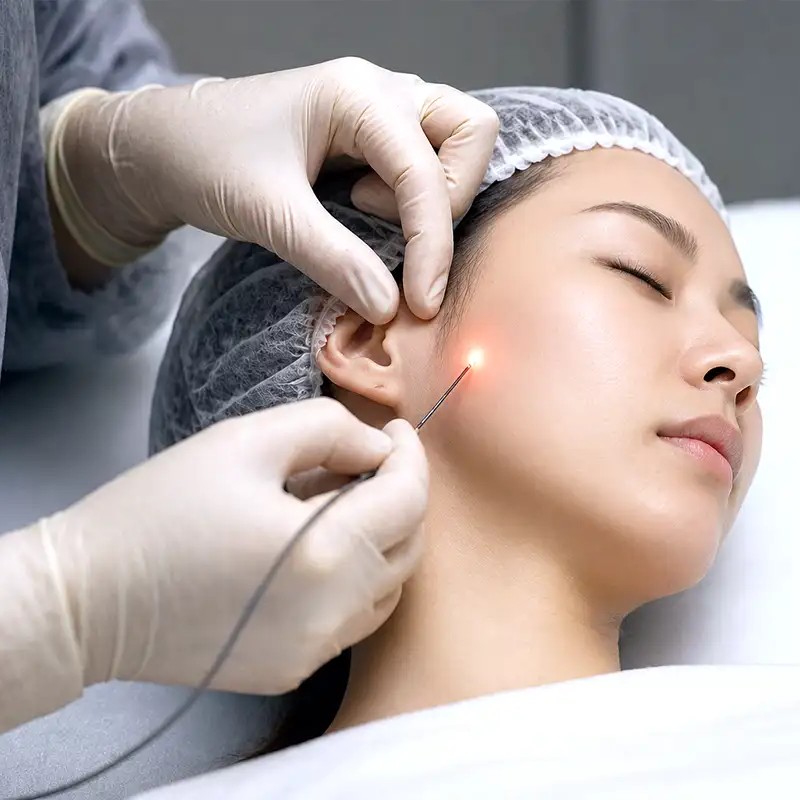
Clinical evidence guide | Facial Endolift, 1470 nm diode laser, skin laxity and wrinkles | Abu Dhabi, UAE
Endolift laser is a minimally invasive, fiber-delivered 1470 nm diode laser treatment used for selected cases of facial skin laxity, jawline definition and mild wrinkles. This guide explains what the 2023 Zerpa and Suárez ultrasound study found, how Endolift compares with HIFU, radiofrequency and facelift surgery, what the risks are, and what to ask before booking in Abu Dhabi.
Quick answer: does Endolift work for wrinkles and loose skin?
A 1470 nm subdermal laser may improve selected facial contours and mild-to-moderate skin laxity, but results vary and high-quality comparative research is limited. A small 2023 case series followed five patients with grade 1–2 facial rhytids for 60 days and described visible improvement in the cheek and jawline, changes in ultrasound appearance and tissue thickness, and satisfaction in all five participants. These findings cannot be generalized to every face or protocol.
Endolift is not a surgical facelift, a resurfacing laser, a filler or HIFU. A fine optical fiber places light energy under the skin, where controlled heat may cause immediate tissue contraction and longer-term remodeling.
At a glance: what the 2023 study found
| Feature | Reported finding | How to interpret it |
|---|---|---|
| Design | Five-patient case series | Exploratory, no comparison group |
| Target problem | Grade 1–2 facial rhytids and contour changes | Most applicable to similar cases |
| Eligibility | Adults aged 40–75 | Not a guarantee of suitability |
| Laser | 1470 nm diode laser via optical fiber | Device and operator technique change outcomes |
| Assessment | Ultrasound, standardized photos, 5-level satisfaction scale | Multi-angle, but not blinded or randomized |
| Follow-up | Baseline and 60 days | Durability beyond 2 months unproven |
| Largest highlighted difference | 3.6 mm in the submental dermis | One value, not an average effect |
| Satisfaction | 5/5 satisfied (2 extremely, 1 very, 2 moderately) | "100%" means five people, not a success rate |
| Safety | No complications in these five cases | Too small to measure uncommon risks |
Why the face ages : anatomy behind wrinkles and sagging
Facial aging is multi-layered: facial skeleton, muscles, retaining ligaments, fat compartments, the SMAS (superficial musculoaponeurotic system), and finally the epidermis, dermis and hypodermis. Rohrich and Pessa showed that superficial fat compartments age unevenly, so one area may lose volume while another descends. That is why an older face can show hollow temples, flat cheeks and jowls at once, and why treating everything as "loose skin" can produce the wrong plan.
Endolift does not reproduce the SMAS repositioning of a surgical facelift. Subdermal heat and surgical tissue mobilization are different mechanisms.
Not all wrinkles are the same
- Fine lines: surface texture and photodamage.
- Dynamic lines: repeated movement, such as around the eyes or between the brows.
- Deep folds and jowls: tissue descent, ligament tethering, volume change and loss of recoil.
Endolift may be considered for selected laxity and contour concerns. It will not reliably fix pigmentation, etched static wrinkles, muscle-driven frown lines or hollow compartments. Neuromodulators, resurfacing, volume restoration or surgery may address those more directly.
What is Endolift and how does the 1470 nm laser work?
Endolift uses a 1470 nm diode laser delivered through a fine optical fiber into the treatment layer. This wavelength is strongly absorbed by water-containing tissue, so absorbed light becomes focused heat. The aim is controlled thermal interaction with soft tissue, not stripping the surface of the skin.
The same water absorption that makes heating efficient means excessive energy or incorrect placement can burn healthy tissue. Fiber diameter, depth, power, exposure time, motion and local anatomy all interact, so numbers from a case series are not a universal prescription.
Is Endolift non-invasive?
No. It is minimally invasive because a fiber is introduced into tissue. Bruising, swelling, discomfort and a recovery period can occur. Claims such as "no risk" or "no downtime for everyone" are inaccurate.
Is it the same as laser resurfacing?
No. Resurfacing lasers treat surface and dermal features from outside. Subdermal laser treats from within. A person with both sagging and photoaged skin may need different treatments for each.
How the 2023 study was designed
Zerpa and Suárez treated five consenting patients with grade 1–2 facial rhytids. Eligibility included ages 40–75 and dynamic or static wrinkles, marionette lines, jowling, reduced jawline definition or focal fat in the cheek or anterior neck. Exclusions included pregnancy, breastfeeding, uncontrolled illness, active disease at the treatment site, selected autoimmune or collagen disorders, active cancer, long-term steroids, prior local radiotherapy and local anesthetic allergy, plus recent cosmetic treatments such as threads, toxin or fillers.
Baseline assessment included history, laboratory screening, photographs in frontal, 45° and 90° views, and ultrasound with a Siemens ACUSON X300 linear transducer (about 7.5–12 MHz) across periorbital, malar and submental regions. Imaging was repeated at 60 days with a five-category satisfaction scale. Lighting, pose, swelling and operator technique can still influence interpretation.
Published device settings (for research context only)
| Variable | Source-study detail | Interpretation |
|---|---|---|
| Equipment | Velas diode laser (GigaLaser system) | Study-specific platform |
| Wavelength / mode | 1470 nm, continuous | Reported setting only |
| Power, face and neck | 6 W | Not a universal safe setting |
| Power, lower eyelid | 2–3 W | Highly anatomy-dependent |
| Fiber, face / eyelid | 400 µm / 200 µm | Periocular work needs special qualification |
| Plane | Deep dermis and superficial subcutaneous tissue | Operator- and device-dependent |
| Motion | Fan-like, about 10–15 passes | Reporting detail, not an instruction |
| Anesthesia | Lidocaine 1–2% entry site plus modified tumescent | Needs individual dose safety |
| Follow-up | Photos and ultrasound at 60 days | No multi-year durability data |
The authors also used cold therapy for 3–5 days, a 5–8 day prophylactic antibiotic course, heat and head-down avoidance, and SPF 50+. These were their own protocol choices. Never change or stop prescribed medication, including anticoagulants, based on an article.
Before-and-after results from the original paper
The paper contains three clinical photo panels and two ultrasound figures. They are published research examples, not patients of this clinic. Day 1 and Day 60 labels reflect the study's timing, not what every patient should expect. Obtain permission from the rights holder before reusing them commercially.
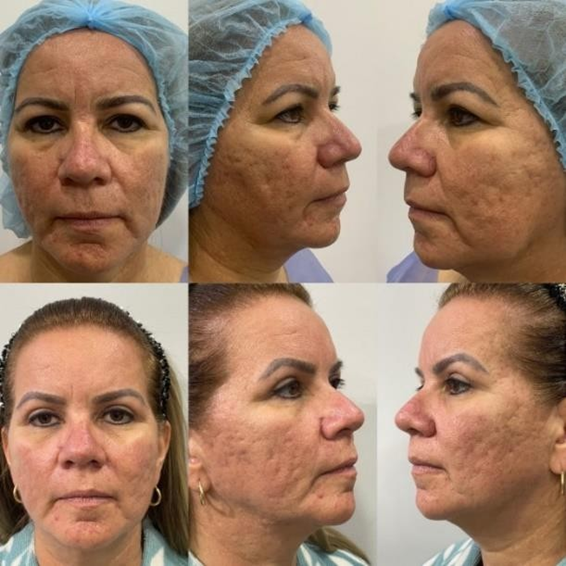
The paper describes improved facial and mandibular contour. A photo does not quantify collagen synthesis, energy delivered or durability past 60 days.
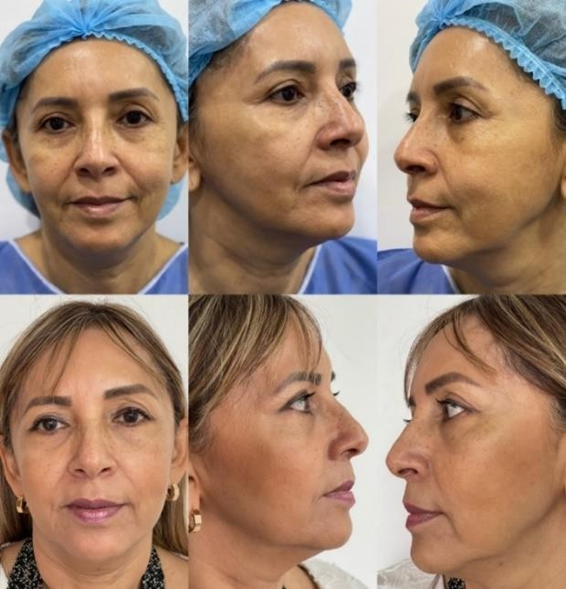
Multiple views help, but appearance alone cannot separate skin contraction from fat distribution, angle or short-term swelling.
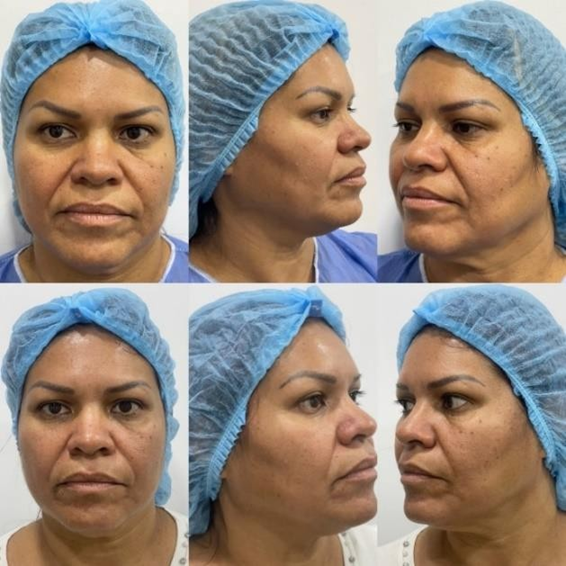
Some differences are subtle. Counseling should separate "visible change in a photo" from the repositioning achieved by surgery.
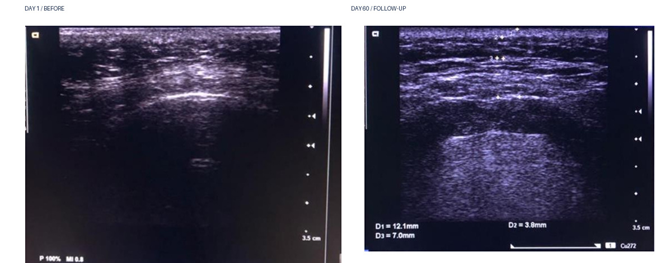
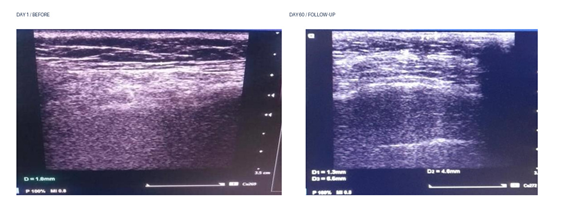
The authors interpreted changes in dermal and hypodermal measurements as compatible with remodeling, but sonography alone cannot prove mature new collagen.
Ultrasound measurements: the original numbers
Table 1 of the paper lists author-reported differences in millimeters (right / left) for five patients across three dermal and three subcutaneous regions. Negative values are kept exactly as published.
| Layer and region | Pt 1 R/L | Pt 2 R/L | Pt 3 R/L | Pt 4 R/L | Pt 5 R/L |
|---|---|---|---|---|---|
| Dermis: periorbital | 1.1 / 1.2 | 1.1 / 1.1 | 0 / 0 | 0.9 / 0.8 | 1.5 / 1.8 |
| Dermis: malar (cheek) | 1.7 / 1.8 | 1.0 / 1.1 | 3.5 / 3.5 | 1.0 / 0.4 | 2.3 / 1.9 |
| Dermis: submental | 1.4 / 1.4 | 1.4 / 1.4 | 2.6 / 2.8 | 2.4 / 1.6 | 3.6 / 2.6 |
| Subcutaneous: upper third | 2.2 / 2.9 | 3.0 / 3.0 | 0.9 / 0 | 4.7 / 2.9 | 2.1 / 2.2 |
| Subcutaneous: middle third | 2.6 / 2.6 | 3.0 / 3.0 | -0.9 / -1.3 | 3.6 / 2.7 | 2.7 / 2.3 |
| Subcutaneous: lower third | 2.8 / 2.9 | 3.3 / 3.2 | 0.4 / -0.5 | 0.8 / 3.0 | 2.9 / 2.8 |
The authors highlighted 3.6 mm in the submental dermis as one of the larger differences. The table also contains a 4.7 mm upper-third subcutaneous entry, so "largest" should be read in the context of the authors' dermal comparison. Responses were uneven, and some entries are zero or negative, which is why distribution, reproducibility and clinical significance need further study.
Can ultrasound prove collagen production?
No. Ultrasound shows thickness, echogenicity and layer appearance, not new collagen fibers. The authors' collagen interpretation is a hypothesis. Stronger studies would use blinded measurement, standardized scan protocols, objective laxity scores, histology where feasible and follow-up beyond two months.
What does 100% satisfaction mean?
Two patients were extremely satisfied (40%), one very satisfied (20%) and two moderately satisfied (40%). This is useful feedback, but it is five responses, not a probability of success.
Cheeks, jawline, double chin and under-eyes
Cheeks and midface
Cheek treatment is not simply "melting fat." Removing volume from an already hollow midface can make a person look older. Selected tissue remodeling may help a face with adequate support and visible laxity.
Jawline and jowls
Jawline definition depends on bone, skin envelope, ligaments, fat and muscle. Laser contraction may improve soft-tissue contour in selected cases, but prominent jowls from significant descent may need surgery.
Double chin and upper neck
A "double chin" may be localized fat, loose skin, a retruded chin, a low hyoid or platysma changes. Over-treatment can cause irregularity or a deflated look. Examination should decide whether submental treatment alone is suitable.
Under-eye skin
The paper used distinct settings for the lower eyelid, but five cases do not establish safety near the orbit. Eyelid laxity, fat herniation, tear trough hollowing and pigment-related dark circles are different diagnoses needing specialist assessment and eye protection.
Who may benefit most from Endolift?
Patients with mild to moderate laxity and realistic expectations are generally better suited to a minimally invasive approach than those with extreme redundant skin or major ptosis. This is a selection principle, not a validated score. A heavier face with residual fat after weight loss needs a different plan than a slim face with hollowing and crepey skin.
Seven questions a good consultation should answer
- What is creating the concern: laxity, fat, muscle, volume loss or a mix?
- How severe is the laxity, and in which areas?
- Is facial volume already depleted?
- What has been done before: fillers, threads, lasers, surgery?
- What medical or anatomical risks apply?
- What result would you consider meaningful?
- How will results be documented (photos, grading, ultrasound)?
Consider alternatives first if you are pregnant, have an active skin infection or uncontrolled illness, have significant skin redundancy or major neck laxity (consider surgical consultation), or mainly want to treat pigmentation or fine texture.
Recovery : What is realistic?
Expect possible tenderness, bruising, swelling, redness and altered sensation. Recovery is often shorter than for a surgical facelift, but it depends on treatment extent and individual healing. Early swelling can hide contour, and remodeling may continue gradually. The 60-day endpoint says nothing about results at 6, 12 or 24 months.
Contact your clinician promptly for worsening pain, spreading redness, fever, blistering, skin color change, progressive asymmetry or new weakness in facial movement. Sudden vision change or marked neurologic symptoms need urgent medical care.
Safety and possible complications
The heat that makes subdermal laser useful is also its main risk. Potential complications include burns, fat atrophy or unintended volume loss, contour irregularity, discoloration, prolonged swelling, infection, scarring, asymmetry, numbness and injury to nearby nerves. Rates remain uncertain because protocols and adverse-event reporting vary. Safe treatment needs proper screening, trained staff, a registered device, laser protection, infection control, informed consent and a complication plan. Be cautious of any clinic promising zero risk.
Endolift vs other facial rejuvenation options
| Treatment | Mechanism | May suit | Main limitation |
|---|---|---|---|
| Endolift 1470 nm | Fiber-delivered heat beneath the skin | Selected laxity and contour concerns | Fiber entry; variable evidence and protocols |
| HIFU / microfocused ultrasound | Focused acoustic energy at set depths | Selected non-surgical tightening | Results depend on device and anatomy |
| Monopolar radiofrequency | External controlled heating | Mild skin tightening | Often more modest than surgery |
| RF microneedling | Needles plus energy in the dermis | Texture, scars, some laxity | Multiple sessions may be needed |
| Neuromodulators | Relax selected muscles | Dynamic lines | Do not fix redundant skin |
| Fillers / biostimulators | Volume support or collagen stimulation | Volume loss, skin quality | Excess volume can distort features |
| Laser resurfacing | Surface and dermal remodeling | Fine lines, scars, photodamage | Does not reposition deep tissue |
| Facelift / neck lift | Dissection, repositioning, skin removal | Significant jowls and ptosis | Surgery, scars, longer recovery |
Endolift vs HIFU: HIFU is external; Endolift uses an inserted fiber. Neither is proven "always stronger" for every anatomy. Endolift vs facelift: a facelift repositions deeper tissue and removes excess skin; a subdermal laser does not do the same operation or promise equal durability. Endolift vs RF: choice depends on the layer of concern, recovery tolerance, skin type and prior treatments.
Can Endolift be combined with other treatments?
Combinations may suit patients with independent issues, such as dynamic lines plus jawline laxity. A 2026 narrative review discussed possible synergies with subdermal 1470 nm laser, but narrative reviews are not controlled comparisons. Adding HIFU, RF or filler does not automatically create a surgical-like lift.
Strengths and limitations of the 2023 study
Strengths: it pairs photographs with ultrasound of the tissue layers, documents eligibility, consent and technical context, and includes a patient-reported measure.
Limitations: only five patients, no randomized comparator or untreated control side, no sham group, 60-day follow-up, and no proof of biological mechanism. It does not show the safest dose for each site, one-year durability, or equivalence to a facelift. Describing the procedure as painless and complication-free reflects the authors' observations in five cases, not a patient guarantee. The authors themselves call the results preliminary.
Endolift in Abu Dhabi: what to ask before booking
If you are searching for Endolift in Abu Dhabi, 1470 nm skin tightening, jawline tightening or double chin treatment, start with a face-to-face medical assessment and confirm the device, procedure, operator and facility are permitted under the relevant UAE regulatory framework.
- What concern is being targeted, and which regions are planned?
- Is an optical fiber inserted under the skin? What anesthesia is needed?
- What are my alternatives, including surgery or non-invasive devices?
- How will recovery affect my work and social plans?
- What symptoms should trigger urgent review?
- Are the before-and-after photos the doctor's own cases or published scientific images?
- Can the clinician explain who is not a suitable candidate?
Cost and sessions: the study gives no Abu Dhabi pricing and no validated session count. Cost depends on treated areas, facility, anesthesia, device and follow-up, so ask for a written quotation after assessment. More sessions are not necessarily better, since repeated thermal procedures carry cumulative risk.
Evaluating online before-and-after photos: look for who performed the treatment, the exact intervention, follow-up interval, other procedures done, and consistent lighting and head position. Images from a journal must be credited to the original authors and used with permission.
Practical takeaways for clinicians
The study shows the value of measuring tissue beneath the surface in the periorbital, malar, submental and upper, middle and lower subcutaneous regions, but it offers no validated algorithm. Distinguish rhytids from ptosis, laxity, local adiposity and volume deficiency. Future research should preregister outcomes, standardize ultrasound, use blinded assessors and comparators, record serious adverse events, and follow patients past one year. For many patients the best result comes from restraint: preserving healthy fat, avoiding excess thermal injury and treating only anatomy that supports the goal.
Frequently asked questions about Endolift 1470 nm
What is Endolift 1470 nm facial rejuvenation?
A minimally invasive diode laser technique that delivers 1470 nm light beneath the skin through an optical fiber to produce controlled tissue heating for selected contour and tightening goals.
Does Endolift really tighten the face?
Small observational studies report favorable contour and tissue changes in some patients. The 2023 series showed early findings at 60 days, but larger controlled studies are needed. It should not be expected to match a surgical facelift.
What did the 2023 1470 nm laser study show?
Five patients with grade 1–2 rhytids showed improvement around the cheeks and jawline, a 3.6 mm submental measurement difference and positive satisfaction from all five. The data are preliminary.
Why use a 1470 nm wavelength?
It is strongly absorbed by water, which supports thermal effects in water-rich tissue. Safety and results still depend on site, energy delivery, movement and operator skill.
Is Endolift painless?
No procedure can promise that. Discomfort, swelling and bruising may occur, and pain control should be planned in advance.
Can Endolift remove a double chin?
In selected cases it may improve submental contour, but a double chin has several possible causes. A full lower-face and neck assessment is needed first.
Can Endolift fix jowls and a blurred jawline?
Some series report visible improvement along the jawline. Pronounced jowls from significant descent or excess skin may respond better to surgery.
Can it treat under-eye bags?
The paper used a lower-eyelid protocol, but that does not make it suitable for everyone. Bags, hollows and dark circles are different problems and need specialist evaluation.
Does Endolift produce new collagen?
Controlled heat can trigger repair responses and collagen remodeling has been proposed. Ultrasound cannot prove how much collagen is formed.
How long do results last?
A 60-day study cannot answer this. Durability depends on anatomy, aging, weight changes, protocol and later procedures. Be wary of fixed multi-year guarantees.
What are the side effects?
Temporary swelling, bruising, tenderness and altered sensation are possible, as are less common risks such as burns, asymmetry, contour irregularity, infection, discoloration, fat loss or nerve injury.
Can Endolift replace a facelift?
Not for patients needing major tissue repositioning and skin removal. Mild laxity may reasonably be managed with less invasive options.
Is Endolift the same as HIFU or Ultherapy?
No. HIFU applies focused ultrasound externally, whereas Endolift places a laser fiber under the skin. They differ in invasiveness, tissue interaction and risk.
What age is best?
Age is a poor selection rule. The study range was 40–75, but suitability depends on skin quality, laxity, fat distribution, health and expectations.
Is Endolift safe for all skin tones?
No treatment should be advertised as automatically safe for all skin tones. A history of post-inflammatory pigmentation or abnormal scarring needs individual counseling.
How many sessions will I need?
No session count is established. It should be based on medical need and response, and more sessions add cumulative thermal risk.
Can it be combined with fillers or Botox?
Staged combinations may suit separate concerns, but safe spacing and sequence are not established for every case. Disclose all prior procedures and products.
How much does Endolift cost in Abu Dhabi?
Pricing depends on areas, facility, device, anesthesia and follow-up. Ask for a personalized written quotation after consultation.
Does 100% satisfaction mean everyone will love the results?
No. It means all five enrolled patients chose a positive category. It cannot predict satisfaction for any other patient.
Conclusion
Endolift 1470 nm laser is a promising, minimally invasive option for carefully selected patients with mild-to-moderate laxity and contour concerns. The best-documented early data come from a five-patient study with 60-day follow-up, so claims about lifting power, longevity and safety should stay cautious. The right plan starts with diagnosing what is actually driving your concern, then choosing the simplest effective treatment, which is sometimes not a laser at all.