
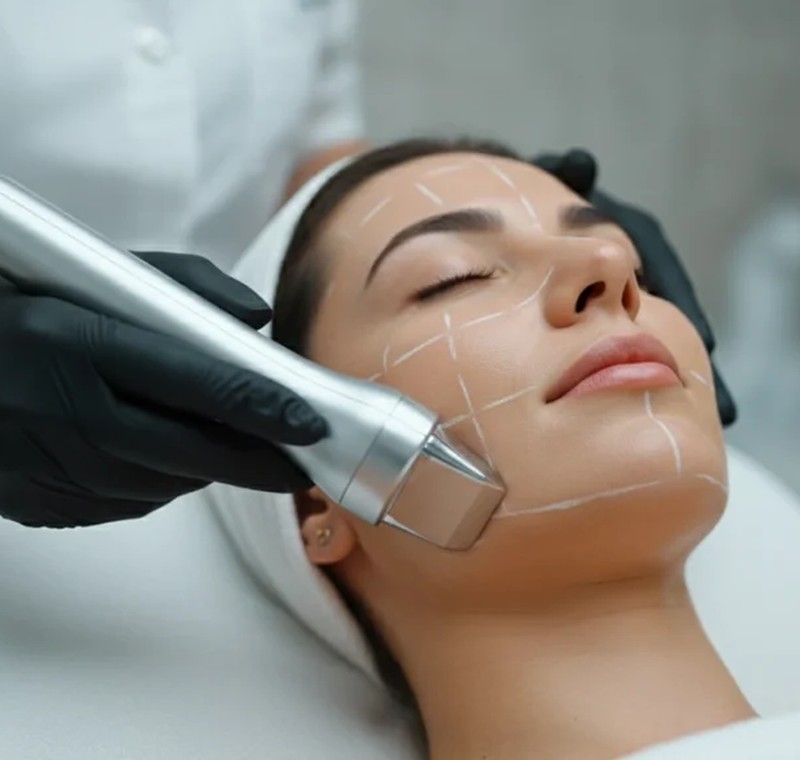
HIFU in Abu Dhabi : What the Evidence Shows for Face and Neck Tightening
High-intensity focused ultrasound (HIFU), often discussed alongside microfocused ultrasound (MFU or MFU-V), is one of the best-known non-surgical technologies for tightening mild-to-moderately lax facial and neck tissue. If you are researching HIFU in Abu Dhabi, it helps to look past marketing claims and understand what clinical research actually shows.
HIFU is attractive because focused acoustic energy can be delivered below the skin surface, creating controlled thermal zones while leaving the epidermis largely intact. The biological goal is not to "melt the face" or mechanically pull tissue like surgery. It is to trigger a wound-healing response that contracts existing collagen and stimulates new collagen formation over time.
The most useful way to judge HIFU is not through a single before-and-after image. A better question is: what happens when results from multiple clinical studies are pooled? The meta-analysis by Ayatollahi and colleagues attempted exactly that. It evaluated 17 studies involving 477 participants and concluded that HIFU was safe in the short term and produced a moderate rejuvenation effect in face and neck treatment. That conclusion is more restrained than many commercial descriptions of HIFU.
Table of Contents
- How HIFU tightens tissue
- Pooled efficacy results
- Which facial areas are treated
- Treatment depths and protocols
- Pain
- Redness, swelling and pigmentation
- Short-term vs long-term safety
- HIFU vs radiofrequency
- Who is a good candidate
- Duration and number of sessions
- HIFU consultation checklist in Abu Dhabi
- HIFU vs other non-surgical options
- FAQs
How HIFU Tightens Tissue
Focused ultrasound converts acoustic energy into heat at predefined tissue depths. The review describes target temperatures of approximately 60–70 °C in the focal zone, producing discrete thermal injury zones in the deep dermis and superficial musculoaponeurotic system (SMAS). Because energy converges at depth rather than uniformly heating the skin surface, the treatment can create localized coagulation while limiting injury to surrounding tissue when technique and parameters are appropriate.
These thermal zones trigger apoptosis and necrosis within the focal points, followed by a wound-healing cascade. Fibroblast activity, neocollagenesis and collagen remodeling then contribute to tightening and a reduction in laxity over the following weeks and months. This is why HIFU results are gradual. The treatment is not a filler, does not instantly replace lost volume, and does not surgically reposition deeply descended tissues.
What Do the Pooled HIFU Efficacy Results Actually Mean?
The meta-analysis used several different outcome systems because the original studies did not measure results uniformly. That creates an important distinction between "the percentage of patients who improved at all" and "the magnitude of improvement." A patient can be classified as improved even when the change is mild, so headline percentages should always be read next to the pooled numerical scores.
| Outcome | Pooled result | Clinical interpretation |
|---|---|---|
| Physician global improvement (PGAIS: any improvement) | 88% overall (95% CI 80%–96%) | Most patients were judged to have at least some improvement, but this does not mean 88% had a dramatic lift. |
| Patient global improvement (SGAIS: any improvement) | 83% overall (95% CI 76%–91%) | A large majority perceived improvement, again without implying equal magnitude in every patient. |
| Objective/physician improvement score | 2.74 out of 5 (95% CI 2.06–3.43) | The pooled magnitude was moderate. |
| Subjective/patient satisfaction score | 2.68 out of 5 (95% CI 1.92–3.45) | Overall satisfaction was moderate rather than near-maximal. |
| Source conclusion | Short-term safety favorable; rejuvenation effect moderate | A balanced summary that is more useful than marketing superlatives. |
Physician-Rated Improvement Over Time
On the physician global aesthetic improvement scale, the proportion with any degree of improvement was about 95% at 2 months, 83% at 3 months and 89% at 6 months. The overall pooled estimate was 88%. Heterogeneity was considerable, meaning results varied substantially among studies. Differences in device, depth, energy, number of treatment lines, facial anatomy, assessment method and baseline laxity likely contributed.
Patient-Rated Improvement Over Time
Patient-reported improvement was approximately 86% at 2 months, 80% at 3 months and 85% at 6 months, with an overall pooled estimate of 83%. These figures support a real patient-perceived benefit in many participants, but the overall satisfaction score on a 5-point scale was only 2.68. For counseling, HIFU is better framed as a gradual non-surgical tightening option than as a dramatic "facelift without surgery."
Why "83% improved" does not mean "83% dramatic lift." Global improvement scales count a patient as improved even when the improvement is small. Pooled numerical satisfaction and physician-improvement scores were around the middle of a 5-point scale. Most participants experienced some improvement, while the average magnitude was moderate.
Which Facial Areas Can HIFU Treat?
Most included studies treated combinations of the face and neck, while a small number focused on the periorbital region. Protocols frequently included the lower face, cheeks, submental region, jawline, neck, brows and periocular tissue. The anatomical target determines which focal depth is reasonable. Thin areas require a different approach from the lower face or submental region, and the same cartridge depth does not correspond to the same tissue layer in every person.
What Treatment Depths and Protocols Were Used?
| Depth / frequency | Common use in included protocols | Important context |
|---|---|---|
| 1.5 mm / ~10 MHz | Superficial facial areas, periocular or brow regions in selected protocols | Targets more superficial tissue; device-specific. |
| 3.0 mm / ~7 MHz | Dermal/subdermal tightening across forehead, temples, cheeks and neck | Frequently combined with deeper passes. |
| 4.5 mm / ~4 MHz | Deeper lower-face, cheek, submental or SMAS-oriented treatment | Requires careful anatomy because deep treatment can affect fat or deeper structures. |
| Treatment lines | Approximately 238 to 800+ lines in different studies | Line count varied greatly and should not be copied across devices or faces. |
| Energy | Varied substantially by transducer and device | More energy was associated with stronger effects in some studies, but also greater pain and potential risk. |
| Treatment planes | Single-plane vs multiple depth/plane strategies | Some evidence suggested multi-depth or multi-plane treatment could produce more displacement or better aesthetic results in selected patients. |
Does More Energy Mean a Better HIFU Result?
Not automatically. The review discusses split-face studies in which greater energy, more treatment planes and more focal depths produced more tissue displacement and elasticity change. Those protocols also produced higher pain scores. This is a classic energy-based device trade-off: increasing dose can increase biological effect, but it can also increase discomfort and the possibility of unwanted tissue injury. The goal is not maximum energy. It is the lowest effective and anatomically appropriate dose for the intended tissue target.
Single Depth vs Multiple Depths
One included comparison suggested that treating at two focal depths could improve aesthetic results in some patients compared with a single depth. This makes biological sense because facial laxity is a three-dimensional problem involving several tissue levels. However, multi-depth treatment is not automatically superior for everyone. In a thin face, indiscriminate deep treatment can be counterproductive if it reduces desirable facial volume.
Is HIFU Painful?
Pain is one of the most practical concerns for patients. Across the pooled data, the overall mean pain score was approximately 4.27 on a 0–10 scale, which the authors described as low to moderate. Analgesia made a meaningful difference: pooled pain averaged about 3.9 with analgesics and 5.09 without. Individual studies used very different pain-control strategies, ranging from no anesthesia to topical anesthetics, oral analgesics, intramuscular medication and, in some protocols, regional nerve blocks.
| Pain metric | Pooled result | How to explain it to patients |
|---|---|---|
| Overall pain | ~4.27 / 10 | Usually tolerable, but not painless. |
| With analgesics | ~3.9 / 10 | Pain-control strategy can improve comfort. |
| Without analgesics | ~5.09 / 10 | Treatment can be moderately uncomfortable without pain control. |
| Variation | Substantial between protocols and areas | Device, depth, energy, number of lines and anatomic zone all influence discomfort. |
Redness, Swelling and Hyperpigmentation After HIFU
Redness and Swelling
The pooled first-day prevalence was approximately 45% for edema and 48% for erythema. However, the underlying studies were extremely heterogeneous: edema ranged from about 3.8% to 100%, and erythema from about 1.9% to 100%, with I² statistics around 99%. The safest interpretation is not that "half of everyone will swell." Transient redness and swelling were common in some protocols, uncommon in others, and highly dependent on study design, device and reporting method.
Hyperpigmentation
No post-inflammatory hyperpigmentation was reported at 3 months in the five studies that contributed to that safety outcome. This is reassuring within the limits of the reviewed data, but it should not be converted into a claim that pigmentation can never occur. The source emphasized short follow-up and limited evidence, and modern devices, protocols and patient populations extend beyond the data captured through 2017.
Short-Term Safety vs Long-Term Safety of HIFU
The meta-analysis supported a favorable short-term safety profile. It did not establish long-term safety with the same confidence because most studies had limited follow-up, with a maximum of 12 months. Rare complications are also difficult to characterize in studies totaling only 477 participants.
Is HIFU Better Than Radiofrequency?
One study in the review compared microfocused ultrasound with subsurface monopolar radiofrequency for neck tightening. Both treatments significantly improved investigator-assessed neck laxity by 90 days, with no significant difference at that time point. At 180 days, the radiofrequency group showed a lower laxity grade, while patient satisfaction at the end of the study was identical. The ultrasound group appeared to produce changes earlier in some subject-assessed measures.
That single comparison does not justify a universal claim that HIFU is better or worse than radiofrequency. Both energy-based approaches can improve laxity, and treatment timing and response patterns can differ. The more useful question is which tissue layer, degree of laxity and facial-volume pattern is being treated.
Who Is a Good HIFU Candidate?
The meta-analysis was not designed to produce a perfect candidate-selection algorithm, but its included studies support several practical principles. HIFU is most logically positioned for patients who want a non-surgical option for mild-to-moderate laxity, understand that improvement is gradual, and do not expect the magnitude of a surgical facelift.
- Mild-to-moderate facial or neck laxity rather than advanced tissue descent.
- A realistic goal of tightening, contour refinement or modest lifting rather than major repositioning.
- Sufficient tissue thickness for the planned focal depth and treatment zone.
- Willingness to accept treatment discomfort and a gradual remodeling period.
- Understanding that one person's response cannot be predicted from pooled percentages.
- No assumption that "more lines" or "more energy" is automatically better.
Who May Need a Different Strategy?
Patients with severe lower-face or neck laxity may require surgical consultation if they want a predictable, dramatic change. Patients whose primary concern is facial deflation, skeletal support or volume loss may need a volumetric strategy rather than aggressive deep energy. Patients with very thin faces require careful depth selection because undesirable fat loss could worsen facial hollowing even if the skin itself tightens.
Can HIFU Replace a Facelift?
No non-surgical energy device should be presented as equivalent to surgery. The source meta-analysis found a moderate effect. HIFU can be a useful option for selected patients who prefer no incision and accept a smaller magnitude of correction. A surgical facelift is a different category of treatment because it physically repositions tissue and can address more advanced laxity.
How Long Do HIFU Results Last, and How Many Sessions Are Needed?
Duration: The included studies followed patients for as little as 2 months and up to 12 months. Some showed continued improvement or maintained satisfaction at later visits, but the review explicitly stated that long-term follow-up was insufficient. Results can persist for months and may remain visible at one year in some protocols, but the meta-analysis does not establish a universal duration or an optimal maintenance interval.
Sessions: Many studies evaluated a single session, but no universal session count was established. The right number depends on baseline laxity, device, depth strategy, dose and treatment goal. Repeat treatment should be based on clinical response and safety rather than a fixed marketing package.
HIFU in Abu Dhabi: What Should a High-Quality Consultation Cover?
Local search pages often focus on machine names and prices. From an evidence and safety perspective, a more useful consultation focuses on anatomy and treatment objectives. A patient considering HIFU in Abu Dhabi should understand what tissue is being targeted, which depth is planned, whether volume preservation matters, what degree of tightening is realistic, and how the clinician manages pain and safety.
HIFU Consultation Checklist
- What is the main problem: skin laxity, submental fullness, volume loss, muscular pull, or a combination?
- Which tissue depth is being targeted and why is that depth appropriate for my anatomy?
- Is the goal skin tightening, contour refinement, fat reduction, or a combination?
- How will the treatment avoid unnecessary injury to facial fat, nerves and other deeper structures?
- What level of improvement is realistic for my degree of laxity?
- What pain-control strategy is available?
- What short-term effects should I expect during the first few days?
- When should I judge the final result?
- What would make you recommend RF, injectables, laser, surgery or another option instead of HIFU?
- What is the plan if I am not a good candidate for HIFU?
Why "Best HIFU in Abu Dhabi" Is Not a Medical Diagnosis
Patients naturally search for the "best HIFU" or "best HIFU doctor," but a safe clinical decision cannot be reduced to a ranking. More useful differentiators are anatomical assessment, realistic expectation setting, conservative depth selection, appropriate device use, experience with the treatment zone, transparent discussion of alternatives, and willingness to say no when HIFU is unlikely to help.
HIFU vs Other Non-Surgical Options
| Concern | HIFU may help when… | Another modality may be more relevant when… |
|---|---|---|
| Mild lower-face/neck laxity | A deeper tightening effect is desired without surgery. | Laxity is severe and a surgical correction is desired. |
| Texture / fine lines | Tightening is part of the problem. | Surface texture, pigment or photodamage is the dominant concern and a resurfacing strategy is more appropriate. |
| Volume loss | Only if laxity is also present and facial volume can be preserved. | Deflation is the main issue; structural or regenerative volumization may be more appropriate. |
| Diffuse dermal laxity | Focused ultrasound is anatomically appropriate. | A broader dermal heating strategy such as RF better fits the target. |
| Submental contour | There is a suitable tissue layer and treatment goal. | There is marked skin redundancy or anatomy requiring another approach. |
Frequently Asked Questions About HIFU Face and Neck Tightening
Is HIFU effective for facial tightening?
The meta-analysis found that most participants had at least some improvement: 88% by physician global assessment and 83% by patient global assessment. The average magnitude of improvement was moderate, not dramatic.
Is HIFU painful?
Pain was generally low to moderate. The pooled overall score was about 4.27/10, around 3.9 with analgesics and 5.09 without analgesics.
Does HIFU cause swelling?
Temporary edema was reported, but rates varied dramatically among studies. The pooled first-day estimate was about 45%, with very high between-study heterogeneity.
Does HIFU cause redness?
Transient erythema was common in some studies and rare in others. The pooled first-day estimate was about 48%, but study-to-study variation was extremely high.
Can HIFU cause hyperpigmentation?
No post-inflammatory hyperpigmentation was reported at 3 months in the five studies included for that outcome, but this does not prove the risk is zero in every patient, device or protocol.
When will I see HIFU results?
Results evolve gradually as collagen remodels. The studies assessed outcomes across 2–12 months, with many evaluations around 3 and 6 months.
How long does HIFU last?
Some benefit can persist for months, but the meta-analysis did not establish one universal duration because long-term follow-up was limited.
How many HIFU sessions do I need?
There is no universal number. Many studies evaluated one session, but treatment frequency should depend on baseline laxity, anatomy, device, dose and response.
Is HIFU better than radiofrequency?
The review included one comparison in which both microfocused ultrasound and subsurface monopolar RF improved neck laxity. The study did not establish a universal winner.
Can HIFU replace a facelift?
No. HIFU can produce non-surgical tightening in selected patients, but the pooled effect was moderate and is not equivalent to surgical tissue repositioning.
Is higher energy better?
Not necessarily. Higher energy and more treatment planes produced more effect in some studies but also increased pain. Appropriate dosing is more important than maximum dosing.
Is HIFU suitable for thin faces?
It may be, but deeper treatment requires caution because unnecessary injury to facial fat could worsen hollowing. Anatomy and tissue thickness should guide depth selection.
What age is best for HIFU?
The review did not define one ideal age. Participants were mainly middle-aged adults, with an overall mean age of about 52 years. Degree of laxity and anatomy matter more than age alone.
Is HIFU safe for darker skin types?
The included studies involved a range of Fitzpatrick types, including Asian cohorts with types III–V. The review did not report post-inflammatory hyperpigmentation at 3 months in five contributing studies, but long-term and subgroup evidence was limited.
What should I ask before HIFU in Abu Dhabi?
Ask what tissue layer is being treated, which focal depth will be used, what degree of improvement is realistic, how facial volume will be preserved, what pain control is offered and what alternatives may be more suitable.
Final Takeaway
HIFU is a reasonable non-surgical option for mild-to-moderate face and neck laxity, with a favorable short-term safety profile and a moderate, gradual effect. It is not a facelift substitute, and more energy is not automatically better. If you are considering HIFU in Abu Dhabi, choose a clinician who assesses your anatomy, sets realistic expectations and discusses alternatives openly. Book a consultation to find out whether HIFU is the right fit for you.