
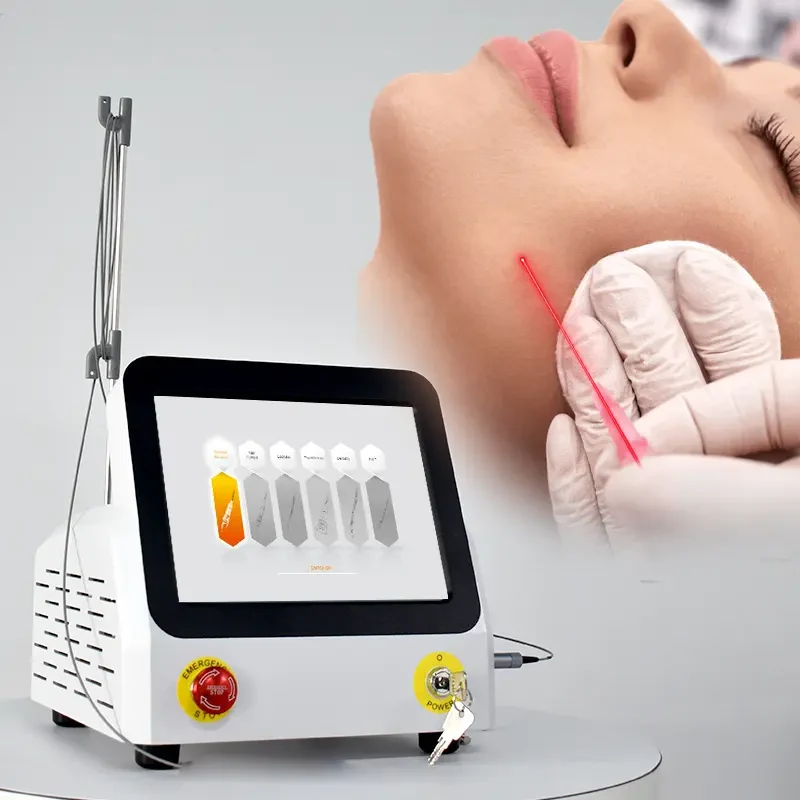
Endolift® 1470 nm Laser for Skin Tightening and Body Contouring: Mechanism, Candidates, Results, Recovery & Safety
What Is Endolift?
Endolift is a minimally invasive subdermal laser technique based on a 1470 nm diode wavelength. Laser energy is delivered beneath the skin to create a controlled photothermal effect at the deep dermis and superficial subcutaneous fat level. The intended response is tissue contraction followed by collagen remodeling, with gradual improvement in skin firmness and selected contour concerns.
The classic clinical report described the technique for the face, neck and body, and emphasized that the best candidates had a moderate degree of skin excess rather than severe ptosis.
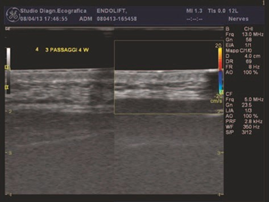
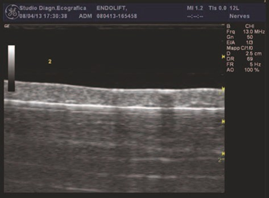
Endolift is not simply a surface laser. Its effect is produced below the skin, where thermal energy interacts with water- and fat-containing tissue and can stimulate progressive tightening over time. The early report also used ultrasound to confirm treatment depth and later tissue fibrosis, which helps explain why visible improvement continued for months after the procedure.
What Is Endolift® / Endolaser Soft-Lift?
Endolaser soft-lift was described as a less invasive alternative for patients seeking skin retraction and contour improvement without a conventional surgical lift. The technique used a 1470 nm diode laser delivered through a fine optical fiber beneath the skin.
The original concept combined two actions: a mechanical component created by controlled subdermal passage, and a photothermal component created by laser energy. Together, these were intended to produce tissue contraction, collagen stimulation and a lifting effect with less tissue trauma than open surgery.
Why 1470 nm?
The 1470 nm wavelength interacts strongly with water and fat-containing tissue. This is why the laser can work effectively in the subdermal treatment plane while producing a controlled thermal response.
The goal is not to burn the skin surface. The intended target is the tissue beneath it, especially the interface between the deep dermis and superficial subcutaneous fat.
| Treatment Principle | Role in Endolift |
|---|---|
| 1470 nm diode wavelength | Delivers subdermal photothermal energy with affinity for water- and fat-rich tissue |
| Deep dermis / superficial fat interface | Primary treatment plane described in the classic technique |
| Controlled thermal injury | Triggers contraction and later collagen remodeling |
| Mechanical tunneling / vectors | Creates directional pathways that support tissue traction |
| Fibrous septa | May influence the degree of skin retraction and mechanical support |
How Does Endolift Tighten the Skin?
The tightening response combines immediate tissue effects with delayed wound-healing biology. Controlled subdermal heat can cause early contraction, while the later remodeling phase is associated with new collagen formation and progressive changes in tissue elasticity.
The report emphasized controlled skin retraction rather than simple volume removal. The desired outcome is not only a smaller fat compartment, but also a firmer and more compact soft-tissue envelope.
How the Classic Endolift Technique Was Performed
The classic technique used an Endolift diode platform with optical fibers of different diameters. A cannula-based approach created controlled subdermal tunnels, while a free-fiber approach was reserved for experienced operators and thinner or smaller anatomical regions.
The cannula was advanced to the junction between the deep dermis and superficial subdermal fat. Multiple treatment tunnels were oriented along antigravitational traction lines. The authors described forward-and-backward movement through each tunnel, with laser energy delivered during withdrawal. The historical protocol used approximately 3 to 10 tunnels, with vector orientation matched to the desired direction of tissue traction.
| Historical Protocol Element | Description in the Source |
|---|---|
| Laser | 1470 nm diode laser |
| Optical fibers | 100, 200, 300, 400, 600, 800 and 1000 microns were listed |
| Treatment plane | Junction between deep dermis and superficial subcutaneous fat |
| Tunnels | Approximately 3–10 depending on the area |
| Movement | Repeated forward/backward passage, with laser delivery during withdrawal |
| Vector orientation | Antigravitational lines to create directional traction |
| Alternative method | Free fiber in expert hands, especially for thin or small areas |
Ultrasound Confirmation of the Treatment Plane and Remodeling
Ultrasonography was used during treatment to check the position of the cannula. The examination was repeated about three weeks later to demonstrate the tissue change associated with laser and cannula treatment. This supports the idea that Endolift is a subdermal procedure: the clinically relevant tissue response occurs beneath the surface and continues after the session.
Who Is the Best Candidate for Endolift?
Endolift was not intended for every degree of laxity. The preferred target was a medium degree of skin excess: a patient who needs tightening and retraction but does not have the severe ptosis that would make a surgical lift more appropriate.
- Mild to moderate skin laxity with realistic expectations of non-surgical improvement
- Patients seeking tightening of the face, jawline or neck without an open surgical lift
- Selected body areas with moderate skin excess and contour concerns
- Patients whose anatomy and tissue quality allow a controlled subdermal treatment plane
- Patients who understand that collagen remodeling develops gradually rather than producing an instant surgical-level result
Who May Not Be a Good Candidate?
Severe skin ptosis was specifically identified as a situation in which the procedure could fail to meet patient expectations. When excess skin is too great, a minimally invasive thermal procedure cannot reproduce the tissue removal and repositioning achieved by surgery.
- Severe skin redundancy or advanced ptosis
- Patients expecting the same magnitude of change as a formal surgical lift
- Anatomy in which the intended subdermal plane cannot be treated safely
- Patients who are not suitable for a minimally invasive procedure after medical assessment
Which Areas Can Endolift Treat?
The clinical material described treatment in many of the regions commonly addressed by lifting procedures, including the face and neck as well as selected body areas such as the arms, abdomen and legs.
| Area | Why It May Be Considered |
|---|---|
| Lower face / jawline | Skin retraction and contour refinement |
| Neck | Selected laxity in a relatively thin anatomical area |
| Arms | Moderate skin excess and soft-tissue laxity |
| Abdomen | Selected contouring and skin-tightening concerns |
| Inner thigh / knee region | Small or thin areas described as suitable for expert free-fiber technique |
| Periumbilical region | A small body area specifically mentioned in the source |
Endolift vs. Thread Lift vs. Surgical Lift
Endolaser soft-lift was developed partly for patients who wanted a lifting effect with less invasiveness than surgery. Thread lifting was already considered less invasive than a facelift, but it still involved surgical sutures and could be associated with bruising, swelling, discomfort, asymmetry, hematoma or thread-related problems.
The authors proposed that Endolaser soft-lift could produce a comparable cosmetic direction of improvement to a small thread lift while using controlled photothermal retraction instead of implanted lifting threads.
Evidence limitation: the 2013 report did not provide a randomized head-to-head trial proving equivalence to thread lift or facelift surgery. The comparison should be understood as an early clinical concept, not proof that Endolift produces the same result as surgery.
| Feature | Endolift / Endolaser | Thread Lift | Surgical Lift |
|---|---|---|---|
| Main mechanism | Subdermal photothermal contraction + remodeling | Mechanical suspension with sutures | Surgical tissue dissection/repositioning |
| Invasiveness | Minimally invasive | Minimally invasive surgical procedure | Surgical |
| Implanted material | No lifting thread | Yes | Usually sutures; procedure-dependent |
| Best suited to | Selected mild/moderate laxity | Selected sagging with thread-suspension goals | More advanced laxity / tissue descent |
| Magnitude of change | Gradual and limited by anatomy | Mechanical but limited compared with formal surgery | Potentially greatest structural change |
When Do Endolift Results Develop?
The clinical report described progressive tightening rather than a single fixed endpoint. Some change may be visible early, but remodeling continues through wound healing and new collagen formation.
- First hours: a burning or warm sensation was described.
- First week: swelling and bruising can be part of recovery.
- Several weeks: tightening becomes easier to assess as edema settles.
- 3–4 months: remodeling and new collagen production make the result more visible.
- Up to 6 months: continued maturation, with improvement reaching its strongest phase.
- Longer follow-up: patients were followed for at least 8 months to allow subcutaneous remodeling to mature.
Before-and-After Example from the Source
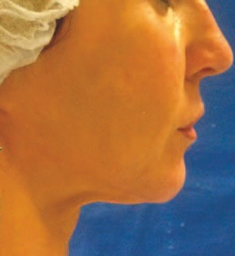
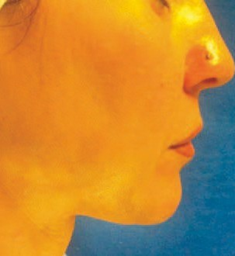
The source includes a pre-treatment profile and a follow-up image taken about four months after one Endolift pass, showing the type of jawline and lower-face contour change the authors associated with subdermal tightening.
 BEFORE
 AFTER
A single before-and-after example cannot establish an average expected outcome. Lighting, facial position, anatomy and patient selection all influence the apparent degree of change.
A single before-and-after example cannot establish an average expected outcome. Lighting, facial position, anatomy and patient selection all influence the apparent degree of change.
Endolift Recovery and Expected Short-Term Effects
The historical material described a recovery dominated by temporary thermal sensation, swelling and bruising rather than large surgical wounds.
| Historical Recovery Finding | Duration Described |
|---|---|
| Burning sensation | Approximately 4–5 hours |
| Edema / swelling | Approximately 5–6 days |
| Ecchymosis / bruising | Approximately 7–10 days |
| Compressive dressing | 24 hours/day for 4 days, then at night for another 4 days in the historical protocol |
| Follow-up | At least 8 months in the classic report |
Historical protocol note: The source also mentioned local anesthesia, oral pain relief, short antibiotic therapy and compression. These details reflect the specific 2013 protocol and should not be copied as a current universal regimen. Contemporary aftercare depends on the device, treatment area, operator technique and local clinical standards.
Is Endolift Safe? What the Early Report Suggested and What It Did Not Prove
The authors described less bruising, hematoma, scarring and recovery burden than more invasive lifting procedures, and proposed that laser treatment could preserve vascular structures within the interstitial tissue.
However, the source was preliminary. It did not provide a large controlled safety dataset or quantify uncommon complications. A low complication rate in a small early experience cannot be used to claim that a procedure is risk-free.
Potential Safety Concerns with Any Subdermal Laser Procedure
- Thermal injury when heat is concentrated too superficially or excessively
- Bruising, hematoma, swelling or prolonged tenderness
- Infection at the entry site or within treated tissue
- Temporary sensory change or nerve irritation in anatomically sensitive regions
- Contour irregularity or asymmetry if treatment distribution is uneven
- Unsatisfactory result when patient selection is poor or laxity is too advanced
How Strong Is the Evidence for Endolift?
The 2013 paper is valuable historically because it explains the original clinical logic of a 1470 nm subdermal laser soft-lift. It is not a modern comparative efficacy trial.
- Published in 2013 and described as preliminary
- Approximately 20 patients were being followed at the time of the conclusion
- No randomized control group
- No blinded comparison with thread lift or surgery
- No standardized validated tightening scores or quantitative 3D volumetric outcomes
- The protocol reflects an early generation of Endolaser technique and should not automatically be treated as a current standard
What the Report Does Support
It supports the biological and procedural rationale for using a 1470 nm diode laser in the subdermal plane to create controlled photothermal retraction and a delayed collagen-remodeling response. It also highlights the importance of treatment depth, vector planning, candidate selection and long-term follow-up.
Endolift in Abu Dhabi: What to Ask Before Treatment
If you are considering Endolift in Abu Dhabi, ask for a treatment plan based on your anatomy rather than a generic number of areas or a fixed energy package.
- Is my main concern skin laxity, localized fat, contour, or a combination?
- Is my degree of laxity suitable for a minimally invasive laser, or would surgery be more predictable?
- Which device and wavelength will be used?
- Which fiber size and tissue plane are planned for my treatment area?
- How will the operator avoid nerves, vessels and overly superficial heating?
- What swelling, bruising and downtime should I realistically expect?
- When should I judge the final result: days, weeks or months after treatment?
- What is the follow-up plan if I develop pain, asymmetry, a persistent lump or skin injury?
The strongest consultation explains both what Endolift can improve and what it cannot. A patient with severe ptosis should not be promised a surgical-level lift from a minimally invasive laser.
Frequently Asked Questions About Endolift
What wavelength is used for Endolift?
The classic Endolaser soft-lift report used a 1470 nm diode laser.
Where is the laser energy delivered?
At the junction between the deep dermis and the superficial subcutaneous fat layer.
Why does 1470 nm work beneath the skin?
The wavelength interacts strongly with water- and fat-containing tissue, allowing controlled photothermal effects in the subdermal plane.
Does Endolift only melt fat?
No. The clinical concept emphasizes skin retraction and collagen remodeling in addition to any effect on fat-containing tissue.
How does Endolift tighten skin?
Subdermal heat creates an early contraction response and then stimulates a longer remodeling process involving new collagen.
What are treatment vectors?
Directional subdermal treatment paths planned to create traction in the desired lifting direction.
Why are antigravitational lines important?
The classic technique oriented treatment tunnels in directions intended to oppose sagging and support tissue traction.
Can Endolift be used on the face and neck?
Yes. The source specifically discussed the face and neck as treatment regions.
Can Endolift be used on the body?
Yes. The classic report described selected treatment of the arms, abdomen and legs, including smaller areas such as the periumbilical region, inner thigh and knee region.
Who is the best candidate for Endolift?
The source described a medium degree of skin excess as the preferred target rather than severe ptosis.
Can Endolift replace a facelift?
Not in every patient. Severe laxity may require surgical tissue removal and repositioning that a minimally invasive laser cannot reproduce.
Is Endolift the same as a thread lift?
No. Endolift uses subdermal laser energy and tissue remodeling, whereas a thread lift uses implanted sutures for mechanical suspension.
How soon are Endolift results visible?
Some change may occur early, but the report described more visible remodeling at three to four months.
Can results keep improving after three months?
Yes. The report described continued improvement as collagen remodeling matured over the following months.
How long was follow-up in the classic protocol?
At least eight months, to allow subcutaneous tissue remodeling to mature.
What short-term side effects were described?
Temporary burning sensation, swelling and bruising.
How long did swelling and bruising last?
Edema lasted approximately five to six days. Bruising resolved spontaneously within approximately seven to ten days.
Was ultrasound used?
Yes. Ultrasound checked cannula position during treatment and was repeated around three weeks later to demonstrate tissue response.
Does a thicker fibrous septal network matter?
The source proposed that thicker septa in superficial fat may be associated with a greater degree of skin retraction.
How many Endolift sessions are needed?
The 2013 protocol described three treatments in a month. This is not a universal modern recommendation; protocols should be individualized by the treating clinician.
Is Endolift painless?
The historical report described treatment under local anesthesia and a temporary burning sensation afterward. Comfort varies by area, technique and individual sensitivity.
Is Endolift risk-free?
No. Patient selection, anatomy, depth, temperature control, sterility and operator experience all matter.
How strong is the evidence from the 2013 report?
It is an early, preliminary clinical report that explains mechanism and technique. It did not provide randomized comparative evidence or a large safety dataset.
Book an Endolift Consultation in Abu Dhabi
Every patient's anatomy is different. A personalized assessment is the best way to find out whether Endolift, a thread lift or a surgical option suits your skin laxity and goals. Contact our clinic to schedule a consultation.